
Contents01
Indiahandmade: A Digital Platform for India’s Craft Heritage
Digital India Corporation · Ministry of Textiles
GS 3GS 2
02
Ayushman Bharat Digital Mission: India’s Digital Health Backbone
National Health Authority · Ministry of Health & Family Welfare
GS 2GS 3
Article 01
Article 01
Indiahandmade: A Digital Platform for India’s Craft Heritage
Digital India Corporation, Ministry of Textiles · Fact-sheet, 6 July 2026
Relevance: GS 3 (inclusive growth, digital economy, e-commerce for artisans) · GS 2 (welfare schemes, livelihood empowerment).
GS 3GS 2
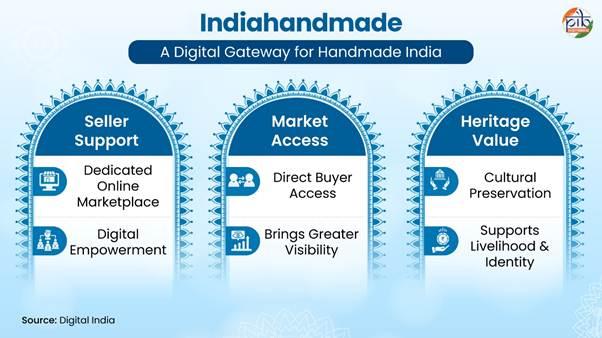
Image: Indiahandmade — digital marketplace connecting artisans and weavers with buyers.
Key Data at a Glance
64 lakh+artisans and weavers onboarded (fact-sheet, 6 July 2026)
2023year Indiahandmade was launched
60 lakh+original artisan onboarding target under Atmanirbhar Bharat
64.66 millionestimated total handloom & handicraft artisans in India
Zeroplatform commission — full sale proceeds credited to artisans
11+product categories, incl. GI-tagged & ODOP items
Issue in Brief
- Indiahandmade, a dedicated digital marketplace for India’s handloom and handicraft artisans, has crossed a fresh milestone of over 64 lakh artisans and weavers brought into digital commerce, per an official government fact-sheet.
- Developed by the Digital India Corporation (DIC) under the Ministry of Textiles, the platform connects artisans directly with buyers, reducing intermediaries and strengthening livelihoods.
Static Background
- The Digital India initiative was launched on 1 July 2015 to build digital public infrastructure across governance, payments and, increasingly, traditional livelihoods.
- Indiahandmade was officially launched in April 2023 by the Ministry of Textiles; indiahandmade.com is designed and developed by DIC (under MeitY) as a national mission — not merely an e-commerce site — to conserve and promote India’s handloom and handicraft heritage.
- India has an estimated 64.66 lakh handloom and handicraft artisans nationally, making artisan livelihoods a significant informal-sector employment base.
- GI (Geographical Indication) tag: legal recognition of a product’s regional origin (e.g., Pashmina shawls). ODOP (One District One Product): a scheme giving each district’s signature product dedicated market visibility.
Key Dimensions — Platform Architecture
- Direct market access: artisans, weavers, Self-Help Groups (SHGs), producer companies and rural enterprises sell directly to buyers; entire sale proceeds credited directly to artisans’ bank accounts without deductions — a zero-commission model.
- Seller-support tools: simplified digital registration, regional-language support, AI-powered listings, integrated order management, secure payments and free logistics/shipping.
- Buyer trust mechanisms: free shipping, purchase protection, secure payments and buyer support — reinforcing confidence in handcrafted products at competitive prices.
Key Dimensions — Craft Diversity & Scale
- Categories span apparel, home décor, furnishings, paintings, furniture, religious items, stationery, musical instruments, jewellery, bags and footwear — with dedicated visibility for GI-tagged and ODOP products.
- Onboarded artisans grew from a few thousand in early phases to over 64 lakh by July 2026 — already exceeding the original 60 lakh+ target set under the Atmanirbhar Bharat vision.
- Illustrative case: Dastkar Bamboo Producer Company has sold bamboo and cane handicrafts on the platform for three years, reporting steadier incomes and sustained demand for a craft that earlier struggled to find buyers beyond local markets.
Critical Analysis — Strengths
- Disintermediation directly raises artisan earnings — a structural fix rather than a subsidy-based intervention.
- Embedding GI/ODOP visibility links e-commerce policy with regional-identity and IPR goals, reinforcing Vocal for Local.
- AI-assisted listings and multilingual support meaningfully lower the digital-literacy barrier for rural sellers.
Critical Analysis — Structural Questions
- Onboarding 64 lakh artisans does not by itself indicate active, repeat sellers; conversion from “onboarded” to “regularly transacting” needs independent verification — Verification Required.
- Logistics and last-mile fulfilment in remote and tribal belts remain a known constraint for e-commerce generally; specific Indiahandmade fulfilment data is unavailable — Verification Required.
- As a single government-run marketplace, the platform competes with well-funded private players (Amazon Karigar, Flipkart Samarth); differentiation depends on sustaining trust and the zero-commission structure at scale.
Way Forward
- Publish transaction-level metrics (active sellers, repeat orders, income uplift), not only onboarding counts, for credible impact assessment.
- Strengthen logistics for fragile handmade goods to reduce damage-in-transit and returns.
- Expand GI/ODOP curation with provenance certification and storytelling to build buyer trust and premium pricing power.
Prelims Pointers
Indiahandmade: launched April 2023; developed by Digital India Corporation under Ministry of Textiles.
Zero-commission model: full sale proceeds credited directly to artisans.
GI tag vs ODOP: GI is legal/IP recognition of regional origin; ODOP is a district-level product-promotion scheme.
Onboarding: over 64 lakh artisans onboarded (July 2026); original target was 60 lakh+.
Practice Mains Question
“Digital marketplaces for traditional artisans can transform livelihoods only if market access is matched by fair returns and sustainable logistics.” Discuss with reference to the Indiahandmade platform.
GS Paper 3 · 250 words · 15 marks
Practice MCQs
Q1. Consider the following statements about Indiahandmade: (1) It was launched in 2023 by the Ministry of Textiles. (2) It is developed by the Digital India Corporation. (3) Sellers are charged a standard platform commission on every sale. Which are correct?
A) 1 and 2 onlyB) 2 and 3 onlyC) 1 and 3 onlyD) 1, 2 and 3
Q2. The “ODOP” (One District One Product) scheme, referenced on the Indiahandmade platform, primarily aims to:
A) Standardise minimum support prices across districtsB) Give each district’s distinctive product dedicated market visibility and promotionC) Regulate GST rates on handicraftsD) Certify organic farming practices
Q3. Match List I with List II: A. GI Tag · B. ODOP · C. Zero-commission model // 1. Full sale proceeds to artisan · 2. Legal recognition of regional origin · 3. District-level product promotion. Choose the correct match:
A) A-2, B-3, C-1B) A-1, B-2, C-3C) A-3, B-1, C-2D) A-2, B-1, C-3
Article 02
Article 02
Ayushman Bharat Digital Mission: India’s Digital Health Backbone
National Health Authority (NHA), Ministry of Health & Family Welfare · Fact-sheet, 6 July 2026
Relevance: GS 2 (governance, digital public infrastructure, health policy) · GS 3 (science & technology, artificial intelligence, data privacy).
GS 2GS 3
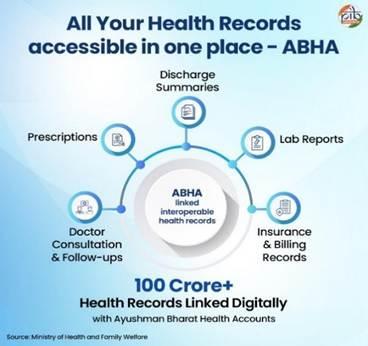
Image: Ayushman Bharat Digital Mission — ABHA-linked national digital health ecosystem.
Key Data at a Glance
104 cr+health records linked under ABDM (July 2026)
93 cr+ABHA accounts created
Sept 2021ABDM launched
23.21 crABHA-linked Scan and Share tokens issued (as on 18 June 2026)
1 hr → 2–5 minpatient wait-time reduction via Scan and Share (IIHMR study)
29 Jun 2026Aarogya Setu 2.0 launched
Issue in Brief
- ABDM has crossed 104 crore linked health records and 93 crore ABHA accounts (official fact-sheet, 6 July 2026), making it one of the world’s largest digital health ecosystems.
- The mission recently rolled out Aarogya Setu 2.0 (launched 29 June 2026) as a unified citizen-facing gateway, alongside AI-governance initiatives SAHI and BODH.
Static Background
- ABDM was launched in September 2021 by the Government of India to build an integrated, citizen-centric national digital health ecosystem, in pursuit of Universal Health Coverage (UHC).
- ABHA (Ayushman Bharat Health Account): a 14-digit unique digital health identifier, analogous to Aadhaar for the health sector, enabling consent-based, portable health records.
- ABHA growth trajectory: 14.7 cr (2021) → 30.4 cr (2022) → 50.6 cr (2023) → 72.2 cr (2024) → 84.5 cr (2025) → crossed 90 cr in 2026, reaching 93 cr+ by July 2026.
- Aarogya Setu origin: built during COVID-19 as a contact-tracing app under a public-private partnership guided by NIC; later handed to the National Health Authority (NHA) and repurposed under ABDM.
- Core ABDM building blocks: ABHA, Healthcare Professionals Registry (HPR), Health Facility Registry (HFR), Health Information Exchange & Consent Manager (HIE-CM), Unified Health Interface (UHI), National Health Claims Exchange (NHCX).
Key Dimensions — Aarogya Setu 2.0
- Launched 29 June 2026 by Union Health Minister J.P. Nadda at Vigyan Bhawan; functions as a single citizen-centric digital gateway: ABHA creation, health-record management, Scan & Register, Scan & Pay for hospital payments.
- AI-powered “Smart Reports” using OCR digitise uploaded documents; the app integrates Google’s Gemma AI model and an open-source Medical Data Toolkit converting unstructured medical documents into the HL7 FHIR standard format.
- Displays AB-PMJAY wallet and private insurance details via NHCX; shows real-time blood-unit availability via e-RaktKosh; enables teleconsultation and appointment booking via UHI.
- Companion launches: Ayushman Sarathi (WhatsApp chatbot for PM-JAY), Drug Registry, Common LOINC Codes for India (CLCI), Bharat Health Terminology Service (BHTS).
Key Dimensions — Scan and Share & Incentives
- Scan and Share: launched 2022 under ABDM by NHA; per an Indian Institute of Health Management Research (IIHMR) study, cut patient waiting times from ~1 hour to 2–5 minutes; over 23.21 crore ABHA-linked tokens issued (as on 18 June 2026).
- Digital Health Incentive Scheme (DHIS): reimburses digitisation expenses. Disbursed (as on 18 June 2026): ₹107+ crore to hospitals, ₹2.95 crore to diagnostics/labs/pharmacies, ₹26+ crore to Digital Solution Companies (DSCs).
- eSushrut@Clinic: lightweight Hospital Management Information System by C-DAC, launched June 2026 for small clinics — 2,200+ facilities onboarded, generating 1,633+ health records; access gated via verification through HPR and HFR.
Key Dimensions — NHCX, UHI & AI Governance
- NHCX: standardises claims exchange among payers, providers, beneficiaries and regulators — speeds up claim decisions and cuts administrative costs. UHI: an open, UPI-like protocol for healthcare built on interoperability, fair discoverability, credential verification and open protocols; five live services — blood bank discovery, PM-JAY hospital search, Jan Aushadhi Kendra discovery, ambulance booking, doctor consultation.
- SAHI (Strategy for Artificial Intelligence in Healthcare for India) and BODH (Benchmarking Open Data Platform for Health AI): launched 17 February 2026 at the India AI Impact Summit. SAHI is a national policy roadmap with 32 recommendations across five pillars. BODH, developed by IIT Kanpur with NHA, lets developers train models on-site on real-world health data without accessing raw patient records, returning only trained model weights.
Critical Analysis — Strengths
- Privacy-by-design: no central government data repository — records stay with the creating entity; apps must clear a sandbox and security audit before going live.
- Interoperability-first architecture (UHI, NHCX) mirrors the proven UPI model — open protocols reduce platform lock-in.
- BODH’s weights-only training is a genuinely privacy-preserving approach to health AI, balancing data utility with patient confidentiality.
- Measurable impact: Scan and Share cutting wait times from ~60 minutes to 2–5 minutes is a concrete efficiency gain.
Critical Analysis — Structural Questions
- Large account/record volumes measure enrolment, not necessarily quality of linked data or active usage.
- DHIS disbursement (₹107 cr to hospitals vs ₹2.95 cr to diagnostics/pharmacies) shows uneven uptake across facility types.
- Aarogya Setu’s history — a discontinued 2022 data-sharing protocol flagged via an RTI by the Internet Freedom Foundation — raises legitimate data-governance trust concerns.
- SAHI/BODH are frameworks and testbeds, not binding regulation; enforcement of SAHI’s liability recommendations depends on downstream rule-making — Verification Required.
Way Forward
- Move health-AI governance from framework to enforceable regulation, particularly on liability allocation.
- Track outcome metrics (reduced duplicate testing, faster claims settlement, rural access) rather than only enrolment numbers.
- Extend DHIS uptake among smaller diagnostic centres and pharmacies through simplified onboarding.
- Rebuild public trust through transparent, publicly auditable consent and data-sharing protocols.
Prelims Pointers
ABDM: launched September 2021; nodal body — National Health Authority (NHA).
ABHA: 14-digit unique digital health ID; 93 crore+ created; 104 crore+ records linked (July 2026).
Scan and Share: 2022; IIHMR study; cut wait times to 2–5 minutes; 23.21 crore tokens issued.
UHI: UPI-like open healthcare protocol; five live services.
SAHI & BODH: launched 17 Feb 2026, India AI Impact Summit; BODH by IIT Kanpur + NHA.
Aarogya Setu 2.0: launched 29 June 2026; integrates Google’s Gemma AI model and HL7 FHIR standard.
Practice Mains Question
“Digital public infrastructure in healthcare must balance interoperability with patient data privacy.” Examine this statement with reference to the Ayushman Bharat Digital Mission and its recent AI-governance initiatives (SAHI, BODH).
GS Paper 2 · 250 words · 15 marks
Practice MCQs
Q1. Consider the following statements: (1) ABHA is a 14-digit unique digital health identifier. (2) ABDM maintains a single central government server storing all patient health records. (3) Apps must clear a sandbox and security audit before connecting to ABDM. Which are correct?
A) 1 and 2 onlyB) 1 and 3 onlyC) 2 and 3 onlyD) 1, 2 and 3
Q2. (Assertion–Reasoning) Assertion (A): BODH enables AI developers to benchmark models on real-world health data without compromising patient privacy. Reason (R): BODH allows model training on-site and returns only trained model weights, not raw patient data.
A) Both A and R are true, and R is the correct explanation of AB) Both A and R are true, but R is NOT the correct explanation of AC) A is true, R is falseD) A is false, R is true