

In-Depth PIB Analysis3 Items
Core TopicImportantConcise
International Relations & SecurityGS Papers II & III
01Maiden BIMSTEC Maritime Security Exercise02India–Myanmar HADR Exercise ‘Rahat Mitra’
History, Art & CultureGS Paper I
03Piprahwa Relics of the Buddha at Tawang
International Relations & SecurityGeneral Studies Papers II & III
01
Maiden BIMSTEC Maritime Security Exercise Concludes at the Andaman & Nicobar Command
Core TopicGS-II · IR — Regional Groupings (BIMSTEC)GS-III · Maritime SecurityPrelims + MainsPIB · Ministry of Defence · 06 Nov 2026
For the first time, warships of BIMSTEC member states have exercised together under the grouping’s own banner — a move that takes the Bay of Bengal grouping from summit declarations into operational maritime cooperation.
◈ From the Basics — What is BIMSTEC?
BIMSTEC stands for the Bay of Bengal Initiative for Multi-Sectoral Technical and Economic Cooperation. It is a regional grouping of seven countries that either border the Bay of Bengal or depend on it for access to the sea.
- Founded: 6 June 1997 through the Bangkok Declaration, as BIST-EC (Bangladesh, India, Sri Lanka, Thailand).
- Expansion: Myanmar joined in December 1997 (BIMST-EC); Nepal and Bhutan became full members in 2004, when the grouping took its present name.
- Composition: five South Asian states (Bangladesh, Bhutan, India, Nepal, Sri Lanka) and two South-East Asian states (Myanmar, Thailand) — which is why it is called a bridge between SAARC and ASEAN.
- Secretariat: Dhaka, set up in 2014; headed by a Secretary General.
- Scale: home to roughly 1.7 billion people — about a fifth of humanity.
Institutional Lineage — How BIMSTEC Got Its Teeth
- BIMSTEC Charter — adopted at the 5th Summit, Colombo (March 2022); entered into force in May 2024, giving the grouping a formal legal personality. Decisions are taken by consensus.
- Sector rationalisation (2022) — the earlier 14 sectors were consolidated into 7 pillars, each led by one member. India leads the Security pillar (counter-terrorism, transnational crime, disaster management and energy).
- 6th Summit, Bangkok (April 2025) — adopted the Bangkok Vision 2030 and an agreement on maritime transport cooperation; the chair passed to Bangladesh.
- Security instruments: a Convention on Combating International Terrorism, Transnational Organised Crime and Illicit Drug Trafficking (signed 2009) and a Convention on Mutual Legal Assistance in Criminal Matters (signed 2022).
- India-hosted centres: BIMSTEC Energy Centre (Bengaluru) and BIMSTEC Centre for Weather and Climate (Noida).
Figure 1 — BIMSTEC: seven members, seven sector leads
SOUTH ASIA (5)BangladeshTrade, Investment& DevelopmentBhutanEnvironment &Climate ChangeIndiaSecurity(CT, DM, energy)NepalPeople-to-PeopleContactSri LankaScience, Tech& InnovationBIMSTEC · Bay of BengalFounded 1997 (Bangkok Declaration) · Secretariat: DhakaSOUTH-EAST ASIA (2)MyanmarAgriculture &Food SecurityThailandConnectivitySeven sectors with lead countries, as rationalised at the 5th Summit, Colombo (2022)
Myanmar and Thailand are BIMSTEC’s land bridge to ASEAN; India holds the Security pillar under which this exercise falls.
◈ Static Anchor — The Andaman & Nicobar Command (ANC)
- Raised in 2001, the ANC is India’s first and only joint (theatre-style) command, with Army, Navy, Air Force and Coast Guard elements under one Commander-in-Chief — hence the release’s description of it as a “Quad Service” Command.
- The post of Commander-in-Chief rotates among the three Services.
- Headquartered at Sri Vijaya Puram (renamed from Port Blair in September 2024).
- The island chain sits astride the western approaches to the Malacca Strait; the Ten Degree Channel (between the Andaman and Nicobar groups) and the Six Degree Channel (between Great Nicobar and Sumatra) carry heavy international shipping.
- Myanmar’s Coco Islands lie just north of the Andaman chain.
▤ Exercise at a Glance
- Name / edition: BIMSTEC Maritime Security Exercise — maiden edition.
- Dates: 30 October – 3 November 2026; harbour phase followed by a sea phase (2–3 Nov).
- Venue: Sri Vijaya Puram and adjoining waters, under the aegis of the Andaman & Nicobar Command.
- Ships: India — INS Taragiri (Project 17A stealth frigate), INS Karmuk (missile corvette), INS Saryu (offshore patrol vessel); Myanmar — UMS King Aung Zeya; Sri Lanka — SLNS Gajabahu.
- Other attendance: the BIMSTEC Secretary General, India’s National Maritime Security Coordinator (NMSC), a senior Myanmar naval commander, a Sri Lankan ministry official and the commanding officer of a Bangladesh Navy ship.
- Mandate: conducted, per the Ministry, in the spirit of the Delhi Declaration and as a follow-up to the 4th BIMSTEC Experts Group Meeting on Maritime Security Cooperation (November 2025).
- Stated aims: interoperability, professional exchange and mutual understanding (as described by the Ministry).
Figure 2 — From declarations to drills: milestones in BIMSTEC security cooperation
1997BIMSTECfounded2009CT Conventionsigned20171st DMExNew Delhi2018MILEX-18Pune2022Charteradopted2024Charterin force20254th EGM onMaritime Sec.2026MaidenmaritimeexerciseCT = counter-terrorism · DMEx = Disaster Management Exercise · EGM = Experts Group Meeting
Earlier BIMSTEC drills were land-based (counter-terrorism, disaster response); 2026 is the first under the grouping’s banner at sea.
Why It Matters — The Bay of Bengal’s Security Agenda
The Bay of Bengal — the world’s largest bay, at roughly 2.2 million km² — is ringed by states that share non-traditional threats no single navy can handle alone.
- Narcotics trafficking by sea from the Golden Triangle — in November 2024 the Indian Coast Guard seized about 6 tonnes of methamphetamine from a boat in Andaman waters.
- IUU fishing (Illegal, Unreported and Unregulated), human trafficking and irregular maritime migration.
- Cyclone-prone waters, making search-and-rescue and HADR coordination a recurring need.
- Rising extra-regional naval presence, including research and survey vessels, which raises the value of shared Maritime Domain Awareness (MDA).
- For India, it operationalises Neighbourhood First, Act East and MAHASAGAR in one forum, and strengthens its standing as a preferred security partner in the region.
The Critical View
- Partial participation: only three navies (India, Myanmar, Sri Lanka) sent ships. Thailand, a littoral member, is not mentioned, and Bangladesh was represented by an officer rather than a listed participating ship. Nepal and Bhutan are landlocked.
- Track record of slow delivery: the BIMSTEC FTA framework agreed in 2004 remains unconcluded, and summits have been infrequent (only six in nearly three decades).
- Internal instability in some members — notably Myanmar’s post-2021 situation — complicates information-sharing and normative positioning.
- Overlapping forums — the Colombo Security Conclave, IORA, IONS and bilateral CORPATs — risk duplication unless BIMSTEC carves out a clear niche.
- Sustainability: a maiden exercise is a signal; institutionalisation (an annual cadence, shared SOPs, an MDA link-up with India’s IFC-IOR) is the real test.
Institutions & Terms to Know (Prelims Hooks)
- IFC-IOR — Information Fusion Centre – Indian Ocean Region, Gurugram (set up 2018), India’s hub for maritime information-sharing.
- NMSC — National Maritime Security Coordinator, a post created in 2022 within the National Security Council Secretariat.
- MAHASAGAR — Mutual and Holistic Advancement for Security and Growth Across Regions (announced 2025), building on SAGAR (2015).
- Colombo Security Conclave — India, Sri Lanka, Maldives, Mauritius and Bangladesh (joined 2024).
- Bilateral patrols: IMCOR (India–Myanmar), Indo-Thai CORPAT, India–Bangladesh CORPAT; exercise SLINEX (India–Sri Lanka).
✎ Mains Practice Question
BIMSTEC has often been called a “natural” platform for the Bay of Bengal but a slow one in delivery. In the light of the maiden BIMSTEC Maritime Security Exercise, examine the scope and limits of BIMSTEC as an instrument of India’s maritime strategy. 15 marks · 250 words
02
India and Myanmar Hold Their First Tri-Services HADR Exercise, ‘Rahat Mitra’
ImportantGS-II · IR — India & its NeighbourhoodGS-III · Disaster ManagementPrelims + MainsPIB · Ministry of Defence · 06 Nov 2026
A first-ever bilateral tri-services exercise with Myanmar focused on disaster relief — a low-sensitivity way of deepening defence ties with a strategically vital but internally troubled neighbour.
◈ From the Basics — What is HADR?
Humanitarian Assistance and Disaster Relief (HADR) is the use of a country’s resources — often its armed forces’ airlift, ships, medical teams and engineers — to help populations hit by natural disasters or crises.
- Militaries are central because they offer speed, logistics and self-sufficiency in the first 72 hours after a disaster, when civil systems are often overwhelmed.
- A tri-services exercise brings the Army, Navy and Air Force together, rehearsing joint planning rather than single-service drills.
- Global framework: the Sendai Framework for Disaster Risk Reduction 2015–2030. India’s institutional contribution: the Coalition for Disaster Resilient Infrastructure (CDRI), launched in 2019.
◈ Static Anchor — India–Myanmar Relations
- Land border: about 1,643 km, shared by Arunachal Pradesh, Nagaland, Manipur and Mizoram; the two countries also share a maritime boundary in the Bay of Bengal.
- Border regime: the Free Movement Regime (FMR) allowed cross-border movement within a strip on either side. In 2024 the Centre moved to fence the entire border and tighten the FMR.
- Gateway to the East: Myanmar is the only ASEAN state with a land border with India — the hinge of the Act East Policy (2014, successor to the Look East Policy of 1991).
- Connectivity: the Kaladan Multi-Modal Transit Transport Project runs Kolkata → Sittwe port (sea, ~539 km) → Paletwa (Kaladan river, ~158 km) → Zorinpui, Mizoram (road, ~109 km); Sittwe port was operationalised in 2023. The India–Myanmar–Thailand Trilateral Highway links Moreh to Mae Sot.
- Existing defence exercises: IMBEX (army), IMNEX (navy) and IMCOR (coordinated naval patrol).
Figure 3 — Myanmar and its neighbourhood
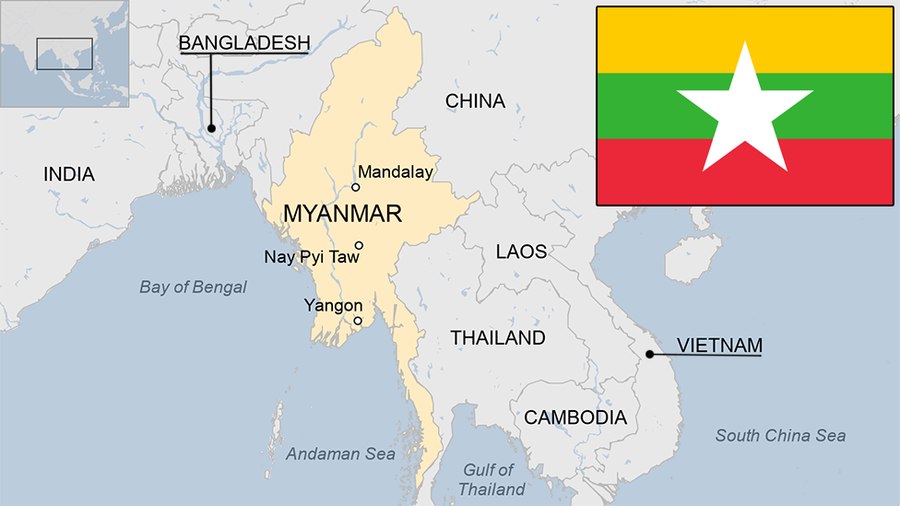
Myanmar borders five countries — India, Bangladesh, China, Laos and Thailand — and faces both the Bay of Bengal and the Andaman Sea. Capital: Nay Pyi Taw. Map is indicative and not to scale. Map image as supplied; reproduced with credit for educational use.
▤ Exercise at a Glance
- Name / type: ‘RAHAT MITRA’ — bilateral tri-services HADR exercise; inaugural edition.
- Dates & venue: 5–6 November 2026, Chennai.
- Lead service (Indian side): coordinated under the aegis of the Indian Navy.
- Strength: 300+ personnel from all three services of both countries.
- Theme: “Together for Humanity, Stronger through Partnership”.
- Stated aims: professional exchange, interoperability in HADR, and mutual trust (as described by the Ministry).
- Policy framing: linked by the Ministry to Neighbourhood First and MAHASAGAR.
Figure 4 — India as first responder: HADR to Myanmar
2008Cyclone NargisIndian Navyrelief ships2023Cyclone MochaOperationKaruna2024Typhoon YagiOperationSadbhav2025M7.7 EarthquakeOperationBrahma2026Rahat Mitrafirst joint HADRexerciseFrom responding to disasters to rehearsing for them together
Repeated relief missions supply the operational logic for a standing joint HADR drill.
Why It Matters
- Disaster geography: Myanmar and India’s eastern coast share the same cyclone basin, and Myanmar sits in an active seismic belt (the Sagaing Fault), so joint preparedness has direct practical value.
- Low-sensitivity engagement: HADR lets India keep military-to-military channels open without the political weight of combat-oriented drills.
- Strategic competition: China’s footprint in Myanmar — the China–Myanmar Economic Corridor and Kyaukphyu port in Rakhine — makes sustained Indian engagement strategically important.
- Border security: cooperation with Myanmar’s forces matters for insurgency, arms and drug smuggling and refugee flows into Mizoram and Manipur.
The Critical View
- Normative questions: deepening ties with Myanmar’s military-led establishment invites criticism given the post-2021 political situation and the Rohingya issue.
- Ground realities: armed groups control large areas of Rakhine and Chin states, slowing projects such as Kaladan — HADR goodwill does not by itself resolve these constraints.
- One-off risk: the value of an inaugural exercise depends on whether it becomes a regular, institutionalised fixture.
✎ Mains Practice Question
Humanitarian Assistance and Disaster Relief has emerged as a low-sensitivity instrument of India’s defence diplomacy. Discuss with reference to India–Myanmar relations. 10 marks · 150 words
History, Art & CultureGeneral Studies Paper I
03
Piprahwa Relics of Shakyamuni Buddha Exhibited at Tawang Monastery, Arunachal Pradesh
ImportantGS-I · Art & Culture — Buddhism, ArchaeologyGS-II · Cultural DiplomacyPrelims + MainsPIB · Ministry of Culture · 06 Nov 2026
The Piprahwa relics — among the most important finds in the archaeology of Buddhism — are touring three monasteries in Arunachal Pradesh, a public exposition that ties India’s Buddhist heritage to its north-eastern frontier.
◈ From the Basics — Relics of the Buddha
“Shakyamuni” means “sage of the Shakyas” — the clan of Siddhartha Gautama, whose capital was Kapilavastu. Relics (Pali sarira) are bodily remains, mostly bone fragments, venerated after a holy person’s death.
- According to the Mahaparinibbana Sutta, after the Buddha’s Mahaparinirvana at Kushinagar (5th century BCE), his remains were divided into eight portions among claimants including Magadha, the Licchavis of Vaishali and the Shakyas of Kapilavastu.
- Each portion was enshrined in a stupa — originally a burial mound, which became the central monument of Buddhist architecture.
- Buddhist tradition credits Ashoka (3rd century BCE) with redistributing the relics into numerous new stupas.
- Four sites mark the Buddha’s life: Lumbini (birth), Bodh Gaya (enlightenment), Sarnath (first sermon) and Kushinagar (Mahaparinirvana).
The Piprahwa Discovery — Static Anchor
- Where: Piprahwa, Siddharthnagar district, Uttar Pradesh, close to the India–Nepal border.
- 1898: William Claxton Peppé, a British estate manager, excavated a stupa and found a stone coffer holding reliquaries, bone fragments and thousands of gems and ornaments.
- The inscription: one reliquary bears an early Brahmi inscription, generally read as recording the relics as those of the Buddha, enshrined by the Shakyas, his kinsmen.
- 1971–77: the Archaeological Survey of India (ASI), under K.M. Srivastava, excavated further. It found more relics and terracotta sealings naming “Kapilavastu”, supporting the identification of Piprahwa with ancient Kapilavastu. A rival identification is Tilaurakot in Nepal, and the question remains debated.
- Custody: the relics are preserved at the National Museum, New Delhi.
- 2025: a privately held portion of the Peppé gems, listed for auction abroad in May 2025, was withdrawn after objections from the Ministry of Culture and returned to India in July 2025 through an arrangement with an Indian business group.
◈ Static Anchor — Tawang Monastery (Gaden Namgyal Lhatse)
- Founded in 1680–81 by Merak Lama Lodre Gyatso, in accordance with the wishes of the 5th Dalai Lama.
- Belongs to the Gelug school of Tibetan (Vajrayana) Buddhism; often described as the largest monastery in India.
- Stands at about 3,000 m in Tawang district, home of the Monpa community; the 6th Dalai Lama was born near Tawang in 1683.
- Road access over Sela Pass is now supplemented by the Sela Tunnel (opened 2024).
Figure 5 — Devotees and monks at Tawang Monastery during the exposition
Inside the main assembly hall (Dukhang) of Tawang Monastery, dominated by a large gilded image of the Buddha. Image courtesy PIB; reproduced with credit for educational use.
▤ Exposition at a Glance
- What: public exposition of the sacred relics of Shakyamuni Buddha (Piprahwa), brought from the National Museum, New Delhi.
- Organisers: Ministry of Culture, with the International Buddhist Confederation (IBC) and the Government of Arunachal Pradesh.
- Footfall: 21,000+ devotees at Tawang so far (Ministry figure).
- Significance claimed: the relics’ return to Arunachal Pradesh after 13 years (per the Ministry).
- Accompanying exhibitions: “Unearthing the Sacred Piprahwa” (by the IBC) and “Crossroads of Dhamma” (curated by the National Museum).
- Itinerary: Tawang (until 7 Nov) → Bomdila (8–13 Nov) → Namsai (14–20 Nov) → back to New Delhi on 21 Nov 2026.
Figure 6 — The relics’ route through Arunachal Pradesh, November 2026
TawangTawang MonasteryGelug · Vajrayanauntil 7 NovBomdilaTGL Monastery(Lower Gompa)8–13 NovNamsaiGolden PagodaTheravada14–20 NovNew DelhiNational Museum(permanent custody)21 NovWest Arunachal (Tawang, West Kameng): Mahayana / Vajrayana monastic traditionEast Arunachal (Namsai): Theravada tradition of the Tai Khamti community
The route spans both major Buddhist traditions present in Arunachal Pradesh — Vajrayana in the west and Theravada in the east.
Why It Matters
- Heritage outreach: taking nationally held antiquities to the communities that practise the living tradition widens public access beyond a Delhi gallery.
- Buddhist soft power: India has sent Buddhist relics for exposition to Mongolia (2022), Thailand (2024) and Vietnam (2025). Domestic expositions in border regions extend the same “relic diplomacy” inward.
- Frontier significance: Tawang is a historic seat of Himalayan Buddhism in a strategically sensitive frontier district, which gives the cultural outreach added symbolic weight.
- Linked policy hooks: Pali was granted classical language status in October 2024. The IBC, set up in 2012 and headquartered in New Delhi, works as an umbrella body for Buddhist organisations.
The Critical View
- Conservation risk: moving fragile, roughly 2,000-year-old antiquities across high-altitude, high-humidity terrain demands strict climate, handling and security protocols.
- Legal gaps: the Antiquities and Art Treasures Act, 1972 controls exports from India, but it could not by itself stop the 2025 overseas sale attempt of material removed in the colonial era. The 1970 UNESCO Convention on illicit trafficking is not retroactive.
- Heritage vs. instrument: there is a fine line between preserving sacred heritage and using it mainly as a tool of diplomatic signalling; religious sentiment and scholarly custody both need respect.
✎ Mains Practice Question
India’s Buddhist heritage is at once a civilisational inheritance and an instrument of soft power. Discuss with reference to the Piprahwa relics and the challenges in safeguarding such heritage. 15 marks · 250 words