
In-Depth PIB Analysis3 Items
Core TopicImportantConcise
EconomyGS Paper III
01ECLGS 5.0 — Emergency Credit Guarantee Support
Environment & EcologyGS Paper III
02NBA — ₹200 Crore ABS Disbursement Milestone0316th National Meet of SBBs & UTBCs
EconomyGeneral Studies Paper III
01
Emergency Credit Line Guarantee Scheme (ECLGS) 5.0
GS-III · Economy — Growth, Employment, Fiscal PolicyPrelims + MainsPIB · Ministry of Finance · Release dated 05 September 2026
The Government has approved ECLGS 5.0, a fifth iteration of the COVID-era credit guarantee scheme, to shield MSMEs, select non-MSME borrowers and scheduled passenger airlines from liquidity pressure caused by external economic shocks.
◈ Background & Context
ECLGS was first launched in 2020 under the Aatmanirbhar Bharat Package to help businesses absorb the financial stress of the pandemic, by having the National Credit Guarantee Trustee Company (NCGTC) guarantee additional working-capital loans extended by banks and NBFCs.
The Government states that the scheme was approved on 5 May 2026 to address renewed liquidity pressure from evolving geopolitical developments — supply-chain disruption, higher logistics costs and working-capital strain across sectors.
Lineage — from pandemic relief to a standing shock-absorber
- ECLGS 1.0 (2020): MSMEs, Mudra borrowers and individual business loans; 100% guarantee; loans up to ₹50 crore outstanding.
- ECLGS 2.0: extended to 26 stressed sectors identified by the Kamath Committee, plus healthcare; loans of ₹50–500 crore.
- ECLGS 3.0: hospitality, travel & tourism, leisure & sporting, civil aviation.
- ECLGS 4.0: hospitals, nursing homes and liquid-oxygen/oxygen-cylinder manufacturers, during the pandemic's second wave.
- Phases 1.0–4.0 together issued 1.19 crore guarantees worth ₹3.68 lakh crore before concluding on 31 March 2023.
- ECLGS 5.0 (2026): the trigger shifts from a health emergency to geopolitical/external-shock resilience, and coverage extends for the first time to scheduled passenger airlines as a standalone category.
Figure 1 — Evolution of ECLGS, 2020–2026
1.0MSMEs,Mudra2.026 stressedsectors3.0Hospitality,aviation4.0Healthcareinfra5.0Geopoliticalshocks + airlinesTrigger shifts: pandemic relief (1.0–4.0) → external-shock resilience (5.0)Phases 1.0–4.0: 1.19 crore guarantees · ₹3.68 lakh crore · concluded 31 Mar 2023
ECLGS has evolved from a pandemic-relief instrument into a recurring credit-guarantee tool the Government now redeploys for external shocks.
▤ Scheme at a Glance
- Outlay: additional credit flow of up to ₹2.55 lakh crore (guarantee ceiling, not a budget outlay).
- Tenure: operational till 31 March 2027, or till guarantees worth ₹2.55 lakh crore are issued, whichever is earlier.
- Nodal agency: National Credit Guarantee Trustee Company (NCGTC), under the Ministry of Finance.
- Approving authority: Union Government (approved 5 May 2026).
- Coverage: MSMEs (all sectors); eligible non-MSME borrowers (several sectors excluded — NBFCs, power, telecom, IT, paper, education, tobacco, most beverages); scheduled passenger airlines.
- Guarantee coverage: 100% for MSMEs; 90% for eligible non-MSMEs and for scheduled airlines. No guarantee fee charged to lending institutions.
- Credit ceiling per borrower: up to 20% of peak Q4 FY26 working-capital outstanding, capped at ₹100 crore for MSMEs/non-MSMEs; up to ₹1,500 crore for airlines (any amount beyond ₹1,000 crore needs matching promoter equity).
- Interest cap: MSMEs/non-MSMEs at EBLR/MCLR + up to 0.75%, capped at 9% p.a. (13% p.a. for NBFC-routed loans); airline lending rate set per the lender's board policy.
- Loan tenure: 5 years (1-year moratorium) for MSMEs/non-MSMEs; 7 years (2-year moratorium) for airlines.
- Delivery channel: Jan Samarth Portal, through Scheduled Commercial Banks, Urban Co-operative Banks, Financial Institutions and eligible NBFCs.
- Stated progress (as reported, 20 August 2026): 6,73,979 guarantees issued, guaranteed amount ₹2,50,024 crore — MSMEs account for 97.3% of guarantees by number and 80.79% by value.
Figure 2 — ECLGS 5.0 at a glance (as reported by the Ministry)
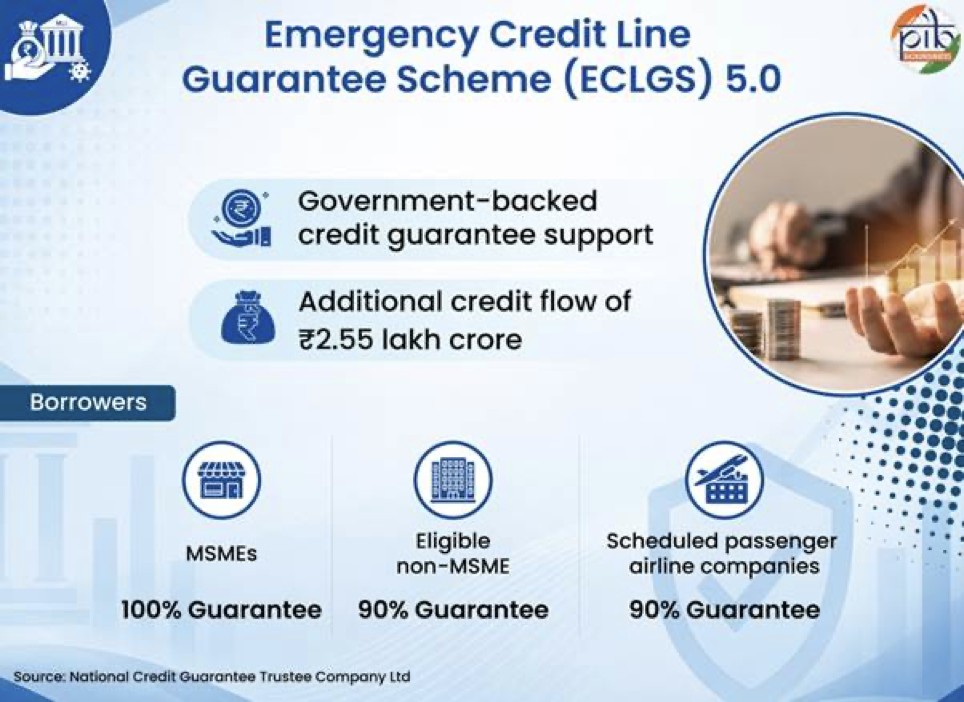
Three borrower categories carry different guarantee ratios — full guarantee for MSMEs, 90% for non-MSMEs and airlines. Image courtesy PIB Delhi / Ministry of Finance; reproduced with credit for educational use.
Figure 3 — Progress under ECLGS 5.0, as of 20 August 2026
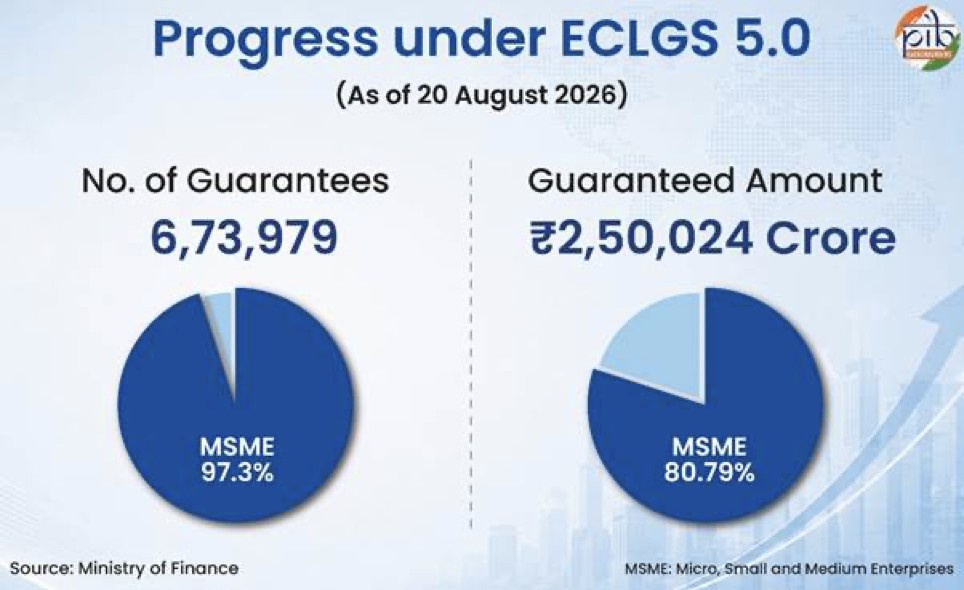
MSMEs dominate by count of guarantees (97.3%) but a smaller share by value (80.79%), implying non-MSME and airline guarantees are, on average, considerably larger tickets. Image courtesy PIB Delhi / Ministry of Finance; reproduced with credit for educational use.
The critical view
- Contingent liability: a credit guarantee is an off-budget, contingent fiscal exposure — it shows up as a liability only if borrowers default, which can understate the near-term fiscal cost of the scheme.
- Sector exclusions: excluding NBFCs, power, telecom and IT from non-MSME coverage narrows the scheme's reach precisely in some capital-intensive sectors exposed to global supply chains.
- Moral hazard & asset quality: a near-zero-cost, high-guarantee credit line can incentivise over-borrowing by weak units; the previous phases drew criticism over restructuring and eventual slippage in some guaranteed accounts.
- Concentration by value: the wide gap between MSMEs' share by number (97.3%) and by value (80.79%) suggests large borrowers, including the newly added airline category, could absorb a disproportionate share of the ₹2.55 lakh crore ceiling.
Institutions & terms to know
- NCGTC — National Credit Guarantee Trustee Company, the scheme's implementing trustee.
- Kamath Committee — identified the 26 stressed sectors first covered under ECLGS 2.0.
- EBLR / MCLR — External Benchmark Lending Rate and Marginal Cost of Funds-based Lending Rate, the reference rates capping interest under the scheme.
- SMA-2 — a loan-account stress classification; airlines classified SMA-2 or worse are excluded from eligibility.
✎ Mains Practice Question
Credit guarantee schemes such as ECLGS are often described as an "off-budget" fiscal tool. Explain this characterisation and discuss, with reference to ECLGS 5.0, the trade-offs between using guarantees versus direct fiscal support to shield the economy from external shocks. 15 marks · 250 words
Environment & EcologyGeneral Studies Paper III
02
National Biodiversity Authority Crosses ₹200-Crore Milestone in Access and Benefit-Sharing Disbursement
GS-III · Environment & Ecology — Biodiversity, ConservationPrelims + MainsPIB · Ministry of Environment, Forest and Climate Change · Release dated 05 September 2026
The National Biodiversity Authority's cumulative Access and Benefit-Sharing (ABS) disbursements have crossed ₹200 crore, with a fresh ₹8.23 crore sanctioned to State Biodiversity Boards and Union Territory Biodiversity Councils from the commercial use of four vegetable crops.
◈ Background & Context
ABS is the mechanism under the Biological Diversity Act, 2002 by which companies accessing India's biological resources for research or commercial use must share a portion of resulting benefits with the communities and States associated with those resources.
The latest tranche was realised from three seed companies for their use of Bitter Gourd, Okra, Chilli and Onion germplasm, and is being distributed to 27 State Biodiversity Boards and 5 UT Biodiversity Councils.
How the money is allocated
- Because the resources were sourced through open markets or traders, individual farmers or communities could not be traced — so, on an Expert Committee's recommendation, proceeds go to the Biodiversity Boards of States/UTs growing each crop, weighted by area under cultivation (Ministry of Agriculture & Farmers Welfare data).
- Madhya Pradesh and Maharashtra are the largest cumulative recipients across the four crops — Maharashtra's share driven mainly by its holding over 49% of India's onion-growing area.
▤ Scheme at a Glance
- Instrument: Access and Benefit-Sharing (ABS) under the Biological Diversity Act, 2002.
- Nodal body: National Biodiversity Authority (statutory body, MoEFCC).
- Latest tranche: ₹8.23 crore, from Bitter Gourd, Okra, Chilli and Onion utilisation.
- Payers: Nunhems India, East West Seeds India, Bayer Science and Innovation.
- Recipients: 27 State Biodiversity Boards + 5 UT Biodiversity Councils.
- Cumulative disbursement: exceeds ₹200 crore to date.
- Permitted end-use (Sec. 32(2), BD Act): People's Biodiversity Registers, in-situ/ex-situ conservation, ecosystem restoration, Biodiversity Heritage Sites, capacity-building of Biodiversity Management Committees (BMCs), community livelihoods.
- International linkage: supports India's commitments under the CBD, the Nagoya Protocol on ABS, and Target 13 of the Kunming-Montreal Global Biodiversity Framework (KMGBF).
The critical view
- Traceability gap: resources sourced through open markets cannot be linked to the actual farmers or communities that conserved the genetic diversity — so benefit-sharing lands with State institutions rather than the original knowledge-holders, diluting the equity principle ABS is meant to serve.
- Absorption capacity: BMCs' ability to spend these funds effectively depends on their institutional strength, which varies widely across states — a recurring concern in NBA/State Biodiversity Board reviews.
- Scale relative to need: ₹200 crore, accumulated over the ABS mechanism's lifetime, remains modest against the stated ambition of the National Biodiversity Strategy and Action Plan (NBSAP) 2024–2030.
Institutions & terms to know
- Biological Diversity Act, 2002 — establishes the three-tier structure: NBA (national), State Biodiversity Boards (state), Biodiversity Management Committees (local).
- Nagoya Protocol — the international ABS supplementary agreement to the CBD, in force for India.
- People's Biodiversity Register (PBR) — a local-level document of biological resources and associated traditional knowledge, maintained by BMCs.
✎ Mains Practice Question
Explain the Access and Benefit-Sharing (ABS) mechanism under the Biological Diversity Act, 2002. Discuss the practical challenges in ensuring that ABS proceeds reach the actual custodians of biological resources rather than only the State-level institutional structure. 15 marks · 250 words
03
16th National Meet of State Biodiversity Boards and UT Biodiversity Councils
GS-III · Environment & Ecology — Biodiversity GovernancePrelims + MainsPIB · Ministry of Environment, Forest and Climate Change · Release dated 06 September 2026
The NBA convened its 16th National Meet of State Biodiversity Boards (SBBs) and UT Biodiversity Councils (UTBCs) at Chandigarh on 6–7 September 2026, to align State-level institutions with India's amended biodiversity governance framework.
What the meet focused on
- States/UTs were urged to align their rules and institutional mechanisms with the Biological Diversity (Amendment) Act, 2023 and the Biological Diversity Rules, 2024.
- A call to operationalise more than 2.76 lakh Biodiversity Management Committees (BMCs) and turn People's Biodiversity Registers into dynamic, actively-used local planning instruments — not static records.
- India's Updated NBSAP 2024–2030 was referenced as the country's roadmap aligned with the Kunming-Montreal Global Biodiversity Framework, including the global "30-by-30" conservation target.
- The Government noted submission of its 7th National Report to the CBD and its 1st National Report on the Nagoya Protocol on ABS.
Why it matters
Biodiversity governance in India is federal by design — national policy is set by the NBA/MoEFCC, but implementation depends on State Boards and, ultimately, local BMCs. A national meet of this kind is where implementation gaps between the amended law and ground-level practice get surfaced.
The critical view
- Functional BMCs vs. registered BMCs: the Government's own framing — calling for BMCs to be made "functional and effective" — implicitly acknowledges that a large share of the 2.76 lakh registered BMCs remain inactive on paper only.
- Federal asymmetry: State Biodiversity Boards vary sharply in capacity and funding, so a uniform national framework may translate unevenly on the ground.
Institutions & terms to know
- Biological Diversity (Amendment) Act, 2023 — eased compliance for AYUSH practitioners and simplified access procedures while strengthening ABS enforcement.
- NBSAP — National Biodiversity Strategy and Action Plan, India's roadmap under the CBD.
- 30-by-30 target — the global goal (under KMGBF) to conserve 30% of land and sea area by 2030.
✎ Mains Practice Question
"Biodiversity conservation in India suffers less from an absence of law than from weak implementation of it." Examine this statement with reference to the functioning of Biodiversity Management Committees under the Biological Diversity Act. 10 marks · 150 words