
Published on Apr 8, 2026
Daily PIB Summaries
PIB Summaries 08 April 2026

Content
- India’s Green Pathway
- A New Chapter in India’s Nuclear Journey
India’s Green Pathway
Why in News?
- PIB release (7 April 2026) highlights India’s transition from biodiversity conservation to climate-centric development, aligning with NDC targets, SDGs, and net-zero 2070 goal.
- Reflects India’s post-COP30 (2025) climate leadership, operationalisation of carbon markets, Green Hydrogen Mission, and Mission LiFE initiatives.
Relevance
- GS III (Environment & Economy)
- Climate change, biodiversity, sustainable development, energy transition
- GS II (Governance & IR)
- Environmental governance, international climate commitments (UNFCCC, CBD)
Practice Question
Q1.“India’s development trajectory is increasingly aligned with sustainability and climate resilience.”Examine in the context of India’s Green Pathway.(250 Words)
Static Background
- Shift from “environment vs development” dichotomy to “mutually reinforcing pillars”, embedding sustainability within economic planning and governance architecture.
- Constitutional backing via Article 48A (State duty) and Article 51A(g) (citizen duty) ensures environmental protection as governance obligation.
- India is among 17 mega-biodiverse countries, hosting ~8% global species on 2.4% land area, making conservation a strategic national priority.
Key Dimensions
- Legal–Institutional Framework built on Environment Protection Act 1986 (umbrella law) supported by Air Act 1981, Water Act 1974, Forest Act 1980, Wildlife Act 1972, ensuring comprehensive regulatory ecosystem.
- Biodiversity Governance anchored in Biological Diversity Act 2002 and NBSAP 2024–30, aligned with Kunming-Montreal Global Biodiversity Framework targeting biodiversity restoration by 2030.
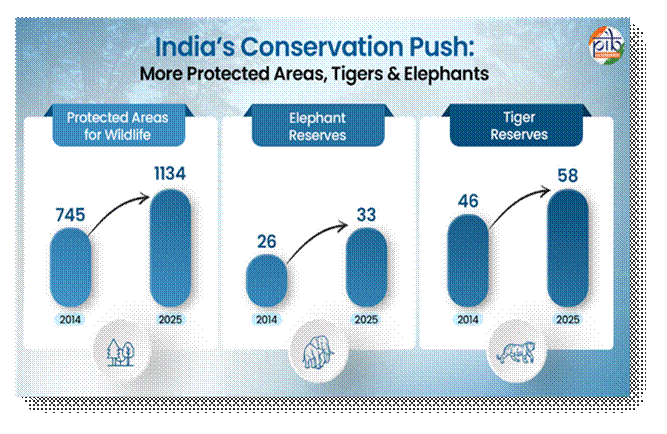
- Administrative Expansion seen in Protected Areas increase: 745 (2014) → 1,134 (2025), strengthening habitat protection and ecological security frameworks.
- Flagship Species Conservation:
- Project Tiger: 58 reserves, ~85,000 sq km, 3,167 tigers (2022).
- Project Elephant: 33 reserves, 150 corridors ensuring connectivity.
- Project Dolphin: 6,327 dolphins (2023) with 2026 reassessment ongoing.
- Ecosystem Restoration Strategy includes 18 Biosphere Reserves (91,425 sq km) with 13 UNESCO recognition, ensuring landscape-level conservation integration.
- Wetland & Coastal Governance: Ramsar Sites increased to 98 (2026) from 26 (2014); MISHTI restored 4,536 hectares mangroves (2025) enhancing coastal resilience.
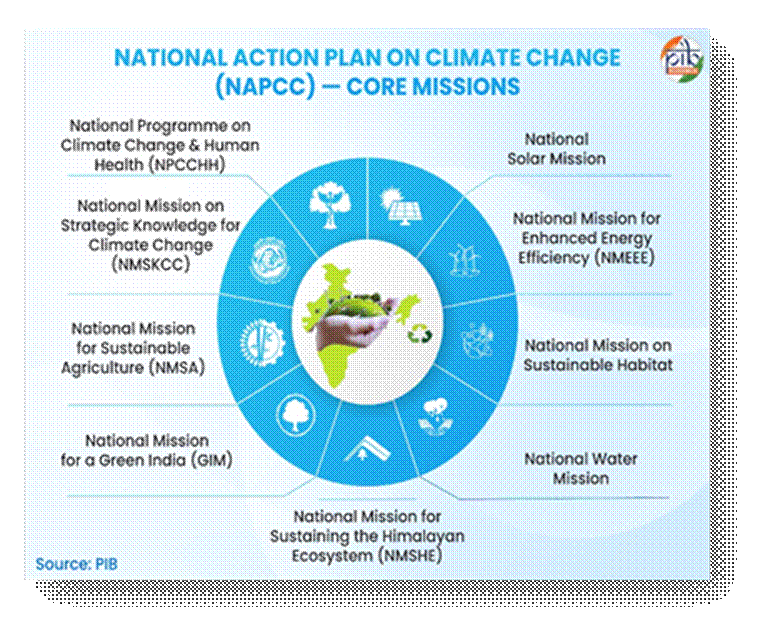
- Climate Policy Architecture driven by NAPCC (9 missions), NDC 2022 targets, and LT-LEDS (net-zero 2070 pathway) ensuring integrated mitigation–adaptation strategy.
- Emission Reduction Targets: 45% emission intensity reduction by 2030, with 36% already achieved (2005–2020) indicating policy effectiveness and early action.
- Clean Energy Transition: >50% installed capacity non-fossil (2025); total capacity 520 GW with ~272 GW non-fossil, reflecting structural decarbonisation.
- Global Renewable Ranking: India is 3rd in solar, 4th in wind and total RE capacity (IRENA 2025) strengthening energy leadership credentials.
- Green Hydrogen Mission targets 5 MMT annual production by 2030, supporting industrial decarbonisation and energy security diversification.
- Carbon Market Development through Carbon Credit Trading Scheme, covering 490 obligated entities (2026), promoting market-based emission reduction mechanisms.
- Industrial Transition Support via ₹20,000 crore CCUS allocation (2026–27) enabling low-carbon technologies in hard-to-abate sectors.
- Pollution Governance strengthened through NCAP (2019), with 103/130 cities improving PM10 levels and 25 cities achieving 40% reduction.
- Circular Economy Push: Fly ash utilisation 332.63 MT out of 340 MT (2024–25) and EPR recycling 375.11 lakh tonnes waste, enhancing resource efficiency.
- Waste Infrastructure Expansion: Recycling plants increased from 829 → 3,036 (2019–25) supporting SDG 12 (responsible consumption).
- Community Participation via Mission LiFE, with 6 crore participants and 4.96 crore pledges, embedding behavioural climate action.
- Mass Afforestation Drive: Ek Ped Maa Ke Naam campaign planted 262.4 crore saplings, reflecting people-centric environmental governance.
- Technological Integration through satellite-based forest fire monitoring (FSI) and real-time alerts, improving disaster preparedness and response.
- International Climate Leadership: Active role in ISA, CBD, UNFCCC, advocacy for climate justice and CBDR principle, strengthening Global South voice.
- Montreal Protocol Success: 67.5% HCFC reduction (2025), demonstrating compliance with global environmental regimes.
- SDG Progress: SDG Index score improved to 71 (2023–24) from 57 (2018), reflecting sustained multi-sectoral development gains.
Challenges and Criticisms
- Implementation deficits in SPCBs and local bodies, limiting enforcement of environmental regulations.
- Human-wildlife conflict persistence despite corridor development, due to habitat fragmentation and land-use change pressures.
- Urban pollution hotspots remain despite NCAP, reflecting compliance and monitoring gaps.
- Climate finance constraints hinder scalability of green hydrogen, CCUS, and renewable infrastructure.
- Federal coordination challenges in coastal and forest governance create overlapping mandates and inefficiencies.
Way Forward
- Strengthen regulatory institutions (CPCB/SPCBs) using AI-based monitoring and real-time compliance systems.
- Scale Nature-based Solutions (NbS) integrating wetlands, forests, mangroves into climate adaptation frameworks.
- Deepen carbon markets with global linkage (Article 6) and robust price signals.
- Promote green federalism through performance-linked fiscal transfers based on SDG/climate outcomes.
- Ensure just transition policies for coal-dependent regions, balancing employment and decarbonisation goals.
Prelims Pointers
- Ramsar Sites: 98 (2026), highest in Asia
- Tiger population: 3,167 (2022)
- Green Hydrogen target: 5 MMT by 2030
- Non-fossil capacity >50% achieved (2025)
- Mission LiFE = behavioural climate action model
A New Chapter in India’s Nuclear Journey
Why in News?
- Prototype Fast Breeder Reactor (PFBR), 500 MWe at Kalpakkam attained first criticality (6 April 2026), marking start of self-sustained nuclear chain reaction.
- India enters Stage-II of Three-Stage Nuclear Programme, becoming 2nd country after Russia with commercial FBR capability.
Relevance
- GS III (Science & Technology)
- Nuclear technology, energy security, advanced reactors
- GS III (Environment)
- Clean energy transition, low-carbon energy
Practice Question
Q1.Discuss the significance of the Prototype Fast Breeder Reactor (PFBR) in India’s three-stage nuclear programme.(250 Words)
Static Background
- India’s nuclear strategy designed by Dr. Homi J. Bhabha, based on closed fuel cycle and thorium utilisation for long-term energy security.
- India has limited uranium but ~25% global thorium reserves, necessitating three-stage programme for resource optimisation.
Key Dimensions of India’s Nuclear Pathway
- Scientific–Technological Breakthrough: PFBR uses MOX fuel (U-Pu mix) and fast neutrons, enabling breeding of more fissile material than consumed.
- Closed Fuel Cycle Strategy: Spent fuel reprocessing ensures resource efficiency, reduced waste, and long-term sustainability of nuclear programme.
- Three-Stage Programme Structure:
- Stage-I (PHWRs): Natural uranium → Plutonium production.
- Stage-II (FBRs): Plutonium fuel → more fissile material generation.
- Stage-III (Thorium): U-233 from thorium → long-term energy source.
- Bridge to Thorium Economy: PFBR enables conversion of Thorium-232 → Uranium-233, unlocking India’s vast thorium potential.
- Institutional Ecosystem: Led by Department of Atomic Energy (DAE), IGCAR (design), and BHAVINI (execution) ensuring indigenous technological capability.
- Energy Security Dimension: Nuclear reduces import dependence on fossil fuels, ensuring base-load, reliable power supply.
- Climate Change Mitigation: Nuclear is low-carbon energy source, supporting India’s net-zero target (2070) and NDC commitments.
- Current Nuclear Status:
- Installed capacity: 8.78 GW
- Generation: 56,681 MU (2024–25)
- Share: ~3.1% of electricity mix
- Future Expansion Plan: Capacity projected 22.38 GW by 2031–32 (~3x increase) with 700 MW PHWRs and 1000 MW reactors.
- Long-Term Vision: 100 GW nuclear capacity by 2047 under Nuclear Energy Mission (Budget 2025–26).
- SMR Development Push:
- ₹20,000 crore allocation for Small Modular Reactors (SMRs).
- Target: 5 operational SMRs by 2033.
- Advanced Reactor Innovation:
- BSMR-200 (200 MWe)
- SMR-55 (55 MWe)
- HTGR (5 MWth) for hydrogen production
- Legal–Regulatory Reform: SHANTI Act, 2025 enables limited private participation, modernising nuclear governance framework.
- International Cooperation: India has civil nuclear agreements with 18 countries, enhancing technology access and global trust.
- Strategic Significance: Strengthens strategic autonomy in critical energy technologies and reduces geopolitical vulnerabilities in energy supply chains.
Challenges and Criticisms
- High capital costs and long gestation periods limit rapid scaling compared to renewables.
- Public concerns over nuclear safety and waste disposal, especially post global nuclear accidents (Fukushima context).
- Limited domestic uranium reserves, making Stage-I partially import-dependent.
- Technological complexity of FBRs and reprocessing, requiring high safety standards and skilled manpower.
- Regulatory and liability issues may constrain private sector participation despite SHANTI Act reforms.
Way Forward
- Accelerate thorium-based reactor R&D to achieve Stage-III transition faster.
- Strengthen independent nuclear regulatory authority ensuring transparency and public trust.
- Integrate nuclear with renewables (hybrid grids) for stable low-carbon energy mix.
- Promote SMRs for decentralised power and industrial use, improving economic viability and scalability.
- Enhance international collaboration for advanced nuclear tech and safety standards.
Prelims Pointers
- PFBR: 500 MWe, Kalpakkam, uses MOX fuel
- Fast Breeder Reactor = produces more fuel than consumed
- India’s nuclear programme = 3-stage, thorium-based
- U-233 derived from Thorium-232 in Stage-II/III
- Nuclear share ~3% of India’s electricity