

Contents01
Strengthening India's Toy Ecosystem — From Local Craftsmanship to Global Markets
Ministry of Commerce & Industry (DPIIT)
GS 1GS 2GS 3
02
Mizoram's Natural History Museum Notified as India's 21st Designated Repository under the Biological Diversity Act, 2002
Ministry of Environment, Forest and Climate Change
GS 3GS 1
Article 01
Article 01
Strengthening India's Toy Ecosystem — From Local Craftsmanship to Global Markets
Ministry of Commerce & Industry (DPIIT) · PIB
Relevance: GS 1 (Indian heritage & culture — craft traditions) · GS 2 (government policies for manufacturing sector) · GS 3 (industry, MSME, exports, employment).
GS 1GS 2GS 3
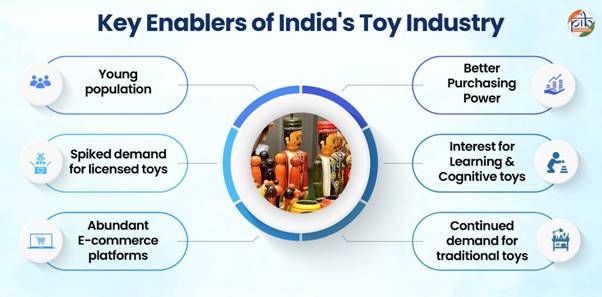
Image: India's toy manufacturing ecosystem — from artisanal craftsmanship to global exports. [Replace src with image URL]
Key Data at a Glance
US$384.7 mntotal toy exports (HSN 9503, 9504, 9505) in 2025–26, up 151.9% from 2017–18
US$152 mntrade surplus in 2025–26, reversing a US$213.01 mn deficit in 2017–18
17,693employment under NIC Code 324 (2023–24), more than double the 2018–19 figure
5% GSTreduced rate on toys, down from 12%
1,454 + 36BIS licences granted to domestic and foreign toy manufacturers (Jan 2024)
14 ministriesinvolved in implementing the National Action Plan for Toys, 2020
Issue in Brief
- India's toy industry is emerging as a strong contributor to manufacturing, exports and employment, backed by a young population, rising incomes, e-commerce expansion, and sustained policy support since 2020.
- The sector has moved from import-dependence to a trade surplus, driven by quality regulation, indigenous branding, and export facilitation.
Static Background
- India's toy-making tradition spans nearly 5,000 years, evidenced by clay carts and figurines excavated at Harappa and Mohenjo-Daro (Indus Valley Civilization).
- Traditional craft streams include wooden figurines (village workshops) and mythological dolls (Ramayana/Mahabharata themes), reflecting cultural transmission through play.
- Pre-2020, India was import-heavy — reports indicate the country imported around 85% of toys sold domestically, mostly low-cost, sub-standard imports, prompting regulatory intervention.
- Bureau of Indian Standards (BIS): statutory body under the BIS Act, 2016, empowered to issue Quality Control Orders (QCOs) mandating conformity to Indian Standards.
- Nodal ministry: Department for Promotion of Industry and Internal Trade (DPIIT), Ministry of Commerce & Industry — implementation involves 14 central ministries (MSME, Textiles, Skill Development, Education, BIS, etc.).
Key Dimensions — Trade Performance
- Toy exports (HSN 9503, 9504, 9505) rose from US$152.7 million (2017–18) to US$384.7 million (2025–26) — growth of 151.9%.
- HSN 9503 (electronic/non-electronic toys) grew ~160%, from US$77.35 million to US$200.89 million; the US is the top destination (exports more than quadrupled to ~US$111.9 million).
- India recorded a trade surplus of US$152 million (2025–26), reversing a US$213.01 million deficit in 2017–18; traditional/educational toy imports declined ~66%.
- Employment under NIC Code 324 (Games & Toys) more than doubled: 8,685 (2018–19) → 17,693 (2023–24).
Key Dimensions — Regulatory Framework
- National Action Plan for Toys (NAPT), 2020: a 21-action-point plan involving 14 central ministries, promoting Made-in-India, culturally-rooted toy design, indigenous clusters, and import restriction on sub-standard toys.
- Toys (Quality Control) Order, 2020 (effective 1 Jan 2021, under Section 16, BIS Act 2016): mandates conformity to 7 Indian Standards and compulsory ISI/BIS certification for domestic and foreign manufacturers; exempts DC(Handicrafts)-registered artisans and GI-tag holders.
- As per available data, BIS has granted 1,454 domestic and 36 foreign manufacturer licences (as of January 2024) under IS 9873/IS 15644.
- Manak Manthan (April 2026): BIS-led stakeholder sensitisation on IS 9873 (Part 1):2025, covering mechanical/physical toy safety.
Key Dimensions — Innovation & Skilling
- Toycathon (2021): collaborative innovation challenge for students, designers, and start-ups under Atmanirbhar Bharat, promoting culturally-inspired toy design.
- e-Toys Lab (MeitY, at C-DAC Noida): one-year structured training (6 months lab research + 6 months industry) for young engineers, including SC/ST and NE-region candidates, in electronic toy design.
- Toy Biz International B2B Exhibition: major domestic trade platform connecting manufacturers with global buyers.
Key Dimensions — Trade & Market Facilitation
- GST on toys reduced from 12% to 5%, improving affordability and supporting educational-toy adoption.
- FTAs with zero-duty access: India–UAE CEPA, India–Australia ECTA, India–EFTA TEPA, India–Oman CEPA, India–New Zealand FTA, India–UK CETA.
- Districts as Export Hubs (DEH): State/District Export Promotion Committees (constituted in 36 States/UTs) have identified 10+ districts with toy/doll export potential.
- GI-tagged toys: Channapatna Toys (Karnataka), Leather Toys of Indore (MP), Thanjavur Doll (Tamil Nadu) — GI status protects craftsmanship and regional identity.
- ODOP (One District, One Product): supports branding, skilling, and market access for district-specific toy products.
Critical Analysis — Strengths
- Quality regulation (QCO + BIS licensing) has curbed unsafe imports while building a credible domestic certification ecosystem — a template also used in fisheries and other sectors.
- Export diversification across HSN categories and multiple geographies (US, UK, Poland, Germany, UAE) reduces market concentration risk.
- Convergence of culture + commerce (GI tags, Toycathon, ODOP) helps preserve artisanal heritage while creating formal livelihoods.
Critical Analysis — Structural Questions
- China still dominates global toy exports (~58.7% share) — India's gains, though significant, remain modest relative to global market size.
- Growth is concentrated in a few markets (US alone accounts for a large export share), creating vulnerability to any single-market trade or tariff disruption.
- MSME/artisan segments may face compliance costs under BIS certification despite exemptions, especially smaller unregistered units outside GI/artisan categories.
- Employment growth (17,693 under NIC 324) remains small in absolute terms relative to the sector's ambition of becoming a global hub.
Way Forward
- Deepen export market diversification beyond the US to de-risk trade dependence.
- Strengthen testing infrastructure and ease compliance for micro/small artisanal units to widen formalisation without diluting safety standards.
- Scale skilling initiatives (e-Toys Lab model) across more regions, especially the North-East and tribal clusters, to widen inclusive participation.
- Leverage FTA zero-duty access more assertively through targeted trade promotion in Europe and South-East Asia.
Prelims Pointers
NAPT, 2020: 21 action points; 14 ministries; nodal — DPIIT.
Toys QCO, 2020: under Section 16, BIS Act 2016; effective 1 Jan 2021; mandates 7 Indian Standards + ISI mark.
GST on toys: reduced from 12% to 5%.
e-Toys Lab: MeitY initiative at C-DAC, Noida.
GI-tagged toys: Channapatna (Karnataka), Thanjavur Doll (Tamil Nadu), Leather Toys of Indore (MP).
Toy trade surplus: US$152 million (2025–26), against a deficit of US$213.01 million in 2017–18.
Practice Mains Question
“India's toy industry reflects a successful blend of cultural heritage and modern industrial policy.” Discuss the role of quality regulation and export promotion measures in transforming India's toy sector from import dependence to global competitiveness.
GS Paper 3 · 250 words · 15 marks
Practice MCQs
Q1. Consider the following statements regarding the Toys (Quality Control) Order, 2020: (1) It is issued under the BIS Act, 2016. (2) It exempts artisans registered with the Development Commissioner (Handicrafts). (3) It applies to toys intended for export from India. Which of the statements given above is/are correct?
A) 1 and 2 onlyB) 2 and 3 onlyC) 1 onlyD) 1, 2 and 3
Q2. With reference to India's toy trade, which of the following is correct?
A) India recorded a trade deficit in toy categories in 2025–26B) HSN 9504 refers to electronic and non-electronic toysC) India achieved a trade surplus of US$152 million in 2025–26 across HSN 9503, 9504 and 9505D) Imports of traditional toys rose sharply between 2017–18 and 2025–26
Article 02
Article 02
Mizoram's Natural History Museum Notified as India's 21st Designated Repository under the Biological Diversity Act, 2002
Ministry of Environment, Forest and Climate Change (MoEFCC) · PIB
Relevance: GS 3 (biodiversity conservation, environment) · GS 1 (geography — North-East biodiversity hotspots).
GS 3GS 1
Key Data at a Glance
21stDesignated Repository notified in India
19 June 2026date of notification by the Central Government
2022year NHM, Mizoram University was established
500+specimens already preserved by NHM before designation
7,500+flowering plant species in Mizoram/North-East region
2,000+faunal species in Mizoram/North-East region
Issue in Brief
- MoEFCC has notified the Natural History Museum (NHM), Mizoram University, Aizawl as a Designated Repository under Section 39 of the Biological Diversity Act, 2002, on the recommendation of the National Biodiversity Authority (NBA).
- The notification (dated 19 June 2026) makes NHM India's 21st Designated Repository, strengthening biodiversity documentation in the Indo-Burma Biodiversity Hotspot.
Static Background
- Biological Diversity Act, 2002 was enacted to give effect to India's obligations under the Convention on Biological Diversity (CBD), 1992, covering access to biological resources, benefit-sharing, and conservation.
- It established a three-tier institutional structure: National Biodiversity Authority (NBA) at the national level, State Biodiversity Boards (SBBs), and Biodiversity Management Committees (BMCs) at the local level.
- Designated Repositories (under Section 39) are institutions authorised to preserve authenticated voucher/type specimens of biological resources accessed under the Act — complementing bodies like the Botanical Survey of India (BSI) and Zoological Survey of India (ZSI).
- The Indo-Burma Biodiversity Hotspot is one of the world's recognised biodiversity hotspots (as per Conservation International criteria — high endemism + high habitat loss), spanning North-East India, Myanmar and adjoining regions.
- Mizoram University is a Central University established by an Act of Parliament; its NHM was established in 2022.
Key Dimensions — Institutional Role of the Repository
- NHM will maintain voucher specimens of select flora (pteridophytes, macrofungi) and fauna (reptiles, amphibians, fishes, moths, beetles, butterflies).
- It will serve as the designated depository for type specimens of newly discovered species from the region, aiding species identification, traceability, and long-term conservation.
- Supports ecological restoration in the event of habitat loss, disasters, or species decline.
Key Dimensions — Regional Biodiversity Significance
- Mizoram and the wider North-eastern Region host over 7,500 flowering plant species and 2,000+ faunal species.
- NHM's specialised taxonomic expertise spans seven groups, including macrofungi, pteridophytes, fishes, moths and butterflies — filling a taxonomic gap in India's repository network.
- The repository will aid documentation of endemic species, including the recently described amphibian Leptobrachella tamdil, found in Mizoram's forests.
Key Dimensions — Existing Scientific Base & Policy Linkage
- Even prior to designation, NHM had preserved over 500 specimens (herbarium sheets, wet-preserved collections), reflecting scientific readiness for the repository role.
- The designation advances National Biodiversity Target 4 of India's National Biodiversity Strategy and Action Plan (NBSAP), 2024–2030, on strengthening ex situ conservation and genetic diversity conservation.
- This aligns with Target 4 of the Kunming–Montreal Global Biodiversity Framework (GBF), adopted under the CBD, on halting biodiversity loss and maintaining genetic diversity.
Critical Analysis — Strengths
- Decentralises repository infrastructure — preserving specimens closer to their source reduces logistical/transit challenges and improves data authenticity for source-region biodiversity.
- Builds regional scientific capacity in a globally significant but historically under-resourced hotspot, complementing centralised bodies like BSI/ZSI.
- Directly operationalises international commitments (GBF Target 4) through a concrete domestic institutional step.
Critical Analysis — Structural Questions
- A repository's value depends on sustained funding, staffing and taxonomic expertise — long-term institutional capacity of a young museum (est. 2022) needs monitoring.
- Designation alone does not guarantee enforcement of access and benefit-sharing (ABS) provisions under the Act; repository status is complementary to, not a substitute for, broader biodiversity governance (state boards, community-level BMCs).
- Coverage gaps may persist for other North-East states with similarly rich but undocumented biodiversity.
Way Forward
- Ensure adequate long-term funding and trained taxonomic manpower to sustain NHM's expanded repository mandate.
- Strengthen collaboration with the Mizoram State Biodiversity Board and regional research institutions for systematic species documentation.
- Consider similar repository designations in other North-East biodiversity-rich states to build a distributed, regionally representative conservation network.
Prelims Pointers
Biological Diversity Act, 2002: implements India's obligations under the CBD (1992); establishes NBA, SBBs, BMCs.
Designated Repository: notified under Section 39 of the Act; NHM Mizoram is the 21st such repository.
NHM, Mizoram University: established 2022; located in the Indo-Burma Biodiversity Hotspot.
NBSAP (2024–2030): National Biodiversity Target 4 relates to ex situ conservation and genetic diversity.
Kunming–Montreal Global Biodiversity Framework: adopted under CBD; Target 4 relates to halting species loss and conserving genetic diversity.
Other repository-holding bodies: Botanical Survey of India (BSI), Zoological Survey of India (ZSI).
Practice Mains Question
Discuss the significance of “Designated Repositories” under the Biological Diversity Act, 2002, in India's biodiversity governance framework, with reference to the recent notification of the Natural History Museum, Mizoram University.
GS Paper 3 · 250 words · 15 marks
Practice MCQs
Q1. “Designated Repositories” in India are notified under which provision of the Biological Diversity Act, 2002?
A) Section 3B) Section 18C) Section 39D) Section 62
Q2. Consider the following statements: (1) The Natural History Museum, Mizoram University, is India's 21st Designated Repository. (2) It is located within the Indo-Burma Biodiversity Hotspot. (3) The designation advances Target 4 of the Kunming–Montreal Global Biodiversity Framework. Which of the statements given above is/are correct?
A) 1 and 2 onlyB) 2 and 3 onlyC) 1 and 3 onlyD) 1, 2 and 3