
In-Depth PIB Analysis3 Items
Core TopicImportantConcise
Polity, Governance & Social JusticeGS Paper II
01CPGRAMS — Samadhan Didi & NextGen Reforms
Economy, Infrastructure & Public FinanceGS Paper III
02GeM — 10th Anniversary & ₹20 Lakh Crore GMV03E-Samudra — Maritime Digital Governance Platform
Polity, Governance & Social JusticeGeneral Studies Paper II
01
CPGRAMS: A Decade of Transformation — Samadhan Didi AI Chatbot & NextGen Platform
GS-II · Governance — Citizen-Centric Administration, e-GovernancePrelims + MainsPIB · DARPG · Ministry of Personnel, Public Grievances & Pensions
The Centralised Public Grievance Redress and Monitoring System (CPGRAMS) — India's flagship digital grievance platform — has published a decade-long performance review coinciding with the launch of the AI-enabled voice chatbot Samadhan Didi (30 May 2026) and the announcement of a NextGen CPGRAMS upgrade, together marking a structural shift from complaint registration to intelligent, multilingual resolution.
◈ Background & Context
Responsive governance requires a mechanism by which citizens can challenge service-delivery failures without approaching courts.
India's experience has historically been fragmented: individual ministries maintained separate grievance cells, resolution timelines were opaque, and redressal was largely paper-based.
The 2nd Administrative Reforms Commission (2005–08) identified grievance redressal as a critical deficit and recommended a centralised, technology-mediated system.
- Origins: CPGRAMS was developed by the National Informatics Centre (NIC) in association with the Directorate of Public Grievances (DPG) and the Department of Administrative Reforms and Public Grievances (DARPG), operating over NICNET — the government's own secure wide-area network.
- Nodal authority: DARPG under the Ministry of Personnel, Public Grievances and Pensions. DARPG is not a standalone ministry; it functions as a department within this ministry.
- Statutory and policy basis: No single act establishes CPGRAMS; it derives authority from executive instructions, the Citizens' Charter framework, and the Sevottam model for public service delivery.
- Sevottam: A BIS standard (IS 15700:2005) for public service delivery organisations. It integrates Citizens' Charter, public grievance redressal, and service quality measurement. It is the backbone of CPGRAMS' capacity-building framework.
Platform Architecture & Process
CPGRAMS functions as a unified digital ecosystem linking all Central Ministries, Departments, State Governments and Union Territories. Citizens register once at pgportal.gov.in or through the CPGRAMS mobile app (integrated with UMANG) and receive a unique registration ID for tracking.
- Access channels: Web portal · CPGRAMS mobile app (UMANG) · 5 lakh+ Common Service Centres (CSCs) operated by 2.5 lakh Village Level Entrepreneurs · offline post (digitised and uploaded)
- Auto-routing: CPGRAMS 7.0 (universalised by 2022) replaced manual forwarding with automatic routing to the last-mile Grievance Redressal Officer (GRO).
- Resolution timeline: Rationalised from 30 days to 21 days by Comprehensive Grievance Redressal Guidelines issued in August 2024.
- Appellate mechanism: Citizens dissatisfied with resolution may escalate to the Nodal Appellate Authority, which must resolve within 30 days.
- Language inclusivity: Submissions accepted in all 22 Scheduled languages; BHASHINI integration enables GROs to respond in the citizen's language.
- Exclusions: RTI matters, court-related/sub-judice matters, religious matters, and service grievances of government employees are outside CPGRAMS' scope.
▤ A Decade of Performance — Key Metrics
- Annual grievances: ~3.01 lakh (2014) → ~27 lakh (2024) — nearly 9× increase
- Grievance Redressal Officers: 10,232 (2014) → 1.11 lakh+ (2025) — nearly 11× increase
- Average disposal time (Central Ministries): 157 days (2014) → 15 days (2025)
- Samadhan Didi chatbot launched: 30 May 2026, by MoS Personnel Dr. Jitendra Singh, at Kartavya Bhawan, New Delhi
- Developer: DARPG in collaboration with BHASHINI (AI-powered language translation platform)
- BHASHINI capabilities used: Speech-to-text, text-to-speech, translation, transliteration
Figure 1 — CPGRAMS: A Decade of Transformation (2014–2025)
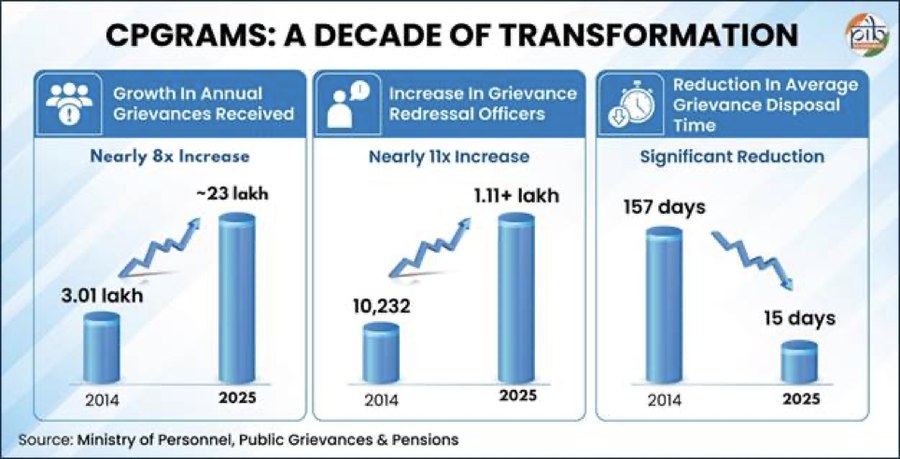
Annual grievances rose nearly 9×, redressal officers ~11×, and disposal time fell from 157 days to 15 days — signalling growing public trust and improved institutional capacity. Image courtesy Press Information Bureau, Government of India; reproduced with credit for educational use.
Figure 2 — CPGRAMS Process Flow
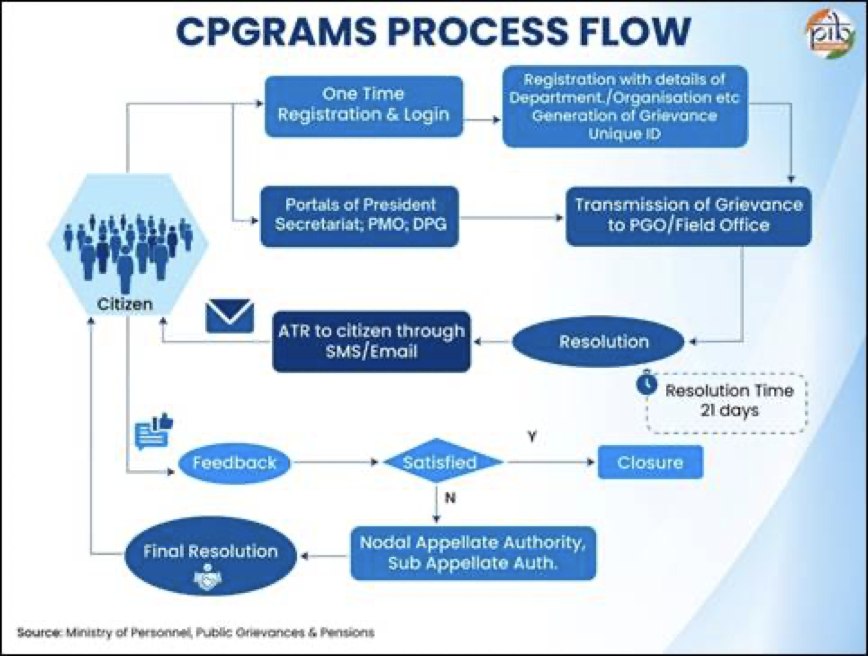
Citizens register once, grieve online or at a CSC; the system auto-routes to the correct GRO; an appellate tier handles dissatisfied complainants — the full cycle must complete within 21 days. Image courtesy Press Information Bureau, Government of India; reproduced with credit for educational use.
The 10-Step Reform Programme (2022 onwards)
Following a Prime Ministerial review in 2022, CPGRAMS underwent a structured 10-step reform overhaul aimed at moving from grievance registration to genuine resolution.
- CPGRAMS 7.0 universalisation: Automatic routing to appropriate GRO; all Central Ministries and Departments onboarded by 2022.
- AI/ML integration: Real-time pattern recognition, systemic issue identification, and evidence-based dashboards for decision-making.
- GRAI (Grievance Redressal Assessment & Index): A performance benchmarking framework evaluating Ministries and Departments on redressal effectiveness — creates accountability through healthy competition.
- Feedback Call Centre: Post-resolution contact with citizens to assess satisfaction. If dissatisfied, the citizen may appeal to the Nodal Appellate Authority.
- One Nation–One Portal: State grievance portals integrated with CPGRAMS for a unified national ecosystem.
- Data Strategy Unit: Dedicated unit within DARPG using advanced analytics to identify trends and inform policy changes.
- Training (Sevottam framework): Regular capacity-building for GROs to improve redressal quality.
Samadhan Didi — The AI Voice Chatbot (May 2026)
Samadhan Didi (launched 30 May 2026) is a significant upgrade to CPGRAMS' accessibility architecture.
Developed by DARPG in collaboration with BHASHINI — the government's AI-powered language translation platform — the chatbot eliminates two historic barriers: the need to identify the correct ministry/department, and the need for English or Hindi proficiency.
- Citizens lodge grievances by speaking in any Eighth Schedule language; the AI classifies the complaint, identifies the relevant ministry/department/category, asks follow-up questions, and files to the correct authority.
- BHASHINI provides: speech-to-text, text-to-speech, translation and transliteration.
- Designed and hosted within secure government infrastructure to protect data privacy.
- Support being extended beyond the 22 Scheduled languages to additional regional and indigenous languages.
- Significance: Eliminates the "literacy barrier" to grievance redressal — citizens with low digital or English literacy, a historically excluded demographic, can now access the system orally.
NextGen CPGRAMS — Upcoming Upgrade
- AI-based grievance categorisation and intelligent routing
- Omni-channel registration: email, social media, mobile apps
- AI-enabled validation of redressal quality — flags cases that are merely transferred or closed without genuine resolution
- Accessibility features for persons with disabilities
- Real-time analytics dashboards and automated escalation
Critical View
- Disposal vs. resolution: A decline in average disposal time to 15 days is a process indicator, not a quality indicator. Critics have noted that grievances closed without genuine remedial action inflate disposal statistics — the NextGen AI-validation feature is partly a response to this concern.
- Rural digital divide: CSC integration partially addresses last-mile access; however, connectivity and awareness gaps persist in remote areas. Samadhan Didi's voice-based interface is an important step but depends on reliable mobile/internet connectivity.
- Exclusion of service-matter grievances: Government employees cannot use CPGRAMS for service/disciplinary matters — a significant exclusion given the size of the public-sector workforce.
- State integration is uneven: While "One Nation–One Portal" is a stated goal, the depth of state integration varies; many state portals remain loosely linked rather than natively embedded.
✎ Mains Practice Question
The launch of an AI-enabled voice chatbot within CPGRAMS signals a shift from e-governance to intelligent governance. Critically analyse how voice-based, multilingual AI tools can deepen citizen access to public grievance systems in India, and identify the structural limitations that such technology cannot resolve. 15 marks · 250 words
₹Economy, Infrastructure & Public FinanceGeneral Studies Paper III
02
Government e-Marketplace (GeM) Completes a Decade: ₹20 Lakh Crore GMV Crossed
GS-III · Economy — Public Procurement, Digital Governance, MSMEsPrelims + MainsPIB · Ministry of Commerce & Industry · GeM Portal
The Government e-Marketplace (GeM) — India's centralised digital public procurement portal — completed ten years of operations on 9 August 2026 and crossed a cumulative Gross Merchandise Value (GMV) of ₹20 lakh crore through 3.78 crore orders, marking it as one of the world's largest B2G (business-to-government) e-procurement platforms.
◈ Background & Context
Government procurement in India historically operated through a complex, paper-intensive, multi-approval tendering framework governed by the General Financial Rules (GFR). The system was susceptible to opacity, discretionary decision-making, and supplier cartelisation.
Multiple reports — including by the Comptroller and Auditor General — highlighted procurement irregularities in defence, infrastructure and social-sector ministries.
- Policy impetus: The government studied global public procurement systems — notably the US Federal Marketplace (FedMall), South Korea's KONEPS, and the European Union's Open eProcurement standards — before designing GeM.
- GFR amendment: Amendments to the General Financial Rules enabled government organisations to procure through GeM, giving the platform legal standing as an approved procurement channel.
- Predecessor: The Directorate General of Supplies and Disposals (DGS&D), which operated centralised rate contracts, was the pre-digital procurement mechanism — GeM effectively digitised and expanded this function.
- DGS&D context: DGS&D was eventually merged into GeM's operational framework; GeM's rate contracts for recurring purchases have replaced the DGS&D system.
- Constitutional basis: Article 299 requires that government contracts be expressed in the name of the President or the relevant Governor, providing the legal basis for government procurement — GeM operates within this framework.
▤ GeM at a Glance — As on 6–9 August 2026
- Launch date: 9 August 2016 — Ministry of Commerce & Industry
- Cumulative GMV: ₹20 lakh crore+ through 3.78 crore orders
- Annual GMV trajectory: ₹422 crore (FY 2016–17) → ₹5 lakh crore+ (FY 2024–25 & FY 2025–26)
- FY 2026–27 (first 4 months): ₹1,47,888 crore
- First ₹10 lakh crore: Took 8+ years; Second ₹10 lakh crore: achieved in under 2 years
- Buyer organisations: 1.37 lakh+ government entities (from 1,707 at inception)
- Sellers & service providers: 25 lakh+ (from 3,339 at inception)
- Registered MSEs: 12.25 lakh (up from 2,424 at inception)
- Product categories: 10,660+ · Service categories: 350+
- Active sellers who are MSEs: 73%
- FY 2025–26 orders: 75 lakh+
Figure 3 — GeM at a Glance (as on 6 August 2026)
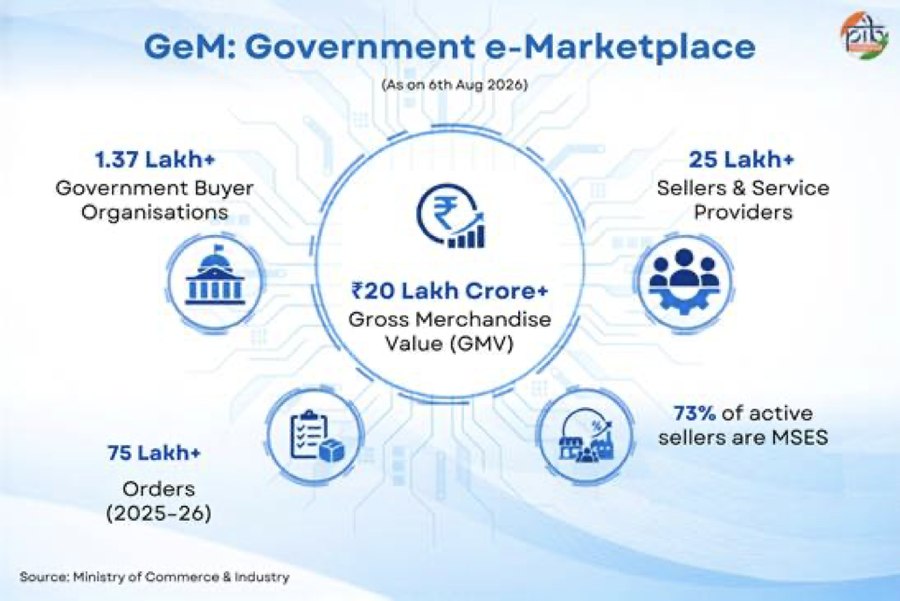
GeM connected 1.37 lakh government buyers with 25 lakh sellers, crossing ₹20 lakh crore in cumulative GMV — 73% of active sellers are MSEs. Image courtesy Press Information Bureau / Ministry of Commerce & Industry; reproduced with credit for educational use.
Figure 4 — GeM: Inclusive Procurement (FY 2025–26)
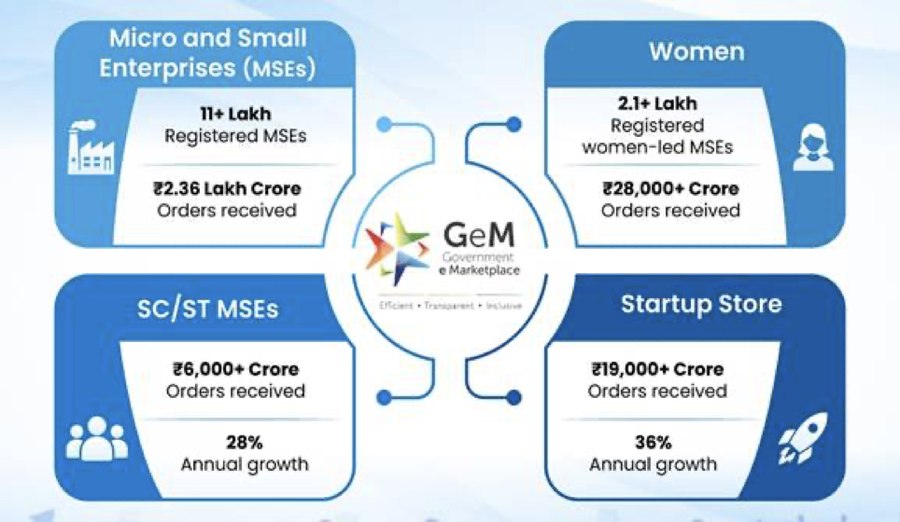
MSEs, women-led enterprises, SC/ST businesses and startups all recorded strong procurement growth in FY 2025–26; MSE share on GeM has consistently exceeded the mandatory 25% procurement target. Image courtesy Press Information Bureau / Ministry of Commerce & Industry; reproduced with credit for educational use.
How GeM Works — Platform Architecture
- Procurement modes: Direct purchase (for low-value items) · comparison · electronic bidding · reverse auctions
- Lifecycle coverage: Seller registration → product listing → bidding → contract award → order fulfilment → payment
- AI/ML tools: Deployed to detect cartelisation, collusion and order-splitting irregularities in real time
- Integration: Central Public Procurement Portal (CPPP); Indian Railway Electronic Procurement System (IREPS); Defence Public Procurement Portal (DPPP) — being integrated for a unified ecosystem
- GFR backing: Amendments to the General Financial Rules allow government entities to procure directly through GeM, giving it legal standing equivalent to open tendering for eligible categories
- Social value: An IIT Delhi study (FY 2023–24 to FY 2025–26) estimated monetised benefits of ₹86,571 crore from price and process efficiencies, with net social savings of ₹1,76,411 crore
Inclusive Procurement — Who Sells on GeM
- MSEs: 11 lakh+ registered; fulfilled orders worth ₹2.36 lakh crore (FY 2025–26); account for 45.6% of cumulative GMV — far exceeding the government's mandatory 25% MSE procurement target
- Women-led MSEs: 2.1 lakh+ registered; ₹28,000 crore+ in orders (FY 2025–26); cumulative ₹99,147 crore through 50 lakh orders
- SC/ST enterprises: ₹6,000 crore+ orders; ~28% annual growth
- Startups: 42,242 startups; ₹19,000 crore+ orders; ~36% annual growth; cumulative ₹65,633 crore
- GeM Suvidha Kendras: 50 pilot centres being established (MoU with CSC-SPV, June 2026) to assist MSEs, women, SC/ST entrepreneurs, artisans, SHGs and local manufacturers with registration, catalogue creation and grievance redressal
Key Initiatives & Partnerships
- SWAYATT: Startups, Women and Youth Advantage Through eTransactions — dedicated initiative to improve access for these categories
- Startup Runway 2.0: Procurement channel specifically for registered startups
- Womaniya: Partnership with UN Women to promote women-led enterprise participation
- SARAS Collection: Promotes SHG and artisan products on GeM
- GeMSahay: Partnership with Union Bank of India for collateral-free working capital loans to registered sellers
- IN-SPACe & DFI (April 2025): Partnerships for space-tech and drone procurement categories
- EPFO integration: Strengthens labour compliance verification for manpower outsourcing services
Critical View
- MSE quality and capacity: While MSE participation is high in volume terms, concerns persist about whether smaller enterprises can consistently meet quality standards across high-value or technically complex procurement categories.
- Cartelisation at scale: Despite AI-based detection tools, the platform's scale — 25 lakh sellers and 1.37 lakh buyers — makes systematic collusion harder to detect in niche product categories.
- State government integration: State-level adoption is uneven; state PSUs and local bodies are nominally onboarded but procurement culture and GFR equivalents vary across states.
- GMV vs. social value: GMV measures transaction volume, not necessarily development outcomes. The IIT Delhi study's social savings estimates rest on assumptions about counterfactual procurement costs, and independent verification of such claims is limited.
- Payment delays: Despite digital workflows, sellers — especially MSEs — have reported delayed payments from government buyers; the platform's payment infrastructure addresses order flow but cannot enforce timely payment by all buyer entities.
✎ Mains Practice Question
The Government e-Marketplace (GeM), in its first decade, has demonstrated that digital platforms can transform public procurement. Examine the mechanisms through which GeM promotes transparency, inclusivity, and efficiency, and critically evaluate the structural challenges that limit its impact. 15 marks · 250 words
03
E-Samudra: India Launches Integrated Digital Platform for Maritime Governance
GS-III · Economy — Infrastructure, Ports & Shipping; GS-II · GovernancePrelims + MainsPIB · Ministry of Ports, Shipping & Waterways · DGMA
India launched E-Samudra on 8 August 2026 — a single-window digital platform integrating maritime services for seafarers, shipping companies and ports — as part of a broader restructuring of maritime administration under the Directorate General of Maritime Administration (DGMA), which was created by the Merchant Shipping Act, 2025 to replace the legacy Directorate General of Shipping.
◈ Background & Context
India's maritime sector has deep historical roots. The first Merchant Shipping Act was enacted in 1923 during the colonial period; post-independence, it was replaced by the Merchant Shipping Act, 1958 — India's principal maritime statute for nearly seven decades.
The 1958 Act regulated ship registration, seafarer certification, safety, and port functions, but became increasingly outdated against the rapidly evolving IMO (International Maritime Organization) convention framework and global shipping practices.
- Merchant Shipping Act, 2025 (Act 24 of 2025): Passed by Lok Sabha on 6 August and Rajya Sabha on 11 August 2025; received presidential assent on 18 August 2025. It repeals the 1958 Act, modernises India's maritime legal framework, aligns domestic law with IMO conventions (SOLAS, MARPOL, MLC 2006, ISPS Code), and reclassifies the Director General of Shipping as the Director General of Maritime Administration (DGMA).
- DGMA: The new apex maritime authority replacing the Directorate General of Shipping (DGS). DGMA has an expanded mandate covering safety, environmental protection, seafarer welfare, security, and facilitation of maritime commerce.
- STCW Convention: The International Convention on Standards of Training, Certification and Watchkeeping for Seafarers (1978, revised Manila 2010) governs global seafarer competency. India is on the IMO's STCW White List — meaning Indian certificates are internationally recognised. DGMA is responsible for maintaining this status.
- Maritime Labour Convention (MLC) 2006: The "Seafarers' Bill of Rights" — the ILO convention establishing minimum working and living standards for seafarers globally. The 2025 Merchant Shipping Act formally aligns India with MLC 2006 provisions.
- India's maritime position: India is the world's second-largest supplier of seafarers (active workforce grew from 1.03 lakh in 2013 to 3.23 lakh in 2025); the world's leading ship recycling destination; and aspires to be among the top five shipbuilding nations.
▤ E-Samudra & DGMA Ecosystem — At a Glance
- Platform: E-Samudra — single digital window for maritime services
- Nodal authority: DGMA under the Ministry of Ports, Shipping & Waterways
- Services covered: Seafarer certificates, online payments, real-time tracking, digitally issued certificates, end-to-end workflows
- Companion initiative: e-NAVIK — 24×7 grievance redressal system for seafarers
- Upcoming: Seafarer Tracking Dashboard; Digital Seafarers Employment Agreement (d-SEA)
- Welfare fund: Seafarers Welfare Fund Society (SWFS) — enhanced under new framework
- Wellbeing programmes: Sagar Mein Yog (physical & mental health); Sagar Mein Samman (women seafarers' opportunities)
- Crisis response (recent): DGMA monitored 16,000+ calls, handled 40,000+ communications, and coordinated repatriation of 4,000+ stranded seafarers amid geopolitical disruptions to global shipping routes
- Policy anchor: Merchant Shipping Act, 2025 — classifies seafarers as "Key Workers"; aligns with MLC 2006 and ILO conventions
Why Now — The Structural Need for E-Samudra
- India's seafarer workforce tripled in 12 years; the legacy DGS paper-based administration was designed for a fraction of this scale.
- ~80% of Indian seafarers serve on foreign-flagged vessels, making access to government services (certificate renewal, welfare schemes) difficult when onboard. E-Samudra's "faceless, digital-first" model addresses this directly.
- The Merchant Shipping Act, 2025 created the regulatory architecture; E-Samudra is the administrative delivery mechanism to operationalise it.
- Red Sea/Gulf shipping disruptions (2024–25) exposed gaps in seafarer tracking and welfare coordination — the forthcoming Seafarer Tracking Dashboard responds to this operational need.
Key Terms for Prelims
- IMO: International Maritime Organization — UN specialised agency for shipping regulation; headquarters in London
- ISPS Code: International Ship and Port Facility Security Code — component of SOLAS; mandates security plans for ships and ports
- MARPOL: International Convention for the Prevention of Pollution from Ships
- INDOS number: Indian National Database of Seafarers — unique identifier for all Indian seafarers, maintained by DGMA
- CDC: Continuous Discharge Certificate — mandatory identity and service record for Indian seafarers; now issued digitally
- CoC: Certificate of Competency — certifies a seafarer's qualification for a specific rank; governed by STCW Rules
- Maritime Amrit Kaal Vision 2047: Long-term strategic framework for India's maritime sector; companion to Maritime India Vision 2030
Critical View
- Connectivity at sea: A "digital-first" platform is useful only if seafarers onboard vessels have reliable internet access. Satellite connectivity is expensive and availability varies by region and ship type — particularly a challenge for seafarers on bulk carriers and older tonnage.
- Third-party intermediary dependence: Despite digitalisation, a significant share of Indian seafarers access services through Recruitment and Placement Service Licensees (RPSLs). Digital platforms can reduce, but not eliminate, the role — and associated vulnerabilities — of these intermediaries.
- Women seafarers: While Sagar Mein Samman targets inclusion, structural barriers — from training institute access in smaller towns to sociocultural resistance to women in the merchant marine — cannot be addressed by a digital platform alone.
✎ Mains Practice Question
India's aspiration to become the world's largest supplier of seafarers and a top-five shipbuilding nation rests on effective maritime governance. Analyse how the Merchant Shipping Act, 2025 and the E-Samudra platform together address the institutional, legal, and welfare dimensions of this ambition. 10 marks · 150 words