
Contents01
BRICS Women Ministerial Meeting: India’s Kochi Declaration and Women-Led Development Architecture
Ministry of Women and Child Development · 6–9 July 2026, Kochi
GS 2GS 1
02
Sub-Mission on Agricultural Mechanization (SMAM): Inclusive Farm Mechanization for Viksit Krishi
Ministry of Agriculture and Farmers Welfare · Centrally Sponsored Scheme
GS 3GS 2
Article 01
Article 01
BRICS Women Ministerial Meeting: India’s Kochi Declaration and Women-Led Development Architecture
Ministry of Women and Child Development · 4th BRICS Women Ministerial Meeting, Kochi · 6–9 July 2026
Relevance: GS 2 (bilateral, regional and global groupings; international institutions; gender policy; governance) · GS 1 (women and social empowerment; role of women in development).
GS 2GS 1
Key Data at a Glance
4thBRICS Women Ministerial Meeting; first-ever Joint Statement adopted in the Women Track
11BRICS full members in 2026; India holds the Chairship (Presidency)
~49.5%of global population represented by BRICS member countries
4priority areas under the BRICS Women Track in 2026
2India-proposed deliverables: Digital Repository + Digital Capacity Building Guidelines
41.7%India’s Female Labour Force Participation Rate (2023–24), up from 23.3% in 2017–18
Issue in Brief
- The 4th BRICS Women Ministerial Meeting (8–9 July 2026, Kochi) concluded India’s four-day BRICS Women Track engagement (6–9 July 2026), comprising the Women Working Group Meeting (6–7 July, senior officials) followed by the Ministerial Meeting (8–9 July, ministers and heads of delegation).
- Under India’s BRICS Chairship 2026, the meeting adopted the first-ever Joint Statement in the BRICS Women Track — a landmark shift from declaratory cooperation to documented, actionable commitments across member countries.
- India proposed two concrete deliverables: the BRICS Digital Repository of Best Practices and the BRICS Digital Capacity Building Guidelines, both aimed at institutionalising knowledge exchange on women’s empowerment.
Static Background
- The acronym “BRIC” was coined by economist Jim O’Neill of Goldman Sachs in 2001; formalised as a political grouping at the BRIC Foreign Ministers’ meeting in 2006 (on the sidelines of UNGA, New York); first BRIC Summit: Yekaterinburg, Russia, 2009; South Africa joined in 2010 (making it BRICS).
- 2024 expansion: Egypt, Ethiopia, Iran, UAE and Saudi Arabia admitted; Indonesia joined in January 2025 — taking full membership to 11. A “partner country” category was created at the Kazan Summit (October 2024), enabling invited states to engage without full membership.
- BRICS operates by consensus with no permanent secretariat; the rotating Chairship sets the agenda. India holds the 2026 Chairship under the theme “Building for Resilience, Innovation, Cooperation and Sustainability” and will host the 18th BRICS Summit in New Delhi.
- The BRICS Women Track is a thematic working structure within BRICS focused on gender equality. India’s 2026 Chairship is the first to produce a Joint Ministerial Statement under this track — establishing institutional precedent and a measurable baseline for future accountability.
- Key institutional backbone (India): Ministry of Women and Child Development (MoWCD) is the nodal ministry. Key legislation: Protection of Women from Domestic Violence Act, 2005; Sexual Harassment of Women at Workplace (POSH) Act, 2013; Nari Shakti Vandan Adhiniyam (Women’s Reservation Act), 2023.
- India’s Female Labour Force Participation Rate (FLFPR) rose from 23.3% (2017–18) to 41.7% (2023–24) as per the Periodic Labour Force Survey (PLFS).
Key Dimensions — Structure and Priority Areas
- Four-day structure: Women Working Group (senior officials, 6–7 July) → Women Ministerial (ministers/heads of delegation, 8–9 July) — designed to build technical consensus before political endorsement, improving outcome quality.
- The four priority areas of the BRICS Women Track under India’s Chairship: (1) Women in governance and leadership; (2) Women’s digital and financial inclusion; (3) Women’s entrepreneurship and skill development; (4) Women’s role in climate action, food security and nutrition.
- Three virtual preparatory meetings preceded the Kochi meetings, enabling member countries to advance consensus ahead of in-person deliberations — a process model that could be replicated across other BRICS tracks.
Key Dimensions — First Joint Statement and Two Deliverables
- The Joint Statement of the 4th BRICS Women Ministerial Meeting is unprecedented in the Women Track — it signals a move from dialogue-only cooperation to documented shared resolve and creates an accountability baseline for future meetings.
- BRICS Digital Repository of Best Practices: A shared digital platform documenting successful policies, programmes and innovations on women’s empowerment across member countries — enables peer-learning and evidence-based policy adoption without requiring new bilateral agreements.
- BRICS Digital Capacity Building Guidelines: A roadmap for expanding institutional partnerships, digital learning and capacity-building across the BRICS community — focuses on sustained cooperation rather than one-off interactions; key to reaching frontline practitioners, not just policymakers.
- Both deliverables are digital-first and scalable — they require no physical infrastructure, reducing implementation friction for the diverse 11-member grouping.
Key Dimensions — India’s Domestic Showcase
- An exhibition showcased India’s women-led development architecture across sectors: rural livelihoods through SARAS and Lakhpati Didi (1.48 crore SHG women achieving ≥₹1 lakh annual income by June 2025); women in sports through ASMITA; women in STEM and financial inclusion.
- MoWCD flagship programmes highlighted: SHE-Box (online portal for sexual harassment complaints under POSH Act, 2013); One Stop Centres (integrated support for women facing violence); Women’s Helpline.
- Thematic panels covered digital inclusion, women’s entrepreneurship, financial empowerment, climate resilience, food security and nutrition — directly mapping onto the four Women Track priority areas and offering a replicable “from beneficiary to decision-maker” narrative.
- India’s G20 2023 Presidency had already shifted the global vocabulary from “women’s development” to “women-led development” — this BRICS meeting deepens that normative leadership into a multilateral institutional framework.
Critical Analysis — Strengths
- The first-ever Joint Statement converts aspirational cooperation into a documented baseline — future meetings can be measured against it, creating genuine institutional memory within the Women Track.
- India coordinates both deliverables, reinforcing its role as a norm-setter in South-South cooperation on gender — extending its domestic “working architecture” outward rather than merely advocating for abstract principles.
- The four-day structured engagement (technical working group → ministerial) is a process innovation that improves outcome quality and ensures buy-in at multiple levels of government across member states.
Critical Analysis — Structural Questions
- BRICS operates by consensus without binding commitments; the Joint Statement is politically persuasive but legally non-enforceable — implementation depends on domestic political will in each member state, which varies widely.
- Divergent legal and cultural contexts across members (from Russia under sanctions to Indonesia’s newly joined status, to Gulf members with different women’s rights frameworks) makes harmonised implementation genuinely challenging.
- The Digital Repository is useful only if members actively populate and update it; the PIB release mentions no dedicated secretariat, funding mechanism or monitoring framework — a gap that past BRICS initiatives have struggled with.
- Geopolitical tensions within BRICS (India–China dynamics; Russia–West friction) can limit candid knowledge-sharing even on ostensibly apolitical tracks like women’s empowerment.
Way Forward
- Establish a dedicated nodal cell within MoWCD to manage, update and quality-control the Digital Repository, preventing it from becoming a static archive after the Chairship ends.
- Create measurable, time-bound indicators (e.g. number of policies adopted from the Repository; number of women trained through the Capacity Building Guidelines) to track implementation across member countries.
- Use the Kazan partner-country framework to extend Women Track cooperation beyond the 11 full members — peer-learning networks benefit from greater diversity of contexts.
- Leverage the 2026 BRICS Leaders’ Summit in New Delhi to elevate Women Track outcomes into the Leaders’ Declaration, giving the commitments the highest political endorsement within the grouping.
- Integrate Women Track outcomes with SDG 5 (Gender Equality) and SDG 8 (Decent Work) reporting to connect multilateral commitments to globally tracked accountability mechanisms.
Prelims Pointers
4th BRICS Women Ministerial Meeting: 8–9 July 2026, Kochi; India’s 2026 Chairship; first-ever Joint Statement adopted in the Women Track.
BRICS Women Track — 4 Priority Areas: (1) Governance & Leadership; (2) Digital & Financial Inclusion; (3) Entrepreneurship & Skill Development; (4) Climate Action, Food Security & Nutrition.
Two India Deliverables: BRICS Digital Repository of Best Practices (shared knowledge platform) + BRICS Digital Capacity Building Guidelines (institutional roadmap) — both proposed by India.
BRICS Chairship Theme 2026: “Building for Resilience, Innovation, Cooperation and Sustainability” — the acronym BRICS maps directly onto the four pillars.
Lakhpati Didi: SHG-linked livelihood initiative; 1.48 crore SHG women achieved ≥₹1 lakh annual income by June 2025.
SHE-Box: Sexual Harassment Electronic Box — online complaint management portal under the POSH Act, 2013; managed by MoWCD.
Partner country category: Created at Kazan Summit, October 2024; allows invited states to engage in select BRICS meetings without full membership.
India’s FLFPR: Rose from 23.3% (2017–18) to 41.7% (2023–24) — source: Periodic Labour Force Survey (PLFS).
Practice Mains Question
The adoption of the first-ever Joint Statement at the BRICS Women Ministerial Meeting (2026) marks a transition from dialogue to institutional cooperation on gender equality. Critically examine its significance and limitations for advancing women-led development.
GS Paper 2 · 250 words · 15 marks
Practice MCQs
Q1. Consider the following statements regarding the BRICS Women Track under India’s 2026 Chairship: (1) The first-ever Joint Statement in the Women Track was adopted at Kochi. (2) The BRICS Digital Repository of Best Practices is legally binding on member states. (3) The BRICS Women Track’s four priority areas include women’s role in climate action and food security. Which of the above are correct?
A) 1 and 2 onlyB) 1 and 3 onlyC) 2 and 3 onlyD) 1, 2 and 3
Q2. Match List I (Initiative) with List II (Purpose): A. BRICS Digital Repository of Best Practices · B. BRICS Digital Capacity Building Guidelines · C. BRICS Partner Country Category // 1. Roadmap for institutional collaboration and digital learning across BRICS · 2. Framework allowing invited states to engage without full membership · 3. Shared platform documenting successful women’s empowerment policies. Choose the correct match:
A) A-3, B-1, C-2B) A-1, B-3, C-2C) A-3, B-2, C-1D) A-2, B-3, C-1
Q3. The SHE-Box portal, showcased at the BRICS Women Ministerial exhibition, is associated with:
A) Financial inclusion for women Self-Help GroupsB) Filing sexual harassment complaints under the POSH Act, 2013C) Tracking women’s participation in STEM educationD) Digital skilling of women under Mission Karmayogi
Article 02
Article 02
Sub-Mission on Agricultural Mechanization (SMAM): Inclusive Farm Mechanization for Viksit Krishi
Ministry of Agriculture and Farmers Welfare · Centrally Sponsored Scheme under RKVY
Relevance: GS 3 (agriculture, food security, technology in farming, inclusive growth) · GS 2 (government schemes for vulnerable sections; welfare for SC/ST, women and marginalised farmers).
GS 3GS 2
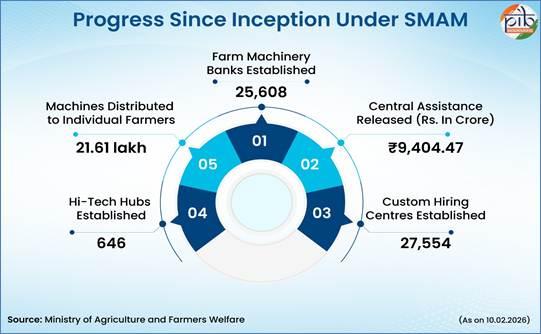
Image: Kisan Drone demonstration under SMAM — precision agriculture for small and marginal farmers. [Replace src with image URL]
Key Data at a Glance
₹9,404.47 crtotal central assistance disbursed under SMAM (2014–15 to 2025–26)
21.61 lakhagricultural machines distributed to individual farmers since inception
27,554Custom Hiring Centres (CHCs) established across India
25,608Farm Machinery Banks (FMBs) established; 646 Hi-tech Hubs
40,928Kisan Drone demonstrations covering 40,918 hectares (2023–24 to 2025–26)
30%of total SMAM funds earmarked for women farmers
Issue in Brief
- SMAM (Sub-Mission on Agricultural Mechanization), launched in 2014–15, is a Centrally Sponsored Scheme under RKVY (Rashtriya Krishi Vikas Yojana) aimed at democratising access to modern farm machinery — particularly for small and marginal farmers, women, SC/ST communities and North-Eastern states.
- A PIB review highlights cumulative achievements: ₹9,404.47 crore disbursed, 21.61 lakh machines distributed, 27,554 CHCs and 25,608 FMBs established since inception, with a major recent thrust on drone-based precision agriculture.
Static Background
- India’s structural agricultural challenge: approximately 86% of farm holdings are small and marginal (below 2 hectares), making individual ownership of machinery economically unviable due to high capital cost and low per-unit utilisation.
- India’s farm mechanisation level stands at approximately 40–45% — far below the USA (~95%), Brazil (~75%) and China (~57%); farm power availability is skewed, with a national average of ~2.02 kW/hectare and stark regional disparities (Punjab/Haryana high; NE states very low).
- RKVY (Rashtriya Krishi Vikas Yojana), launched in 2007, is India’s flagship scheme incentivising states to increase investment in agriculture and allied sectors; restructured as RKVY-RAFTAR in 2017–18 with enhanced pre- and post-harvest focus. SMAM operates as a sub-mission within this architecture.
- SMAM was originally a sub-mission under NMAET (National Mission on Agricultural Extension and Technology); aligned under PM-RKVY per revised 2025 operational guidelines.
- Custom Hiring Centres (CHCs) allow farmers to rent machinery at affordable rates, separating ownership (costly) from access (affordable) — the key solution to the small-landholding structural barrier.
- Farm Machinery Banks (FMBs) are a collective-ownership model for village-level institutions, enabling aggregated demand in remote areas. Van Dhan Vikas Kendras and Krishi Vigyan Kendras (KVKs) serve as implementation nodes for training and demonstration.
Key Dimensions — Financial Architecture and Subsidy Structure
- Individual farmer subsidy: 40% of machine cost for general beneficiaries; 50% for SC/ST farmers, small/marginal farmers and NER beneficiaries; delivered via Direct Benefit Transfer (DBT).
- Custom Hiring Centre (CHC) support: 40% of project cost for projects up to ₹250 lakh; mechanised service delivery rate of ₹2,000 per hectare for CHC/SHG/FPO-provided services (including drones).
- Farm Machinery Bank (FMB) support: 80% funding for projects up to ₹30 lakh (for SHGs, FPOs and local institutions) — the higher subsidy rate reflects the collective-ownership model serving the most marginalised.
- NER special provisions: Up to 100% subsidy for small machinery; 95% support for FMBs — acknowledging the region’s structural disadvantage in mechanisation access.
- Centre–State cost sharing: General states 60:40; North-Eastern and Himalayan states 90:10; Union Territories 100% Central funding.
Key Dimensions — Drone Integration and Precision Agriculture
- 40,928 Kisan Drone demonstrations across 40,918 hectares (2023–24 to 2025–26) conducted by ICAR with State Agricultural Universities (SAUs) and KVKs; ₹52.5 crore financial support under SMAM.
- Drone funding tiers: ICAR institutes, KVKs and SAUs → 100% support, up to ₹10 lakh per drone; FPOs → 75% grant; service-model agencies → ₹6,000 per hectare contingency expenditure.
- Demonstrations focused on application of nutrients, fertilizers and agro-chemicals per prescribed Standard Operating Procedures (SOPs) — precision over blanket application, reducing input waste and environmental load.
- Convergence with Namo Drone Didi scheme: SHG women trained as drone pilots, combining mechanisation outreach with women’s economic empowerment — a deliberate entry into higher-skilled, higher-income agricultural work.
Key Dimensions — Inclusivity and NER Focus
- 30% of total SMAM funds earmarked for women farmers — ensures mechanisation is not male-default and that women’s participation in mechanised farming is structurally incentivised.
- Beneficiary count grew from 2.07 lakh (2020–21) to 2.32 lakh (2024–25) for individual farm machinery ownership, reflecting steady expansion in scheme coverage.
- Special regional focus on North-Eastern states through enhanced subsidies (up to 100%), region-specific interventions, and Hi-tech Equipment Hubs (646 established) for crop-specific high-capacity machinery.
- Targeted IEC (Information, Education and Communication) activities and on/off-field training through FMTTIs, SAUs and ICAR institutions build operator capacity alongside equipment access.
Critical Analysis — Strengths
- The CHC/FMB model is structurally sound: it separates ownership (costly) from access (affordable), solving the capital-barrier problem without requiring land consolidation — politically feasible and economically rational.
- Differentiated subsidy tiers (40% / 50% / 80% / 95% / 100%) directly calibrate support to beneficiary vulnerability — a meaningful attempt at equity-weighted public expenditure.
- Drone integration is forward-looking — it positions even small farmers to benefit from precision agriculture without individual ownership costs; convergence with Namo Drone Didi links this to women’s livelihoods.
Critical Analysis — Structural Questions
- Coverage gap: 21.61 lakh machines over 11 years against India’s ~14 crore farm holdings — penetration remains very thin relative to structural need; the scheme’s scale has not yet matched the problem’s magnitude.
- Post-purchase support is weak: Machinery subsidies do not guarantee skill to operate, maintain or repair equipment — especially for women, SC/ST and NER beneficiaries who may face social and geographic barriers to accessing repair networks.
- CHC viability risk: Profitability of CHCs depends on sufficient local demand density; in fragmented, rain-fed or tribal areas, utilisation rates may be too low to sustain centres beyond initial grant periods.
- Drone demonstrations ≠ drone adoption: 40,928 demonstrations over 40,918 hectares is impressive outreach, but the leap to commercial drone-based farming requires certified operators at scale, robust SOPs and a viable local market for services — all still nascent.
- Data quality limitation: Beneficiary counts and machine distribution figures are from government self-reporting; independent outcome data on yield improvement, income gains and drudgery reduction for targeted groups is not cited in the PIB release.
Way Forward
- Create post-purchase handholding clusters — especially for women, SC/ST and NER beneficiaries — combining repair networks, operator training and troubleshooting support to bridge the ownership-to-productivity gap.
- Scale FPO-linked CHC models to improve demand aggregation and centre viability in remote areas where individual farmer density is too low to sustain standalone CHCs.
- Integrate Kisan Drone demonstrations with a certified drone operator pipeline (linked to skill development missions) so demonstrations convert into livelihood opportunities, not just awareness events.
- Commission independent third-party outcome audits (yield, income, drudgery indices) rather than relying solely on input metrics (machines distributed, CHCs established) to provide credible evidence for scheme redesign.
- Deepen convergence with PM-KUSUM (solar-powered irrigation), PMFBY (crop insurance) and post-harvest infrastructure under PMKSY — mechanisation delivers maximum impact when embedded in a full value-chain support system.
Prelims Pointers
SMAM: Launched 2014–15; Ministry of Agriculture and Farmers Welfare; Centrally Sponsored Scheme under RKVY; originally under NMAET; revised under PM-RKVY (2025).
Funding pattern: General states 60:40; NE & Himalayan states 90:10; UTs 100% Central.
Subsidy rates: General beneficiaries 40%; SC/ST, small/marginal, NER — 50% (individual machines); FMBs — 80%; NER small machinery — up to 100%.
CHC vs FMB: CHC = rental service centre (40% subsidy, projects up to ₹250 lakh); FMB = collective ownership bank (80% subsidy, projects up to ₹30 lakh).
Kisan Drone support: ICAR/KVK/SAU → 100% (up to ₹10 lakh/drone); FPO → 75%; service model → ₹6,000/hectare; total ₹52.5 cr, 40,928 demos.
Women earmark: 30% of total SMAM funds reserved for women farmers; convergence with Namo Drone Didi for SHG women drone pilots.
Cumulative (2014–25–26): ₹9,404.47 cr · 21.61 lakh machines · 27,554 CHCs · 25,608 FMBs · 646 Hi-tech Hubs.
RKVY: Launched 2007; restructured as RKVY-RAFTAR in 2017–18 (Remunerative Approaches for Agriculture and Allied Sector Rejuvenation).
Practice Mains Question
Farm mechanisation in India remains skewed by landholding size, region and gender. Critically examine how the Sub-Mission on Agricultural Mechanization (SMAM) addresses these structural barriers and where it falls short.
GS Paper 3 · 250 words · 15 marks
Practice MCQs
Q1. Consider the following regarding SMAM: (1) It was launched in 2014–15 under the Ministry of Agriculture and Farmers Welfare. (2) Farm Machinery Banks receive 80% financial support for projects up to ₹30 lakh. (3) The funding pattern for North-Eastern states is 60:40 (Centre:State). Which are correct?
A) 1 and 2 onlyB) 2 and 3 onlyC) 1 and 3 onlyD) 1, 2 and 3
Q2. Under SMAM’s drone promotion framework, which institutions receive 100% financial support (up to ₹10 lakh per drone) for demonstrations?
A) Individual farmers and FPOsB) ICAR institutes, KVKs and State Agricultural UniversitiesC) Private agri-tech startups under DPIIT recognitionD) Custom Hiring Centres and SHGs
Q3. (Assertion–Reasoning) Assertion (A): SMAM prioritises Custom Hiring Centres over individual machine ownership for small farmers. Reason (R): Small and fragmented landholdings make individual ownership economically unviable due to high capital costs and low equipment utilisation.
A) Both A and R are true, and R is the correct explanation of AB) Both A and R are true, but R is NOT the correct explanation of AC) A is true, R is falseD) A is false, R is true