
In-Depth PIB Analysis3 Items
Core TopicImportantConcise
Polity, Governance & Social JusticeGS Paper II
01PM SHRI Schools & NEP 2020 Implementation
Science, Technology & Digital GovernanceGS Paper III
02UIDAI Aadhaar Face Authentication SDK & Sandbox
Society & Social JusticeGS Paper I / II
03International Literacy Day 2026 & ULLAS Mela
Polity, Governance & Social JusticeGeneral Studies Paper II
01
PM SHRI Schools: Status Update on the Flagship School-Upgradation Scheme
GS-II · Polity & Governance — Education Policy, Federalism, Centrally Sponsored SchemesPrelims + MainsPIB · Ministry of Education · PIB Backgrounder, 9 September 2026
A PIB backgrounder gives the current numbers on PM SHRI, the Centrally Sponsored Scheme meant to operationalise the National Education Policy (NEP) 2020 through a network of exemplar schools.
◦ Background & Context
Launched on 7 September 2022, Pradhan Mantri Schools for Rising India (PM SHRI) seeks to strengthen existing government schools into exemplar institutions demonstrating NEP 2020 in practice, rather than build new infrastructure from scratch.
- Implemented by the Department of School Education and Literacy (DoSEL), Ministry of Education, over 2022–23 to 2026–27.
- India has 14.71 lakh schools and over 24.69 crore students — PM SHRI targets a demonstrator subset, not universal coverage.
▤ Scheme at a Glance
- Outlay: ₹27,360 crore total project cost, including a Central share of ₹18,128 crore.
- Tenure: Five years, 2022–23 to 2026–27.
- Nodal Ministry: Department of School Education and Literacy, Ministry of Education.
- Approving authority: Centrally Sponsored Scheme approved by the Union Government; implemented jointly with States/UTs, KVS and NVS.
- Coverage: As of July 2026, 13,092 schools selected — about 90% of the envisaged 14,500–plus target — across 725 districts and 8,340 blocks/ULBs. (government-reported figure)
- Composition: 1,305 primary, 3,102 upper primary, 3,141 secondary, 5,544 higher secondary schools, plus 80 KGBVs, 913 KVS and 620 NVS schools, and 4 NCERT schools.
- Stated targets: Government expects the scheme to directly benefit more than 20 lakh students. (government projection)
Figure 1 — State/UT-wise distribution of selected PM SHRI schools
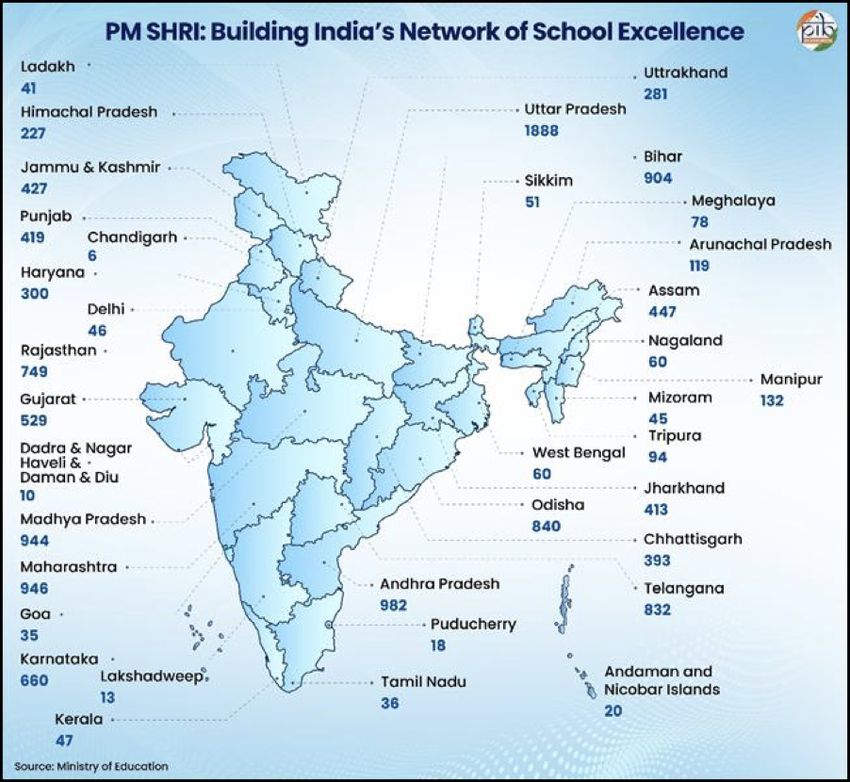
Uttar Pradesh (1,888), Maharashtra (946) and Madhya Pradesh (944) lead the count; smaller UTs such as Chandigarh (6) and Lakshadweep (13) have the fewest. Image courtesy PIB/Ministry of Education, 9 September 2026; reproduced with credit for educational use.
Lineage — what PM SHRI replaces
- PM SHRI does not create a new legal category of school; it layers a quality-upgradation and mentoring framework onto existing government/aided schools selected competitively.
- It follows the Sarva Shiksha Abhiyan/RMSA-era emphasis on access with a shift toward demonstrable quality benchmarks — infrastructure, learning outcomes, inclusion — consistent with NEP 2020's shift from enrolment-driven to outcome-driven schooling.
- Selection is via a three-stage Challenge Method: State/UT MoU → eligibility screening on UDISE+ data → competitive scoring (urban schools need 70%, rural schools 60%) verified by physical inspection.
Six pillars & the NEP-2020 linkage
Figure 2 — The six major pillars of PM SHRI (derived from NEP 2020)
The six pillars are drawn from nine chapters of NEP 2020 and structure the School Quality Assessment Framework (SQAF). Image courtesy PIB/Ministry of Education, 9 September 2026; reproduced with credit for educational use.
- Curriculum follows the 5+3+3+4 structure prescribed by NEP 2020, with States retaining flexibility to localise content.
- Mother-tongue/regional-language instruction is emphasised in early grades — UDISE+ 2025–26 records 6,102 Sanskrit, 1,994 Urdu and 9,152 regional-language teachers in PM SHRI schools.
- Teacher and principal capacity-building runs through District Institutes of Education and Training (DIETs), with financial support capped at ₹3 lakh per DIET and ₹2,500 per teacher trained.
Skills orientation
Figure 3 — 21st-century skills PM SHRI schools are designed to build
Government framing links the scheme's technology-enabled, experiential-learning components to this competency set. Image courtesy PIB/Ministry of Education, 9 September 2026; reproduced with credit for educational use.
The critical view
- Coverage vs. universality: 13,092 schools out of 14.71 lakh is a small demonstrator fraction; the "ripple effect" of mentoring neighbouring schools remains unverified at scale.
- Centre–State cost-sharing: as a Centrally Sponsored Scheme, State fiscal capacity affects the pace of matching contributions and infrastructure upgrades, raising familiar federalism concerns around CSS design.
- Assessment burden: the Challenge Method's minimum-score thresholds may favour already better-resourced schools, a critique also made of similar competitive-selection models (e.g., Smart Cities Mission).
- Independent, outcome-level evaluation (learning-outcome gains, not just infrastructure/selection counts) is not yet available four years into a five-year scheme.
✎ Mains Practice Question
"The PM SHRI scheme marks a shift from an access-driven to a quality-driven approach in Indian school education." Critically examine this claim with reference to the scheme's design and its Centre–State implementation architecture. 15 marks · 250 words
Science, Technology & Digital GovernanceGeneral Studies Paper III
02
UIDAI Launches Aadhaar Face Authentication SDK and Sandbox at Global Fintech Fest 2026
GS-III · Science & Technology — Digital Public Infrastructure, Biometric AuthenticationPrelims + MainsPIB · Ministry of Electronics & IT / UIDAI, 9 September 2026
UIDAI has released a developer SDK and a testing Sandbox for Aadhaar Face Authentication, aimed at letting banks and fintechs embed face-based identity verification directly inside their own apps.
◦ Why it matters
Face Authentication is one of UIDAI's three authentication modes (alongside OTP and fingerprint) and underpins several DBT and welfare-delivery use cases. Until now, users needed a separate "FaceRD" background app, lengthening onboarding.
▤ The launch, at a glance
- What was launched: an SDK embedding Face Authentication natively into Android/iOS apps, and a Sandbox for partners to test the full authentication journey before production.
- Nodal body: Unique Identification Authority of India (UIDAI), under MeitY.
- Venue: Global Fintech Fest 2026.
- Use case driver: RBI-mandated multi-factor authentication for BFSI (banking, financial services and insurance) onboarding.
- Adoption so far: UIDAI states its Face Authentication technology, launched in 2021, has processed over 500 crore transactions and been adopted by nearly 200 entities. (government-reported figure)
- Companion document: a "Playbook on Ease of Onboarding" for BFSI entities integrating with UIDAI's authentication ecosystem.
Lineage — from FaceRD to native SDK
- Earlier model: users needed a separate government-issued FaceRD app running in the background alongside the bank/fintech app — a two-app journey.
- What changed: the SDK folds face capture, liveness/anti-spoofing checks and encrypted data handling directly into the partner's own single app.
- Face Authentication already anchors services such as Jeevan Pramaan (digital life certificates), Ayushman Bharat onboarding, SIM e-KYC, and beneficiary authentication for PM-KISAN, PM Awas Yojana and PM e-DRIVE.
The critical view
- Privacy and consent: embedding biometric capture inside third-party apps widens the surface across which facial data is collected, even if UIDAI states data is encrypted and processed under its own protocols — a recurring concern flagged around Aadhaar-linked authentication generally.
- Liveness/anti-spoofing reliability: AI/ML-based spoof detection is an evolving field; sandbox testing of "failure scenarios" is a step toward auditability but does not itself guarantee foolproof security.
- Digital-access divide: face authentication assumes a smartphone with adequate camera/processing capability, which can exclude some users the underlying welfare schemes are meant to reach.
Institutions & terms to know
- UIDAI — statutory authority under the Aadhaar Act, 2016, issuing and authenticating Aadhaar numbers.
- SDK vs. Sandbox — SDK = code library for building the feature into an app; Sandbox = isolated test environment before production deployment.
- DPI (Digital Public Infrastructure) — the broader India Stack framing (Aadhaar, UPI, DigiLocker) within which this launch sits.
✎ Mains Practice Question
Discuss how Aadhaar-based authentication technologies are evolving to support India's Digital Public Infrastructure, and examine the privacy safeguards needed as biometric authentication is embedded within third-party applications. 15 marks · 250 words
Society & Social JusticeGeneral Studies Paper I / II
03
International Literacy Day 2026 Celebrations Conclude with ULLAS Mela
GS-I/II · Society — Literacy, Adult EducationPrelims-orientedPIB · Ministry of Education (DoSEL), 9 September 2026
The two-day International Literacy Day 2026 observance concluded in New Delhi with the ULLAS Mela, inaugurated by DoSEL Secretary Shri T. K. Anil Kumar, featuring exhibition stalls from 28 States/UTs, NCERT, NCTE and NIOS showcasing literacy best practices.
- ULLAS (Understanding of Lifelong Learning for All in Society) is the Centre's ongoing adult-literacy and functional-literacy movement; the Mela is its annual public showcase.
- NCERT Director Prof. Dinesh Prasad Saklani flagged the growing importance of financial, legal, digital and electoral literacy as extensions of the traditional literacy agenda.
- Prelims hook: ULLAS Mela exhibitors included NCERT, NCTE and NIOS alongside 28 participating States/UTs — know these as the key institutional stakeholders in India's adult-literacy architecture.