
Published on Apr 11, 2026
Daily PIB Summaries
PIB Summaries 11 April 2026
Content
- MoSPI Breaks New Ground: First-Ever Deep Dive into Unincorporated Construction Sector in Decades
- Womaniya: Building Inclusive Market Access for Women Entrepreneurs
MoSPI Breaks New Ground: First-Ever Deep Dive into Unincorporated Construction Sector in Decades
Context & Basics
- Ministry of Statistics and Programme Implementation released first comprehensive construction-sector pilot study after decades, focusing on unincorporated enterprises and own-account household construction.
- National Statistical Office conducted study with ASUSE 2025, addressing data gaps in informal construction and improving national accounts estimation.
- Construction defined using NIC 2008 codes 41–43, covering buildings, civil engineering, and specialized activities across rural and urban sectors.
Relevance
GS II (Governance)
- Evidence-based policymaking via National Statistical Office data systems.
- Strengthening statistical capacity and addressing informal sector invisibility.
- Centre–State coordination in construction (Concurrent List).
GS III (Economy)
- Informal economy measurement → improved GDP estimation accuracy.
- Construction sector as growth driver (8–9% GDP, ~50 million jobs).
- Financial inclusion trends in informal enterprises (credit penetration).
Practice Question
Q.“Improving measurement of the informal construction sector is critical for accurate national income estimation and inclusive policymaking.”Discuss in the context of the recent MoSPI study. (250 words)
Static Background
- Construction lies in Concurrent List (Entry 20) enabling Centre-State coordination in infrastructure and housing.
- Linked to Directive Principles (Articles 38, 39, 43) ensuring livelihood, housing access, and equitable growth.
- Sector contributes ~8–9% of GDP and employs ~50 million workers, with strong backward (cement, steel) and forward linkages (housing, infrastructure).
Key Findings
Scale of Activity
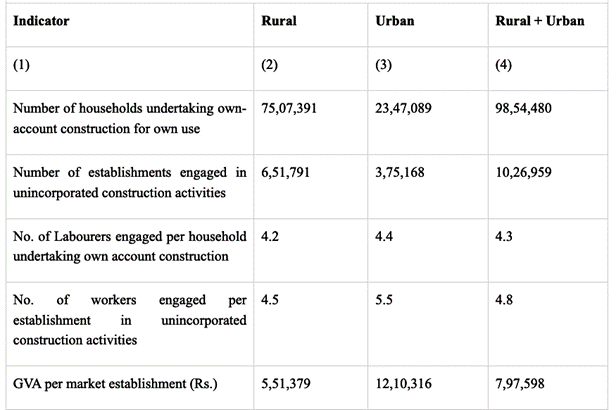
- 98.54 lakh households undertook own-account construction, reflecting large-scale self-driven housing activity.
- 10.27 lakh unincorporated establishments dominate sector, highlighting informal micro-builder ecosystem.
Employment
- Average 4.8 workers per establishment, indicating labour-intensive small-scale operations.
- 77% establishments hired at least one regular worker, showing partial formalization.
- Households engaged ~4.3 labourers, indicating employment multiplier effect.
Capital & Finance
- Average fixed assets ₹5.21 lakh, reflecting low capital intensity and mechanization.
- Average outstanding loans ₹1.4 lakh, indicating limited but growing institutional finance access.
Productivity
- GVA per market establishment ₹7.98 lakh, output ₹16.25 lakh, showing moderate productivity.
- Non-market GVA ₹2.77 lakh, output ₹5.59 lakh, reflecting subsistence-level activities.
Financing Patterns
- 97% households used own income, contributing ~77% expenditure, indicating low credit dependence.
- 21% households accessed institutional loans; higher in rural (23%) vs urban (13%).
Cost Structure
- ~75% expenditure on materials, ~22% on labour, showing material-intensive construction pattern.
- Bricks, cement, iron & steel (~60%) dominate costs, indicating strong industrial linkage.
Analysis
- Informal construction significantly contributes to GVA but remains undercaptured in GDP estimation.
- High own-account construction reflects housing demand, rising incomes, and gaps in formal housing supply.
- Improved data enhances policy targeting in housing, urban planning, and infrastructure.
- Rising rural institutional credit (23%) reflects success of financial inclusion initiatives.
- Low asset base indicates limited technology adoption and productivity constraints.
Challenges
- Informal nature leads to poor regulation, safety risks, and quality issues.
- Data reliability concerns due to recall-based oral surveys.
- Credit constraints persist despite improvements, especially in urban informal sector.
- Low productivity due to fragmentation, skill gaps, and absence of scale economies.
- High reliance on cement and steel increases carbon footprint and environmental stress.
Way Forward
- Institutionalize regular surveys for informal construction within NSO framework.
- Expand targeted credit schemes for micro-builders and self-construction households.
- Strengthen skill development (PMKVY) for construction workforce productivity.
- Promote green construction materials and technologies.
- Incentivize formalization via registration, GST integration, and digital platforms.
Prelims Pointers
- NSO operates under MoSPI and conducts ASUSE, ASISSE, national accounts.
- NIC 2008 codes 41–43 relate to construction sector classification.
- Own-account construction = construction for self-use, not sale.
- GVA = Output – Intermediate Consumption.
Womaniya: Building Inclusive Market Access for Women Entrepreneurs
Why in News ?
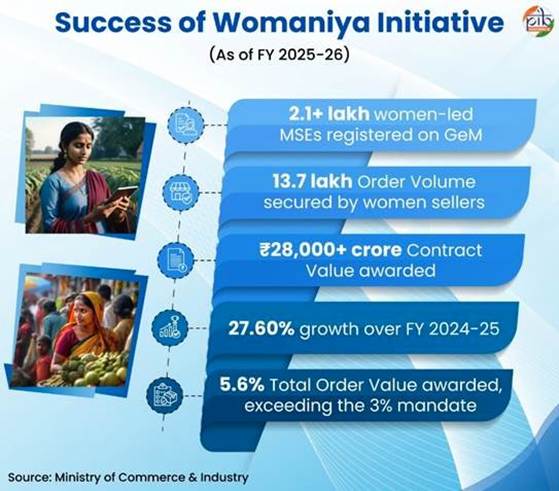
- Government e-Marketplace reported major expansion of Womaniya initiative, with 2.1 lakh women MSEs and 13.7 lakh orders in FY 2025–26.
- ₹28,000 crore procurement value awarded with 27.6% growth, and women share rising to 5.6% vs mandated 3%, indicating strong policy traction.
Relevance
GS II (Governance)
- Digital governance via Government e-Marketplace.
- Inclusive procurement policy implementation.
- Women-centric policy backed by Article 15(3).
GS III (Economy)
- MSME formalisation through digital platforms.
- Public procurement as demand-side economic tool (~20–22% GDP globally).
- Financial inclusion and enterprise scaling.
GS I (Society)
- Women empowerment and SHG-led rural transformation.
- Gender-inclusive growth (SDG-5 alignment).
Practice Question
Q1.“Public procurement can act as a powerful instrument of socio-economic inclusion.”Examine with reference to the Womaniya initiative on GeM. (250 words)
Context & Basics
- Womaniya (2019) is a targeted initiative on GeM enabling women entrepreneurs and SHGs to directly participate in government procurement markets.
- Implemented under Ministry of Commerce and Industry, focusing on formalisation, inclusion, and market linkage.
- GeM (2016) ensures paperless, cashless, contactless procurement, improving transparency and efficiency.
Static Background
- Public procurement constitutes a major economic lever (~20–22% GDP globally), enabling demand-side inclusion policies.
- Supported by Article 15(3) and Article 39(a) promoting women’s participation in economic activities.
- SHG ecosystem includes 10.05 crore women across 90.09 lakh SHGs, forming backbone of rural livelihoods and micro-enterprises.
Key Features
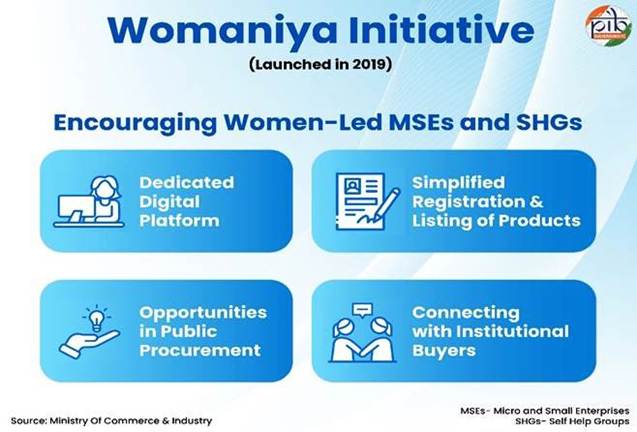
- Dedicated digital interface enhances market visibility and discoverability for women-led enterprises.
- Udyam-based onboarding simplifies entry and promotes formal MSME registration.
- Standardised catalogues ensure uniformity, transparency, and easier buyer evaluation.
- Fully digital procurement lifecycle reduces intermediation and corruption risks.
- Time-bound payment mechanisms address working capital constraints.
- Capacity building under SWAYATT improves skills, compliance awareness, and onboarding readiness.
Data & Performance
- 2.1 lakh women MSEs registered on GeM platform.
- 13.7 lakh orders recorded in FY 2025–26.
- ₹28,000 crore contracts awarded, reflecting 27.6% annual growth.
- Women-led enterprises achieved 5.6% procurement share, surpassing 3% policy target.
Analysis
- Converts procurement into a market-based empowerment tool, moving beyond subsidy-driven approaches.
- Promotes formalisation and creditworthiness of women enterprises through digital transaction history.
- Reduces middlemen dependency, ensuring better price realisation and transparency.
- Strengthens rural non-farm economy via SHG integration into national procurement systems.
- Aligns with Digital India, Atmanirbhar Bharat, and SDG-5 (Gender Equality) objectives.
Challenges
- Digital literacy gaps among rural women entrepreneurs limit effective participation and navigation of GeM platform features.
- Quality standardisation and certification deficiencies restrict competitiveness of SHG products in formal government procurement processes.
- Logistics and supply chain constraints, especially in remote regions, affect timely delivery and reliability of women-led enterprises.
- Limited awareness and capacity regarding tendering, compliance requirements, and pricing strategies reduces effective utilisation of opportunities.
- Working capital constraints despite time-bound payments hinder scaling of production for bulk government orders.
- Risk of market concentration and algorithmic visibility bias, where larger or better-rated sellers overshadow small women producers.
Way Forward
- Expand last-mile digital literacy programmes and assisted onboarding models through CSCs and SHG federations to bridge participation gaps.
- Establish dedicated quality certification, branding, and packaging support systems for women-led products to improve competitiveness.
- Strengthen logistics ecosystems through integration with India Post, ONDC, and local supply chains for reliable delivery.
- Enhance credit access through targeted financial products under MUDRA, Stand-Up India, and SHG-bank linkage programmes.
- Introduce preferential procurement norms and higher quotas for women-led enterprises across ministries and PSUs.
- Develop AI-driven discovery tools and fair algorithm mechanisms to ensure equitable visibility for small sellers on GeM.
Prelims Pointers
- GeM (2016) – digital procurement platform.
- Womaniya (2019) – initiative for women MSEs and SHGs.
- SWAYATT – promotes inclusion of startups, women, youth, MSEs.
- Udyam Registration – mandatory MSME registration system.