
Contents01
Ethanol Blended Petrol Programme: From E5 to E20 and Beyond
Ministry of Petroleum & Natural Gas · PIB Q&A, 10 July 2026
GS 3GS 2
Article 01
Article 01
Ethanol Blended Petrol Programme: From E5 to E20 and Beyond
Ministry of Petroleum & Natural Gas · PIB Q&A Release, 10 July 2026
Relevance: GS 3 (energy security, biofuels, environment, agriculture — food vs. fuel) · GS 2 (governance, policy implementation, international cooperation — Global Biofuels Alliance).
GS 3GS 2
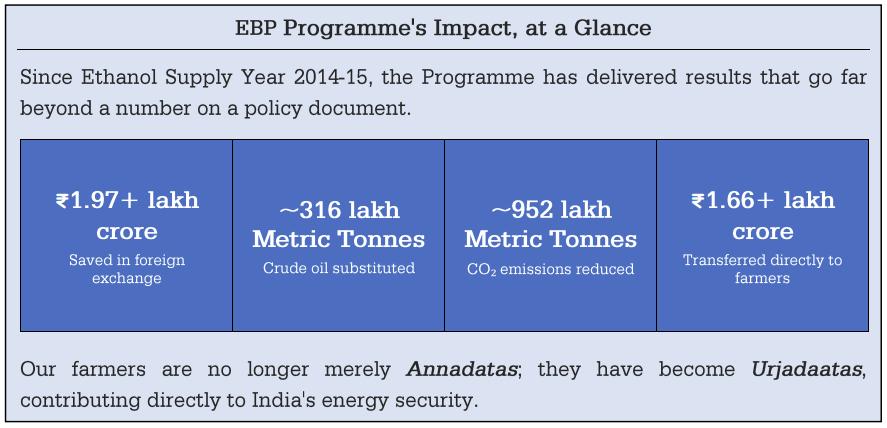
Image: Ethanol Blended Petrol Programme — India’s journey from E5 to E20 and the road to energy security. [Replace src with image URL]
Key Data at a Glance
<1.5% → 20%Ethanol blending rise from ESY 2013–14 to ESY 2025–26
5 yearsahead of schedule; original 2030 deadline advanced to ESY 2025–26
38 cr → 1,200+ cr litresEthanol procurement growth (ESY 2013–14 to 2025–26 projected)
~2,000 cr litresEthanol production capacity 2026 (from 421 cr litres in 2014 — ~5× growth)
₹1.97 lakh crForeign exchange saved since ESY 2014–15 (up to May 2026)
₹1.66 lakh crTransferred to Indian farmers under EBP since ESY 2014–15
952 lakh MTCO₂ emissions reduced (cumulative)
316 lakh MTCrude oil substituted (cumulative)
RON 95Minimum Research Octane Number mandated for E20 petrol from April 2026
Issue in Brief
- The Ethanol Blended Petrol (EBP) Programme — India's flagship biofuel initiative under the Ministry of Petroleum and Natural Gas — achieved 20% ethanol blending (E20) in 2025–26, five years ahead of the original 2030 deadline set in the National Policy on Biofuels (NPB), 2018.
- From April 2026, all petrol sold nationwide mandatorily contains 20% ethanol and must meet a minimum Research Octane Number (RON) of 95, making India one of the few countries to operationalise a nationwide E20 mandate.
- The Ministry issued a detailed FAQ clarification (10 July 2026) via PIB addressing public concerns about vehicle safety, mileage, pricing and policy rationale — the context for this analysis.
Static Background — What is Ethanol?
- Ethanol (C₂H₅OH) — also called ethyl alcohol — is a renewable biofuel produced by the fermentation of sugars or starches from crops (sugarcane, maize, rice) or via petrochemical synthesis.
- It is 99.9% pure alcohol, chemically miscible with petrol, and carries a high octane rating (~108.5 RON); however, its energy content is about 27% lower than petrol, which can marginally reduce mileage.
- Ethanol burns cleaner than petrol, emitting lower carbon monoxide (CO) and hydrocarbons (HC) at the tailpipe; lifecycle carbon reduction with E20 is approximately 40%.
- Ethanol blending = mixing a fixed percentage of ethanol with petrol. E10 = 10% ethanol + 90% petrol; E20 = 20% ethanol + 80% petrol. Standard IC engines handle blends up to defined limits; higher blends (E85, E100) require Flex-Fuel Vehicles (FFVs).
Static Background — India's EBP Programme: A Two-Decade Journey
- 2001: Pilot EBP programme launched; formally announced in 2004; E5 (5% blending) rolled out across several states by 2006.
- January 2013: Policy notified in the Gazette of India (UPA government); target: 5% blending across 10 states and UTs. Despite this, blending remained stuck at ~1.5% due to supply constraints — near-total dependence on sugarcane (annual capacity ~400 crore litres) was the binding constraint.
- May 2018: National Policy on Biofuels (NPB), 2018 — landmark reform widening feedstocks beyond sugarcane to maize, surplus food grains, damaged grains, B-heavy molasses, sugar syrup; made the programme a "whole-of-government mission" across MoPNG, DFPD, MoRTH, Ministry of Heavy Industries and Indian Railways.
- July 2018: Ethanol Interest Subvention Scheme launched; GST on ethanol reduced from 18% to 5%.
- 2020–21: OMCs (IOCL, BPCL, HPCL) began offering off-take guarantee letters and tripartite financing with public sector banks for Dedicated Ethanol Plants (DEPs) in deficit regions.
- June 2021: NITI Aayog's "Ethanol Blending Roadmap 2020–25" released by an inter-ministerial committee; set intermediate target of 10% by November 2022.
- June 2022: 10% blending target achieved five months ahead of schedule (ESY 2021–22) — translated into forex savings of ₹41,500 crore, reduction of 27 lakh MT in GHG emissions and ₹40,600 crore to farmers at that milestone.
- February 2023: PM launched E20 fuel at 84 retail outlets across 11 states/UTs at India Energy Week, Bengaluru.
- September 2023: India led the launch of the Global Biofuels Alliance (GBA) at the G20 Summit, New Delhi.
- 2025: E20 target achieved — five years ahead of the original 2030 deadline; blending rose from 1.5% (2014) to 20% (2025) — a ~13-fold increase in 11 years.
- April 2026: E20 mandated pan-India; all Bharat Stage-VI (BS-VI) vehicles required to meet E20 emission standards; minimum RON 95 specified.
Static Background — Key Policy Instruments & Institutions
- National Policy on Biofuels (NPB), 2018 (amended 2022): Nodal policy; expanded feedstocks; formally advanced E20 deadline to ESY 2025–26; covers 1G (food-crop) and 2G (lignocellulosic biomass) ethanol.
- Administered Price Mechanism (APM): Annual price-fixation for ethanol, differentiated by feedstock; e.g., maize-based ethanol procured at ~₹71.86/litre. Ensures remunerative prices for farmers.
- Ethanol Supply Year (ESY): December–November procurement cycle (not calendar year); introduced for uniform supply planning.
- Long-Term Offtake Agreements (LTOAs): Guaranteed purchase contracts for Dedicated Ethanol Plants — de-risked private capital and rapidly unlocked production capacity.
- PM JI-VAN Yojana (modified 2024): Viability Gap Funding for 2nd-generation (2G) bio-refineries using agricultural residues (paddy stubble, bamboo, bagasse); now includes Sustainable Aviation Fuel (SAF) projects.
- Public sector banks have financed ~₹1 lakh crore/year in ethanol plants, storage and logistics — scale that cannot be unwound without stranding farmer and entrepreneur investments.
| Institution | Role |
|---|---|
| MoPNG | Nodal ministry for EBP programme |
| IOCL, BPCL, HPCL | Oil Marketing Companies — procure, blend and distribute ethanol-blended petrol |
| DFPD | Allocates food grain feedstocks (FCI rice, maize) for ethanol production |
| ARAI | Automotive Research Association of India — vehicle testing and homologation |
| SIAM | Society of Indian Automobile Manufacturers — industry coordination |
| BIS | Sets mandatory quality specifications for ethanol and blended petrol at every supply chain stage |
| NITI Aayog | Prepared the 2021 Ethanol Blending Roadmap; chairs the Inter-Ministerial Committee (IMC) |
| Global Biofuels Alliance (GBA) | India-led multilateral forum (G20, September 2023) for international biofuel cooperation |
Key Dimensions — Scale of Achievement (2014–2026)
- Ethanol blending rose from ~1.5% (ESY 2013–14) to 20% (ESY 2025–26) — a ~13-fold increase in 11 years; procurement grew from ~38 crore litres to projected >1,200 crore litres.
- Production capacity expanded from ~421 crore litres (2014) to ~2,000 crore litres (2026) — a nearly fivefold increase, far exceeding the ~1,100 crore litres required for the E20 mandate.
- E20 petrol now available at >15,600 retail outlets nationwide; from April 2026, it is the only base petrol sold across India's 1 lakh+ outlets.
- Cumulative impact (since ESY 2014–15, up to May 2026): forex saved ₹1.97 lakh crore, crude substituted 316 lakh MT, CO₂ reduced 952 lakh MT, farmer payments ₹1.66 lakh crore.
Key Dimensions — Technical Properties of E20 & Vehicle Safety
- Research Octane Number (RON): Ethanol RON ~108.5 vs. pure petrol ~84.4; E20 raises the effective petrol RON to approximately 95, improving combustion in modern engines.
- Performance advantages: superior anti-knock characteristics, faster combustion, smoother acceleration, near-zero particulate emissions; lifecycle carbon reduction of ~40%.
- Mileage impact: 3–5% reduction possible; however, real-world mileage depends more on driving habits, tyre pressure, servicing and AC use than fuel type — for a car giving 20 km/litre, the drop is roughly 0.6 km.
- Vehicle safety evidence: E15+ blends have been in operation across India for over 3.5 years. Maruti Suzuki serviced 2.84 crore vehicles in FY 2025–26, including 1.5 crore older non-E20-certified vehicles — no E20-linked corrosion, component damage or engine failure found.
- Hero MotoCorp reported similarly: analysis of extensive service data found no higher incidence of damage in vehicles running on E20.
- All manufacturers are currently honouring warranties on all vehicles (old or new) using E20 — the strongest industry-level endorsement of compatibility.
- "E10 compatible" label in vehicle manuals reflects the fuel standard at the time of homologation; it does not mean the vehicle becomes unsafe when standards evolve after scientific validation.
Key Dimensions — Pricing Logic: Why E20 Is Not Cheaper at the Pump
- Government procures ethanol at administered prices to ensure fair farmer compensation; maize-based ethanol costs ~₹71.86/litre before GST, transport and storage.
- At global crude ~USD 70/barrel: E20 costs as much as or more than pure petrol to produce — ethanol is not the cheaper input at current oil prices.
- At crude ~USD 120–130/barrel: economics reverse — ethanol becomes cheaper and blending delivers direct price benefits.
- The real benefit is price stability and energy insulation: 20% of every litre is domestically priced, insulated from Brent crude volatility, wars or shipping disruptions — why India recorded one of the lowest retail fuel price increases globally during the 2022–24 energy crisis.
Key Dimensions — Global Comparison
| Country | Current Blend | Direction / Notes |
|---|---|---|
| USA | E10 nationwide | E15 expanding; millions of FFVs capable of E85 |
| Brazil | E27 mandatory | Moving toward ~35%; >80% of new cars are flex-fuel vehicles |
| Japan | E10 (phased) | Brought ethanol into fuel mix through phased approach |
| Canada / Thailand / EU nations | E5–E10 range | Ethanol blending part of clean fuel strategies |
| India | E20 (April 2026) | Examining E25/E27/E30; E85 promotion begun (June 2026) |
Key Dimensions — Future Roadmap: Beyond E20
- Government examining E25, E27 and E30 targets; distillery sector submitted Expression of Interest for ~1,776 crore litres vs. E20 requirement of ~1,050 crore litres — supply headroom exists.
- Flex-Fuel Vehicles (FFVs): Hero MotoCorp launched the Splendor+ and HF Deluxe Flex Fuel motorcycles (2026) — can run on any ethanol-petrol blend; government examining supportive pricing frameworks for E85 adoption.
- E85 promotion: PM led the launch event at an IOCL retail outlet on World Environment Day (5 June 2026), positioning FFVs alongside EVs in India's low-carbon mobility mix.
- 2nd-generation (2G) ethanol: Uses lignocellulosic biomass (paddy stubble, bamboo, bagasse) — reduces food-crop dependency and directly addresses stubble burning pollution. Supported by PM JI-VAN Yojana VGF; however, commercially unproven at scale.
- Sustainable Aviation Fuel (SAF): Modified PM JI-VAN Yojana (2024) now includes SAF projects, aligning EBP with aviation decarbonisation.
- Farmers transitioning from Annadatas (food providers) to Urjadaatas (energy providers) — a term used at the highest policy level to signal the rural economic transformation enabled by EBP.
Critical Analysis — Strengths
- Whole-of-government coordination: MoPNG, DFPD, MoRTH, Ministry of Heavy Industries and Indian Railways worked in concert — a model for inter-ministerial mission execution.
- Phased, consultative rollout: SIAM and ARAI involved from 2020–21; NITI Aayog roadmap gave industry years of advance notice; manufacturers certified compatibility and honoured warranties.
- Triple dividend: energy security (import reduction) + farmer income (₹1.66 lakh crore) + environmental gain (952 lakh MT CO₂ reduced) — addressed simultaneously under one programme.
- Feedstock diversification post-NPB 2018 eliminated the single-point failure of sugarcane-only supply, making the programme resilient to crop-specific shocks.
- Guaranteed offtake + tripartite bank financing de-risked private capital and rapidly unlocked production capacity — a replicable model for industrial policy.
- Global leadership through the GBA (G20, 2023) positions India as a knowledge exporter on biofuels for the Global South, reinforcing South-South cooperation credentials.
Critical Analysis — Structural Questions
- Food vs. Fuel tension: Diversion of maize, surplus rice and sugar for ethanol can put upward pressure on food prices; programme viability depends on true surplus availability, which is weather- and procurement-policy-dependent.
- Water intensity: Sugarcane-based ethanol is highly water-intensive; concentration of distilleries in water-stressed regions (Maharashtra, Karnataka) poses long-term groundwater sustainability concerns.
- 2G ethanol remains nascent: PM JI-VAN Yojana bio-refineries are commercially unproven at scale; without 2G scale-up, food-vs-fuel pressures will intensify as targets rise to E25/E30.
- Consumer choice gap: No option for pure petrol or E10 at pumps — India's 100,000+ outlet network makes parallel supply chains logistically prohibitive, but the blanket mandate removes consumer agency.
- Pricing asymmetry at low crude: When global crude is ~USD 65–75/barrel, E20 costs more to produce than pure petrol — consumers effectively cross-subsidise energy security and farmer-income objectives.
- E85/FFV ecosystem underdeveloped: High capital cost of flex-fuel vehicles and near-absence of E85 infrastructure limit the transition to higher blends beyond E20.
- Quality control risk: Tight BIS specifications exist, but enforcement across thousands of distilleries, depots and retail outlets remains an institutional challenge; adulteration can damage engines and erode public trust.
Way Forward
- Scale 2G ethanol rapidly using agricultural residues (stubble, bagasse, bamboo) through enhanced PM JI-VAN Yojana funding and IIT-led R&D, reducing food-crop dependency and addressing stubble-burning pollution.
- Publish independent, disaggregated outcome data — vehicle failure rates by category, mileage changes, water use per litre — to build public credibility beyond government self-assessment.
- Develop a national FFV policy with production-linked incentives for automakers to mainstream flex-fuel vehicles, enabling higher blend adoption (E85) over the medium term.
- Establish dedicated quality surveillance units at depot and retail levels with real-time digital reporting to enforce BIS specifications and zero tolerance for adulteration.
- Set transparent E25/E30 timelines now in consultation with auto manufacturers, giving industry the same advance notice that made the E10→E20 transition orderly.
- Mandate water-use audits for ethanol feedstock cultivation and incentivise water-efficient crops (maize over sugarcane in drought-prone areas).
- Expand ethanol into cooking stoves (R&D at IITs) and explore ethanol-diesel blending to address the larger diesel-dominated transport sector.
Prelims Pointers
EBP Programme: Under Ministry of Petroleum & Natural Gas; ethanol blended with petrol only (not diesel in current phase); nodal OMCs — IOCL, BPCL, HPCL.
E20 mandate: From April 2026, all petrol sold in India = 20% ethanol; minimum RON 95; all BS-VI vehicles must meet E20 emission norms.
NPB 2018: National Policy on Biofuels, 2018 — widened feedstocks beyond sugarcane; amended 2022 to advance E20 deadline to ESY 2025–26.
ESY: Ethanol Supply Year = December to November (not April–March); uniform procurement cycle for OMCs.
NITI Aayog Roadmap 2021: "Ethanol Blending in India 2020–25" — inter-ministerial committee; set 10% by Nov 2022, 20% by 2025.
Milestones: 10% achieved June 2022 (5 months ahead); 20% achieved ESY 2025–26 (5 years ahead of original 2030 deadline).
Feedstocks (NPB 2018+): B-heavy molasses, sugarcane juice, sugar syrup, damaged food grains, broken rice, maize — in addition to C-heavy molasses.
2G Ethanol: Uses lignocellulosic biomass (stubble, bamboo, bagasse); supported by PM JI-VAN Yojana (VGF); avoids food-vs-fuel conflict.
GBA: Global Biofuels Alliance — India-led; launched G20 New Delhi, September 2023. Members include USA, Brazil, Italy, Argentina, Singapore, Bangladesh, Mauritius, UAE.
ARAI: Automotive Research Association of India — vehicle testing/homologation; key body for E20 validation alongside SIAM and BIS.
RON of ethanol: ~108.5 (vs. ~84.4 for petrol); E20 raises effective petrol RON to ~95. Ethanol has ~27% lower energy content than petrol.
FFV: Flex-Fuel Vehicle — can run on any ethanol-petrol blend; required for E85/E100. Hero MotoCorp launched first FFV motorcycles (Splendor+ and HF Deluxe) in 2026.
Practice Mains Question
India's Ethanol Blended Petrol Programme is not merely an energy policy but a convergence of energy security, environmental sustainability and agricultural welfare. Critically examine this statement in light of India's journey from E5 to E20 and the structural challenges ahead.
GS Paper 3 · 250 words · 15 marks
Practice MCQs
Q1. Consider the following statements about India's Ethanol Blended Petrol (EBP) Programme: (1) The National Policy on Biofuels, 2018 widened ethanol feedstocks beyond sugarcane for the first time. (2) India achieved the 10% blending target in June 2022, five months ahead of schedule. (3) The Ethanol Supply Year (ESY) runs from April to March. (4) The minimum RON mandated for E20 petrol from April 2026 is 95. Which of the above are correct?
A) 1, 2 and 4 onlyB) 2, 3 and 4 onlyC) 1, 3 and 4 onlyD) 1, 2, 3 and 4
Q2. (Assertion–Reasoning) Assertion (A): E20 fuel is priced similarly to pure petrol in India even though it contains a domestically produced biofuel. Reason (R): When global crude oil trades at ~USD 70 per barrel, the cost of procuring ethanol at administered prices (~₹71.86/litre for maize-based ethanol) is comparable to or higher than the cost of refining crude into petrol.
A) Both A and R are true, and R is the correct explanation of AB) Both A and R are true, but R is NOT the correct explanation of AC) A is true, R is falseD) A is false, R is true
Q3. Which of the following is/are features of second-generation (2G) ethanol in India? (1) It uses lignocellulosic biomass such as paddy stubble and bagasse as feedstock. (2) It avoids diversion of food crops and reduces the food-vs-fuel conflict. (3) It is currently the dominant source of ethanol supply under the EBP Programme. (4) It is supported under the PM JI-VAN Yojana through Viability Gap Funding.
A) 1 and 4 onlyB) 1, 2 and 4 onlyC) 2, 3 and 4 onlyD) 1, 2, 3 and 4