

In-Depth PIB Analysis2 Items
Core TopicImportantConcise
Polity, Governance & Social JusticeGS Paper II
01Tribunals Reforms Bill, 2026 & National Tribunals Commission
Environment, Ecology & Disaster ManagementGS Paper III
02World Elephant Day 2026 & Project Elephant — Conservation Framework
Polity, Governance & Social JusticeGeneral Studies Paper II
01
Tribunals Reforms Bill, 2026: Establishing the National Tribunals Commission
GS-II · Polity — Judiciary, Statutory Bodies, Separation of PowersPrelims + MainsPIB · Ministry of Law & Justice · PIB Backgrounder, 12 Aug 2026
Parliament has passed the Tribunals Reforms Bill, 2026, repealing the Tribunals Reforms Act, 2021 and creating a judiciary-led National Tribunals Commission to oversee appointments, performance and discipline across India's specialised adjudicatory bodies — a structural response to sustained Supreme Court intervention on executive dominance in tribunal administration.
Figure — What is a Tribunal? Purpose and Examples
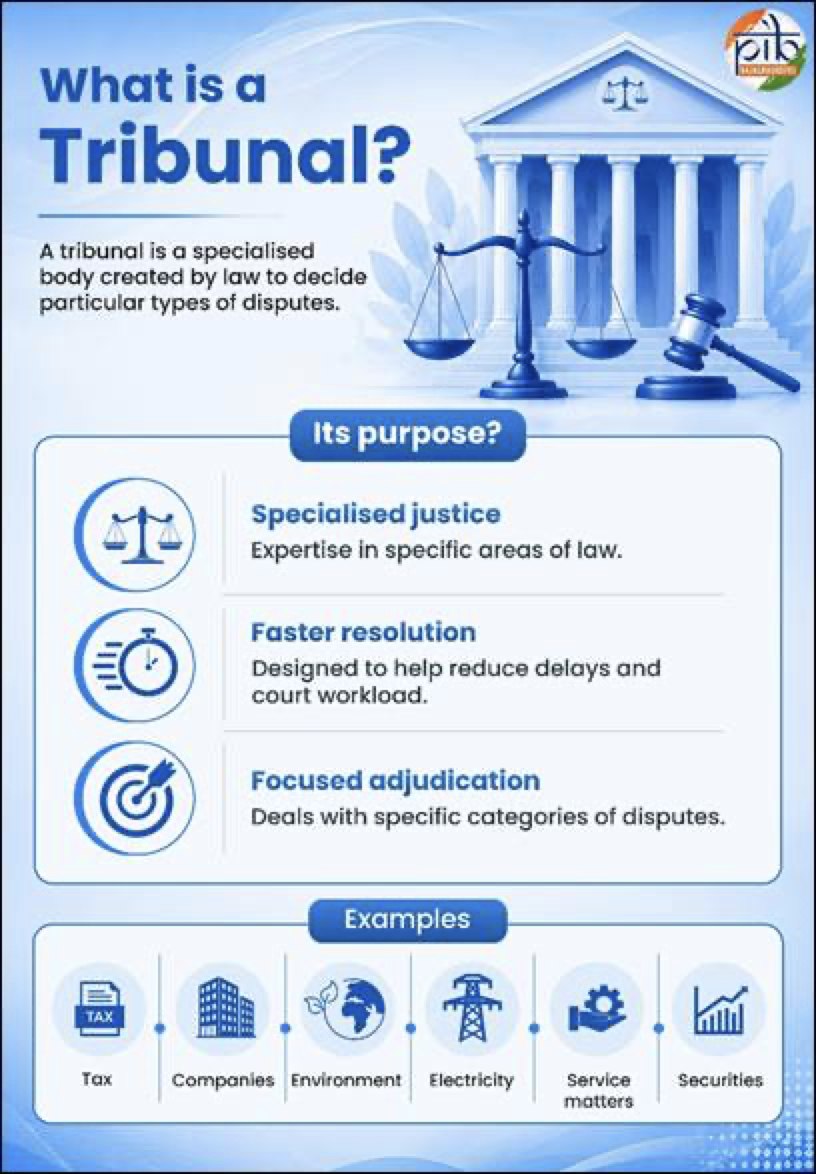
Tribunals serve three core purposes — specialised justice, faster dispute resolution, and focused adjudication — and cover domains from taxation and company law to electricity and securities.
◈ Background & Context
Tribunals in India are specialised quasi-judicial bodies created by statute to adjudicate disputes in specific technical domains — tax, service matters, environment, company law, electricity, securities — outside the regular court hierarchy.
They combine expertise with procedural flexibility, reducing the burden on constitutional courts.
- Constitutional basis: Articles 323-A and 323-B (inserted by the 42nd Constitutional Amendment, 1976) empower Parliament and State Legislatures to establish administrative and other tribunals. Article 323-A covers service matters; 323-B covers a wider range including taxation, industrial disputes, and elections.
- The core tension: Tribunals substitute for High Court jurisdiction in their domains. If they are controlled by the executive — through appointments, service conditions and funding — judicial independence is compromised. This constitutional concern has driven a decade of litigation.
- The 2021 Act and its fate: The Tribunals Reforms (Rationalisation and Conditions of Service) Act, 2021 abolished eight tribunals and transferred their jurisdiction to existing courts. It also vested control over service conditions and appointments in the Central Government. The Supreme Court struck down several of its provisions in the Madras Bar Association v. Union of India (2021) series of cases, finding that executive primacy over tribunal appointments violated the doctrine of separation of powers.
- The 2026 trigger: In Madras Bar Association v. Union of India [(2026) 2 SCC 1], the Supreme Court struck down further provisions of the 2021 Act and directed the Government to establish an independent National Tribunals Commission — providing the immediate legislative mandate for the 2026 Bill.
▤ Scheme at a Glance — Tribunals Reforms Bill, 2026
- Status: Passed by Parliament, August 2026
- Primary effect: Repeals the Tribunals Reforms Act, 2021
- Nodal Ministry: Ministry of Law and Justice
- Key institutional creation: National Tribunals Commission (NTC) — an independent, judiciary-dominated oversight body
- Tribunals covered: All tribunals, appellate tribunals and authorities listed in the Schedule to the Bill (including NCLT, NGT, TDSAT, CESTAT, SAT, CAT, among others)
- NTC Chairperson tenure: 5 years or age 70, whichever is earlier
- Tribunal Member tenure: 5 years or age 67, whichever is earlier
- Financial accountability: CAG audit of NTC accounts; report tabled before both Houses of Parliament
- Data architecture: National Tribunals Data Grid — a centralised repository for case data across 16 tribunals
Structure of the National Tribunals Commission
The NTC replaces the Central Government as the primary institutional actor in tribunal governance. It has a built-in judicial majority, which is the structural answer to the Supreme Court's concern about executive capture.
- Chairperson: Former Supreme Court Judge or Chief Justice of a High Court; formally appointed by the Central Government after mandatory consultation with the Chief Justice of India.
- Judicial Members (2): Former Chief Justices or Judges of High Courts.
- Technical Members (2): Persons with at least 25 years' experience in public administration, finance, law, accountancy, banking, management or technology.
- Secretariat: Headed by a Secretary to the Government of India; functions under the administrative oversight of the NTC Chairperson; prepares annual reports and facilitates selection processes.
Figure 1 — Architecture of the National Tribunals Commission (NTC)
National Tribunals Commission (NTC)Independent oversight body · Judicial majorityChairpersonFormer SC Judge /HC Chief JusticeJudicial Members (2)Former HC Chief Justiceor HC JudgeTechnical Members (2)25+ yrs: admin, finance,law, banking, techSecretariatHd. by Secretaryto Govt. of IndiaKey Functions of NTCSelectionsVia Search-cum-Selection CommitteesPerformance ReviewAnnual reports toCentral GovernmentDisciplinary OversightSupervise inquiriesagainst membersData GridNational TribunalsData Grid (16 tribunals)CAG AuditAccounts tabledin ParliamentAppointment by Central Government after consultation with CJI (for Chairperson & Judicial Members)
The NTC has a 3:2 judicial-to-technical ratio; the Chairperson and Judicial Members are appointed by the Centre only after CJI consultation, limiting executive discretion.
The Search-cum-Selection Committee: How Appointments Will Work
The Bill creates structured, judicially chaired committees for each category of tribunal vacancy, replacing the previous practice of government-controlled search panels. The design limits executive discretion at multiple points.
- For Tribunal Chairpersons: Committee chaired by the NTC Chairperson; includes a Technical Member of NTC, a retired HC Chief Justice, a Secretary nominated by the Centre, and two empanelled domain experts.
- For Tribunal Members: Committee chaired by a Judicial Member of NTC; otherwise similarly structured with a retired HC Judge instead of HC Chief Justice.
- Single-candidate recommendation: Each committee recommends exactly one candidate per vacancy (plus one for the waiting list) — removing the executive's ability to pick from a panel.
- Timeline discipline: The Secretariat must transmit recommendations to the government within 3 days; the government must make the appointment within 3 months.
- Casting vote: Rests with the judicial Chair; the Member Secretary and domain experts have no voting rights.
The Lineage: From Executive Control to Judicial Independence
- Swamy v. Union of India (1987): Early challenge to administrative tribunal conditions; Supreme Court affirmed tribunal legitimacy but flagged service condition risks.
- L. Chandra Kumar (1997): A Constitution Bench held that tribunal orders must remain subject to High Court superintendence under Articles 226/227; tribunals cannot wholly exclude judicial review.
- Roger Mathew v. South Indian Bank (2019): Constitution Bench found the Finance Act, 2017 provisions on tribunal conditions unconstitutional for conferring excessive executive control — struck down the relevant rules.
- Madras Bar Association series (2010, 2014, 2021): Supreme Court progressively tightened standards on independence — holding that the executive cannot dominate selection, that fixed terms are essential, and that national tribunals must not be under the administrative ministries they adjudicate against.
- 2021 Act → 2026 Bill: The 2021 Act was passed after Roger Mathew but continued to vest key functions in the executive. The 2026 Bill is the direct legislative response to the Supreme Court's 2026 direction to create an independent NTC.
Critical Analysis
- Structural advance: The judicial-majority composition of the NTC and the single-candidate recommendation mechanism represent a genuine shift from the pattern condemned in the Madras Bar Association cases. The 3-month appointment deadline, if enforced, would address the historically chronic problem of long vacancies.
- Residual executive role: The Central Government retains formal appointment authority and continues to fund tribunals through parliamentary appropriation. The Bill does not address the placement of tribunal secretariats within administrative ministries — a concern repeatedly raised in judicial decisions.
- Vacancy crisis: Structural reform is necessary but not sufficient. The NCLAT, NGT and CAT have historically run with 30–60% vacancy rates. The new selection machinery must demonstrate speed to translate legislative intent into functioning benches.
- Reappointment risk: Allowing reappointment with "previous performance" as a factor could subtly influence member conduct if evaluation criteria lack objective definition.
- Federalism dimension: State Administrative Tribunals (established under Article 323-A) are also covered. The Chief Secretary replaces the Central Secretary on SAT selection committees — a concession to federal sensitivity, but the NTC's jurisdiction over State-level tribunals raises questions about Centre-State relations.
✎ Mains Practice Question
The Tribunals Reforms Bill, 2026 seeks to transfer control over tribunal appointments from the executive to an independent judicial commission. Critically examine whether the proposed institutional design adequately addresses the concerns raised by the Supreme Court in the Madras Bar Association series of cases. What structural gaps, if any, remain? 15 marks · 250 words
Environment, Ecology & Disaster ManagementGeneral Studies Paper III
02
World Elephant Day 2026: India's Comprehensive Conservation Architecture
GS-III · Environment — Biodiversity, Conservation, Human-Wildlife ConflictPrelims + MainsPIB · MoEFCC · 12 Aug 2026
On World Elephant Day 2026, the Ministry of Environment, Forest and Climate Change published a comprehensive account of India's elephant conservation programme — covering population estimates, corridor mapping, railway safety interventions and captive elephant management — underscoring India's position as custodian of nearly 60% of the world's wild Asian elephant population.
◈ Background & Context
The Asian elephant (Elephas maximus) is listed as Endangered on the IUCN Red List and is protected under Schedule I of the Wildlife (Protection) Act, 1972 — the highest level of legal protection in India.
Unlike the African elephant, the Asian species exhibits significant sexual dimorphism in tusk development; only some males carry tusks (known as makhnas if tuskless), complicating poaching dynamics.
- Global status: Of the estimated 48,000–52,000 wild Asian elephants globally, India hosts approximately 22,446 — around 60% — making it the single most important range country for the species.
- Distribution: Elephants are found in four broad landscape clusters in India: Northern (foothills of the Himalaya in Uttarakhand and UP), North-Eastern (Assam, Meghalaya, Arunachal Pradesh, and others), East-Central (Odisha, Jharkhand, Chhattisgarh), and Southern (Karnataka, Tamil Nadu, Kerala — the largest population bloc).
- Keystone role: Elephants are ecological engineers. Their movement creates water holes and pathways used by other species; their feeding habits cycle nutrients and disperse seeds across long distances, aiding forest regeneration and maintaining genetic diversity in plant communities.
- World Elephant Day: Observed annually on 12 August since 2012, co-founded by Canadian filmmakers Patricia Sims and Michael Clark of Canazwest Pictures and the Thai Elephant Reintroduction Foundation, to raise awareness about the conservation of both Asian and African elephants.
▤ Project Elephant at a Glance
- Launched: 1992
- Nodal Ministry: Ministry of Environment, Forest and Climate Change (MoEFCC)
- Nature: Centrally Sponsored Scheme — provides financial and technical support to elephant-range states
- Wild elephant population (SAIEE 2021–25): 22,446
- Elephant Reserves: 33, spread across 14 major elephant-range states
- Total Elephant Reserve area: 80,777 km² (expanded by 8,610 km² since 2014)
- Identified corridors: 150 corridors across 14 states (per Elephant Corridors of India, 2023, with technical support from Wildlife Institute of India)
- Ex-gratia for human death/permanent incapacitation: ₹10 lakh
- Ex-gratia for grievous injury: ₹2 lakh
- Ex-gratia for minor injury (treatment): Up to ₹25,000
- Train-hit deaths: Reduced from 26 (2013) to 12 (2024) — a 54% decline
Mapping India's Elephant Corridors
Corridors are connective habitats that link fragmented elephant ranges — essential for genetic exchange, seasonal migration and reducing human-elephant conflict by channelling elephant movement away from human settlements. The 2023 corridor mapping exercise is the most comprehensive survey to date.
Figure — Mapping India's Elephant Corridors: Regional Distribution
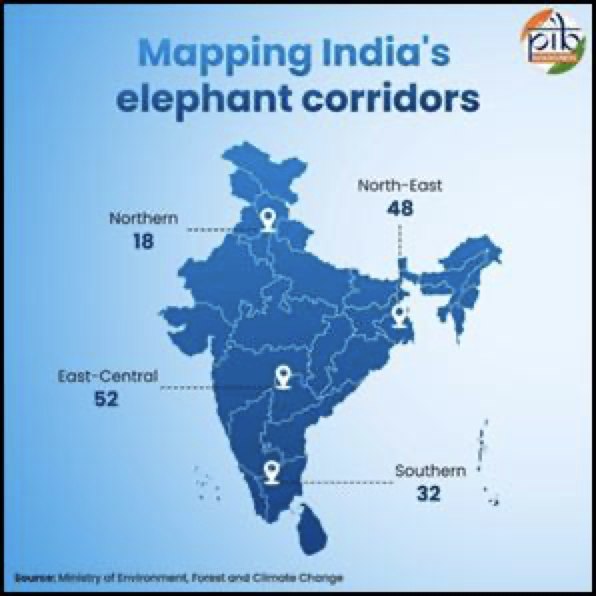
East-Central region leads with 52 corridors; North-East has 48; Southern 32; Northern 18 — totalling 150 corridors across 14 states. Source: MoEFCC / Wildlife Institute of India, Elephant Corridors of India, 2023.
- East-Central region: 52 corridors — highest count, spanning Odisha, Jharkhand, Chhattisgarh and West Bengal's southern districts
- North-East: 48 corridors — covering Assam, Meghalaya, Arunachal Pradesh, Nagaland, Mizoram and others; critical transboundary linkages with Bhutan and Myanmar
- Southern region: 32 corridors — including the famed Nilgiris–Eastern Ghats landscape
- Northern region: 18 corridors — the Shivalik foothills belt
- State with maximum corridors: West Bengal — 26 corridors (17% of national total), reflecting the critical role of the Dooars-Terai landscape
- Inter-state corridors: 19; Transboundary (India–Nepal): 6
- Status breakdown: Increased elephant use in 59 corridors (40%); stable in 29 (19%); declining use in 29 (19%); impaired in 15 (10%)
Railway Safety — A Case Study in Technology Integration
Railway tracks passing through elephant habitat are among the most acute sources of elephant mortality in India. The Government's response integrates structural engineering with real-time sensor technology.
- Survey scope: Joint surveys covering 127 sensitive stretches spanning 3,452.4 km
- Recommended mitigation: 77 stretches across 14 states (1,965.2 km) earmarked for 705 structures — underpasses, overpasses, ramps, level crossings and bridge modifications
- Technologies deployed: Optical-fibre-based intrusion detection, seismic sensors, thermal cameras, and AI-enabled Distributed Acoustic Sensing (DAS) systems providing real-time alerts to loco pilots and control rooms
- Outcome: Train-hit deaths fell from 26 (2013) to 12 (2024) — a 54% reduction over 11 years
Captive Elephant Management: The Gajah Suchana System
- Legal framework: Section 43 of the Wildlife (Protection) Act, 1972 prohibits trade in captive elephants (declared as "wild animals" in captivity); transfers require prior permission from the Chief Wildlife Warden.
- Gajah Suchana app: A national genetic database maintaining DNA profiles, morphological characteristics and ownership records of all registered captive elephants — enabling forensic verification before any transfer and producing admissible evidence in legal proceedings.
- Significance: Addresses a long-standing enforcement gap, since physical identification of captive elephants was easily manipulated; genetic profiling creates a permanent, tamper-resistant identity record.
Governance Innovations — Management Effectiveness and Regional Action Plans
- Management Effectiveness Evaluation (MEE) for Elephant Reserves: Launched in 2023; piloted in four representative reserves — Shivalik (Northern), Kaziranga–Karbi Anglong (North-East), Mayurbhanj (East-Central) and Nilgiri (Southern). Being scaled nationally with CAMPA funding. Provides a standardised, measurable framework for assessing conservation outcomes.
- Regional Action Plans: Developed for all elephant-bearing regions, recognising that elephants range across state boundaries. Provides a coordinated, landscape-scale framework for states to plan conflict mitigation and habitat management — addressing the jurisdictional fragmentation that has historically limited conservation effectiveness.
- CAMPA: Compensatory Afforestation Fund Management and Planning Authority — funds generated from forest diversion for non-forest uses, used for afforestation and wildlife conservation activities.
Critical Analysis
- Human-elephant conflict (HEC): Despite institutional progress, HEC remains the most intractable challenge. As per government data, over 400 humans and approximately 100 elephants are killed annually in conflict situations across India. Rapid agricultural expansion into elephant corridors drives both elephant crop-raiding and retaliatory killing.
- Corridor encroachment: The 2023 data showing 15 impaired and 29 declining corridors reflects real-world pressure. Legal protection of corridors remains incomplete — most are on revenue lands or private lands outside protected area boundaries, limiting the Government's enforcement capacity.
- Data credibility: The shift to the Synchronous All India Elephant Estimation (SAIEE) methodology (replacing the earlier drive-count system) is a methodological improvement, but comparable baseline data across decades is limited, making trend analysis difficult.
- Captive welfare: The welfare of temple and working elephants — particularly regarding chain time, diet and veterinary care — remains under-regulated relative to wild elephant conservation standards.
Figure 2 — Elephant Deaths on Railway Tracks: 2013 vs 2024
0132626 deaths201312 deaths2024↓ 54%reduction
Train-hit elephant deaths declined by 54% over 11 years — from 26 (2013) to 12 (2024) — following structural mitigation works and AI-enabled DAS sensor deployment. Source: MoEFCC / PIB, 12 Aug 2026.
✎ Mains Practice Question
India hosts approximately 60% of the world's wild Asian elephant population, yet human-elephant conflict continues to cause hundreds of fatalities annually on both sides. Examine the institutional mechanisms established under Project Elephant to balance conservation imperatives with the livelihood security of communities living in elephant landscapes. 15 marks · 250 words