
Contents01
Weaving Sustainability: India's Textile Sector and the Circular Economy Pathway
Ministry of Textiles · Circular Economy, Sustainable Manufacturing
GS 3GS 2
02
India's Clean Sweep at IPhO 2026: All Five Win Gold, Joint World No. 1
Department of Atomic Energy / HBCSE-TIFR · Science Olympiad, Education
GS 2GS 3
Article 01
Article 01
Weaving Sustainability: India’s Textile Sector and the Circular Economy Pathway
Ministry of Textiles · PIB Factsheet & Report: “Mapping of Textile Waste Value Chain in India” (2026)
Relevance: GS 3 (Indian Economy — industry, infrastructure, inclusive growth; environment — conservation) · GS 2 (Governance — welfare schemes, social justice for marginalised communities).
GS 3GS 2
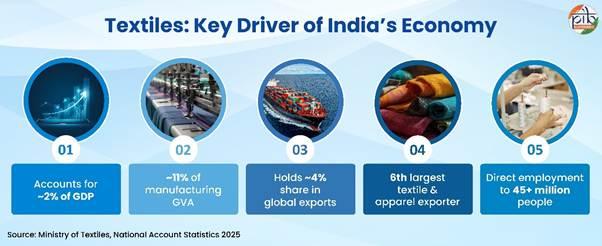
Image: Circular textile value chain — from fibre input to post-consumer waste recovery and reuse. [Replace src with image URL]
Key Data at a Glance
~2%of India’s GDP from the textile and apparel sector (NAS 2025)
~11%share of manufacturing GVA from textiles and apparel
45 million+direct employment in the sector, including women and rural workers
7.8 MTtextile waste managed annually; >70% recovered into recycling / reuse
~95%pre-consumer (factory scrap) textile waste recovery rate
40–45 lakhlivelihoods supported by the textile waste recovery ecosystem
Issue in Brief
- India’s textile sector — the “spinning wheel” of industrial growth — is the world’s sixth-largest textile and apparel exporter (~4% global export share), contributing ~2% of GDP and ~11% of manufacturing GVA (National Account Statistics 2025).
- The government released a factsheet and the report “Mapping of Textile Waste Value Chain in India” (2026), showcasing how circular economy principles are being embedded across the textile value chain — from raw material input to post-consumer waste management.
- Global markets are shifting towards environmentally responsible production; the EU’s Digital Product Passport (DPP) compliance cliff (2027) adds regulatory urgency for Indian textile exporters.
Static Background
- Circular Economy (CE): a regenerative model contrasted with the linear “take-make-dispose” approach. Core actions — Reuse (return without change), Upcycling (convert to higher value), Downcycling (convert to lower value, e.g., cotton rags → industrial wipes), and Recycling (break down to raw material).
- India has a centuries-old tradition of textile reuse, repair and resource-conscious production — from dhobis and darzis to Panipat (Haryana), globally known as the “Cast-off Capital”, which mechanically reprocesses second-hand textiles into blankets, yarn and shoddy fibre.
- Key legislative anchors: Environment (Protection) Act, 1986 (parent law); Environment Protection Rules, 1986 (effluent discharge standards for textile units); Stockholm Convention (ratified by India in 2006) targeting Persistent Organic Pollutants (POPs), including certain textile chemicals.
- Solid Waste Management Rules, 2026: came into force 1 April 2026 under the Environment (Protection) Act; incorporate Extended Producer Responsibility (EPR) principles and mandate gradual use of Refuse Derived Fuel (RDF) by industrial units — rising from 5% to 15% over six years.
- MSMEs account for over 80% of India’s textile and apparel production capacity (Economic Survey 2023-24) — making MSME-targeted sustainability interventions structurally critical.
Key Dimensions — Input Stage: Organic Fibres & Cleaner Raw Materials
- National Programme for Organic Production (NPOP): Certifies organic fibres including organic cotton; standards recognised by the European Commission and Switzerland for unprocessed plant products; covers accreditation of certification bodies and promotion of organic products.
- Jute-ICARE (Improved Cultivation and Advanced Retting Exercise, launched 2015): Promotes scientific jute cultivation through high-yielding certified seeds and retting accelerators; expanded from 130 blocks in 7 states → 289 blocks in 10 states; coverage grew from ~1.11 lakh ha → 2.15 lakh ha (2024-25).
- New Age Fibre Mission (MM-III): Mini-mission under the Mission for Cotton Productivity; promotes allied natural fibres as eco-friendly synthetic alternatives; focuses on climate-smart cultivation, mechanisation and innovation.
- National Fibre Scheme: Strengthens self-reliance across natural, man-made and new-age fibres; reduces import dependence; encourages innovation in advanced textile materials.
- Hazardous chemical restrictions: Benzidine-based dyes restricted; 70 azo dyes prohibited; Stockholm Convention (2006) restricts POPs including harmful textile chemicals from the supply chain.
- Pilot — “Eliminating Hazardous Chemicals from the Textile Fashion Supply Chain in India”: Covers 400 factories across 8 clusters and 4 fashion houses; targets reduction of 10,530 tonnes of harmful chemicals and mitigation of 1,47,000 tCO₂eq.
Key Dimensions — Production Stage: Sustainable Manufacturing
- PM MITRA Parks (Mega Integrated Textile Region and Apparel): 7 parks approved with an outlay of ₹4,445 crore (up to 2027-28) at Virudhunagar (TN), Warangal (Telangana), Navsari (Gujarat), Kalaburagi (Karnataka), Dhar (MP), Lucknow (UP) and Amravati (Maharashtra); built around the ‘5F’ vision — Farm → Fibre → Factory → Fashion → Foreign; sustainability integrated via CETPs, wastewater recycling and waste management; MoUs for investments >₹27,434 crore signed as of December 2025.
- RAMP Programme — MSE-GIFT: Supports green technology adoption in MSMEs; provides 2% annual interest subvention on term loans up to ₹2 crore and 75% credit guarantee coverage.
- RAMP Programme — MSE-SPICE (Scheme for Promotion and Investment in Circular Economy): Helps micro and small enterprises adopt circular and resource-efficient practices; provides 25% capital subsidy for eligible plant and machinery; promotes nationwide awareness.
- Textile Sector under the Indian Carbon Market (ICM): Greenhouse Gas Emission Intensity (GEI) targets notified under the Carbon Credit Trading Scheme (CCTS); textile units must disclose Scope-1 (direct emissions) and Scope-2 (indirect — purchased electricity, heat) emissions; outperformers earn tradeable Carbon Credit Certificates.
- Tex Eco Initiative: Promotes globally competitive and environmentally sustainable textile manufacturing; aligns India’s textile industry with international sustainability standards and green market opportunities.
Key Dimensions — Post-Production Stage: Waste Management & Recovery
- Of the ~7.8 million tonnes of textile waste managed annually, over 90% is sourced from domestic pre-consumer (factory scrap) and post-consumer waste; >70% is recovered into recycling, upcycling, downcycling or reuse.
- Pre-consumer recovery (factory scrap): ~95% collected and reintegrated; the spinning sector demonstrates near-closed-loop circularity with almost all spinning waste reprocessed within production.
- Post-consumer recovery (discarded textiles): ~55% diverted from landfills through collection and sorting networks — a significant but improvable rate reflecting weak household-level collection infrastructure.
- The waste ecosystem supports 40–45 lakh livelihoods, with women from marginalised communities playing a major role in collection, sorting and redistribution.
- National Technical Textiles Mission (NTTM): R&D projects sanctioned to convert textile waste, biomass and bio-residues into carbon fibres and functional textiles.
- Report “Mapping of Textile Waste Value Chain in India” (2026): Data-driven blueprint for turning textile waste into an economic resource; highlights Panipat as the leading mechanical recycling hub; notes emerging chemical recycling technologies for fibre recovery at molecular level.
- India’s first Municipal Textile Recovery Facility in Belapur, Navi Mumbai: integrates collection, sorting, upcycling and livelihoods; collected 30 MT of post-consumer textile waste; reached 1.14 lakh families.
Key Dimensions — Promotion Stage: Standards, Markets & Awareness
- Eco-Mark Scheme, 2024: Textiles identified as an eligible category; 13 Indian Standard titles notified; Eco-Mark granted to products meeting criteria on resource use, climate impact, biodiversity, energy use, waste and hazardous substances.
- Kasturi Cotton and Silk Mark: Traceability and quality branding initiatives for premium Indian cotton and silk — build global identity and support responsible sourcing and supply chain transparency.
- MoU (2024) between Textiles Committee, GeM (Government e-Marketplace) and SCOPE (Standing Conference of Public Enterprises): institutionalises public procurement of upcycled textile products, creating demand-side pull for circularity.
- SURE (Sustainable Resolution): Led by CMAI, Reliance Brands Limited (RBL), UN India and the Ministry of Textiles — one of India’s largest voluntary sustainability commitments; drives industry transition towards cleaner, more responsible fashion.
- Circle Back Campaign: Raises awareness among students about textile recycling; exhibitions such as Vastra Katha at Bharat Tex 2024 and 2025 showcased sustainable textile practices.
- ESG Task Force: Constituted to guide sustainable production, certification and exports; enables platforms like Circular Samvaad and the Cluster Exchange Mechanism.
- Bharat Tex (India’s flagship global textile event — editions 2024, 2025, 2026): showcases circular textiles, technical textiles, MSME innovations and policy dialogue on a single integrated platform.
Critical Analysis — Strengths
- Recovery of >70% of textile waste nationally — with the pre-consumer loop at ~95% — is a strong baseline, largely driven by industry-embedded networks rather than mandates alone.
- A multi-layered policy architecture: PM MITRA (production infrastructure), RAMP (MSME green finance), ICM (carbon market discipline) and Eco-Mark (demand-side standards) operate across the value chain simultaneously.
- GeM-linked upcycled product procurement creates institutional demand-side pull — a rare and effective market-creation mechanism for circular outputs.
- The Belapur Municipal Textile Recovery Facility offers a replicable model combining collection, upcycling, technology and livelihoods in a single circular ecosystem.
Critical Analysis — Structural Questions
- India lacks a dedicated legislative framework for textile circularity; unlike the EU or China, there are no strict textile recycling mandates; EPR for textiles remains unformulated — the SWM Rules 2026 are a step but are not sector-specific.
- Post-consumer recovery remains at ~55% vs ~95% pre-consumer, revealing the weakness of household-level collection infrastructure — a structural gap that policy has yet to close.
- Chemical (molecular-level) recycling — critical for true textile-to-textile circularity — is nascent and capital-intensive; Panipat dominates mechanical recycling but cluster-level facilities are needed at other textile hubs (Surat, Tiruppur, Ludhiana).
- The 2027 EU Digital Product Passport (DPP) compliance cliff poses traceability and data-infrastructure challenges across India’s fragmented MSME textile clusters.
- Over 90% of textile waste workers are informal, with limited social protection or formalisation — circular economy growth must address this structural inequality to be truly inclusive.
Way Forward
- Enact a dedicated Textile EPR framework under the Environment (Protection) Act, mandating producers to manage end-of-life garments — similar to the existing plastic EPR rules.
- Scale chemical recycling infrastructure through NTTM R&D support and public-private partnerships; mechanical recycling alone cannot achieve true textile-to-textile fibre circularity.
- Expand Municipal Textile Recovery Facilities beyond Navi Mumbai to major textile clusters (Surat, Tiruppur, Ludhiana) to bridge the post-consumer recovery gap.
- Formalise waste worker livelihoods — link sorters and collectors to social security, MSME registration and skill certification under the SURE framework.
- Accelerate DPP readiness for export clusters: incentivise digital traceability adoption before the 2027 EU compliance deadline.
Prelims Pointers
PM MITRA Parks: 7 locations; ₹4,445 cr outlay (2027-28); ‘5F’ vision — Farm → Fibre → Factory → Fashion → Foreign; include CETPs and wastewater recycling.
MSE-SPICE: 25% capital subsidy for circular economy machinery in micro and small enterprises (under RAMP programme).
MSE-GIFT: 2% interest subvention + 75% credit guarantee for green technology adoption in MSEs (RAMP).
NPOP: Certifies organic cotton and other organic products; recognised by EU and Switzerland.
Jute-ICARE: Launched 2015; now covers 289 blocks in 10 states; ~2.15 lakh ha in 2024-25.
Eco-Mark Scheme, 2024: 13 Indian Standard titles notified for textiles; covers climate impact, hazardous substances, resource use.
SWM Rules, 2026: In force 1 April 2026; incorporate EPR; RDF mandate rising from 5% to 15% over six years.
Stockholm Convention (2006): Targets Persistent Organic Pollutants (POPs) — relevant to benzidine-based dyes and azo dye restrictions in textiles.
Kasturi Cotton: Traceability and branding initiative for Indian cotton; quality and identity in global markets.
ICM / CCTS: Textile sector is an obligated sector; Scope-1 and Scope-2 emission disclosures required; outperformers earn tradeable Carbon Credit Certificates.
SURE: Voluntary sustainability commitment — led by CMAI + Reliance Brands + UN India + Ministry of Textiles.
Panipat (Haryana): ‘Cast-off Capital’ — India’s leading hub for mechanical textile recycling; shoddy fibre, blankets, yarn.
Practice Mains Question
India’s textile sector has made progress in adopting circular economy practices, yet structural gaps persist across the value chain. Critically examine the policy framework for circular textiles in India and suggest measures for a more inclusive and legally binding transition.
GS Paper 3 · 250 words · 15 marks
Practice MCQs
Q1. Consider the following statements regarding India’s textile circular economy: (1) India’s pre-consumer textile waste recovery rate is nearly 95%. (2) MSE-SPICE provides 2% interest subvention on term loans for circular economy machinery. (3) The Solid Waste Management Rules, 2026 incorporate Extended Producer Responsibility principles. Which of the above are correct?
A) 1 and 2 onlyB) 1 and 3 onlyC) 2 and 3 onlyD) 1, 2 and 3
Q2. The ‘5F’ vision associated with PM MITRA Parks refers to:
A) Farm → Fabric → Factory → Fashion → ForeignB) Farm → Fibre → Factory → Fashion → ForeignC) Fibre → Fabric → Finishing → Fashion → ForeignD) Farm → Fibre → Fabric → Fashion → Finance
Q3. (Assertion–Reasoning) Assertion (A): India’s post-consumer textile waste recovery rate (~55%) is significantly lower than its pre-consumer rate (~95%). Reason (R): Household collection infrastructure for discarded garments is weak, unlike established factory-level scrap networks.
A) Both A and R are true, and R is the correct explanation of AB) Both A and R are true, but R is NOT the correct explanation of AC) A is true, R is falseD) A is false, R is true
Article 02
Article 02
India’s Clean Sweep at IPhO 2026: All Five Win Gold, Joint World No. 1
Department of Atomic Energy / HBCSE–TIFR · 56th International Physics Olympiad, Bucaramanga, Colombia
Relevance: GS 2 (Education — science and technology institutions, role of government) · GS 3 (Science & Technology — indigenisation, innovation ecosystem, STEM capacity building).
GS 2GS 3
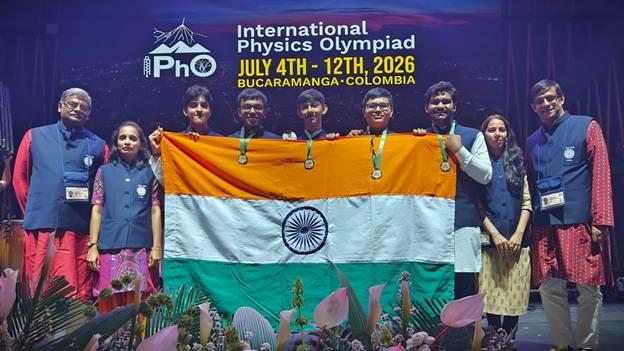
Image: Indian contingent at the 56th International Physics Olympiad 2026, Bucaramanga, Colombia — all five members with Gold Medals. [Replace src with image URL]
Key Data at a Glance
5 / 5Gold Medals won by India at IPhO 2026 — a clean sweep
Joint No. 1World rank, shared with China, Kazakhstan, Russia, South Korea, Taiwan
381students from 87 countries competed at IPhO 2026
56thedition of IPhO; held in Bucaramanga, Colombia (first time in Colombia)
10 yrsevery Indian IPhO participant has secured a podium finish over the last decade
5-stageNational Olympiad Programme selection process run by HBCSE-TIFR
Issue in Brief
- All five members of India’s team won Gold Medals at the 56th International Physics Olympiad (IPhO) 2026 in Bucaramanga, Colombia, securing a joint World No. 1 rank alongside China, Kazakhstan, Russia, South Korea and Taiwan, among 381 students from 87 countries.
- The achievement is attributed to the National Olympiad Programme run by HBCSE-TIFR under the Department of Atomic Energy (DAE) — a multi-stage talent identification and mentoring system sustained over decades.
- India’s gold medalists: Kanishk Jain (Pune, Maharashtra), Riddhesh Anant Bendale (Indore, MP), Rishit Garg (Dwarka, New Delhi), Shresth Suraiya (Mumbai, Maharashtra), Svarit Joshi (Ahmedabad, Gujarat).
Static Background
- International Physics Olympiad (IPhO): Annual international competition for pre-university (school-level) students; participants tested on theoretical and experimental physics far beyond standard curricula. First held in Warsaw, Poland, in 1967 with 3 countries; now spans 87+ countries. Each country can send up to 5 students.
- HBCSE (Homi Bhabha Centre for Science Education): A National Centre of TIFR (Tata Institute of Fundamental Research); functions as an aided institution under DAE; is India’s nodal agency for all international Science and Mathematics Olympiads (Physics, Chemistry, Biology, Astronomy, Mathematics).
- National Olympiad Programme — 5-stage selection process:
- NSE (National Standard Examination) — Stage 1, conducted by IAPT (Indian Association of Physics Teachers).
- INPhO (Indian National Physics Olympiad) — HBCSE.
- OCSC (Orientation-cum-Selection Camp) — intensive residential camp; final 5 selected.
- Pre-departure training — advanced theory + lab experiments.
- International Olympiad participation.
- Department of Atomic Energy (DAE): Oversees India’s nuclear and atomic energy programmes including BARC, TIFR, NPCIL and AERB; provides long-term institutional funding for HBCSE’s Olympiad programme as a science capacity investment.
- Constitutional anchor — Article 51A(h): Fundamental Duty — “to develop the scientific temper, humanism and the spirit of inquiry and reform” — the constitutional foundation for STEM Olympiad culture.
- India at IPhO 2025 (Paris): Won 3 Gold + 2 Silver medals — strong but not a clean sweep; the 2026 5/5 Gold is India’s finest IPhO performance to date.
Key Dimensions
- Team leadership and mentoring: Led by Prof. Anwesh Mazumdar (HBCSE-TIFR) and Dr. Leena Joshi (St. Xavier’s College, Mumbai); scientific observers Prof. Ananda Dasgupta (IISER Kolkata) and Ms. Nisha Kelkar (Gogate-Joglekar College, Ratnagiri).
- HBCSE training methodology: Residential orientation camps; advanced problem-solving; laboratory experiments beyond standard curriculum; mentoring by TIFR and IISER faculty — connecting school-level talent to frontier research culture.
- Geographic diversity of winners (Pune, Indore, Delhi, Mumbai, Ahmedabad) suggests the Olympiad talent pool is not purely metro-centric, signalling breadth in India’s STEM ecosystem.
- India’s joint No. 1 alongside China, Russia and Kazakhstan — countries with highly structured, state-sponsored STEM pipelines — underlines India’s competitiveness despite relatively lower per-student state investment in school science.
- Complementary national programmes: NEP 2020 emphasises critical thinking and scientific temper; Atal Tinkering Labs (ATL) under the Atal Innovation Mission (NITI Aayog) promote STEM culture in schools; PM SHRI Schools under NEP serve as preparatory ecosystems.
Critical Analysis — Strengths
- Institutional continuity: HBCSE’s decades-long patient investment — identifying, training and mentoring over years, not months — is the structural differentiator over commercially driven coaching models.
- DAE’s sustained funding model demonstrates that long-term, non-commercial science investment yields compounding dividends in national scientific prestige and the talent pipeline.
- Multi-state winner geography suggests that India’s talent pool is widening beyond the top-tier metros, reflecting the expanded reach of the NSE (Stage 1) feeder programme.
Critical Analysis — Structural Questions
- IPhO success represents a very narrow talent peak — the system excels at identifying the top 0.001%, but broad school-level science quality in rural and semi-urban India remains weak.
- The 5-stage process is largely English-medium and urban-accessible in practice; language and geographic barriers exclude many talented students from vernacular-medium and semi-urban schools.
- No guaranteed pathway from Olympiad excellence to India-based research careers; many IPhO medalists pursue higher education abroad — a brain drain concern for the national innovation ecosystem.
- China and South Korea maintain state-level structured STEM pipelines with dedicated curriculum tracks; India’s system relies more on individual initiative and the HBCSE programme, without equivalent national school-level integration.
Way Forward
- Scale the Olympiad feeder programme to regional language mediums; partner with State Boards and Navodaya Vidyalayas to widen the talent funnel beyond English-medium urban students.
- Create a national alumni network of IPhO / IMO / IChO medalists to mentor the next generation; formalise the mentorship chain through HBCSE.
- Strengthen STEM infrastructure in Tier-2 and Tier-3 cities via Atal Tinkering Labs and PM SHRI Schools as preparatory ecosystems for Olympiad culture.
- Link Olympiad excellence to Indian research fellowships (INSPIRE, JRF, BS-MS programmes at IISERs) to reduce post-IPhO brain drain.
- Institutionalise the Olympiad programme in NEP 2020 implementation frameworks — recognise Olympiad participation in school assessment and college admission.
Prelims Pointers
IPhO 2026: 56th edition; Bucaramanga, Colombia (first time in Colombia); India — 5 Gold, Joint World No. 1; 381 students from 87 countries.
HBCSE: Homi Bhabha Centre for Science Education — National Centre of TIFR; under Department of Atomic Energy (DAE); nodal agency for all international Science and Maths Olympiads in India.
National Olympiad Programme: 5-stage — NSE (Stage 1, by IAPT) → INPhO → OCSC → Pre-departure training → International Olympiad.
IAPT: Indian Association of Physics Teachers — conducts Stage 1 (NSE) of the Physics Olympiad.
IPhO started: 1967, Warsaw, Poland; 3 founding countries (Poland, Czechoslovakia, Romania).
India at IPhO 2025: 3 Gold + 2 Silver (Paris, France); 2026 is India’s first-ever clean sweep (5/5 Gold).
DAE bodies: BARC, TIFR, NPCIL, AERB, HBCSE — India’s apex atomic energy and science capacity institutions.
Article 51A(h): Fundamental Duty — “to develop the scientific temper, humanism and the spirit of inquiry and reform”.
Atal Tinkering Labs (ATL): Under Atal Innovation Mission, NITI Aayog — promote STEM innovation culture in schools.
INSPIRE Fellowship (DST): Supports early science career development — relevant retention mechanism for Olympiad talent.
Practice Mains Question
India’s success at International Science Olympiads reflects institutional strength, but does not yet translate into a broad-based scientific culture. Critically examine this statement with reference to the role of HBCSE and the National Olympiad Programme in building India’s scientific talent pipeline.
GS Paper 2 · 250 words · 15 marks
Practice MCQs
Q1. Consider the following statements regarding the International Physics Olympiad (IPhO) 2026: (1) It was held in Bogotá, Colombia. (2) India secured the joint World No. 1 rank alongside five other countries. (3) HBCSE-TIFR functions under the Department of Science and Technology (DST). Which of the above are correct?
A) 1 and 2 onlyB) 2 onlyC) 1 and 3 onlyD) 1, 2 and 3
Q2. (Match the Following) Match List I (Olympiad stage) with List II (Conducting body): A. NSE (Stage 1) · B. OCSC (Orientation-cum-Selection Camp) · C. INPhO // 1. HBCSE-TIFR (residential camp) · 2. IAPT · 3. HBCSE-TIFR. Choose the correct match:
A) A-2, B-1, C-3B) A-1, B-2, C-3C) A-2, B-3, C-1D) A-3, B-1, C-2
Q3. Which Fundamental Duty under the Indian Constitution is most directly linked to promoting a culture of science Olympiads and STEM education?
A) Article 51A(e) — Promote harmony and the spirit of common brotherhoodB) Article 51A(h) — Develop the scientific temper, humanism and the spirit of inquiry and reformC) Article 51A(j) — Strive towards excellence in all spheres of individual and collective activityD) Article 51A(b) — Cherish and follow the noble ideals of the freedom struggle