
In-Depth PIB Analysis2 Items
Core TopicImportantConcise
Polity, Governance & Social JusticeGS Paper II
01One Nation One Ration Card — PDS Portability & Digitisation
EconomyGS Paper III
02NITI Aayog’s Impact Assessment of PLI Schemes
Polity, Governance & Social JusticeGeneral Studies Paper II · with GS-III Food Security
01
One Nation One Ration Card: Portability, Digitisation and the Reform of the Public Distribution System
GS-II · Governance — Welfare Schemes, Vulnerable SectionsGS-III · Food Security, PDS & Buffer StocksPrelims + MainsPIB · Ministry of Consumer Affairs, Food & Public Distribution · 12 Nov 2026
A status note from the Department of Food & Public Distribution reports that One Nation One Ration Card (ONORC) now operates in all 36 States/UTs, logging about 3.27 crore portability transactions a month — the point at which a ration card stopped being tied to one shop, one village or one State.
◈ From the Basics: What the PDS Is and Who Runs It
Food security, as defined at the 1996 World Food Summit, exists when all people at all times have physical and economic access to sufficient, safe and nutritious food. Its four pillars are availability, access, utilisation and stability. The Public Distribution System (PDS) is India's main instrument for the access pillar.
The PDS is a shared responsibility. Foodgrain is bought from farmers at the Minimum Support Price (MSP), stored, moved and finally sold through a network of Fair Price Shops (FPSs) — popularly, ration shops.
- Centre: procurement through the Food Corporation of India (FCI) and State agencies, storage, transport to principal depots, allocation to States, and fixing the Central Issue Price (CIP).
- States/UTs: identifying eligible households, issuing ration cards, licensing and supervising FPSs, and intra-State delivery to the shop.
- Constitutional anchors: Article 47 (DPSP — duty to raise the level of nutrition), Article 21 (right to food read into the right to life in PUCL v. Union of India, 2001), and Entry 33, Concurrent List (supply and distribution of foodstuffs).
Static Background: How the PDS Evolved
- 1940s — Wartime rationing: general rationing began during the Second World War; the Bengal Famine of 1943 made public food distribution a lasting State function.
- 1965 — Institutions: the FCI (under the Food Corporations Act, 1964) and the Agricultural Prices Commission (renamed CACP in 1985) were set up during the Green Revolution phase.
- 1992 — Revamped PDS (RPDS): focused on drought-prone, tribal, hilly and remote blocks.
- June 1997 — Targeted PDS (TPDS): replaced the universal system with BPL/APL targeting.
- December 2000 — Antyodaya Anna Yojana (AAY): for the poorest of the poor, at 35 kg per household per month.
- 2013 — National Food Security Act (NFSA): turned subsidised grain from a welfare benefit into a legal entitlement.
- 2018 — Integrated Management of PDS (IM-PDS): the central technology platform on which national portability was built.
- 2019 → 2022 — ONORC: inter-State portability began among State clusters in 2019; national coverage was completed when Assam became the 36th State/UT in 2022.
- 2020 → 2028 — PMGKAY: launched in April 2020 as COVID relief; since 1 January 2023 NFSA grain is free of cost, extended for five years from 1 January 2024.
Figure 1 — From wartime rationing to a portable ration card
1940sWartimerationing1992RevampedPDS2000AntyodayaAnna Yojana2018IM-PDSplatform2020PMGKAY(COVID relief)2024Free grainto 20281965FCI & Agri.Prices Comm.1997Targeted PDS(BPL / APL)2013NFSA — legalentitlement2019ONORCbegins2022All 36States/UTsMaroon: early PDS · Blue: institutions & targeting · Green: rights & portability era
The arc runs from universal rationing to targeting, then to a statutory right (2013) and finally to portability of that right (2019 onwards).
▤ NFSA, 2013 — The Entitlement ONORC Makes Portable
- Coverage ceiling: up to 75% of the rural and 50% of the urban population — about 81.35 crore people on Census 2011 figures.
- Two categories: Priority Households — 5 kg per person per month; AAY households — 35 kg per household per month.
- Price: statutory CIP of ₹3/₹2/₹1 per kg for rice/wheat/coarse grains; reduced to zero under PMGKAY since 2023.
- Women's empowerment clause: the eldest woman aged 18 or above is to be the head of the household for issue of the ration card.
- Other entitlements: maternity benefit of at least ₹6,000; meals for pregnant/lactating women and children (through ICDS and mid-day meals); a Food Security Allowance if grain is not supplied.
- Grievance machinery: District Grievance Redressal Officer, State Food Commission, and vigilance committees at FPS, block, district and State levels.
▤ Scheme at a Glance — One Nation One Ration Card
- Launched: 2019, as a reform under the TPDS, running on the IM-PDS technology platform.
- Nodal Ministry / Department: Department of Food & Public Distribution, Ministry of Consumer Affairs, Food & Public Distribution.
- Coverage: all 36 States/UTs; 100% of PMGKAY beneficiaries.
- How it works: the beneficiary authenticates with Aadhaar biometrics on an ePoS device at any FPS; the transaction is recorded centrally, so the same card works anywhere — no new card is needed.
- Benefit: the full NFSA entitlement, intra-State or inter-State; a family split across two places can draw its quota in parts at each location.
- Companion tool: Mera Ration mobile app, now in 13 languages.
Where ONORC Stands: The Portability Numbers
36
States/UTs implementing
3.27 cr
Portability transactions per month
233+ cr
Transactions since inception
614+ LMT
Foodgrain distributed via portability
These are cumulative operational figures reported by the Department. Dividing 614 lakh tonnes by 233 crore transactions gives roughly 26 kg per transaction — consistent with household-level rather than individual lifting.
Figure 2 — ONORC portability milestones (official infographic)
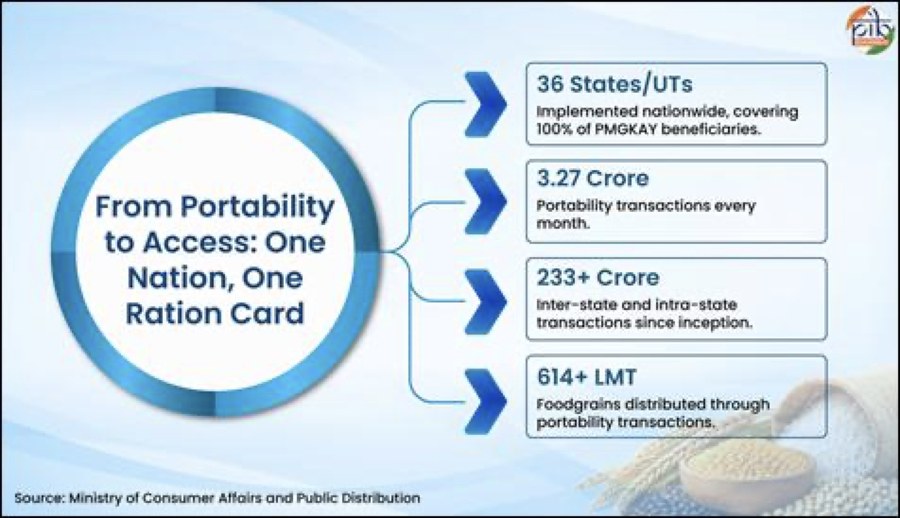
Portability has moved from a pilot to a routine, monthly-scale service across the country. Image courtesy Press Information Bureau / Ministry of Consumer Affairs, Food & Public Distribution; reproduced with credit for educational use.
◈ Key Terms Explained from the Basics
- Portability: the ability to draw an entitlement at a location other than where it was registered — like mobile number portability, but for food rations.
- Intra-State vs inter-State portability: moving to another district/shop within the same State, versus moving to another State.
- Aadhaar seeding: linking each ration card and beneficiary record to the person's Aadhaar number, so one person cannot appear on two cards.
- e-KYC: electronic identity verification against UIDAI records — the step that confirms the person on the card is real and alive.
- ePoS (electronic Point of Sale): the biometric device at the ration shop that authenticates the buyer and records every sale online.
- De-duplication: data analytics that flags duplicate, ghost or ineligible entries for field verification before deletion.
The Digital Backbone Behind Portability
Portability is possible only because the underlying records are digital and linked. The Department reports the following status as of September–October 2026:
- Databases: ration-card and beneficiary records are 100% digitised, covering about 78.65 crore beneficiaries, and published on State/UT transparency portals.
- Aadhaar seeding: 20.27 crore of 20.51 crore ration cards (98.8%); 76.97 crore beneficiaries seeded.
- e-KYC: completed for 71.52 crore beneficiaries (91%) as on 30 September 2026.
- Shops: 5.50 lakh of 5.51 lakh FPSs (99.8%) run on ePoS.
- Supply chain: online allocation nationwide; supply chain computerised in 31 States/UTs.
- Grievances: transparency portals, online grievance systems and toll-free helplines in every State/UT.
Figure 3 — How far PDS digitisation has gone (per cent)
Databases digitised100%FPSs on ePoS99.8%Ration cards Aadhaar-seeded98.8%Beneficiaries with e-KYC91%States/UTs: supply chain computerised86.1% (31/36)0%100%
Front-end digitisation (records, shops, Aadhaar seeding) is nearly complete; e-KYC and supply-chain computerisation are the remaining gaps. Each bar has a different base, as stated in its label.
Rightful Targeting and the SARTHAK-PDS Umbrella
- Rightful Targeting (Version 1): Aadhaar–PDS analytics flagged 5.95 crore suspicious records; 2.58 crore duplicate or ineligible entries were deleted after verification.
- A later round (Version 3): about 3.63 crore records were flagged and about 68 lakh deleted, as reported by the Department.
- SARTHAK-PDS (Scheme for Assistance in Ration Transport and Handling-Income with Automation in PDS): the umbrella scheme, running until 31 March 2031. It funds intra-State movement, handling and FPS dealer margins.
- NIRMAL: component for data architecture and analytics.
- SAKSHAM: component for real-time data integration, including Vehicle Location Tracking Systems, from procurement to distribution.
- SMART-PDS (Scheme for Modernisation and Reforms through Technology in PDS): links ration cards, distribution, supply chain and grievances on an integrated central system, filling State-level technology gaps.
Mera Ration App — The Beneficiary Interface
Launched in 2021, the Mera Ration app is now available in 13 languages. It is designed mainly for migrants who arrive in a new town and do not know where their nearest ration shop is.
- Information: monthly entitlement, past transactions, Aadhaar-seeding status and eligibility for national portability.
- Action: voluntary ONORC registration, plus GPS-based FPS locator and map navigation to the nearest shop.
Why It Matters
- Migrants: Census 2011 counted about 45 crore internal migrants (around 37% of the population); the Economic Survey 2016–17 estimated about 90 lakh people move between States each year. Earlier, migrating meant losing one's ration.
- Constitutional value: it makes the NFSA entitlement follow the person, giving practical effect to Article 19(1)(e) (freedom to reside anywhere) without loss of a welfare right.
- Leakage control: biometric sale and de-duplication shrink the space for ghost cards and diversion.
- Beneficiary choice: a cardholder can switch shops, giving FPS dealers an incentive to serve better.
- Judicial push: in June 2021, the Supreme Court (in the suo motu case on migrant workers' problems) directed all States/UTs to implement ONORC by 31 July 2021.
The Critical View
- Authentication failures: worn fingerprints of manual workers and the elderly, and patchy connectivity, can lead to exclusion at the shop; robust offline and non-biometric fallbacks are essential.
- Deletions need due process: removal of "ineligible" entries can sweep in genuine families; transparent verification, notice and appeal must accompany every deletion drive.
- An outdated ceiling: NFSA coverage is still computed on Census 2011 population. Eligible people added since then may remain outside the quota until the next Census (reference date 1 March 2027) is used.
- Receiving-State stock planning: heavy inflows to migrant-destination States strain FPS stocks and dealer margins, which are already thin.
- Awareness gap: much portability is intra-State; many inter-State migrants still do not know they can draw rations away from home.
- Nutrition, not just calories: the basket is cereal-heavy; pulses, millets and fortified rice matter for tackling hidden hunger.
- Data protection: linked databases of nearly 79 crore people must meet the standards of the Digital Personal Data Protection Act, 2023.
Way Forward
- Pair portability with dynamic allocation, so grain follows migration patterns in real time.
- Use e-Shram registrations to bring unorganised migrant workers without cards into the PDS net.
- Make exception handling (OTP, iris, nominee) a right, not a dealer's discretion.
- Revise coverage once fresh Census data is available, and diversify the basket toward millets and pulses.
▤ Prelims Hooks
- ONORC launch: 2019; nodal: Department of Food & Public Distribution; platform: IM-PDS.
- NFSA, 2013 coverage: 75% rural / 50% urban; 5 kg per person (PHH), 35 kg per household (AAY).
- TPDS: 1997; AAY: 2000; FCI: 1965; PMGKAY free grain extended to 2028.
- SARTHAK-PDS components: NIRMAL (analytics), SAKSHAM (real-time tracking), SMART-PDS (integrated tech); valid to 31 March 2031.
- Mera Ration app: 13 languages; Entry 33, Concurrent List covers foodstuff distribution.
✎ Mains Practice Question
"One Nation One Ration Card has made the food entitlement under the National Food Security Act portable, but portability alone does not guarantee food security for migrant workers." Critically examine. 15 marks · 250 words
Indian EconomyGeneral Studies Paper III
02
NITI Aayog's Impact Assessment of the Production Linked Incentive (PLI) Schemes
GS-III · Economy — Industrial Policy, Manufacturing, Growth & EmploymentPrelims + MainsPIB · NITI Aayog · 12 Nov 2026
NITI Aayog, with IIM Ahmedabad as knowledge partner, has released the first sector-wise evaluation of all 14 PLI schemes. Its headline finding is that nearly 70% of targeted segments are on track.
◈ From the Basics: What Is a Production Linked Incentive?
A PLI is a payment the Government makes to a manufacturer as a percentage of its incremental sales — sales above a fixed base year — of goods made in India. The firm must also meet minimum investment and sales thresholds.
The logic differs from an old-style subsidy. The firm is rewarded only after it produces and sells more, so public money follows output rather than promises. Rates vary by sector and usually taper over the scheme period.
- Scale: it rewards firms that build large, globally competitive plants, addressing the small-scale problem of Indian manufacturing.
- Global value chains (GVCs): it aims to pull production of components and finished goods into India as firms diversify supply chains.
- Domestic value addition (DVA): the share of a product's value actually created in India — the true test of whether manufacturing has deepened or merely assembled imports.
Static Background: The Lineage of Manufacturing Policy
- National Manufacturing Policy, 2011: set a goal of raising manufacturing to 25% of GDP and creating 10 crore jobs by 2022.
- Make in India (September 2014): an investment-promotion and ease-of-doing-business push across 25 sectors.
- MEIS → RoDTEP: a WTO panel (2019) found India's export subsidy, the Merchandise Exports from India Scheme, inconsistent with WTO rules; it was replaced by RoDTEP from January 2021.
- PLI (2020): launched first for mobile phones and electronic components (LSEM), bulk drugs and medical devices; extended under Atmanirbhar Bharat. The Union Budget 2021–22 announced a combined outlay of about ₹1.97 lakh crore for 14 sectors.
- Why the design is WTO-safe: the Agreement on Subsidies and Countervailing Measures (SCM) prohibits subsidies tied to exports or to local content. PLI pays on total incremental sales, domestic and export, to stay outside that prohibition.
▤ Report at a Glance
- Title: Impact Assessment of PLI Schemes.
- Released by: NITI Aayog; knowledge partner Indian Institute of Management, Ahmedabad.
- Scope: all 14 notified PLI sectors, implemented by different Ministries/Departments.
- Parameters: investment, additional production, exports and employment.
- Data: firm-level data from implementing Ministries, supplemented by industry-level inputs.
- Rating categories: On-Track, Partial Impact, Insignificant Evidence of Impact and Data Unavailable.
- Headline: nearly 70% of targeted segments on track; investment and production reported above targets.
What the Report Found
- Strongest performers: Pharmaceuticals, Mobile Manufacturing (LSEM), Food Processing, Telecom, White Goods, Automobiles and Drones — the last described as an early implementation success.
- Clean energy: manufacturing capacity in High-Efficiency Solar PV Modules has expanded significantly.
- Frontier sectors: ACC Batteries, Specialty Steel and Technical Textiles show gradual capacity and ecosystem build-up.
- Pattern: sectors with strong industry participation did best.
- Caveat in the report itself: long-term effectiveness depends on deeper domestic value addition and stronger supply chains; it calls for more MSME participation and harmonised data systems.
Figure 4 — How the PIB summary characterises the 14 PLI sectors
Notable progress7 sectors• Pharmaceuticals• Mobile mfg. (LSEM)• Food processing• Telecom & networking• White goods• Automobiles & parts• Drones (early success)Significant capacityexpansion · 1 sector• High-efficiencysolar PV modulesGradual build-up3 sectors• ACC batteries• Specialty steel• Technical textilesNot individuallydescribed in summary · 3• Critical KSMs / APIs• Medical devices• IT hardwareGrouping follows the wording of the PIB release; the full report rates each segment On-Track / Partial / Insignificant / Data Unavailable.
Mature, demand-led sectors (phones, pharma, autos, appliances) responded fastest; deep-tech sectors such as battery cells and specialty steel are still at the build-up stage.
The Critical View
- Assembly vs manufacturing: in electronics, output and exports have risen sharply, but much of the value still comes from imported components. This is why the follow-on Electronics Component Manufacturing Scheme (2025) targets the component layer.
- Concentration: incentives flow to a few large firms by design; MSME suppliers benefit only if linkages are deliberately built.
- Jobs: capital-intensive sectors such as ACC batteries and solar create relatively few jobs per rupee of incentive.
- Data gaps: a "Data Unavailable" category in an official evaluation shows the need for harmonised, public reporting across Ministries.
- The sunset question: PLIs are time-bound; the test is whether firms stay competitive after incentives end, which depends on logistics, power, labour and tariff policy.
- Fiscal discipline: incentive payments should be tied to verified output, with clear criteria to exit sectors that do not respond.
▤ Prelims Hooks
- PLI sectors: 14; combined outlay about ₹1.97 lakh crore (Budget 2021–22).
- Incentive base: incremental sales over a base year — not export performance.
- NITI Aayog: set up on 1 January 2015 by executive resolution, replacing the Planning Commission (1950); neither constitutional nor statutory.
- WTO SCM Agreement: prohibits export-contingent and local-content-contingent subsidies.
✎ Mains Practice Question
The Production Linked Incentive schemes have succeeded in raising investment and output, but their long-term value depends on domestic value addition. Evaluate the PLI approach as a tool of industrial policy in India. 15 marks · 250 words