
Published on Apr 14, 2026
Daily PIB Summaries
PIB Summaries 14 April 2026
Content
- National Agriculture Market (e-NAM)
- ANRF developing AI-based platform ‘SARAL AI’
National Agriculture Market (e-NAM)
Why in News?
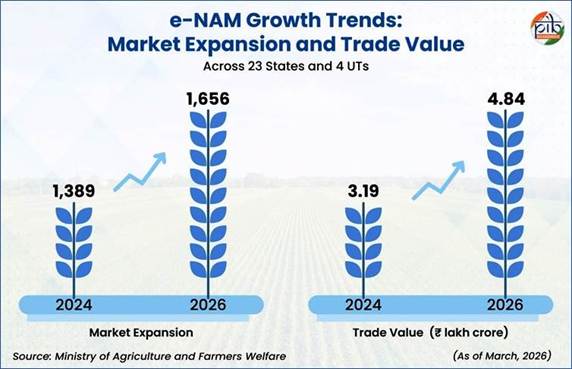
- On 13 April 2026, Government data highlighted expansion of e-NAM to 1,656 mandis, with rising trade value and farmer participation, signalling deeper digital integration of agricultural markets.
Issue in Brief
- e-NAM, launched on 14 April 2016, is a pan-India electronic trading portal integrating APMC mandis to enable transparent price discovery and nationwide agricultural trade.
- By March 2026, cumulative trade reached ₹4.84 lakh crore (13.25 crore MT), indicating rapid scaling and growing institutional adoption.
Relevance
- GS Paper II: Governance, Cooperative Federalism, Welfare delivery (farmer-centric reforms)
- GS Paper III: Agriculture, Agricultural Marketing Reforms, Digital Economy, Inclusive Growth
Practice Question
- “e-NAM seeks to transform India’s fragmented agricultural markets into a unified national market. Evaluate its impact on price discovery, farmer welfare, and market efficiency, while highlighting key challenges.” (250 words)
Structural Background: APMC Constraints
- India has ~6,900+ APMC mandis, governed by state laws, resulting in fragmented markets, entry barriers, and restricted inter-state agricultural trade flows.
- Trader cartels and multiple mandi fees historically depressed farm-gate prices and increased transaction costs, disproportionately affecting small and marginal farmers.
- e-NAM acts as a digital integration layer, not a replacement, connecting mandis into a single national market architecture.
Core Features and Operational Architecture
- e-NAM offers end-to-end digital trade lifecycle: gate entry, assaying, electronic bidding, price discovery, and direct bank payment settlement.
- Platform integrates 1.80 crore farmers, 2.73 lakh traders, and 4,724 FPOs (March 2026), demonstrating expanding stakeholder participation.
- Supports 247 tradable commodities, expanding diversification and improving farmers’ access to multiple markets and buyers.
- Provides inter-state trading through unified licensing, reducing geographical barriers and enabling competitive national-level bidding.
Multi-Dimensional Impact
Constitutional and Federal Dimension
- Advances Article 38 (economic justice) and Article 39(b) by ensuring equitable access to markets and reducing exploitative intermediaries in agricultural trade.
- Reflects cooperative federalism, where agriculture remains a State subject, but Centre provides digital infrastructure and financial assistance for mandi integration.
Governance and Administrative Dimension
- Digital workflows reduce discretionary power of intermediaries, improving transparency, auditability, and accountability in mandi operations.
- Real-time dashboards enable data-driven governance, allowing policymakers to monitor price trends, arrivals, and inter-state trade flows efficiently.
- Government provides financial assistance up to ₹75 lakh per mandi for infrastructure upgradation, strengthening digital ecosystem integration.
Economic Dimension
- Competitive bidding across mandis improves price realisation, reducing dependence on local traders and enhancing farmers’ income potential.
- Trade value increased from ₹3.19 lakh crore (2024) to ₹4.84 lakh crore (March 2026), reflecting deepening market penetration and efficiency gains.
- Integration with logistics, warehousing, and financial services reduces transaction costs and supply chain inefficiencies.
Social Dimension
- Participation of 4,724 FPOs enhances aggregation, enabling small farmers to achieve economies of scale and stronger bargaining power.
- Direct digital payments via UPI, NEFT, RTGS promote financial inclusion and create formal credit histories for farmers.
- Reduces dependency on arthiyas (commission agents), limiting exploitative informal credit-trade linkages.
Technology and Innovation Dimension
- Incorporates AI-enabled quality assaying, improving standardisation, dispute resolution, and enabling quality-based price discovery mechanisms.
- Platform of Platforms (PoP) launched on 14 July 2022 integrates logistics, insurance, warehousing, and advisory services into a unified interface.
- Mobile-based access ensures scalability, though effectiveness depends on digital literacy and rural internet penetration levels.
Environmental Dimension
- e-NWR integration reduces physical transportation of produce, lowering logistics costs and associated carbon emissions in agricultural supply chains.
- Scientific warehousing reduces post-harvest losses (estimated 6–10% in India), improving resource efficiency and sustainability.
Institutional Innovation: e-NWR Integration
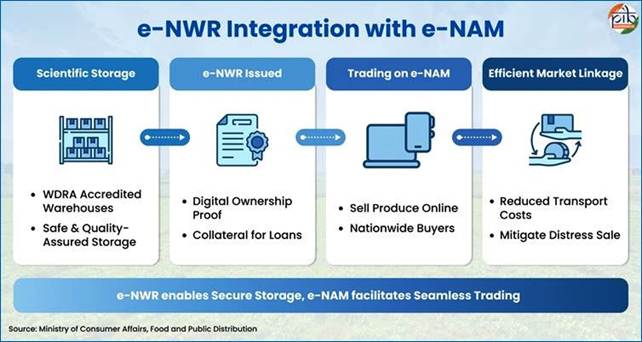
- Electronic Negotiable Warehouse Receipts (e-NWR) enable digital ownership and transfer of stored produce without physical movement, improving market flexibility.
- Farmers can use e-NWR as collateral for institutional credit, enhancing liquidity and reducing distress sales immediately after harvest.
- Integration with e-NAM links storage, finance, and market access, strengthening the agricultural value chain and price discovery efficiency.
Challenges and Structural Gaps
- Only about 23% of total APMC mandis are integrated with e-NAM, limiting its reach and effectiveness in achieving full national market integration.
- Inter-state trade remains low, as many states have not fully amended APMC laws to allow seamless electronic trading across borders.
- Rural digital divide persists, with rural teledensity ~60% compared to >140% urban, constraining digital participation.
- Inadequate infrastructure such as assaying labs, grading facilities, and reliable internet connectivity limits quality-based trading adoption.
- Behavioural resistance persists as farmers prefer cash transactions and trusted local intermediaries, slowing digital adoption.
Way Forward
- Harmonise APMC Acts across states to enable seamless inter-state trade and deepen the “One Nation, One Market” framework.
- Expand digital infrastructure through BharatNet and mandi modernisation, ensuring universal connectivity and real-time access to e-NAM services.
- Strengthen assaying, grading, and warehousing infrastructure, ensuring quality-based pricing and improved market trust.
- Promote digital literacy via KVKs and extension services, targeting small and marginal farmers for inclusive participation.
- Integrate private agri-tech platforms and e-commerce players, creating a hybrid competitive agricultural marketing ecosystem.
- Use AI and big data analytics for price forecasting, crop planning, and real-time decision-making support.
Prelims Pointers
- Launch date: 14 April 2016
- Implementing agency: Small Farmers’ Agribusiness Consortium (SFAC)
- PoP launch: 14 July 2022
- e-NWR Act: Warehousing (Development and Regulation) Act, 2007
- e-NAM integrates APMCs; does not replace them
ANRF developing AI-based platform ‘SARAL AI’
Why in News?
- On 13 April 2026, Government reviewed Anusandhan National Research Foundation (ANRF) progress and announced SARAL AI, an AI platform to simplify research into multilingual public-oriented formats.
Issue in Brief
- ANRF, India’s apex research body, is shifting focus toward mission-mode research, societal impact, and innovation-led governance, aligning science outputs with national development priorities.
- Launch of SARAL AI enables conversion of complex research into podcasts, videos, and social media content in 18 Indian languages, enhancing accessibility and outreach.
Relevance
- GS Paper III: Science & Technology (AI, R&D ecosystem), Innovation, Digital Public Infrastructure
- GS Paper II: Governance (Science policy, institutional frameworks), Education (research accessibility)
Practice Question
- “AI-based platforms like SARAL developed by ANRF aim to democratise scientific knowledge and strengthen India’s research ecosystem. Critically analyse their significance and limitations.” (250 words)
Static Background and Basics
- The Anusandhan National Research Foundation Act, 2023 (Act No. 25 of 2023) received Presidential assent on 12 August 2023, establishing ANRF as India’s apex research coordination body.
- The Act came into force on 5 February 2024, signalling a major reform in India’s fragmented research funding architecture.
- ANRF replaces the Science and Engineering Research Board (SERB, 2008) and expands scope to include industry participation and interdisciplinary research ecosystems.
- It aligns with National Education Policy (NEP) 2020, aiming to build a robust, innovation-driven knowledge economy through integrated R&D systems.
Key Developments (Data-rich)
- ANRF evaluated nearly 20,000 research applications within 4 months, indicating rapid expansion and strong national participation in research funding programmes.
- Deployment of nodal officers in ~250 institutions improves administrative efficiency and reduces procedural delays in research project execution.
- SARAL AI will convert research outputs into podcasts, short videos, presentations, and multilingual content in 18 Indian languages, enhancing science communication.
- Launch of MAHA (Mission for Advancement in High Impact Areas) programmes promotes mission-driven research targeting national priorities like climate resilience, agriculture, and health.
Conceptual Foundation: Science–Society Interface
- Traditional research ecosystems often suffer from knowledge silos, where scientific outputs remain inaccessible to policymakers, industry, and citizens.
- ANRF introduces a “lab-to-society” model, ensuring research translates into policy inputs, technological solutions, and public awareness.
- SARAL AI operationalises this by converting technical knowledge into vernacular, simplified, and scalable communication formats.
Dimensions
Constitutional and Ethical Dimension
- Promotes scientific temper (Article 51A(h)), enabling citizens to understand science in accessible formats and fostering rational, evidence-based societal decision-making.
- Strengthens democratic participation, as informed citizens can engage with policies related to health, climate change, and technology.
Governance and Administrative Dimension
- ANRF centralises fragmented funding mechanisms, improving coordination across ministries, institutions, and research domains.
- Appointment of nodal officers enhances ease of doing research, reducing bureaucratic delays and improving project execution efficiency.
- Promotes mission-mode governance, aligning research funding with national priorities instead of isolated academic pursuits.
Economic and Innovation Dimension
- India’s GERD remains ~0.64% of GDP, significantly lower than global leaders like USA (~3.5%) and China (~2.4%), indicating underinvestment in R&D.
- ANRF aims to crowd-in private sector participation, currently ~36% of total R&D expenditure, compared to >70% in developed economies.
- MAHA programmes focus on high-impact sectors, accelerating innovation-led growth and improving India’s global competitiveness.
Social Dimension
- SARAL AI’s 18-language output addresses linguistic barriers, enabling inclusive dissemination of scientific knowledge across rural and non-English populations.
- Simplified formats such as podcasts and videos enhance public engagement with science, improving awareness in areas like health, agriculture, and disaster management.
- Encourages youth and early-career researchers, strengthening India’s human capital in science and innovation.
Technology and AI Dimension
- SARAL AI represents application of Generative AI in science communication, transforming dense academic outputs into structured, accessible content.
- Integration with platforms like WhatsApp and digital channels ensures real-time dissemination and wider outreach.
- Reflects India’s push toward AI-enabled governance and knowledge ecosystems, aligning with emerging global digital trends.
Science Policy and Institutional Dimension
- ANRF shifts focus from fragmented schemes to “fewer, high-impact flagship programmes”, improving efficiency and reducing duplication in funding.
- Emphasis on Technology Readiness Levels (TRLs) ensures faster transition from laboratory research to real-world applications.
- Initiatives like ATRI (Translational Research Initiative) bridge gap between TRL-4 (lab validation) and TRL-7 (commercialisation), addressing innovation bottlenecks.
Challenges and Concerns
- India’s low R&D expenditure (~0.64% of GDP) limits global competitiveness despite institutional reforms like ANRF.
- Risk of AI-driven oversimplification, potentially distorting complex scientific findings or reducing technical accuracy in public communication.
- Uneven research capacity across institutions, especially in state universities and tier-2/3 cities, limits equitable utilisation of ANRF funding.
- Limited private sector participation constrains innovation-commercialisation pipeline, affecting technology translation into market-ready solutions.
- Digital divide and infrastructural gaps may hinder last-mile dissemination of simplified scientific knowledge despite multilingual initiatives.
Way Forward
- Increase R&D expenditure to at least 1–2% of GDP, ensuring sustained funding for innovation and aligning with global benchmarks.
- Develop AI governance and validation frameworks to ensure accuracy, credibility, and ethical use of SARAL AI outputs.
- Strengthen industry-academia collaboration through co-funded projects, innovation clusters, and incentives for private R&D investment.
- Expand research infrastructure and institutional capacity, particularly in emerging universities and regional institutions.
- Promote science communication as a discipline, integrating it into education, research training, and public outreach strategies.
- Align ANRF initiatives with national missions like Viksit Bharat 2047, Digital India, and Climate Action goals.
Prelims Pointers
- ANRF Act: 2023 (Act No. 25 of 2023)
- Assent date: 12 August 2023
- Operationalised: 5 February 2024
- Replaces: Science and Engineering Research Board (SERB)
- SARAL AI:
- AI-based science communication platform
- Multilingual (18 languages)