
In-Depth PIB Analysis2 Items
Core TopicImportantConcise
Social Justice & WelfareGS Paper II
01SHATAYU — National Geriatric Caregiver Directory
Environment & EnergyGS Paper III
02India’s Renewable Energy Journey — Status & Schemes
Social Justice & WelfareGeneral Studies Paper II · Vulnerable Sections
01
SHATAYU: Building a Skilled Geriatric Care Workforce for an Ageing India
GS-II · Social Justice — Welfare of Vulnerable Sections (Senior Citizens), Government PoliciesGS-I · Society — Population & Associated IssuesPrelims + MainsPIB · Ministry of Social Justice & Empowerment · 13 Nov 2026
The Department of Social Justice and Empowerment reports that SHATAYU — Senior Holistic Care Assistance and Training for Your Utility — now lists 30,151 trained caregivers across States and UTs. It is a national digital directory that connects families with professional geriatric caregivers.
◈ From the Basics: Ageing, Geriatric Care and the Care Economy
- Senior citizen: a person aged 60 years or above, as defined in the Maintenance and Welfare of Parents and Senior Citizens Act, 2007.
- Geriatric care: health and support services for older people — help with daily activities, mobility, chronic illness, dementia and end-of-life (palliative) care.
- Care economy: all paid and unpaid work of caring for children, the elderly, the sick and persons with disabilities. Much of it is unpaid and done by women within families.
- Why it matters now: smaller, nuclear families and migration of working-age children mean fewer family members are available to provide care at home.
Static Background: India's Framework for Older Persons
- Constitution: Article 41 (DPSP) directs the State to provide public assistance in cases of old age, sickness and disablement; "relief of the disabled and unemployable" is Entry 9, State List, while social security is Entry 23, Concurrent List.
- National Policy on Older Persons, 1999: the first policy framework for the financial security, health care and protection of the elderly.
- Maintenance and Welfare of Parents and Senior Citizens Act, 2007: a legal duty on children and relatives to maintain parents and senior citizens, enforced through Maintenance Tribunals.
- Atal Vayo Abhyuday Yojana (AVYAY): the umbrella scheme of the Department, covering Integrated Programme for Senior Citizens (old-age homes, day-care), Rashtriya Vayoshri Yojana (assistive devices), and the national elderly helpline Elderline (14567).
- Social security: the Indira Gandhi National Old Age Pension Scheme under the National Social Assistance Programme (1995).
- Health: the National Programme for Health Care of the Elderly (NPHCE), and Ayushman Bharat PM-JAY cover extended in 2024 to all citizens aged 70+ regardless of income.
Figure 1 — India is ageing fast: share of population aged 60+
202210.5%≈ 14.9 crore people2050 (projected)20.8%≈ 34.7 croreSource of estimates: India Ageing Report 2023 (UNFPA–IIPS). Bars to scale (20 px per percentage point).
The elderly share is set to double by mid-century; one in five Indians will be over 60, raising demand for trained caregivers far beyond what families alone can supply.
▤ Scheme at a Glance — SHATAYU
- Launched: 22 May 2026, at the National Workshop on "Creating a Well-Functioning Care Economy".
- Nodal Department: Department of Social Justice and Empowerment, Ministry of Social Justice and Empowerment.
- Nature: a centralised national Geriatric Caregiver Dashboard and Directory — a digital matching platform, not a direct service provider.
- Scale: 30,151 caregivers listed, searchable by State/UT and district.
- Cost to users: searching and placing callback requests are free of charge; covers full-time and hourly care.
- Training partners: National Institute of Social Defence (NISD) (MoSJE) and National Skill Development Corporation (NSDC) (MSDE).
- Portal: shatayu.dosje.gov.in.
Figure 2 — How SHATAYU connects caregivers and families
CAREGIVER SIDE1 · Enroldetails + training certificates2 · Review & approvalstatus tracked on dashboard3 · Listedin the national directoryFAMILY / INSTITUTION SIDEA · Searchby State/UT, district, care typeB · Request callbackOTP-verified contactC · Shared withcaregivers in that districtDirect connectcare delivered →feedback & ratingSchematic based on the features described in the PIB release.
SHATAYU works as a matching platform: the State certifies and lists trained workers, and families reach them locally through a verified, free channel.
What the Platform Offers
- Services covered: general geriatric care, post-surgical care, dementia and Alzheimer's care, physiotherapy and mobility assistance, palliative care, and help with daily living and rehabilitation.
- Four training categories: Geriatric Care Provider, Geriatric Caregiver (institutional and home care), Wellness Therapist (Elderly) and Elderly Care Companion.
- Competencies: physiological monitoring, emergency handling, bedside mobility, therapeutic rehabilitation, cognitive engagement and emotional companionship.
- Trust features: OTP-based verification, profile access, enrolment tracking and a feedback and rating system.
Figure 3 — SHATAYU at a glance (official infographic)
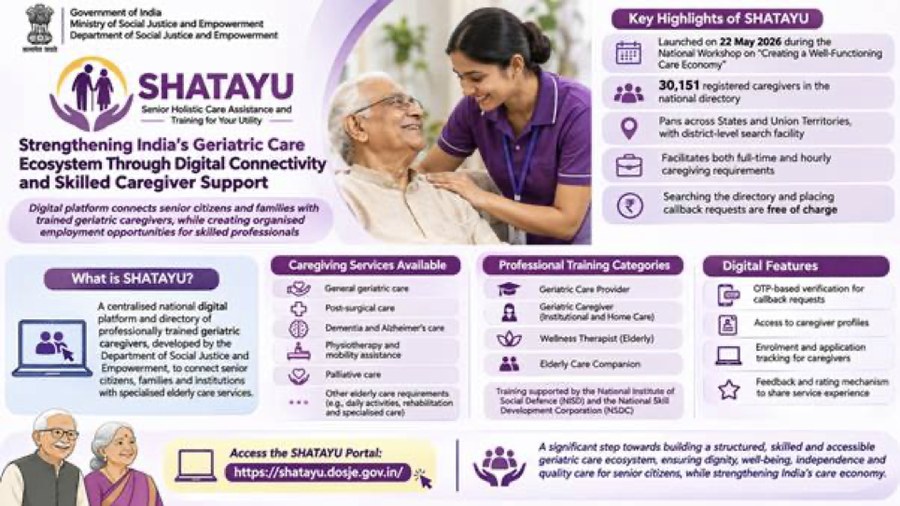
Services, training categories and digital features of the platform. Image courtesy Press Information Bureau / Ministry of Social Justice & Empowerment; reproduced with credit for educational use.
Significance
- Formalising care work: it gives trained caregivers visibility, credentials and a route to organised employment in a largely informal market.
- Women's employment: paid care work can draw more women into the labour force while easing the unpaid care burden that falls mainly on them.
- Ageing in place: home-based care lets older persons stay in familiar surroundings, which is usually cheaper and preferred over institutional care.
- Skilling linkage: it links NSDC/NISD training to actual jobs, addressing the gap between certification and employment.
The Critical View
- Scale gap: about 30,000 listed caregivers is small against an elderly population of nearly 15 crore.
- Affordability: the directory is free, but care itself is paid; poorer households may still be unable to afford it without subsidy or insurance.
- Quality and safety: background verification, grievance redress and protection against abuse of elders need clear rules.
- Worker protection: wages, working hours and social security for home-based caregivers are not yet defined; the Code on Social Security, 2020 offers a possible route for coverage.
- Digital divide: many older persons in rural areas cannot use online platforms; assisted access through panchayats or helplines will be needed.
▤ Prelims Hooks
- SHATAYU: launched 22 May 2026; Department of Social Justice and Empowerment; 30,151 caregivers; four training categories.
- Training partners: NISD (MoSJE) and NSDC (MSDE).
- Senior citizen = 60+ (MWPSC Act, 2007); Article 41 — public assistance in old age.
- Elderline: 14567; AVYAY is the umbrella scheme for senior citizens.
✎ Mains Practice Question
India's demographic transition is turning elderly care from a family responsibility into a public policy concern. Examine the need for a formal care economy in India, with reference to recent initiatives for geriatric caregivers. 15 marks · 250 words
Environment, Energy & InfrastructureGeneral Studies Paper III
02
India's Renewable Energy Journey: Where the Transition Stands and the Schemes Driving It
GS-III · Infrastructure — Energy; Environment — Climate Change MitigationPrelims + MainsPIB · Ministry of New & Renewable Energy · 13 Nov 2026
India's installed power capacity has grown from 249 GW in 2014 to about 560 GW in October 2026. Non-fossil sources now make up about 55% of installed capacity, and India ranks third in the world in installed renewable capacity.
◈ From the Basics: Reading Energy Numbers
- Capacity vs generation: capacity (GW) is the maximum output a plant can produce; generation (GWh or units) is the electricity actually produced over time.
- Capacity utilisation factor (CUF): actual output as a share of maximum possible output. Solar plants run only in daylight, so their CUF in India is typically around 18–20%, far below coal.
- The implication: a 55% share of capacity translates into a much smaller share of electricity generated; storage and transmission decide how much clean power is actually used.
- Renewable vs non-fossil: "non-fossil" includes nuclear and large hydro in addition to solar, wind, small hydro and bio-power.
- Variable renewable energy: solar and wind output depends on weather and time of day, so grid flexibility — storage, hydro, demand response — becomes essential.
Static Background: The Policy Lineage
- 1981–1992: the Commission for Additional Sources of Energy (1981), then a Department of Non-Conventional Energy Sources (1982), became a separate Ministry in 1992, renamed Ministry of New and Renewable Energy (MNRE) in 2006.
- Electricity Act, 2003: provided for Renewable Purchase Obligations on distribution companies.
- National Action Plan on Climate Change (2008): its National Solar Mission (2010) began with a 20 GW target, raised in 2015 to 100 GW within an overall 175 GW renewable goal for 2022.
- International Solar Alliance (2015): launched by India and France at COP21, Paris; headquartered in Gurugram.
- COP26 (2021) — Panchamrit: 500 GW of non-fossil capacity by 2030 and net zero by 2070.
- Updated NDC (2022): about 50% of installed capacity from non-fossil sources by 2030 — a target India has now crossed well ahead of time.
Numbers at a Glance
~560 GW
Total installed capacity (Oct 2026), from 249 GW in 2014
308 GW
Non-fossil capacity — 55% of total (31 July 2026)
3rd
Global rank in renewable installed capacity
$63.7 bn
RE investment, July 2024 – June 2026
Figure 4 — India's renewable capacity by source (GW, late October 2026)
Solar~175Wind59.20Hydro (large + small)57.49Bio-power11.75Solar as on 31 Oct 2026; others as on 29 Oct 2026 (PIB). Nuclear, also non-fossil, is not shown. Bars to scale.
Solar now makes up the bulk of India's clean capacity — more than wind, hydro and bio-power combined.
Solar: From 2.8 GW to ~175 GW
Installed solar capacity has grown about 60-fold since 2014. In 2025, India added more than 37 GW, becoming the world's second-largest solar growth market ahead of the United States (34 GW).
Figure 5 — India's solar capacity growth (official infographic)
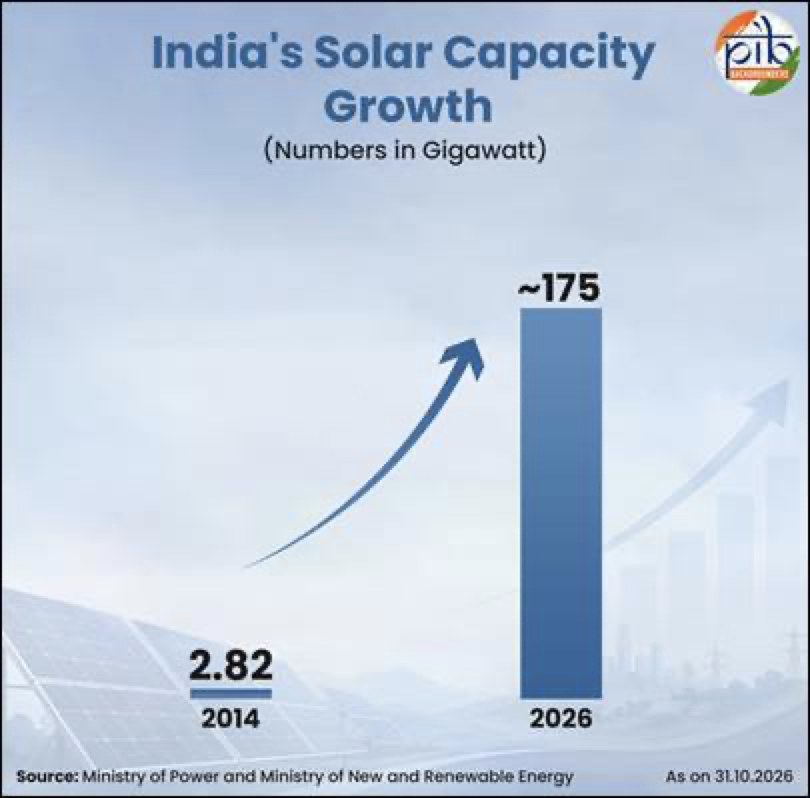
From 2.82 GW (2014) to ~175 GW (31 October 2026). Image courtesy Press Information Bureau / Ministry of Power and MNRE; reproduced with credit for educational use.
▤ Schemes at a Glance
- PM-Surya Ghar: Muft Bijli Yojana (Feb 2024): outlay ₹75,021 crore for rooftop solar on 1 crore households; 65.26 lakh households covered, 19.1 GW commissioned, about ₹35,800 crore of subsidy transferred.
- PM Surya Sarovar Yojana (31 July 2026): ₹5,070 crore for 5,000 MW of floating solar with co-located storage of at least two hours (10,000 MWh); FY 2026–27 to 2030–31.
- Offshore wind VGF (June 2024): ₹7,453 crore for 1 GW of offshore wind.
- GOBARdhan — National Circular Bioenergy Scheme (6 Aug 2026): ₹23,731 crore for FY 2026–27 to 2035–36, aiming to raise domestic compressed biogas (CBG) output nearly ten-fold.
- Small Hydro Power Development Scheme (March 2026): ₹2,584.60 crore to add about 1,500 MW through 1–25 MW projects, with a focus on hilly and North-Eastern regions.
- National Green Hydrogen Mission (Jan 2023): ₹19,744 crore; target 5 MMT a year by 2030.
- National Policy on Geothermal Energy (15 Sept 2025): framework for exploring a potential of about 10,600 MW.
◈ Key Terms Explained from the Basics
- Floating solar: panels mounted on reservoirs and lakes; it saves land, cuts evaporation, and the cooling effect of water can improve panel efficiency.
- Viability Gap Funding (VGF): a one-time government grant that covers part of the capital cost so that an economically useful but costly project becomes commercially viable.
- Compressed Biogas (CBG): purified biogas (mostly methane) from agricultural residue, cattle dung and municipal waste, usable like CNG. The SATAT initiative (2018) promoted CBG plants.
- Green hydrogen: hydrogen made by splitting water with renewable electricity. India's Green Hydrogen Standard caps emissions at 2 kg CO₂-equivalent per kg of hydrogen.
- Geothermal energy: heat from within the Earth, available round the clock, unlike solar and wind.
Source-wise Highlights
- Wind: 59.20 GW installed; India is fourth globally. A record 6.05 GW was added in FY 2025–26 (46% more than the previous year); about 28 GW is under implementation; turbine manufacturing capacity is about 24 GW, with 70–80% indigenisation.
- Bio-energy: 11.75 GW of bio-power, mostly bagasse-based cogeneration in sugar mills (about 9.8 GW); 839 CBG plants registered, 210 commissioned.
- Hydro: 57.49 GW (large and small); its flexibility helps balance the grid as solar and wind grow.
- Green hydrogen: about 5.5 lakh MTPA of offtake commitments since 2023, over 70% for export; about 8,000 TPA of production capacity commissioned by February 2026; India's first hydrogen fuel-cell train runs on the Jind–Sonipat section.
- Geothermal: the Geological Survey of India studied 381 hot springs and identified 42 promising sites; well-known areas include Puga Valley (Ladakh) and Tattapani (Chhattisgarh).
The Critical View: What Capacity Numbers Don't Show
- Storage gap: solar peaks at midday while demand peaks in the evening; without large-scale battery and pumped storage, clean power may be curtailed.
- Transmission: renewable-rich areas (Rajasthan, Gujarat) are far from demand centres; Green Energy Corridors must keep pace.
- DISCOM finances: loss-making distribution companies delay payments to generators, raising investment risk.
- Upstream manufacturing: India's module capacity is large, but cells, wafers and polysilicon still depend heavily on imports.
- Land and livelihoods: large solar parks and wind farms compete with agriculture and grazing commons, and affect habitats such as that of the Great Indian Bustard.
- Green hydrogen cost: it remains costlier than grey hydrogen made from natural gas; an export-led offtake model depends on overseas demand.
▤ Prelims Hooks
- Non-fossil share: about 55% of installed capacity (308 GW, July 2026); 500 GW target by 2030.
- Global ranks: 3rd in RE capacity; 4th in wind.
- PM-SSY: floating solar, 5,000 MW + 10,000 MWh storage; PM Surya Ghar: 1 crore households.
- NGHM: 2023, 5 MMT by 2030; Geothermal policy: Sept 2025, potential ~10,600 MW.
- ISA: 2015, HQ Gurugram; MNRE named in 2006.
✎ Mains Practice Question
India has crossed its 2030 NDC target for non-fossil installed capacity well ahead of time, yet coal still dominates electricity generation. Explain this paradox and suggest measures to make the energy transition reliable and equitable. 15 marks · 250 words