

In-Depth PIB Analysis3 Items
Core TopicImportantConcise
International Relations & EconomyGS Paper II / III
01India–MERCOSUR: First Additional Protocol on e-Certificates of Origin
Environment & EcologyGS Paper III
02GIB Conservation, Grassland Restoration & Project Cheetah Review at Bhuj03World Circular Economy Forum 2026, Gandhinagar
International Relations & EconomyTrade Agreements & Economic Diplomacy
01
India and MERCOSUR Sign First Additional Protocol to Facilitate Electronic Certificates of Origin
GS-II · IR — Trade Agreements & GroupingsGS-III · Economy — External TradePrelims + MainsPIB · Ministry of Commerce & Industry
India and the MERCOSUR bloc have amended their 2004 Preferential Trade Agreement to let electronically issued Certificates of Origin carry the same legal validity as paper ones, a incremental but concrete step in trade-facilitation reform.
◆ Background & Context
The India–MERCOSUR Preferential Trade Agreement (PTA) was signed on 25 January 2004 and entered into force on 1 June 2009. It offers preferential tariff concessions on 450 tariff lines from the Indian side and 452 from MERCOSUR.
The First Additional Protocol amends Article 16 of Annex III (Rules of Origin), recognising electronically issued and signed Certificates of Origin as legally equivalent to paper certificates, per each party's domestic law.
▦ Protocol at a Glance
- Parent agreement: India–MERCOSUR PTA, signed 25 Jan 2004; in force since 1 Jun 2009
- What it amends: Article 16 of Annex III (Rules of Origin)
- Signed by: Commerce Secretary Rajesh Agarwal (India), with the Ambassadors of Uruguay and Paraguay, in the presence of Uruguay's Foreign Minister (holding MERCOSUR's rotating Pro Tempore Presidency)
- Coverage: 450 tariff lines (India) / 452 tariff lines (MERCOSUR)
- Entry into force: On completion of internal procedures by India and MERCOSUR parties, and mutual notification — not yet in effect
- Institutional route: Cleared by the PTA's Joint Administrative Committee — discussed at its 4th meeting (27 Nov 2025), adopted at the 5th (9 Apr 2026)
Figure 1 — MERCOSUR membership tiers
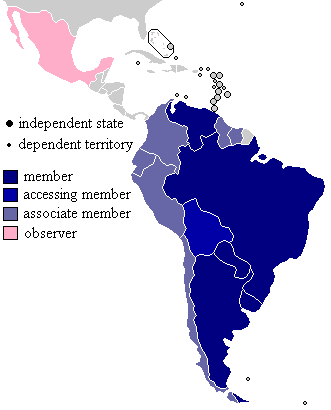
Schematic of MERCOSUR's membership tiers — member, accessing member, associate member and observer. Current status (Sep 2026): full members are Argentina, Brazil, Paraguay, Uruguay and Bolivia (acceded 2024); Venezuela's membership has been suspended since 2016 — the map predates these changes.
Why it matters
- Paper-based Certificates of Origin are a recurring friction point in claiming preferential tariffs — issuance delays, verification lag and physical document loss raise transaction costs.
- Electronic Certificates of Origin are already part of India's trade-facilitation push under other agreements (e.g. ASEAN, India–UAE CEPA); this extends the approach to MERCOSUR.
The critical view
The Protocol only fixes documentation format — it does not expand tariff coverage, which has stayed static at 450–452 lines since 2009 despite repeated talk of expanding the India–MERCOSUR PTA into a fuller trade agreement.
Utilisation of the existing PTA by Indian exporters has also historically been modest, so the gain from paperless certificates is likely to be efficiency-linked rather than volume-linked in the near term.
Institutions & terms to know
- MERCOSUR (Mercado Común del Sur): South American customs union, HQ Montevideo, founded by the 1991 Treaty of Asunción.
- Certificate of Origin: document certifying a good's country of manufacture, used to claim preferential tariff treatment under a PTA/FTA.
- Joint Administrative Committee: the PTA's institutional mechanism for reviewing and amending its provisions.
✎ Mains Practice Question
Preferential Trade Agreements are often updated through protocols rather than renegotiated afresh. Discuss this practice with reference to the India–MERCOSUR PTA, and examine why India's engagement with MERCOSUR has remained limited in scope compared to its other trade partnerships. 15 marks · 250 words
Environment & EcologyBiodiversity, Conservation & Sustainable Development
02
Gujarat Action Plan for GIB Conservation Released; Grassland Restoration and Project Cheetah Reviewed at Bhuj
GS-III · Environment — Biodiversity & ConservationPrelims + MainsPIB · Ministry of Environment, Forest and Climate Change
The Union Environment Minister reviewed three linked conservation efforts at Bhuj, Kachchh — the Critically Endangered Great Indian Bustard, national grassland restoration, and Project Cheetah — releasing a Gujarat-specific GIB action plan and inaugurating a Soft Release Centre for captive-bred birds.
Figure 1 — The Great Indian Bustard (Ardeotis nigriceps)
Representative photograph of the Great Indian Bustard, IUCN Critically Endangered, the subject of the Gujarat Action Plan released at this review.
▦ Conservation Effort at a Glance
- Species: Great Indian Bustard (GIB) — IUCN Critically Endangered
- Plan released: Gujarat Action Plan for GIB Conservation, prepared by the Wildlife Institute of India with the Gujarat Forest Department
- Target: a minimum viable population of 30+ birds over 200–500 sq. km of contiguous habitat (government target)
- Priority landscape: Lala–Rawa (~200 sq. km), Kachchh
- On-ground action so far: ~11 sq. km of Prosopis juliflora-infested grassland restored at Naliya; 30 km of predator-proof fencing over 15 sq. km; a GIB Soft Release Centre established near Naliya for captive-bred birds from Rajasthan
- Breeding intervention: a ‘jump-start’ technique — infertile wild-laid eggs replaced with viable eggs from the conservation-breeding programme; the second such chick has survived past its critical first three months
Grassland restoration — the wider frame
- Grasslands cover nearly 24% of India's land area but remain among its most degraded and least-protected ecosystem types (government figure).
- A proposed five-year national assessment (Wildlife Institute of India, ICFRE, Forest Survey of India, National CAMPA-supported) is meant to build a national grassland-management framework, covering Gujarat's Banni Grassland among others.
Figure 2 — Project Cheetah population trajectory
29Founder cheetahsNamibia & S. Africa, 2022–2352Current populationas of September 202649Cubs born in IndiacumulativeCub survival rate in Kuno: approximately 68%
India's cheetah population has grown from 29 founders (translocated from Namibia and South Africa) to 52, with cub survival at Kuno around 68% — figures as stated at the Bhuj review.
Lineage — Project Cheetah
India's original Asiatic cheetah population was declared extinct in 1952; a translocation of African cheetahs (a related subspecies) began in September 2022 at Kuno National Park under Project Cheetah.
The protected habitat has since expanded to 3,428 sq. km through integrated management of Kuno and Gandhi Sagar, with Banni Grasslands (Gujarat) and Nauradehi Wildlife Sanctuary (Madhya Pradesh) identified as future release sites.
The critical view
Project Cheetah faced early criticism over high mortality among translocated adults and habitat-carrying-capacity concerns; a 68% cub survival rate and population growth to 52 suggest stabilisation, though the programme remains dependent on continual habitat expansion beyond Kuno's original limits.
For GIB, isolated small populations (as in Kachchh) face inbreeding and stochastic extinction risk even where habitat is secured — the plan's 200–500 sq. km target reflects this concern, but power-line collision (a major historical cause of GIB mortality elsewhere in Rajasthan) is not detailed in this release's account of Kachchh-specific mitigation.
Institutions & terms to know
- Wildlife Institute of India (WII): Dehradun-based autonomous institute under MoEFCC, the technical author of both the GIB plan and the grassland assessment proposal.
- National CAMPA: the Compensatory Afforestation Fund body that would support the national grassland assessment.
- MISHTI: Mangrove Initiative for Shoreline Habitats & Tangible Incomes, referenced alongside the Bhuj visit's mangrove review at Jakhau.
✎ Mains Practice Question
"Conservation succeeds when whole landscapes are restored, not isolated species." Examine this statement with reference to India's Great Indian Bustard and Project Cheetah conservation efforts. 15 marks · 250 words
03
India to Host World Circular Economy Forum 2026 at Gandhinagar
GS-III · Environment/Economy — Sustainable DevelopmentPrelims + MainsPIB · Ministry of Environment, Forest and Climate Change
India hosts the World Circular Economy Forum (WCEF) 2026 at Gandhinagar from 15–18 September — the first time the event, co-founded by Finland's Sitra, has been held in South Asia.
▦ Forum at a Glance
- Dates & venue: 15–18 September 2026, Gandhinagar, Gujarat
- Theme: ‘Circular Economy: Transition for People and Prosperity’
- Organisers: Central Pollution Control Board, Finnish Innovation Fund Sitra, Government of Finland, MoEFCC, Government of Gujarat, Gujarat Pollution Control Board
- Scale: 2,000+ stakeholders from 65+ countries; 125+ exhibitors (organiser projection)
- Structure: 4 plenaries and 16 thematic sessions (15–16 Sep); 80 accelerator sessions, online/hybrid and in-person, worldwide (17–18 Sep)
- Side event: in-person Board meeting of the 10-Year Framework of Programmes on Sustainable Consumption and Production (10YFP), which India currently co-chairs
Figure 3 — The circular economy loop
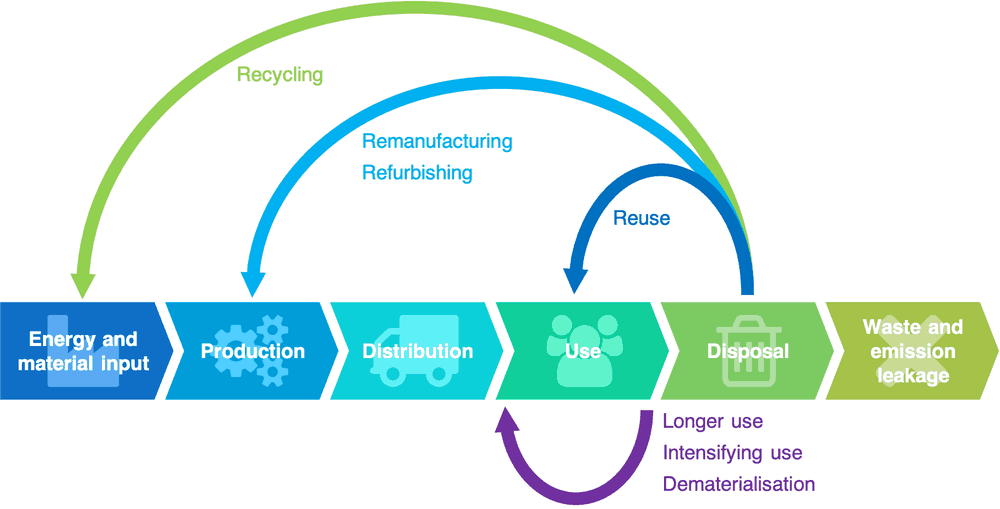
Circularity keeps materials in use through reuse, remanufacturing and recycling, and slows the flow through longer/intensified use, rather than routing everything to disposal and waste.
Why it matters
- A linear "take-make-dispose" economy depletes virgin resources and generates waste and emissions at the disposal stage; circularity aims to decouple economic growth from material and energy consumption.
- Hosting WCEF gives India a platform to showcase domestic circularity initiatives (e.g. extended producer responsibility rules, the National Resource Efficiency Policy process) to a global audience and to mobilise circular finance.
The critical view
India's actual material-recycling and reuse rates remain well below the aspirations typically voiced at such forums, and enforcement of existing rules (plastic waste management, e-waste, EPR) has been uneven. A hosting role signals diplomatic and policy intent but is not itself a measure of domestic circularity performance.
Institutions & terms to know
- Sitra: Finnish Innovation Fund, a public fund under the Finnish Parliament that co-founded WCEF in 2017.
- 10YFP: UN-linked framework on Sustainable Consumption and Production Patterns, under UNEP.
- Circular economy: an economic model prioritising reuse, refurbishment, remanufacturing and recycling over single-use consumption and disposal.
✎ Mains Practice Question
What is meant by a ‘circular economy’? Discuss its relevance to India's resource-security and climate goals, and the gap between policy intent and implementation in this area. 10 marks · 150 words