
In-Depth PIB Analysis3 Items
Core TopicImportantConcise
Indian Economy & Inclusive GrowthGS Paper III · GS Paper I
01Women, Work & Enterprise — LFPR, Credit, Labour Codes
Science & TechnologyGS Paper III
02NITI Aayog’s Data Centre Evaluation Framework
Environment & EcologyGS Paper III
03Ramsar Sites 102 & 103 — Sukhna & Sauj Jheel
Indian Economy & Inclusive GrowthGeneral Studies Paper III · Paper I (Women & Society)
01
Women, Work and Enterprise: From Rising Participation to the Quality of Employment
GS-III · Economy — Employment, Inclusive Growth, MSMEsGS-I · Society — Role of WomenPrelims + MainsPIB Backgrounder · MoSPI, M/o MSME, M/o Labour & Employment · 15 Oct 2026
The female Labour Force Participation Rate (LFPR) has risen from 23.3% in 2017-18 to 40.0% in 2025. A Government backgrounder now shifts the question from how many women work to on what terms — formal identity, credit, markets, skills and workplace rights.
◈ Background & Context
India’s female LFPR fell through the 2000s and 2010s and touched a low in 2017-18, the first year of the Periodic Labour Force Survey (PLFS), launched by the National Statistical Office to replace the quinquennial NSS Employment–Unemployment Surveys.
The low figure fuelled the long-running “missing women” debate in India’s labour market.
- LFPR — share of the population (here, 15+ years) that is working or seeking work.
- Worker Population Ratio (WPR) — share of the population that is actually employed.
- Unemployment Rate — unemployed persons as a share of the labour force (not of the population).
- The “feminisation U” hypothesis — women’s participation first falls and then rises with development — is linked to the work of Claudia Goldin, awarded the 2023 Nobel Memorial Prize in Economics for research on women’s labour-market outcomes.
▤ The Numbers at a Glance
- Female LFPR (15+): 23.3% (2017-18) → 40.0% (2025); Female WPR: 22.0% → 38.8% — together implying a female unemployment rate of roughly 3%.
- Women employed: an estimated 20 crore women aged 15+ in 2025.
- Women-owned MSMEs: about 3.69 crore, roughly 38% of all registrations (October 2026).
- Startups: over 1.07 lakh DPIIT-recognised startups — about 48% — have at least one woman director or partner (March 2026).
- Manufacturing & high-skill: women are nearly 70% of the direct workforce in mobile phone manufacturing and about 25% of the semiconductor workforce; 15% of India’s pilots are women.
- STEM research: women’s share rose from 13% (2000-01) to 18.6% (2020-21) and 29% (2023-24), per the R&D Statistics 2025-26.
Figure 1 — Female LFPR and WPR, 2017-18 vs 2025
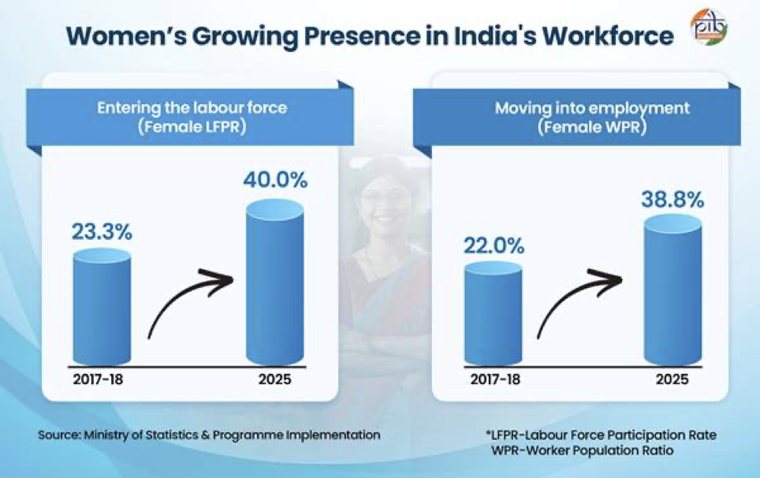
Both participation and actual employment have risen by about 17 percentage points in seven years. Image courtesy PIB / Ministry of Statistics & Programme Implementation; reproduced with credit for educational use.
The enterprise support stack — formalise, finance, market, skill
The backgrounder frames support for women-led enterprise as a value chain: formalisation gives an enterprise an identity, credit enables production, and market access converts output into income. Skilling widens the entry point into newer sectors.
Figure 2 — How the schemes fit together
1 · FormaliseUdyam RegistrationYashasvini (2024)Swavalambini (2025)identity → access2 · FinancePMMY · CGTMSEPMEGP subsidyFFS · SISFS · CGSScapital → production3 · MarketWomaniya on GeMPMS (trade fairs)TEAM via ONDCoutput → income4 · SkillNAVYA (PMKVY 4.0)AI Careers for WomenWISE-KIRAN (DST)entry into new sectors
A schematic drawn by Legacy IAS from the backgrounder’s own framing of the enterprise value chain.
▤ Scheme at a Glance — Formalisation & Credit
- Yashasvini Campaign (2024, Ministry of MSME): aims at gender parity on the Udyam Registration Portal and Udyam Assist Platform by 2029; over 22 lakh women-owned MSME registrations facilitated (July 2026).
- Swavalambini (2025): ideation-to-enterprise support with 21 weeks of mentorship; pilot targets met — 1,276 trained against 1,200 (awareness), 602 against 600 (entrepreneurship development), 82 faculty trained.
- Pradhan Mantri MUDRA Yojana (2015): collateral-free loans up to ₹20 lakh for non-farm micro and small enterprises; 57.79 crore loans sanctioned by April 2026, about two-thirds to women.
- Credit Guarantee Fund Trust for MSEs (CGTMSE, 2000): women-led MSEs get 90% guarantee cover and a 10% fee concession; about 30.75 lakh guarantees worth ~₹2.07 lakh crore for women-owned MSEs (FY 2000-01 to FY 2025-26).
- PMEGP (2008, KVIC as national nodal agency): women get a margin-money subsidy of 25% (urban) and 35% (rural); women account for nearly 40% of units and ~45% of subsidy disbursed (May 2026).
- Startup India (2016) instruments for women-led startups (Jan 2026): Fund of Funds for Startups — ~₹2,995 crore invested via AIFs since 2025; Seed Fund Scheme (2021) — ~₹294 crore approved; Credit Guarantee Scheme for Startups (Apr 2023) — ~₹39 crore guaranteed.
Market access — the government as buyer
- Womaniya on GeM (Government e-Marketplace, launched 2016): over 2.17 lakh women-owned MSEs registered (July 2026); contracts above ₹28,000 crore in FY 2025-26, up 27.6%.
- Women received 5.6% of total GeM order value, and overall procurement from women-owned MSEs was 3.8% — both above the 3% sub-target under the Public Procurement Policy for MSEs Order, 2012.
- Procurement & Marketing Support (PMS) Scheme: 100% subsidy on built-up stall rent at trade fairs for women-owned MSEs.
- MSME TEAM (2024-27, under the World Bank-assisted RAMP programme): onboarding MSEs to the Open Network for Digital Commerce (ONDC); 1,700 women-owned MSEs registered up to 2025-26.
Skilling for emerging sectors
- NAVYA (2025) — vocational training of adolescent girls in non-traditional trades under PMKVY 4.0; target 3,850, of whom 1,105 trained by 31 August 2026 (about 29%).
- AI Careers for Women (2025) — 30 Centres of Excellence in women’s colleges across six States, with 150 spoke centres in Tier-II/III towns; target of 20,000 learners.
- WISE-KIRAN (Department of Science & Technology) — fellowships (WISE-PhD, WISE-PDF, WISE-SCOPE, WISE-IPR, WIDUSHI) and institutional programmes (CURIE, Vigyan Jyoti, GATI, Women in Space Leadership Programme); in 2025-26, 180 PhD scholars, 606 post-doctoral/translational researchers and 29,443 schoolgirls were supported.
Workplace rights under the Labour Codes
The four Labour Codes — the Code on Wages, 2019, the Industrial Relations Code, 2020, the Code on Social Security, 2020 and the Occupational Safety, Health and Working Conditions Code, 2020 — consolidate 29 central labour laws. Several provisions bear directly on women’s access to, and retention in, work.
Figure 3 — Four areas of change for women workers
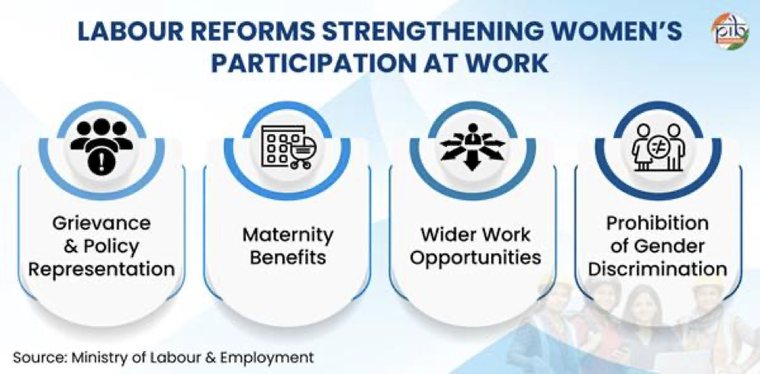
Representation, maternity, wider work options and non-discrimination form the core of the codified framework. Image courtesy PIB / Ministry of Labour & Employment; reproduced with credit for educational use.
- Maternity: up to 26 weeks of paid leave; 12 weeks for adoptive and commissioning mothers; a ₹3,500 medical bonus where free pre- and post-natal care is not provided; two nursing breaks a day until the child is 15 months old.
- Crèche: mandatory in establishments with 50 or more workers, with four visits a day permitted.
- Night work: women may work in all establishments, including night shifts, with consent and prescribed safeguards.
- Representation: women in Grievance Redressal Committees in proportion to their share of the workforce; one-third of Central and State Advisory Boards.
- Non-discrimination: gender discrimination in recruitment, wages and conditions of work is prohibited.
Lineage — what the current framework builds on
- Maternity Benefit Act, 1961 → 2017 amendment (leave raised from 12 to 26 weeks; crèche mandate added) → subsumed in the Code on Social Security, 2020.
- Equal Remuneration Act, 1976 → subsumed in the Code on Wages, 2019, which extends non-discrimination to all genders.
- Factories Act, 1948, which restricted women’s night work → replaced by consent-based night work under the OSH Code, 2020.
- Prime Minister’s Rozgar Yojana and REGP → merged into PMEGP in 2008.
The critical view
- Composition matters: labour economists have noted that much of the post-2017 rise has come from rural self-employment, including unpaid work in household enterprises; the share of women in regular salaried jobs has grown far more slowly.
- Count vs value of credit: women’s strong share in the number of MUDRA loans sits alongside small average loan sizes; ticket size, not just access, decides whether enterprises grow.
- Scale of newer schemes: startup-finance figures for women-led ventures (e.g. ₹39 crore under CGSS) and NAVYA’s 29% progress against a modest target show these remain pilots rather than system-level levers.
- The care constraint: the Time Use Survey 2024 shows women still carry the bulk of unpaid domestic and care work; crèche and night-work provisions depend on enforcement and on public childcare and safe transport.
- Data caveat: the PLFS design was revamped from January 2025, so long-run comparisons should be read with care.
✎ Mains Practice Question
The rise in India’s female labour force participation since 2017-18 has been sharp, yet the quality of women’s employment remains a concern. Examine the factors behind this trend and suggest how participation can be converted into decent and secure work for women. 15 marks · 250 words
Science & TechnologyGeneral Studies Paper III
02
NITI Aayog’s Data Centre Evaluation Framework: From Attracting Investment to Being Investment-Ready
GS-III · S&T — IT & Digital Infrastructure; Economy — Infrastructure, InvestmentPrelims + MainsPIB · NITI Aayog · 15 Oct 2026
The Frontier Tech Hub of NITI Aayog released a Data Centre Evaluation Framework on 14 October 2026 to help States judge data-centre proposals against power, water, land and economic value before committing incentives.
◈ Background & Context
India’s data-centre capacity has grown from about 375 MW in 2020 to roughly 1.5 GW now — about a fourfold rise — driven by AI, cloud computing, high-performance computing and data-heavy applications. Capacity is measured in megawatts of IT load, not floor area, because electricity is the binding input.
- Draft Data Centre Policy, 2020 (MeitY) first set out a national approach to the sector.
- Data centres were added to the Harmonised Master List of Infrastructure in 2022, easing access to long-term credit.
- The IndiaAI Mission (approved March 2024, outlay ₹10,371.92 crore) and the Digital Personal Data Protection Act, 2023 add demand for domestic compute and storage.
- The Union Government has announced a tax holiday until 2047 for eligible foreign cloud service providers using India-based data-centre infrastructure.
▤ Framework at a Glance
- Issued by: NITI Aayog — Frontier Tech Hub, released 14 October 2026.
- Inputs from: MeitY, Ministry of Power, DPIIT (Ministry of Commerce & Industry) and industry.
- Nature: a decision-support tool for State governments — not an additional layer of regulation.
- Structure: five pillars — Power & Energy; Water & Cooling; Siting & Environmental Sustainability; Economic & Strategic Value; Policy, Governance & Implementation.
- Resource tests: grid readiness and net grid draw; renewable and storage-backed power; basin-level water stress and impact on public supply.
- Value tests: notified data-centre zones; distinguishing colocation from active compute; incentives linked to measurable outcomes; Make in India across IT and non-IT equipment.
- Process: time-bound approvals, clear accountability and monitoring of project commitments.
Figure 4 — The five pillars of the Framework
Data Centre Evaluation FrameworkPower &Energygrid readinessRE + storageWater &Coolingbasin stresswater reuseSiting &EnvironmentDC zonese-waste, batteriesEconomic &Strategicoutcome-linkedincentivesPolicy &Governancetime-boundapprovalsOutcome: investment-ready, sustainable data-centre capacity
A schematic drawn by Legacy IAS from the pillars named in the Framework.
Why it matters
Data centres are capital-intensive but resource-hungry: a hyperscale campus can draw as much power as a mid-sized town, and evaporative cooling consumes large volumes of water. Locating them in water-stressed basins or on weak grids shifts the cost onto local users.
- Moves the State question from “how much investment?” to “can this location sustain it for 20–30 years?”.
- Pushes lifecycle planning for e-waste and batteries, aligning with the E-Waste (Management) Rules, 2022 and Battery Waste Management Rules, 2022.
- Seeks domestic value — R&D, advanced cooling, energy-efficient computing and local equipment manufacturing.
Institutions & terms to know
- Power Usage Effectiveness (PUE): total facility energy ÷ IT equipment energy; 1.0 is the theoretical ideal.
- Water Usage Effectiveness (WUE): litres of water used per kWh of IT energy.
- Colocation vs active compute: renting space, power and cooling to clients, versus operating the servers and services that generate higher value and skilled jobs.
- Frontier Tech Hub: NITI Aayog’s platform for policy work on emerging technologies.
The critical view
- Incentive competition: States bidding with land, power-tariff and stamp-duty concessions risk a race to the bottom; outcome-linked incentives are the Framework’s answer, but adoption is voluntary.
- Low job intensity: data centres create relatively few direct jobs per rupee invested, so “economic value” must be measured beyond employment.
- Concentration: capacity is clustered around a few metros, notably Mumbai and Chennai, deepening regional grid and water pressure.
- Green-power gap: round-the-clock loads need storage-backed renewables; without them, growth adds to coal-based demand.
✎ Mains Practice Question
Data centres are emerging as critical infrastructure for India’s AI ambitions, but they make heavy demands on power, water and land. Discuss how States can balance investment attraction with resource sustainability. 15 marks · 250 words
Environment & EcologyGeneral Studies Paper III
03
Sukhna Wetland and Sauj Jheel Take India’s Ramsar Tally to 103
GS-III · Environment — Conservation, Wetlands; GS-I · Geography — Places in NewsPrelims + MainsPIB · Ministry of Environment, Forest & Climate Change · 15 Oct 2026
The Union Environment Ministry announced on 15 October 2026 that Sukhna Wetland (Chandigarh) and Sauj Jheel (Uttar Pradesh) have been designated Ramsar Sites, raising India’s total to 103. Sukhna is Chandigarh’s first Ramsar Site.
Figure 5 — India’s Ramsar Sites 102 and 103
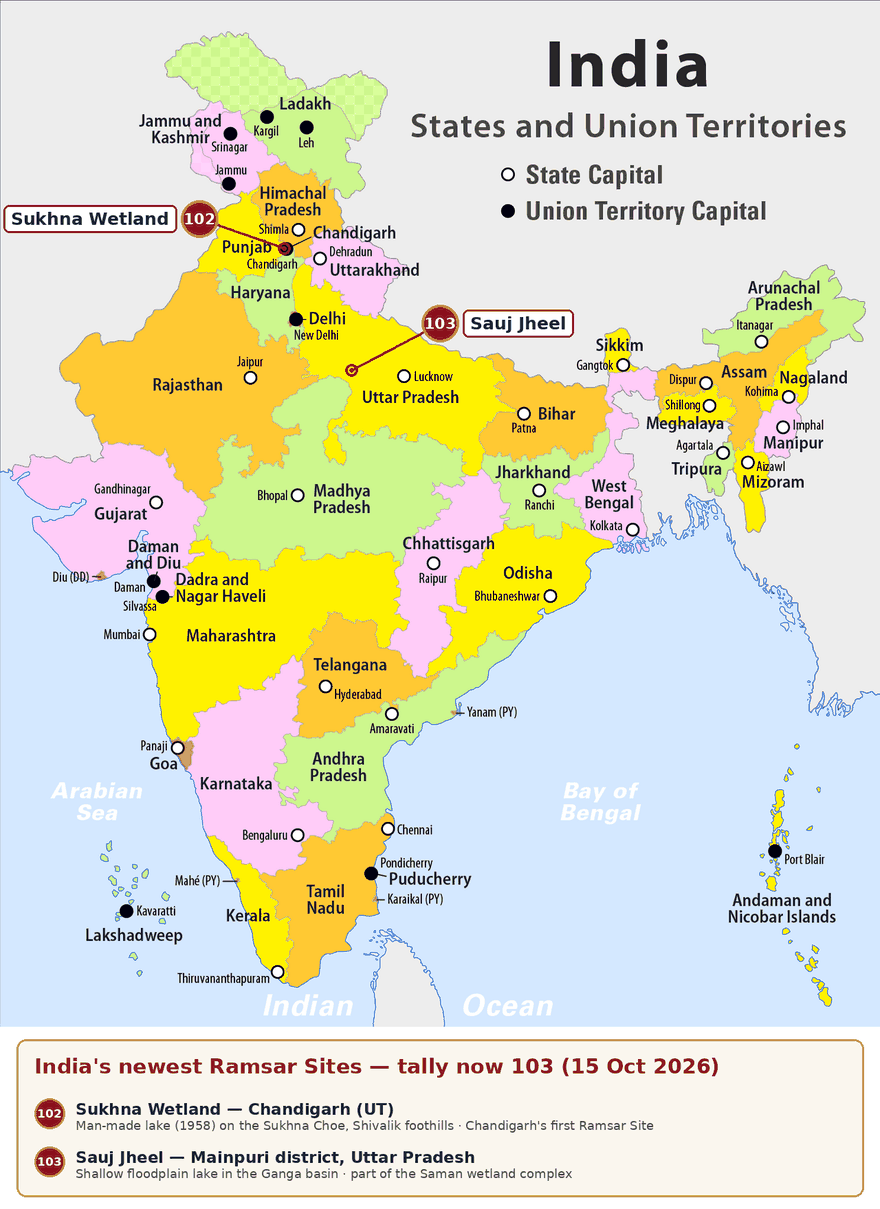
Sukhna lies at the Shivalik foothills; Sauj Jheel lies in the Ganga floodplain of Mainpuri district. Pins placed by Legacy IAS on the base map at the sites’ approximate coordinates; numbering follows the order of their Ramsar List site numbers.
▤ Site Profiles
- Sukhna Wetland — Chandigarh (UT), Ramsar Site No. 2602: a man-made reservoir created in 1958 by damming the Sukhna Choe, a seasonal stream from the Shivalik foothills, as part of Le Corbusier’s plan for the city; about 3 km² of open water, adjoining the Sukhna Wildlife Sanctuary.
- Habitats range from open water and shallow-water vegetation to scrub and forest, supporting resident and migratory birds on the Central Asian Flyway.
- Sauj Jheel — Mainpuri district, Uttar Pradesh, Ramsar Site No. 2603: a shallow floodplain lake ringed by farmland in the Ganga basin, near the Karhal–Kishni road; part of the Saman wetland complex, whose satellite wetlands are Important Bird Areas.
- Mainpuri now has two Ramsar Sites — Sauj Jheel and Saman Bird Sanctuary (designated 2019). The Mainpuri–Etawah wetland belt is also Sarus Crane country, Uttar Pradesh’s State bird.
◈ The Ramsar Convention — Static Anchor
- Convention on Wetlands signed at Ramsar, Iran, on 2 February 1971 (now World Wetlands Day); in force from 1975. It is not a UN convention.
- India became a party on 1 February 1982; its first sites were Chilika Lake (Odisha) and Keoladeo National Park (Rajasthan), listed in 1981.
- A site must meet at least one of nine criteria — e.g. regularly supporting 20,000+ waterbirds or 1% of a waterbird population.
- Montreux Record — sites whose ecological character is threatened; India’s entries are Keoladeo and Loktak Lake (Manipur).
- India’s network grew from 26 sites in 2014 to 101 in August 2026, when Glaw Lake in the Kamlang Tiger Reserve became Arunachal Pradesh’s first; Tamil Nadu has the most sites.
Domestic framework for wetlands
- Wetlands (Conservation and Management) Rules, 2017, under the Environment (Protection) Act, 1986 — set up State Wetland Authorities and restrict reclamation and encroachment.
- National Plan for Conservation of Aquatic Ecosystems (NPCA), formed in 2015 by merging the National Lake Conservation Plan and the National Wetlands Conservation Programme.
- Amrit Dharohar (announced in the Union Budget 2023-24) — promotes the wise use of Ramsar Sites through eco-tourism and local livelihoods.
- Wetland City Accreditation under the Convention — Indore and Udaipur were India’s first accredited cities (2025).
The critical view
- Designation is not protection: Ramsar status brings international reporting and visibility, but on-ground protection depends on management plans, State Wetland Authorities and enforcement of the 2017 Rules.
- Sukhna’s known pressures: siltation from the erodible Shivalik catchment, falling water levels and construction in the catchment; the Punjab and Haryana High Court declared the lake a living legal entity in 2020.
- Farmland wetlands: shallow lakes like Sauj face agricultural runoff, drainage for cultivation and seasonal drying.
- Numbers vs health: rapid growth in the tally needs to be matched by monitoring of ecological character, as the Convention requires.
✎ Mains Practice Question
India’s Ramsar network has grown nearly fourfold since 2014. Critically examine whether this expansion has translated into better protection of wetlands, with reference to India’s institutional framework for wetland conservation. 10 marks · 150 words