

In-Depth PIB Analysis2 Items
Core TopicImportantConcise
Polity, Governance & Social JusticeGS Paper II
01Forest Rights Act, 2006: 25.42 Lakh Titles & New Digital Platform
Disaster ManagementGS Paper III · GS Paper I
02Kutch Earthquake 2001: Recovery & Disaster Governance Lessons
Polity, Governance & Social JusticeGeneral Studies Paper II
01
Forest Rights Act, 2006: 25.42 Lakh Titles Distributed; National FRA Digital Platform Launched
GS-II · Welfare of Scheduled Tribes; Statutory Mechanisms; Local Governance (Gram Sabha)GS-III · Conservation; Land Reforms; Inclusive GrowthPrelims + MainsPIB Backgrounder · Ministry of Tribal Affairs · 16 Nov 2026
A PIB Backgrounder reviews progress under the Scheduled Tribes and Other Traditional Forest Dwellers (Recognition of Forest Rights) Act, 2006. As on 31 August 2026, 25.42 lakh titles had been distributed over nearly 238 lakh acres. The Ministry of Tribal Affairs launched a National FRA Digital Platform during the Janjatiya Gaurav Pakhwada (1–15 November 2026).
◈ Basics First — Why a ‘Forest Rights’ Law Was Needed
For generations, tribal and other forest-dwelling communities lived in and depended on forests. But when the colonial and later the independent State ‘consolidated’ forests as government land, their customary use went unrecorded. Overnight, they became ‘encroachers’ on land they had always occupied.
- The FRA calls this a ‘historical injustice’ and seeks to recognise — not grant — pre-existing rights.
- Title: the official document recording a forest right — who holds it, where, and its boundaries. It is heritable but cannot be sold or transferred.
- Individual vs community rights: a family’s house and farm plot, versus a village’s shared use of grazing land, water bodies, fishing and forest produce.
- Minor Forest Produce (MFP): non-timber produce such as bamboo, honey, lac, tendu leaves and medicinal plants. The FRA gives dwellers ownership of the MFP they traditionally collect.
Static Anchor — Lineage of Forest Governance
- Colonial era: Indian Forest Acts of 1865, 1878 and 1927 asserted State control over forests and curtailed customary rights.
- Forest (Conservation) Act, 1980 — Central approval needed to divert forest land; renamed the Van (Sanrakshan Evam Samvardhan) Adhiniyam by the 2023 amendment.
- National Forest Policy, 1988 — first to recognise the symbiotic relationship between tribals and forests.
- PESA Act, 1996 — empowered Gram Sabhas in Fifth Schedule areas, including ownership of MFP.
- FRA, 2006 — Act No. 2 of 2007; President’s assent 29 December 2006; in force 31 December 2007. Rules 2008, amended in 2012.
▤ The Act at a Glance
- Nodal Ministry: Ministry of Tribal Affairs (not MoEFCC); implemented by States and UTs — currently 20 States and the UT of Jammu and Kashmir.
- Beneficiaries: (i) Forest-dwelling Scheduled Tribes; (ii) Other Traditional Forest Dwellers (OTFDs) — those who have lived in and depended on forests for three generations (75 years).
- Cut-off date: land must have been occupied before 13 December 2005.
- Ceiling: individual rights over land actually occupied, up to 4 hectares.
- Coverage: all forest land, including reserved and protected forests, sanctuaries and national parks.
- No eviction until recognition and verification are complete (Section 4(5)).
- Development facilities: forest land of under 1 hectare each for schools, hospitals, anganwadis, drinking water, roads etc., on the Gram Sabha’s recommendation (Section 3(2)).
- Titles are signed by the Divisional Forest Officer, the District Tribal Welfare Officer and the District Collector; individual titles are issued in the joint names of spouses.
Three Kinds of Title
- Individual Forest Rights (IFR): land a family lives on or cultivates, up to 4 ha.
- Community Forest Rights (CFR): shared uses — grazing, fishing, water bodies, MFP, traditional seasonal resources.
- Community Forest Resource (CFRR) rights: the Gram Sabha’s right to protect, regenerate, conserve and manage the forest within its customary boundary (Section 3(1)(i)) — the most transformative provision, as it gives communities a governance role.
- Habitat rights for Particularly Vulnerable Tribal Groups (PVTGs) over their customary habitat. Guidelines were issued on 5 January 2026; 11 PVTGs in Odisha, Chhattisgarh and Madhya Pradesh have received them.
Figure 1 — From claim to title: the recognition process
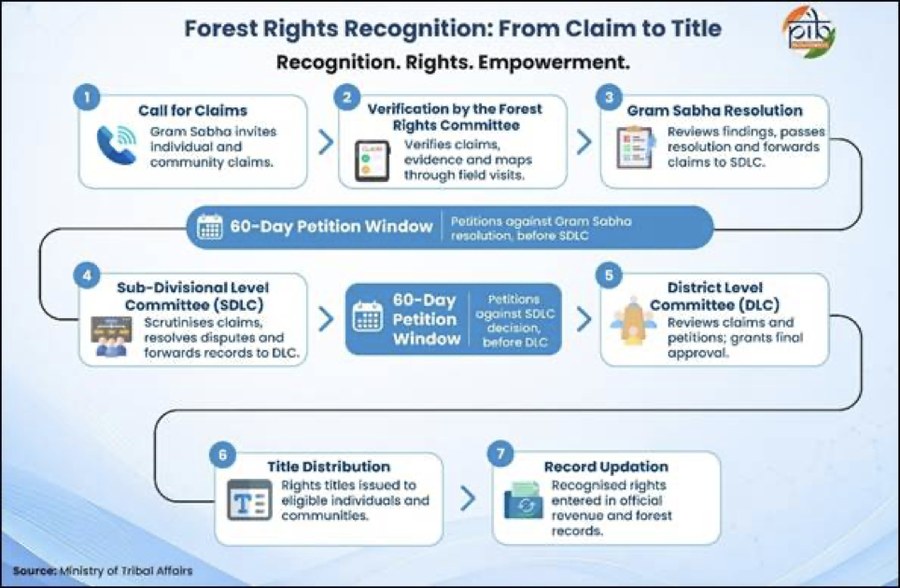
The Gram Sabha starts the process; the District Level Committee’s decision is final. Image courtesy Ministry of Tribal Affairs / PIB; reproduced with credit for educational use.
How a Claim Is Decided
- Gram Sabha — all adult members of the village, with full participation of women — elects a Forest Rights Committee (10–15 members). At least two-thirds must be Scheduled Tribes and at least one-third women.
- The Gram Sabha receives and verifies claims, maps the land and passes a resolution → Sub-Divisional Level Committee (SDLC) prepares the record of rights → District Level Committee (DLC), whose decision is final and binding.
- SDLC and DLC include Revenue, Forest and Tribal Affairs officers and three PRI members (two of them STs, at least one a woman).
- Appeals: within 60 days to the next committee (extendable by 30 days). Every rejection must carry a reasoned order sent to the claimant.
- Records: rights must be entered in revenue and forest records — within three months under the 2012 amendment.
- Monitoring: State Level Monitoring Committee, chaired by the Chief Secretary, meeting at least quarterly.
Figure 2 — National progress in claims and titles (as on 31 August 2026)
Image courtesy Ministry of Tribal Affairs / PIB.
Figure 3 — What happened to the claims? (lakh)
Claims received≈54.0Disposed of43.56Titles distributed25.42Disposed, no title*≈18.1Pending*≈10.4* Derived: disposed − titles; received − disposed. ‘Disposed, no title’ is mainly rejections.Titles: 24.18 lakh individual + 1.24 lakh community. Source: Ministry of Tribal Affairs.
Roughly two in five disposed claims did not end in a title — the core of the rejection debate.
What Is New
- National FRA Digital Platform: the full claims process — Gram Sabha submission to digitally signed titles — on one system.
- Dharti Aaba Janjatiya Gram Utkarsh Abhiyan (DA-JGUA) (launched October 2024; outlay about ₹79,156 crore; ~63,000 tribal-majority villages) funds FRA cells at State and district levels, State FRA portals and ₹15 lakh per CFR Management Plan.
- A joint MoTA–MoEFCC communication (27 July 2026) lets CFR management plans align with Forest Department Working Plans, while keeping the Gram Sabha’s authority central.
- Linking to livelihoods: entering titles in revenue records opens access to PM-KISAN, crop loans, Kisan Credit Cards and insurance. Maharashtra (forms 7E and 12E), Andhra Pradesh (Giribhumi portal) and Telangana (BhuBharathi link) offer models.
Critical View
- High rejections: about 18 lakh disposed claims did not yield titles. Rejections often lack reasoned orders, or rest on insisting on documents the Act does not require. In Wildlife First v. MoEFCC (2019), the Supreme Court’s eviction order for rejected claimants was stayed within weeks, and States were asked to review rejections.
- Community rights lag: only about 1.24 lakh community titles against 24.18 lakh individual ones; CFR — the Act’s conservation core — remains under-recognised.
- Forest bureaucracy vs Gram Sabha: overlapping authority with Forest Departments, compensatory afforestation on community lands and Critical Wildlife Habitats create friction.
- Records gap: titles not entered in revenue records cannot unlock credit or schemes.
- Landmark precedent: in Orissa Mining Corporation v. MoEF (2013, Niyamgiri), the Supreme Court upheld the Gram Sabha’s role in deciding on mining affecting forest rights.
▤ Way Forward
- Time-bound review of rejected claims, with reasoned orders and legal aid.
- Prioritise CFR recognition and fund Gram Sabha-led management plans.
- Complete digital mapping and revenue-record entry to unlock livelihood schemes.
- Build capacity of Forest Rights Committees, SDLCs and DLCs — e.g. through the free iGOT (Mission Karmayogi) courses.
✎ Mains Practice Question
Two decades after its enactment, the Forest Rights Act, 2006 has recognised individual rights far more than community rights. Examine the reasons and suggest measures to realise its conservation and governance potential. 15 marks · 250 words
Disaster ManagementGeneral Studies Papers III & I
02
Kutch Earthquake, 2001: How the Recovery Shaped India’s Disaster Management Framework
GS-III · Disaster & Disaster ManagementGS-I · Earthquakes; Important Geophysical PhenomenaPrelims + MainsPIB Backgrounder · 16 Nov 2026
A PIB Backgrounder revisits the 26 January 2001 Kutch (Bhuj) earthquake and the reconstruction that followed. It highlights the creation of the Gujarat State Disaster Management Authority (GSDMA), an owner-driven housing model and institutional reforms that came before the national Disaster Management Act, 2005.
◈ Basics First — Why Kutch Shakes
- Plate-boundary vs intraplate earthquakes: most large quakes occur where plates meet, as along the Himalaya. The Kutch earthquake was intraplate — inside the Indian Plate.
- The Kachchh Rift Basin: an ancient rift (from the break-up of Gondwana) whose old faults are reactivated by the northward push of the Indian Plate, producing reverse (thrust) faulting.
- History: the 1819 Rann of Kutch earthquake raised a natural ridge, the ‘Allah Bund’.
- Magnitude: the release cites 6.9 (Indian estimate); the US Geological Survey put it at Mw 7.7. Magnitude scales differ, so always check the source.
- Seismic zone: Kutch lies in Zone V, the highest category under IS 1893:2016. A 2025 revision that created a new Zone VI (including Kutch) was withdrawn by BIS on 3 March 2026; the 2016 code (Zones II–V) applies again.
▤ The Scale of the Disaster (official figures)
13,805Lives lost (12,221 in Kutch)
1.67 lakhPeople injured
7,633Villages in 181 talukas
₹9,909 crDamage (WB–ADB estimate)
- Nearly one crore people affected; over 2 lakh houses destroyed and about 9 lakh damaged.
- Over 10,000 small and medium units stopped production; about 50,000 artisans lost livelihoods.
- Gujarat had plans for cyclones and floods, but none for earthquakes.
The Response and Recovery
- First hours: landline and mobile networks failed within an hour; satellite phones and police wireless carried the response. The National Crisis Management Committee met the same day; ₹500 crore was sanctioned for immediate relief.
- GSDMA (8 February 2001): set up by Government Resolution, modelled on the Orissa SDMA created after the 1999 Super Cyclone. It began as a registered society and became statutory under the Gujarat State Disaster Management Act, 2003.
- Funding: reconstruction cost estimated at about ₹10,575 crore. The World Bank and the Asian Development Bank lent US$703 million and US$350 million respectively (revised from US$1 billion and US$500 million). The State bore about 30% (~₹2,603 crore).
- Owner-driven reconstruction: five housing packages (February–April 2001); families rebuilt their own homes with staged cash assistance, technical guidance and safe designs, rather than through contractors. NGOs adopted villages under a public–private partnership.
- Quality and fairness: damage graded G1–G5; re-surveys allowed; the District Judge as Ombudsman in each district (47,156 petitions by October 2003); 1,082 material banks; ~30,000 masons and 6,200 engineers trained; ~2.6 lakh houses independently inspected; houses registered jointly in the names of husband and wife.
- Village level: a Gram Navrachna Samiti in each village — Sarpanch, a woman member, members of backward castes and minorities, the school headmaster and an NGO representative.
- Mid-course correction: an October 2001 review found families still in tents and slow urban reconstruction. After a new State government took office that month, senior Secretaries were assigned to the worst-hit talukas, with weekly reviews.
Figure 4 — Houses reconstructed against the target (lakh)
Target ≈ 2.15 lakh0.601.431.87 (87%)Jan 2002Jan 2003Jan 2004Repairs: ~7.7 lakhhouses by Jan 2002Source: PIB Backgrounder, 16 Nov 2026. Recreated in Legacy palette.
Repairs were largely done within a year; rebuilding took longer, especially in towns needing re-planning.
Static Anchor — Evolution of India’s Disaster Management Framework
- Before 2000: a relief-centric approach under the Agriculture Ministry; the High Powered Committee on Disaster Management (1999) began the shift.
- 1999 → 2001: Orissa SDMA (after the Super Cyclone) → GSDMA (after Kutch); a National Committee on Disaster Management under the PM (February 2001).
- 2002–03: Gujarat’s State Disaster Management Policy and Act — the first State DM law; the Gujarat Institute of Disaster Management.
- Disaster Management Act, 2005 (after the 2004 tsunami): NDMA (chaired by the PM), SDMAs (CMs), DDMAs (Collectors), the NDRF and the NIDM.
- National Policy on DM (2009); National Disaster Management Plan (2016), India’s first, aligned with the Sendai Framework (2015–2030).
- Disaster Management (Amendment) Act, 2025: statutory status for the National Crisis Management Committee (Cabinet Secretary) and the High Level Committee (Union Home Minister); Urban Disaster Management Authorities; national and State disaster databases; State Disaster Response Forces.
◈ Key Concepts from Basics
- Build Back Better: using reconstruction to reduce future risk — Priority 4 of the Sendai Framework. The release calls Gujarat’s approach ‘reconstruction plus’.
- Owner-Driven Reconstruction (ODR): families rebuild with money and technical support, rather than receiving contractor-built houses — better ownership, local designs, faster uptake.
- Base isolation: flexible bearings (rubber/lead) placed between a building and its foundation to decouple it from ground shaking. It was used in the rebuilt Bhuj District Civil Hospital (2004).
- Community preparedness: village Afat Sajjat Senas in 484 villages; disaster preparedness as a standing Gram Sabha agenda item.
Lessons — and Limits
- Lessons: act before certainty; build a dedicated institution with a clear mandate; put people and Gram Sabhas at the centre; build in grievance redress and quality checks; review honestly and correct course.
- Recognition: the UN Sasakawa Award for Disaster Reduction (2003) and a CAPAM Gold Award (2004).
- Limits noted in the record: slower urban reconstruction; water and site problems in some relocated villages; irregularities in debris clearance led to disciplinary action against 276 employees.
- Today’s gaps: enforcement of building codes in fast-growing towns, retrofitting of old structures, and urban risk — which the 2025 amendment’s Urban DMAs aim to address.
▤ Prelims Pointers
- 26 January 2001, 8:46 a.m.; epicentre in Kutch (near Bhachau); intraplate.
- GSDMA — 8 February 2001; statutory under the Gujarat SDM Act, 2003; first statutory State DM law.
- DM Act, 2005 — NDMA chaired by the Prime Minister; NCMC chaired by the Cabinet Secretary (statutory since 2025).
- Sendai Framework — 2015–2030; 4 priorities, 7 targets.
- Seismic zones — framed by BIS (IS 1893); currently four zones (II–V) after the 2025 code was withdrawn.
✎ Mains Practice Question
The post-2001 reconstruction in Kutch is often cited as a model of ‘building back better’. Discuss its key features and evaluate how far these lessons have been institutionalised in India’s disaster management framework. 15 marks · 250 words