

In-Depth PIB Analysis2 Items
Core TopicImportantConcise
Economy — Energy & InfrastructureGS Paper III
01India’s Solar Growth: 2.82 GW to ~175 GW
Social Sector — HealthGS Paper II
029th National Naturopathy Day: Institutions & Evidence
Economy — Energy & InfrastructureGeneral Studies Paper III
01
India’s Solar Growth Enters a New Era: From 2.82 GW to ~175 GW — Policy, Manufacturing and the Road Ahead
GS-III · Infrastructure — Energy; Environment — Climate Change; Industrial PolicyGS-II · Government Schemes; International Groupings (ISA)Prelims + MainsPIB Backgrounder · MNRE · 17 Nov 2026
A PIB Backgrounder released after the Bharat Renewable Energy Summit & Expo (BRESE) 2026 (2–5 November, Bharat Mandapam) reviews a decade of solar expansion. Installed solar capacity has grown from 2.82 GW (2014) to about 175 GW (31 October 2026) — roughly 62-fold. Solar is now the largest share of India’s renewable capacity.
Figure 1 — A decade of solar expansion
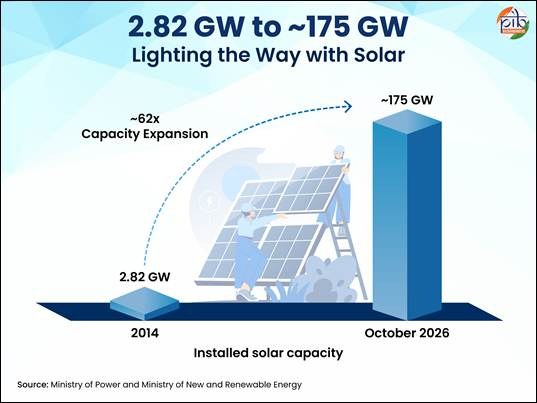
Installed capacity has grown about 62-fold since 2014. Image courtesy MNRE / PIB; reproduced with credit for educational use.
◈ Basics First — Key Terms in Solar Power
- Solar photovoltaic (PV): cells, usually of silicon, convert sunlight directly into electricity through the photovoltaic effect. Cells are assembled into modules (panels).
- Capacity vs generation: GW measures maximum output; actual energy (kWh) depends on sunlight hours. Solar’s capacity utilisation factor in India is roughly 18–20%, as panels produce nothing at night.
- Utility-scale vs distributed: large ground-mounted plants that sell to the grid, versus rooftop and farm systems near the point of use.
- LCOE (Levelised Cost of Electricity): the average cost per unit over a plant’s life, including building and running it. It allows comparison across technologies.
- e-Reverse Auction: bidders compete downward on tariff; the lowest bid wins.
- Renewable Purchase Obligation (RPO): a mandate that DISCOMs and large consumers buy a set share of power from renewables. It originated in the Electricity Act, 2003; the target for 2026–27 is 35.95%, with a trajectory notified to 2029–30.
Static Anchor — Lineage of Solar Policy
- National Solar Mission (2010) — one of eight missions under the National Action Plan on Climate Change (2008); initial target 20 GW by 2022.
- 2014–15: Solar Parks Scheme (December 2014); target raised to 100 GW by 2022 (60 GW utility-scale + 40 GW rooftop) within a 175 GW renewables goal.
- 2015: International Solar Alliance launched by India and France at COP21, Paris; headquartered in Gurugram.
- 2019: PM-KUSUM for farmers; ALMM quality list for modules.
- 2021: Panchamrit at COP26, Glasgow — 500 GW non-fossil capacity by 2030, net zero by 2070; PLI scheme for high-efficiency modules.
- 2024: PM Surya Ghar: Muft Bijli Yojana for household rooftops.
- 2026: PM Surya Sarovar Yojana for floating solar with storage; ALMM List-II extends the domestic-content rule to solar cells.
Figure 2 — India’s solar journey: key dates
Image courtesy MNRE and Ministry of Power / PIB.
▤ Key Numbers (as per the release)
~175 GWSolar capacity, 31 Oct 2026
308 GWNon-fossil capacity, 30 Sep 2026
192 GWModule-making capacity, June 2026
$35/MWhUtility solar LCOE, 2025 (global $44)
- Mix of solar capacity: 133 GW utility-scale (including the solar part of hybrids), 34.97 GW grid-connected rooftop, the rest off-grid.
- Non-fossil 308.03 GW = 299.25 GW renewable + 8.78 GW nuclear. Record non-fossil addition of 55.29 GW in FY 2025–26.
- Tariffs fell from about ₹18/unit (2010) to a record ₹1.99/unit (GUVNL auction, 2020).
- On 29 July 2025, renewables met 51.5% of electricity demand — the highest share yet.
- The release states India added 37 GW in calendar 2025, surpassing the US in annual additions, and is the world’s second-largest solar growth market.
Figure 3 — Annual solar capacity additions (GW)
2040023.8344.6124.29*FY 2024–25FY 2025–26FY 2026–27** Part-year (April–October 2026). Source: MNRE via PIB, 17 Nov 2026. Recreated in Legacy palette.
Additions nearly doubled in FY 2025–26; distributed solar (rooftop 8.7 GW + PM-KUSUM 7.6 GW) made up 36% of that year’s addition.
The Five Pillars of the Policy Architecture
- 1. Vision — targets: Panchamrit and the updated NDC (2022) under the Paris Agreement; Mission LiFE for sustainable lifestyles.
- 2. Demand: the National Solar Mission, RPOs, rooftop subsidies for households and PM-KUSUM for farmers.
- 3. Lower costs: transparent e-reverse auctions, run by agencies such as the Solar Energy Corporation of India (SECI).
- 4. Infrastructure: the Solar Parks Scheme (target raised from 20 GW to 40 GW in 2017; sanctioned capacity 39,461 MW) and the Green Energy Corridor transmission programme (~24.6 GW evacuated by February 2026; ~44 GW planned).
- 5. Manufacturing: PLI for high-efficiency modules (₹4,500 crore in 2021 + ₹19,500 crore in 2022) and the ALMM quality and domestic-sourcing list.
▤ Solar Parks — Where the Capacity Is (sanctioned, MW)
- Gujarat 12,150 · Rajasthan 10,726 · Madhya Pradesh 4,208 · Andhra Pradesh 4,200 · Uttar Pradesh 3,740 · Karnataka 2,000.
- Bhadla Solar Park (Rajasthan, Thar Desert): ~2,245 MW on ~5,700 ha; built 2015–2020; high irradiation, low rainfall and sparse vegetation suit it to solar.
- Other major parks: Pavagada (Karnataka), Ananthapuramu and Kurnool (Andhra Pradesh), Rewa Ultra Mega Solar Park (Madhya Pradesh).
- One inter-State floating solar park spans Jharkhand and West Bengal.
Schemes at a Glance
- PM Surya Ghar: Muft Bijli Yojana (launched 13 February 2024; outlay ₹75,021 crore): subsidy and collateral-free loans for household rooftop solar, aiming at 1 crore households and up to 300 units of free power a month. About 65 lakh households solarised by November 2026; ₹28,024 crore of Central assistance disbursed by July 2026.
- PM-KUSUM (2019): Component A — small solar plants on farmers’ land; B — standalone off-grid solar pumps; C — solarising grid-connected pumps and agricultural feeders. Target about 34,800 MW by 2026–27 with ₹34,422 crore of Central support. Achieved so far: ~11.91 lakh off-grid pumps, ~17.18 lakh pumps covered by feeder solarisation, but only ~2,426 MW of decentralised plants.
- PM Surya Sarovar Yojana (approved 31 July 2026; outlay ₹5,070 crore; FY 2026–27 to 2030–31): 5,000 MW of floating solar with at least 2-hour storage (10,000 MWh). Floating panels on reservoirs save land, reduce evaporation and run cooler. NISE estimates ~102 GWp of floating potential; current capacity is ~800 MW.
Figure 4 — The solar value chain: where India is strong and where it is not
Polysiliconrefined siliconMinimal in IndiaIngot / Wafersliced siliconMinimal in IndiaCellconverts light~31 GW (ALMM-II)Moduleassembled panel~192 GW (ALMM-I)Moving upstream is the next test: cells ≈ only one-sixth of module capacityALMM List-II (cells) in force from 1 June 2026; upstream stages remain import-dependent
Assembling modules adds less value than making cells, wafers and polysilicon — the stages where global supply is most concentrated.
◈ India’s Global Solar Diplomacy
- International Solar Alliance (ISA): launched by India and France at COP21 (2015); the first treaty-based intergovernmental organisation headquartered in India (Gurugram). Membership was opened to all UN members in 2020. Its 9th Assembly was held alongside BRESE 2026.
- One Sun One World One Grid (OSOWOG): proposed by India in 2018; launched with the UK as the Green Grids Initiative–OSOWOG at COP26 (2021) — a vision of cross-border renewable grids.
- G20 New Delhi Declaration (2023): consensus on pursuing a tripling of global renewable capacity by 2030.
Critical View
- Past targets missed: India did not meet its 100 GW-by-2022 solar goal. Rooftop was the weakest link — only about 7.4 GW of the 40 GW rooftop target had been installed by December 2022.
- Manufacturing depth: module capacity (~192 GW) far exceeds cell capacity (~31 GW); polysilicon and wafers are largely imported. Domestic-content rules may raise costs for developers in the short run.
- Integration and storage: solar peaks at midday while demand peaks in the evening. Without storage and flexible supply, there is a risk of curtailment (wasting surplus power).
- Transmission and ecology: evacuation lines lag generation; in Rajasthan and Gujarat, lines must be planned around the Great Indian Bustard. The Supreme Court revisited its curbs in M.K. Ranjitsinh v. Union of India (2024), recognising a right against the adverse effects of climate change.
- Distributed gaps: PM-KUSUM’s farmer-owned plants (~2.4 GW) lag far behind the pump components; PM Surya Ghar has reached about two-thirds of its 1 crore household goal.
- DISCOM finances: weak distribution utilities delay power-purchase agreements and payments, slowing the pipeline of auctioned projects.
- Data caution: the release’s count of solar parks varies (54 in the table’s total, 56 in the text); the sanctioned capacity of 39,461 MW is consistent.
▤ Prelims Pointers
- National Solar Mission — 2010, under the NAPCC (2008).
- ISA — India + France, COP21 (2015); HQ Gurugram.
- Panchamrit — COP26 (2021): 500 GW non-fossil capacity by 2030; net zero by 2070.
- ALMM — List-I modules (2019); List-II cells (from 1 June 2026).
- Bhadla — Rajasthan (Thar); Pavagada — Karnataka; Rewa — Madhya Pradesh.
✎ Mains Practice Question
India’s solar capacity has grown over sixty-fold in a decade, yet the energy transition faces challenges of manufacturing depth, grid integration and distributed adoption. Examine. 15 marks · 250 words
Social Sector — HealthGeneral Studies Paper II
02
9th National Naturopathy Day (18 November): India’s Institutional Framework for Naturopathy — and the Question of Evidence
GS-II · Health; Government Policies; Statutory & Regulatory BodiesGS-I · Modern Indian History (Gandhi)Prelims + MainsPIB Backgrounder · Ministry of Ayush · 17 Nov 2026
The 9th National Naturopathy Day is observed on 18 November 2026 at the Central Research Institute of Yoga and Naturopathy (CRIYN), Nagamangala, Karnataka, on the theme ‘Prakrutik Chikitsa, Swasth Bharat’, with a focus on preventing obesity. A PIB Backgrounder outlines the Government’s institutions for naturopathy treatment, training and research.
◈ Basics First — What Is Naturopathy?
- A drug-free system that holds that the body can heal itself, supported by diet, fasting, water, mud, sunlight, air and massage.
- Philosophy: ‘Return to Nature’ — simple eating and living in harmony with oneself, society and the environment. Indian naturopathy draws on the Panchabhuta (five elements: earth, water, fire, air, ether) and is paired with yoga.
- Origins: modern nature cure grew in 19th-century Europe — hydrotherapy and the ‘Return to Nature’ movement — and found a strong advocate in Mahatma Gandhi.
- Where it is used: mainly as lifestyle and preventive care for chronic and stress-related conditions, obesity and healthy ageing.
Figure 5 — Treatments in naturopathy
Diet, fasting, hydrotherapy and mud therapy are core; magnetotherapy and chromotherapy (colour therapy) are also offered. Image courtesy Ministry of Ayush / NIN Pune / PIB.
Static Anchor — Gandhi and Nature Cure
- On 18 November 1945, Gandhi became Lifetime Chairman of the All India Nature Cure Foundation Trust, Pune, and signed its deed — hence the date of Naturopathy Day, observed since 2018.
- In 1946, he led a nature cure campaign at Uruli Kanchan, near Pune, linking health to sanitation, diet and exercise (writing in Harijan).
- National Institute of Naturopathy (NIN), Pune: set up on 22 December 1986 at ‘Bapu Bhavan’ — the nature cure centre handed to the Government in 1975; an autonomous body under the Ministry of Ayush.
▤ The Institutional Framework at a Glance
- Ministry of Ayush (a full Ministry since 2014): Ayurveda, Yoga & Naturopathy, Unani, Siddha, Sowa-Rigpa and Homoeopathy.
- Nisarg Gram, Pune (inaugurated 25 February 2024): NIN’s new 25-acre campus (₹213.55 crore), with India’s first national naturopathy hospital (250 beds) and a medical college (100 BNYS seats, 2026–27).
- BNYS (Bachelor of Naturopathy and Yogic Sciences): 5½ years including a one-year internship. NIN is the first Central Government institution to offer it, affiliated to a Central University.
- Research: Central Council for Research in Yoga and Naturopathy (CCRYN), since 1978, with 22 units — one of the Ministry’s five research councils.
- Hospitals: 200-bed CRIYNs at Jhajjar (Haryana) and Nagamangala (Karnataka); two more planned at Khorda (Odisha) and Raipur (Chhattisgarh). Naturopathy care in 35 hospitals (1,663 beds) and 95 dispensaries (2024).
- Workforce: 71 UG colleges (5,214 seats), 6 PG colleges (144 seats); 5,083 registered practitioners (2024).
- Outreach: a tribal yoga and naturopathy hospital at Gohe (Budruk), Pune district; a national drive to recognise one lakh tribal healers.
Figure 6 — How Ayush systems are regulated
Ministry of Ayush (2014)NCISM Act, 2020National Commission forIndian System of MedicineAyurveda · Unani · Siddha · Sowa-RigpaNCH Act, 2020National Commissionfor HomoeopathyHomoeopathyYoga & NaturopathyState boards + NaturopathyRegistration Board (under NIN)No national statutory commissionResearch: five councils — CCRAS, CCRUM, CCRS, CCRH and CCRYN (Yoga & Naturopathy, 1978)
Unlike other Ayush systems, Yoga and Naturopathy have no national statutory regulator of the kind created by the 2020 Acts.
Why It Matters
- Lifestyle diseases: with rising obesity, diabetes and hypertension, diet, activity, sleep and stress management are central to prevention.
- Cost: low-cost, low-technology care can complement primary healthcare, including Ayush-linked Ayushman Arogya Mandirs.
- Medical value travel: international patients rose from 1.83 lakh (2020) to 6.44 lakh (2024); an Ayush Visa was introduced in July 2023 under the ‘Heal in India’ initiative.
Critical View — The Evidence Question
- Uneven evidence: diet, fasting regimes, exercise and yoga have growing research support for lifestyle conditions. Therapies such as magnetotherapy and chromotherapy lack robust clinical evidence. The Ministry itself stresses the need for ‘scientific validation’.
- Integration, not substitution: the risk is patients delaying evidence-based treatment for serious illness. The Minister’s emphasis on ‘responsible integration with conventional healthcare’ is the right frame.
- Regulatory gap: without a national statutory commission, standards for education and practice vary across States.
- Advertising: the Drugs and Magic Remedies (Objectionable Advertisements) Act, 1954 bars claims to cure listed diseases; the Supreme Court’s 2024 proceedings on misleading health advertisements underline the need for enforcement.
- Data caution: the rise in international patients is measured from 2020, a pandemic-hit year, which inflates the apparent growth.
▤ Prelims Pointers
- National Naturopathy Day — 18 November, since 2018 (Gandhi, 1945).
- NIN — Pune (1986); Nisarg Gram — first national naturopathy hospital.
- CCRYN — 1978; CRIYN — Jhajjar, Nagamangala.
- Ayush Visa — 2023; WHO Global Centre for Traditional Medicine — Jamnagar, Gujarat.
- Uruli Kanchan — Gandhi’s 1946 nature cure campaign, near Pune.
✎ Mains Practice Question
Traditional systems such as naturopathy can complement modern medicine in preventing lifestyle diseases, but only on a foundation of evidence and regulation. Discuss with reference to India’s Ayush framework. 10 marks · 150 words