
In-Depth PIB Analysis2 Items
Core TopicImportantConcise
Polity, Governance & Social JusticeGS Paper II
01VB-G RAM G: Ombudsperson & Grievance Redressal
Economy & External SectorGS Paper III
02India’s Exports to FTA Partners (H1 FY27)
Polity, Governance & Social JusticeGeneral Studies Paper II
01
Ombudsperson and Appellate Authority Guidelines under the VB-G RAM G Act — Strengthening Grievance Redressal in Rural Employment
GS-II · Governance — Transparency & Accountability, Welfare Schemes for Vulnerable SectionsGS-III · Inclusive Growth, EmploymentPrelims + MainsPIB · Ministry of Rural Development · 18 Nov 2026
The Ministry of Rural Development has issued Guidelines for the Ombudsperson and Appellate Authority under the VB-G RAM G Act, 2025. The guidelines set up a district-level forum where rural workers can complain when they are denied their legal entitlements, backed by a digital tracking platform and closer links with social audits.
◈ Static Background — From MGNREGA to VB-G RAM G
A rights-based employment law makes work a legal entitlement, not a matter of official discretion. If the State fails to provide work or pay wages on time, the worker has a legal claim — and a right only works if there is an accessible forum to enforce it.
- Constitutional roots: Article 41 (DPSP) asks the State to secure the right to work within its economic capacity; Article 21 has been read by the Supreme Court to include the right to livelihood.
- Mahatma Gandhi NREGA, 2005 guaranteed 100 days of unskilled wage work a year to every rural household whose adult members volunteered for it.
- Under MGNREGA, Section 17 mandated social audit of all works by the Gram Sabha, and the Ombudsperson guidelines were framed under Section 27; the Ministry last revised them in January 2021.
- VB-G RAM G Act, 2025 (Viksit Bharat – Guarantee for Rozgar and Ajeevika Mission (Gramin); Act 36 of 2025) replaced MGNREGA and came into force on 1 July 2026.
▤ Scheme at a Glance — VB-G RAM G Act, 2025
- Nodal Ministry: Ministry of Rural Development.
- Legal status: statutory guarantee; implemented as a Centrally Sponsored Scheme.
- Entitlement: 125 days of wage employment per rural household per financial year (up from 100 under MGNREGA).
- Funding pattern: 60:40 (Centre:State) for most States; 90:10 for North-Eastern and Himalayan States; 100% Central for UTs without legislature. Under MGNREGA the Centre bore the entire unskilled wage cost.
- Administrative ceiling: raised from 6% to 9% for staffing, technical capacity and training.
- Planning unit: Viksit Gram Panchayat Plans (VGPPs) — participatory, convergence-based village plans.
- Early performance (to 24 Sept 2026): 31.69 crore person-days, 2.81 crore workers, 61.65% women’s share (official data).
What the New Guidelines Provide
- Who: a dedicated Ombudsperson in each district, with an Appellate Authority to hear appeals against the Ombudsperson’s awards.
- What complaints: job cards, allotment of work, wage payments, compensation for delayed wages, worksite facilities, muster rolls, and denial of any statutory entitlement.
- Rights protection: discrimination, harassment and violation of workers’ rights, with specific attention to women and vulnerable groups.
- Wider talent pool: eligible candidates now include people with experience in rural development, public administration, law, academics, social work and management.
- Tenure and pay revised to provide continuity; emphasis on field visits, community engagement and digital familiarity.
- Digital platform: online registration and tracking of complaints, recording of proceedings, uploading of awards and monitoring of action taken; geo-tagged, time-stamped photographs of field visits.
- Link with social audit: each Ombudsperson must attend at least three Social Audit public hearings or Gram Sabhas a month.
Figure 1 — The Accountability Architecture under VB-G RAM G
Rural workerfiles complaintOmbudsperson(district level)enquiry → awardAppellateAuthoritySocial Audit & Gram Sabha≥ 3 hearings attended a monthDigital platformtracking · awards · geo-tagged visitsappeal
Individual complaints and community findings from social audits meet at the district Ombudsperson; the digital platform makes each step traceable.
Institutions & Terms to Know
- Ombudsperson — an independent official who receives complaints against administrative action, enquires into them and passes awards; the term comes from the Swedish institution of 1809.
- Social audit — a review of official records by the community itself, in a public hearing, to check whether the reported spending and works match what exists on the ground.
- Muster roll — the attendance register of workers at a worksite, which determines wage payment; fake or inflated rolls are a classic leakage.
- Delay compensation — a statutory payment owed to the worker when wages are not paid within the prescribed time.
- Grievance redressal ladder — Gram Panchayat → Programme Officer (block) → District Programme Coordinator → Ombudsperson → Appellate Authority.
Lineage — What Has Changed
- Then: MGNREGA-era Ombudspersons were often appointed late, shared across districts, or paid on a per-sitting basis, which limited their reach.
- Now: a dedicated district post with a wider candidate pool, revised tenure and remuneration, a mandatory field presence and a common digital platform.
- Continuity: social audit and public disclosure remain the community-level pillars, now formally tied to the Ombudsperson’s work.
Why It Matters
- Enforceable rights — a guarantee of 125 days is meaningful only if denial of work or delayed wages can be challenged quickly and cheaply.
- Leakage control — combining complaints with social-audit findings helps detect fake job cards and inflated muster rolls.
- Gender lens — with women forming the majority of workers, explicit coverage of harassment and discrimination matters.
- Citizen-centric governance — aligns with the Second ARC’s emphasis on accessible grievance redressal and social accountability.
The Critical View
- Past performance: CAG performance audits of MGNREGA in several States found large shortfalls in social audits, missing complaint registers and long pendency of complaints before Ombudspersons — gaps the new guidelines must close in practice.
- Independence: an Ombudsperson appointed and paid within the implementing system may hesitate to rule against it; selection and removal procedures will be decisive.
- Enforcement of awards: awards matter only if penalties are recovered and compensation is actually paid.
- Digital exclusion: online-first systems can disadvantage workers with low literacy or poor connectivity unless offline channels remain open.
- Federal and fiscal concerns: the shift of 40% of costs to most States, and normative allocations in place of a fully demand-driven model, have been flagged by critics as risks to timely work and wage payment — the very grievances the Ombudsperson will hear.
Way Forward
- Fill every district post on time, with transparent selection and security of tenure.
- Fix time limits for disposal of complaints and publish pendency data on the platform.
- Fund State Social Audit Units adequately and keep them independent of implementing agencies.
- Retain assisted and offline complaint channels through Gram Panchayats and Common Service Centres.
✎ Mains Practice Question
“A statutory right is only as strong as the mechanism available to enforce it.” In the context of the VB-G RAM G Act, 2025, examine the role of the Ombudsperson and social audit in securing rural workers’ entitlements, and discuss the challenges in making these mechanisms effective. 15 marks · 250 words
Economy & External SectorGeneral Studies Paper III
02
India’s Exports to FTA Partners, April–September FY 2026-27 — Geographical Diversification and the Free Trade Agreement Strategy
GS-III · Indian Economy — External Sector, Trade PolicyGS-II · IR — Bilateral & Regional AgreementsPrelims + MainsPIB Backgrounder · Ministry of Commerce & Industry · 18 Nov 2026
A PIB Backgrounder reports growth in India’s merchandise exports to most Free Trade Agreement (FTA) partners in the first half of FY 2026-27. The fastest growth was in ASEAN (+58%), led by Singapore and Malaysia. The Government presents this as evidence of a widening geographical spread of exports.
◈ Static Background — Trade Agreements from the Basics
A trade agreement is a treaty in which countries lower tariffs and other barriers on each other’s goods, services or investment. The deeper the agreement, the more it covers beyond tariffs.
- Preferential Trade Agreement (PTA) — tariffs reduced on a limited list of products (e.g. India–Afghanistan, India–MERCOSUR).
- Free Trade Agreement (FTA) — tariffs removed on substantially all trade between members, but each keeps its own tariffs on outsiders.
- CECA / CEPA / TEPA / CETA — “comprehensive” agreements that add services, investment, intellectual property, government procurement and other areas. No strict legal distinction exists between the labels.
- Customs union (e.g. the EU) — members also adopt a common external tariff; a common market adds free movement of labour and capital.
- WTO basis: FTAs are an exception to the Most-Favoured-Nation rule under GATT Article XXIV (goods) and GATS Article V (services); developing countries may also use the Enabling Clause (1979).
- Rules of Origin (RoO) — criteria that decide whether a product really “originates” in a partner country, preventing goods from third countries being routed through it to avoid duty.
- FTA utilisation rate — the share of eligible exports that actually claim the preferential tariff; low utilisation means an agreement exists on paper but is not used.
Figure 2 — Milestones in India’s Trade-Agreement Network
1998Sri Lanka FTA2005Singapore CECA2006SAFTA in force2010ASEAN goods FTA· Korea CEPA2011Japan CEPAMalaysia CECA2019Exit from RCEPtalks2021–22Mauritius CECPAUAE CEPA · Aus ECTAOct 2025EFTA TEPAin force2026Oman CEPA (Jun)UK CETA (Jul)NZ FTA (Oct)EU FTAconcludedJan 2026Dates are entry into force unless marked. Hollow marker = concluded, not yet in force.
After the 2019 exit from RCEP talks, India shifted to bilateral agreements with developed and Gulf economies.
▤ Key Data at a Glance — April–September FY 2026-27 (vs FY 2025-26)
- ASEAN: US$ 17.75 bn → 28.06 bn (+58%); Singapore +103% (US$ 11.07 bn), Malaysia +83% (US$ 5.58 bn), Vietnam and Indonesia +36% each.
- SAFTA partners: US$ 12.55 bn → 15.29 bn (+22%); Sri Lanka +73%, Maldives +52%, Nepal +19%, Bhutan +16%; Bangladesh the largest market in the region (US$ 5.66 bn, +2%).
- European Union: US$ 36.97 bn → 38.79 bn (+5%); Spain +45%, Italy +25%, Germany +12% (largest EU market, US$ 6.34 bn), France +9%.
- EFTA: US$ 0.98 bn → 1.03 bn (+5%); Switzerland the largest (US$ 758.4 mn, +11%).
- East Asia: Japan +40% (US$ 4.10 bn); South Korea +24% (US$ 3.91 bn).
- Others: Oman +47%, Mauritius +45%, Australia +11%, UK +7% (US$ 7.32 bn).
Figure 3 — Exports by Trade Bloc, April–September (US$ billion)
EU (+5%)36.9738.79ASEAN (+58%)17.7528.06SAFTA (+22%)12.5515.29EFTA (+5%)0.981.03Apr–Sep FY26Apr–Sep FY27Data: Ministry of Commerce & Industry (PIB Backgrounder, 18 Nov 2026). Chart recreated by Legacy IAS.
The EU remains the largest bloc market by value; ASEAN contributed the largest absolute increase (about US$ 10.3 bn).
Figure 4 — India’s Exports to ASEAN (PIB infographic)
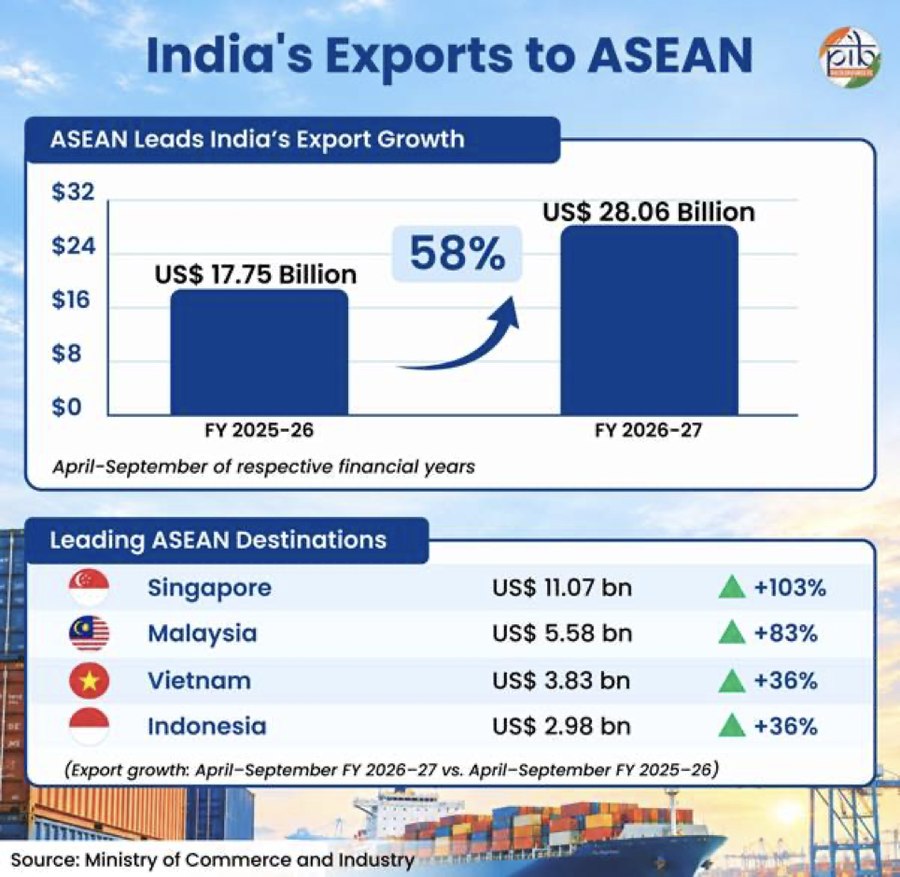
Singapore alone accounts for about 40% of exports to ASEAN in the period. Image courtesy PIB / Ministry of Commerce & Industry; reproduced with credit for educational use.
The Agreements Behind the Numbers
- ASEAN: the ASEAN–India Trade in Goods Agreement (AITIGA), signed 2009, in force from 2010; deeper bilateral pacts with Singapore (CECA, 2005 — India’s first comprehensive agreement) and Malaysia (CECA, 2011). AITIGA is currently under review, mainly over India’s widening trade deficit and rules-of-origin concerns.
- SAFTA: signed in Islamabad (2004), in force 2006, among the eight SAARC members; India also has a separate India–Sri Lanka FTA (1998, in force 2000) and trade treaties with Nepal and Bhutan.
- Japan (CEPA, 2011) and South Korea (CEPA, 2010) — both under discussion for upgrade.
- EFTA (Switzerland, Norway, Iceland, Liechtenstein): TEPA, signed March 2024, in force 1 October 2025 — the first Indian FTA with a commitment to raise US$ 100 bn investment over 15 years.
- Oman CEPA (in force 1 June 2026) — duty-free access on 98.08% of Oman’s tariff lines, covering 99.38% of India’s exports by value.
- UK CETA — signed July 2025, in force 15 July 2026.
- Australia ECTA — in force December 2022; all Indian exports duty-free from 1 January 2026.
- Mauritius CECPA (2021) — India’s first trade agreement with an African country.
- EU — FTA concluded on 27 January 2026, not yet signed or in force, so current EU growth reflects ordinary (non-preferential) market access.
Figure 5 — India’s Exports to the EU (PIB infographic)
Growth in Southern Europe (Spain, Italy) outpaced the EU average of 5%. Image courtesy PIB / Ministry of Commerce & Industry; reproduced with credit for educational use.
Why It Matters
- Diversification — spreading exports across many markets reduces exposure to a slowdown or tariff shock in any single one.
- Neighbourhood First — rising exports to Sri Lanka, Nepal, Bhutan and the Maldives deepen regional economic integration.
- Act East — ASEAN and East Asia link India to regional manufacturing value chains.
- Export target — the Government has set a goal of US$ 2 trillion in goods and services exports by 2030 under the Foreign Trade Policy 2023 (government target).
The Critical View
- Partial picture: the Backgrounder reports only partner markets with growth; it gives no figure for total exports, imports or the trade balance, and omits large markets such as the United States, China and the UAE.
- No product break-up: without commodity data it is unclear how much growth comes from petroleum products, electronics or price effects rather than broad-based competitiveness.
- Hub effects: Singapore is a major transshipment and trading hub, so part of the export surge may be destined for third countries.
- Correlation, not causation: several fast-growing markets (e.g. Spain, Italy) are not FTA partners, so growth cannot be attributed to agreements alone; trade diversion away from tariff-hit markets may also play a role.
- FTA trade deficits: India’s imports from ASEAN, Japan and Korea grew faster than exports after those agreements, a recurring concern in trade-policy debates.
- Low utilisation: studies have long found that Indian exporters, especially MSMEs, claim FTA preferences on a modest share of eligible trade because of rules-of-origin paperwork.
Way Forward
- Raise FTA utilisation through simpler certificates of origin and MSME outreach.
- Conclude the AITIGA review with balanced market access and stricter anti-circumvention rules.
- Use new agreements (UK, EFTA, Oman, NZ, EU) to move into higher-value exports and services.
- Address domestic constraints — logistics costs, quality standards and trade finance — under the Export Promotion Mission.
✎ Mains Practice Question
India has moved from a cautious approach to free trade agreements after leaving RCEP to an active phase of comprehensive bilateral agreements. Examine how FTAs can help diversify India’s exports, and discuss the conditions needed to prevent them from widening trade deficits. 15 marks · 250 words