
Published on Apr 21, 2026
Daily PIB Summaries
PIB Summaries 21 April 2026

Content
- From Margins to Mainstream
- India Emerges as Cradle of Jamun Evolution
From Margins to Mainstream
Why in News?
- 20 April 2026 (PIB Release) highlighted progress of the SMILE Scheme, presenting updated financial allocations, rehabilitation outcomes, and institutional expansion under the ongoing 2021–2026 implementation cycle.
- The update reflects a transition from fragmented welfare delivery to an integrated, convergence-based social justice framework, aligning with constitutional guarantees (Articles 14, 21) and India’s commitment to inclusive growth and SDGs.
Relevance
GS II (Polity & Governance)
- Welfare schemes for vulnerable sections (Transgender persons, homeless, beggars)
- Rights-based framework: Article 14 (equality), Article 21 (dignity)
- Role of local governance (ULBs) in service delivery
- Digital governance (JAM Trinity, DBT, National Portal)
GS I (Society)
- Issues of marginalised groups: transgender community, urban poor
- Social exclusion, identity deprivation, stigma
Practice Question
- “The SMILE scheme marks a transition from welfare-based assistance to a rights-based, capability-enhancing framework for marginalised communities.” Critically examine in the context of implementation challenges.(250 Words)
Static Background
- Historically, transgender persons and individuals engaged in begging have faced systemic exclusion due to stigma, lack of identity documents, and limited access to state services, resulting in intergenerational deprivation.
- The Transgender Persons (Protection of Rights) Act, 2019 provides a statutory foundation, recognising self-perceived gender identity and prohibiting discrimination in education, employment, healthcare, and public services, with penal provisions for violations.
- The landmark NALSA v. Union of India linked gender identity to dignity under Article 21, mandating affirmative action and welfare measures for transgender persons.
- Directive Principles (Articles 38, 39, 41, 46) obligate the State to promote social justice, livelihood security, and protection of vulnerable sections, forming the normative basis for schemes like SMILE.
- Traditional legal frameworks such as the Bombay Prevention of Begging Act, 1959 criminalised poverty; recent judicial trends have shifted towards a rehabilitative, rights-based approach.
- Ayushman Bharat serves as a foundational platform for universal health coverage, extended under SMILE to include gender-affirming healthcare services.
Core Issue / Key Findings
- The scheme has a total financial outlay of ₹390 crore (2021–2026), with ₹265 crore allocated to transgender welfare and ₹125 crore to beggary rehabilitation, indicating a structured prioritisation of vulnerable groups.
- A 225% increase in annual allocation between 2021–22 and 2025–26 demonstrates a clear shift from pilot-scale intervention to mission-mode programme expansion.
- As of March 2026, 31,055 individuals engaged in begging have been identified, while only 9,935 have been rehabilitated, indicating a rehabilitation rate of approximately 32%.
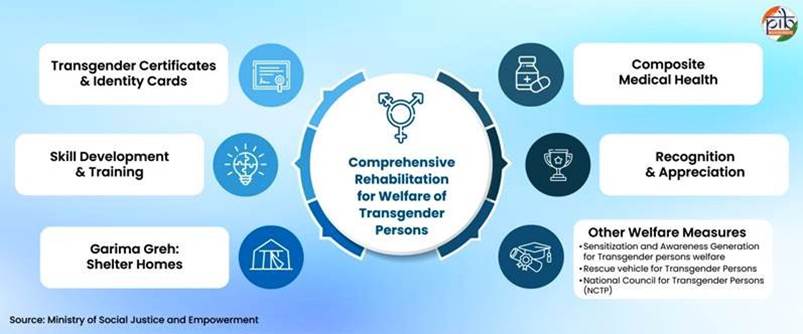
- 21 Garima Greh shelter homes are operational across 17 states, with 3 additional homes sanctioned in August 2025, reflecting gradual institutional expansion.
- Under Ayushman Bharat TG Plus, each transgender beneficiary receives ₹5 lakh annual health coverage, including sex reassignment surgery, hormone therapy, and related procedures.
- The scheme is currently implemented in 181 cities, highlighting a predominantly urban governance approach involving Urban Local Bodies (ULBs).
Overview
- The sharp increase in financial allocation (225%) signifies a policy shift towards mission-mode governance, where marginalised inclusion is treated as a core development priority rather than a peripheral welfare concern.
- The integration of transgender healthcare within SMILE directly operationalises constitutional guarantees under Article 21 and the NALSA judgment, transforming abstract rights into tangible service delivery mechanisms.
- The urban-centric implementation through ULBs reflects administrative practicality, yet also reveals the importance of local governance capacity in determining programme success, especially in identification, counselling, and rehabilitation processes.
- The relatively low rehabilitation success rate (~32%) suggests structural challenges such as floating populations, lack of permanent housing, weak follow-up systems, and socio-economic vulnerabilities leading to relapse into begging.
- The National Portal for Transgender Persons, combined with geotagging of facilities, demonstrates effective digital governance integration, leveraging the JAM Trinity (Jan Dhan–Aadhaar–Mobile) to enable direct benefit transfers, transparency, and real-time monitoring.
- However, this digital model also exposes a “documentation trap”, where beneficiaries without basic identity or permanent address struggle to access the very systems designed to include them, necessitating flexible administrative innovations.
- The scheme embodies a capability-enhancement approach (Amartya Sen) by linking healthcare, education, skill development, and shelter, thereby enabling long-term socio-economic independence instead of short-term relief.
- Convergence opportunities with schemes like PM-DAKSH and PM Vishwakarma Scheme can unlock traditional artisanal or informal skills within marginalised communities, providing culturally rooted livelihood pathways.
- The institutional architecture, including the National Council for Transgender Persons, Protection Cells, and State Welfare Boards, reflects an evolving governance model emphasising coordination, accountability, and rights enforcement.
- From a federal perspective, while SMILE is a centrally funded scheme, its outcomes depend heavily on state-level implementation capacity, leading to inter-state disparities and highlighting the role of competitive-cooperative federalism.
- The upcoming Census 2027 self-enumeration exercise is likely to provide accurate baseline data on transgender and homeless populations, which will be critical for designing the next phase of SMILE post-2026.
- In the broader democratic context, while debates on political representation (e.g., 131st Amendment discussions) are important, schemes like SMILE build the foundational socio-economic capabilities necessary for meaningful participation in governance.
Challenges / Concerns / Gaps
- The low rehabilitation rate (~32%) indicates persistent barriers such as lack of sustained livelihood opportunities, social reintegration challenges, and risk of relapse into begging.
- The documentation barrier (“identity trap”) continues to exclude many eligible beneficiaries who lack basic ID or proof of residence, especially among homeless populations.
- The scheme’s urban-centric focus (181 cities) leads to underrepresentation of rural and semi-urban marginalisation, where vulnerabilities are often less visible but equally severe.
- Deep-rooted social stigma and discrimination against transgender persons limit access to employment, housing, and social acceptance, reducing the effectiveness of economic interventions.
- Capacity constraints in Urban Local Bodies and district administrations affect quality of implementation, monitoring, and follow-up services.
- Significant inter-state disparities exist in establishing Transgender Protection Cells and Welfare Boards, leading to uneven outcomes across regions.
- Absence of robust outcome-based indicators (such as long-term income stability, social integration, and quality of life) limits the evaluation of true programme success.
Key Takeaways
- SMILE represents a shift from “charity-based welfare” to “citizenship-based entitlement and capability-building”, aligning with constitutional morality and human dignity principles.
- It is a strong example of convergent governance, integrating healthcare, education, livelihood, housing, and legal protection within a single framework.
- Demonstrates the importance of digital public infrastructure (JAM Trinity) in enhancing targeted delivery, transparency, and accountability in welfare schemes.
- Highlights federal governance challenges, where centrally funded schemes depend on state capacity and local administrative efficiency.
- Emphasises that future policy success depends on shifting from “rescue and rehabilitation” to “long-term social integration and behavioural change”, including public sensitisation.
Prelims Pointers
- SMILE Scheme launchedon 12 February 2022 by the Ministry of Social Justice and Empowerment.
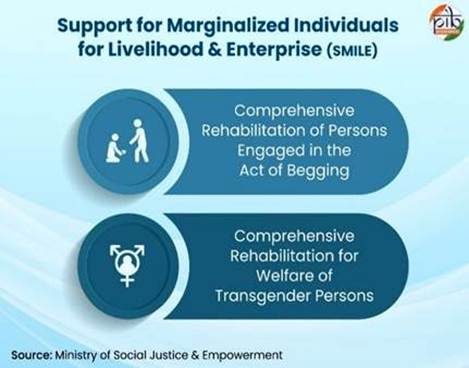
- It comprises two sub-schemes: Comprehensive Rehabilitation of Transgender Persons and Persons Engaged in Begging.
- Garima Greh refers to government-supported shelter homes for transgender persons, implemented through Community-Based Organisations.
- Ayushman Bharat TG Plus provides ₹5 lakh annual health coverage, including gender-affirming procedures and therapies.
- The National Portal for Transgender Persons is mandatory for issuing identity certificates and accessing scheme benefits.
India Emerges as Cradle of Jamun Evolution
Why in News?
- 20 April 2026 (PIB Release) reported a major palaeobotanical finding establishing India as the evolutionary cradle of Jamun (genus Syzygium), based on new fossil evidence from Early Miocene deposits.
- The study challenges earlier theories of Australian/Southeast Asian origin, repositioning India as a primary centre of plant diversification, with implications for biogeography, climate science, and biodiversity policy.
Relevance
GS I (Geography)
- Biogeography, Continental Drift, Gondwana
- Himalayan uplift and monsoon evolution
GS III (Science & Tech)
- Palaeobotany, fossil evidence vs molecular phylogeny
- Interdisciplinary research (taxonomy + modelling)
Practice Question
Q1.Discuss the significance of fossil evidence in reconstructing evolutionary history. How does the recent Jamun study reshape India’s role in global biogeography? (250 words)
Static Background
- Continental Drift Theory explains how India, once part of Gondwana, drifted northwards and collided with Eurasia, shaping Asian flora and fauna distribution.
- East Gondwana included India, Australia, Antarctica, enabling early plant evolution before continental separation.
- Biogeography studies spatial and temporal distribution of species, influenced by plate tectonics, climate, and evolution.
- Palaeobotany reconstructs ancient vegetation using fossil records, complementing molecular phylogeny (DNA-based timelines).
- Geological time relevance:
- Late Cretaceous (~80 MYA): India isolated as a drifting landmass.
- Eocene (~55 MYA): Tropical climate during India–Asia collision phase.
- Miocene (~20 MYA): Himalayan uplift influencing monsoon and vegetation patterns.
Core Issue / Key Findings / Data
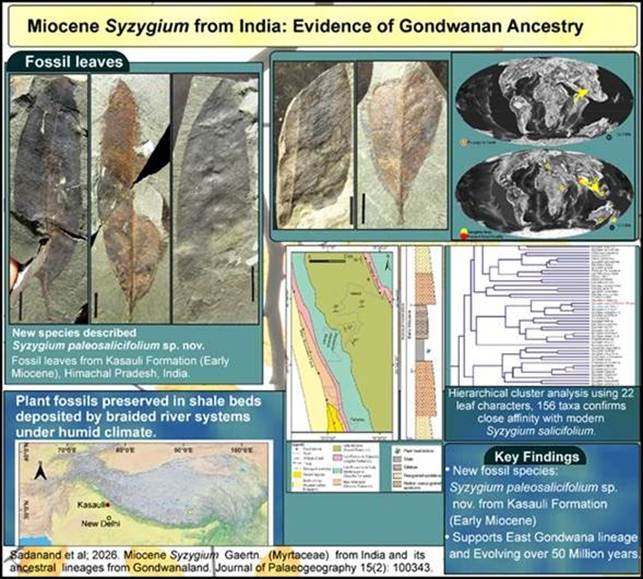
- Study led by Birbal Sahni Institute of Palaeosciences establishes East Gondwanan origin (~80 MYA) of Syzygium, contradicting earlier ~51 MYA origin estimates.
- Discovery of 11 well-preserved fossil leaves (Early Miocene, ~20 MYA) from Kasauli Formation (Himachal Pradesh).
- New species identified: Syzygium paleosalicifolium, confirming continuous presence in India since Early Eocene (~55 MYA).
- Fossil evidence suggests dispersal pathway: India → Southeast Asia → Australia, reversing earlier models.
- Analysis based on 22 morphological characters, statistical validation, and comparison with global herbarium datasets.
Overview
- The study strengthens the “Out-of-India hypothesis”, suggesting India acted as a biogeographical source region rather than a passive recipient of flora.
- Fossil evidence bridges the “molecular vs fossil gap”, where DNA-based timelines underestimated the antiquity of species evolution.
- India’s position as a “floating island” during Late Cretaceous created conditions for independent evolutionary radiation of tropical plant groups.
- The Kasauli Formation fossils (Miocene) coincide with Himalayan uplift, indicating adaptive expansion of species into new ecological niches shaped by orogeny.
- Jamun’s ecological preference for humid tropical climates makes it a proxy indicator (“palaeo-thermometer”) for reconstructing past monsoon patterns and climate conditions.
- Demonstrates integration of morphological taxonomy + statistical modelling + fossil re-evaluation, highlighting advancements in interdisciplinary palaeoscience research.
- Elevates India’s scientific contribution in global evolutionary biology and palaeogeography, aligning with Atmanirbhar Bharat in research ecosystems.
- Institutional significance of Department of Science and Technology support underscores state-led promotion of fundamental research.
Challenges / Concerns / Gaps
- Fossil record incompleteness may still leave gaps in reconstructing continuous evolutionary pathways.
- Dating uncertainties between molecular clocks and fossil timelines require further interdisciplinary calibration.
- Limited geographical sampling (mainly Himalayan foothills) may not fully represent pan-India evolutionary spread.
- Need for high-resolution climate modelling to correlate fossil evidence with precise palaeo-climatic conditions.
- Insufficient public and policy integration of palaeobotanical findings into biodiversity conservation strategies.
Key Takeaways
- Provides strong evidence for India’s central role in global plant evolution.
- Demonstrates importance of fossil evidence over sole reliance on molecular data in evolutionary reconstruction .
- Reinforces concept of India as both a “sink and source” of biodiversity, critical for ecological and conservation debates.
Prelims Pointers
- Syzygium (Jamun) now traced to East Gondwanan origin (~80 million years ago).
- Kasauli Formation (Himachal Pradesh) associated with Early Miocene (~20 MYA) fossil discoveries.
- New fossil species: Syzygium paleosalicifolium.
- Study conducted by Birbal Sahni Institute of Palaeosciences (BSIP) under DST.
- Fossil evidence shows presence in India since Early Eocene (~55 MYA).
- Revised dispersal route: India → Southeast Asia → Australia, reversing earlier theories.