
In-Depth PIB Analysis2 Items
Core TopicImportantConcise
Economy, Agriculture & Tribal AffairsGS Paper III
01Pradhan Mantri Janjatiya Vikas Mission (PMJVM)
Environment, Ecology & Blue EconomyGS Paper III
02National Report on Deep-Sea and Distant-Water Fishery Resources — CMLRE
₹Economy, Agriculture & Tribal AffairsGeneral Studies Paper III
01
Pradhan Mantri Janjatiya Vikas Mission — Unlocking India's Tribal Forest Economy
GS-III · Economy — Tribal Livelihoods, Agriculture, MFP Value ChainPrelims + MainsPIB · Ministry of Tribal Affairs · 20 August 2026
Minor Forest Produce (MFP) forms 20–40% of annual income for millions of forest-dwelling tribal families — yet most sellers receive only a fraction of market value through intermediary chains. PMJVM, launched in 2021–22, attempts to restructure this equation by combining MSP guarantees, value-addition infrastructure, and digital market linkages into a single umbrella mission.
◈ Background & Static Context
India's tribal welfare architecture has evolved through four major legislative and policy milestones over 25 years, each addressing a gap the previous one left open:
- PESA, 1996 — gave tribal Gram Panchayats governance rights over forests and ownership of Minor Forest Produce (MFP).
- Forest Rights Act (FRA), 2006 — made those rights legally enforceable; tribals could now collect, use, and sell MFP without fear of dispossession.
- MSP for MFP Scheme, 2013–14 — addressed the market-failure gap: rights alone could not fix a price floor; direct procurement at MSP protected gatherers from intermediaries.
- Van Dhan Yojana, 2018 (April 14) — added the processing arm: Van Dhan Vikas Kendras (VDVKs) enabled value addition, improving margins significantly.
- PMJVM, 2021–22 — merged all preceding schemes with a parallel institutional-support component into one umbrella mission.
Figure 1 — Policy Lineage: A Shift Toward Tribal Empowerment (1996–2022)
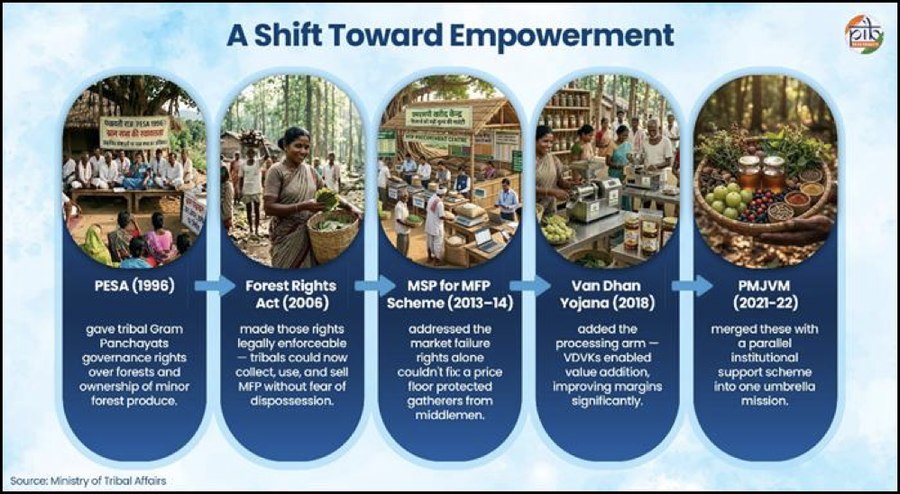
Each milestone addressed a specific gap in the preceding policy: from rights → market protection → value addition → umbrella integration. Image courtesy Ministry of Tribal Affairs / PIB; reproduced with credit for educational use.
▤ Scheme at a Glance — PMJVM
- Launched: 2021–22
- Nodal Ministry / Department: Ministry of Tribal Affairs
- Approving authority: Union Cabinet
- Core instrument: Van Dhan Vikas Kendras (VDVKs) — clusters of 15 SHGs (~300 tribals each); minimum 60% Scheduled Tribe membership
- Coverage / beneficiaries: Forest-dwelling tribal communities across tribal districts; focus on MFP gatherers and processors
- Benefit structure: MSP procurement directly from gatherers; primary processing equipment (decorticators, dryers, packaging tools); working capital via NSTFDC tie-ups; storage & transport support; digital market linkages (ONDC, Amazon, Flipkart, Tribes India outlets)
- Status (July 31, 2026): 4,172 VDVKs sanctioned; 2,911 functional; ₹168 crore reported sales (government projection / running total)
- Tribal members linked: 12.48 lakh
- MFP covered: Honey, tendu leaves, mahua flowers, tamarind, lac, bamboo, wild herbs — over 87 items notified under MSP for MFP
The MFP Value Chain — Four Phases
PMJVM intervenes at every stage of the MFP economy, converting subsistence gathering into a competitive enterprise:
Figure 2 — The Minor Forest Produce (MFP) Economic Value Chain
Value addition at VDVKs can triple or quadruple gatherer incomes; women-led SHGs gain economic agency and seasonal migration declines. Image courtesy Ministry of Tribal Affairs / PIB; reproduced with credit for educational use.
Institutional Architecture
- TRIFED (Tribal Cooperative Marketing Development Federation of India) — the nodal implementing agency; disseminates daily market-rate intelligence, manages branding and e-commerce platforms.
- NSTFDC (National Scheduled Tribes Finance and Development Corporation) — provides working capital to SHGs.
- Haat Bazaars: Over 5,000 haats in tribal areas serve as primary MFP procurement points; being modernised with permanent structures, storage, drinking water, shade, and weighing equipment.
- GI Tags & Branding: Geographical Indication registration is being pursued for tribal produce with distinctive origin-linked qualities.
- Geo-tagging of VDVKs and scheme assets for real-time monitoring.
Lineage & What Changed
- Predecessor: Van Dhan Yojana (2018) focused only on processing infrastructure; MSP for MFP Scheme (2013–14) addressed only price floors. PMJVM merges MSP, Van Dhan, institutional skilling, and marketing support into one mission.
- Key shift: From welfare-centric to enterprise-centric — tribal gatherers are becoming owners of VDVKs rather than wage workers.
- Women's inclusion: Most MFP collection and VDVK operations are women-led, making PMJVM a significant instrument of tribal women's economic empowerment.
Critical View — Implementation Gaps
- Only 2,911 of 4,172 sanctioned VDVKs are functional — a 30% gap between sanction and operation, suggesting absorption and capacity constraints.
- ₹168 crore in sales across 12.48 lakh members translates to roughly ₹1,350 per member — a modest incremental income, indicating the scheme is still scaling.
- MSP procurement reach remains limited in remote tribal districts where state procurement machinery is weak.
- Digital market linkage (ONDC, e-commerce) requires smartphone access and digital literacy — both remain barriers in remote tribal areas.
- The sustainability of tribal forest economy is threatened by deforestation and climate variability affecting MFP yields — a structural challenge the scheme does not directly address.
Key Institutions & Terms for Prelims
- PESA, 1996 — Panchayats (Extension to Scheduled Areas) Act; applies to Fifth Schedule areas; grants Gram Sabha rights over MFP.
- FRA, 2006 — Forest Rights Act; recognises forest-dwellers' rights to collect, use, and sell MFP without licence or fee.
- Fifth Schedule — Constitutional provision (Art. 244) governing Scheduled Areas.
- TRIFED — statutory body under Ministry of Tribal Affairs; the apex national-level marketing body for tribal products.
- Van Dhan Yojana — launched on Ambedkar Jayanti, April 14, 2018; forms the processing foundation of PMJVM.
- GI Tag — Geographical Indication: a sign indicating a product has specific geographical origin and qualities attributable to that origin (under GI of Goods (Registration & Protection) Act, 1999).
- ONDC — Open Network for Digital Commerce; a government-backed open digital protocol for e-commerce.
✎ Mains Practice Question
The Pradhan Mantri Janjatiya Vikas Mission (PMJVM) represents a shift from welfare-based to enterprise-based tribal development. Critically examine the scheme's design, the institutional architecture supporting it, and the structural challenges that limit its transformative potential for forest-dwelling tribal communities. 15 marks · 250 words
Environment, Ecology & Blue EconomyGeneral Studies Paper III
02
CMLRE Releases National Report on Deep-Sea & Distant-Water Fishery Resources of India's EEZ
GS-III · Environment — Blue Economy, Marine Resources, Ocean SciencePrelims + MainsPIB · Ministry of Earth Sciences · 20 August 2026
India has compiled its most comprehensive scientific assessment of deep-sea and distant-water fishery resources within its Exclusive Economic Zone (EEZ) of approximately 2.02 million sq km (with total maritime jurisdiction including the continental shelf reaching ~2.37 million sq km), synthesising over two decades of systematic oceanographic research and 400+ total voyages by FORV Sagar Sampada — a foundation for managing the Blue Economy scientifically.
◈ Background & Static Context
India's engagement with its maritime domain rests on a body of constitutional, legal, and institutional architecture that UPSC regularly tests:
- UNCLOS, 1982 (UN Convention on the Law of the Sea) — defines the EEZ as extending up to 200 nautical miles from the baselines; gives the coastal state sovereign rights over living and non-living resources within the EEZ.
- India's EEZ: approximately 2.02 million sq km (core EEZ); total maritime jurisdiction including the continental shelf reaches approximately 2.37 million sq km.
- CMLRE (Centre for Marine Living Resources & Ecology) — established under the Ministry of Earth Sciences (MoES), Kochi; India's premier marine research institution for living resources; upgraded from the Sagar Sampada Cell and formally established in 1998 (Silver Jubilee celebrated around 2023–2026).
- FORV Sagar Sampada — India's flagship Fishery and Oceanographic Research Vessel; commissioned in 1984; completed over 400 total oceanographic cruises by the mid-2020s; systematic Marine Living Resources Programme (MLRP) work began in the late 1990s.
- Blue Economy Policy (2023) — India's national framework treating the ocean as a key economic and strategic resource; covers fisheries, coastal tourism, marine biotechnology, offshore energy, and shipping.
- Deep Ocean Mission (2021) — approved at ₹4,077 crore over five years; a multi-institutional programme under MoES with NIOT (National Institute of Ocean Technology) leading key components; focuses on deep-sea mineral exploration, ocean biology, and climate change research.
- UN SDG 14 — "Life Below Water" — covers conservation and sustainable use of oceans, seas, and marine resources.
- UN Decade of Ocean Science for Sustainable Development (2021–30) — a framework under which India's research aligns.
▤ Report at a Glance
- Releasing body: CMLRE, Ministry of Earth Sciences
- Research span: ~40 years of oceanographic data; 30 years of systematic surveys
- Cruises covered: > 400 total oceanographic cruises by FORV Sagar Sampada (commissioned 1984); systematic MLRP data since the late 1990s
- Platform: FORV Sagar Sampada (research vessel)
- EEZ surveyed: Arabian Sea, Bay of Bengal, Lakshadweep waters, Andaman Sea, and Southern Ocean (Antarctica)
- Key deep-sea zone: Mesopelagic layer (200–1,000 m depth) — the "Twilight Zone"
- Species of interest: Lanternfishes (myctophids), deep-sea shrimps, cephalopods, tunas, billfishes, sharks, oceanic squids, Antarctic krill
- Biodiversity hotspots identified: Kollam Bank, Angria Bank, Off-Mangalore Deep-Sea Slope, Terrace off Trivandrum, Lakshadweep & Andaman–Nicobar Islands
Key Scientific Findings
- Mesopelagic (Twilight Zone) resources: Dense communities of lanternfishes and deep-sea shrimps in the 200–1,000 m zone drive the ocean's "biological carbon pump" — nightly vertical migrations transfer carbon from surface waters to the deep, regulating global climate.
- Deep-Sea Demersal Resources: Substantial, currently underexploited stocks of deep-sea shrimps, perches, scombroids, flatfishes, and eels identified on the continental slope beyond 200 m depth.
- Distant-Water Fisheries: Data compiled on high-value open-ocean species including tunas, billfishes, sharks, oceanic squids, and Antarctic krill — positioning India for expansion of distant-water fishing operations.
- Biodiversity & Conservation: Ecologically sensitive nursery habitats documented in specific banks and slopes; the report argues for marine spatial planning to balance exploitation with conservation.
Technology Integration — A Vision 2047 Framework
- The report advocates integrating fisheries acoustics, environmental DNA (eDNA), autonomous observing platforms, satellite remote sensing, AI, and advanced ecosystem modelling into India's marine survey architecture.
- This positions the report as more than an inventory — it is a marine spatial planning roadmap for the Blue Economy post-2030.
- Aligns with India's Vision 2047 which treats the Blue Economy as a core pillar of national growth.
Lineage — CMLRE & Indian Ocean Research
- CMLRE was established in 1998 at Kochi under MoES, upgraded from the Sagar Sampada Cell; its Silver Jubilee falls around 2023–2026.
- The Marine Living Resources Programme (MLRP) — the operational programme generating the data synthesised in this report — has run continuously since the early 1990s, making it one of India's longest-running oceanic research programmes.
- India is a signatory to UNCLOS (ratified 1995) and has submitted data to the UN Commission on the Limits of the Continental Shelf (CLCS) to extend its continental shelf jurisdiction beyond 200 NM.
- Parallel institutional efforts: the National Institute of Oceanography (NIO, Goa) under CSIR, and the Indian National Centre for Ocean Information Services (INCOIS) under MoES, together form India's marine science ecosystem.
Critical View
- The report is a scientific milestone but not a policy mandate — actual exploitation of newly identified deep-sea stocks will require separate fisheries development schemes, fishing vessel upgrades, and port infrastructure.
- Distant-water fishing has implications for India's foreign policy: access agreements with distant nations, compliance with Regional Fisheries Management Organisations (RFMOs), and conservation commitments under UNCLOS.
- The biological carbon pump identified in the Twilight Zone is a globally significant climate mechanism — its exploitation for biomass must be balanced against its role in carbon sequestration.
- India's coastal fishers face depletion of near-shore resources; the report's focus on the deep sea may inadvertently divert attention from the immediate livelihood crisis of small-scale fishers.
Key Institutions & Terms for Prelims
- CMLRE — Centre for Marine Living Resources & Ecology, Kochi; under Ministry of Earth Sciences.
- FORV Sagar Sampada — India's fishery and oceanographic research vessel.
- EEZ — Exclusive Economic Zone; 200 nautical miles from baselines; sovereign resource rights under UNCLOS.
- UNCLOS — UN Convention on the Law of the Sea, 1982; the constitution of the oceans.
- Deep Ocean Mission — Government of India, 2021; ₹4,077 crore; covers deep-sea mining, ocean biology, climate change.
- Biological carbon pump — oceanic process by which carbon fixed by phytoplankton is transported to deep waters via marine organisms' vertical migration and sinking organic matter.
- eDNA — environmental DNA: traces of genetic material shed by organisms into the environment; used to detect species presence without direct sampling.
- Mesopelagic zone — ocean layer from 200 to 1,000 m depth; also called the "twilight zone" due to minimal light penetration.
- SDG 14 — Life Below Water; one of the 17 UN Sustainable Development Goals.
- NIO Goa — National Institute of Oceanography; CSIR institute; co-edited the report.
✎ Mains Practice Question
India's Blue Economy ambitions rest on scientific understanding of its maritime resources. In light of CMLRE's comprehensive national report on deep-sea and distant-water fishery resources, evaluate the opportunities and challenges in harnessing India's EEZ for sustainable economic growth, with reference to relevant international legal frameworks. 15 marks · 250 words