

In-Depth PIB Analysis2 Items
Core TopicImportantConcise
Agriculture, Nutrition & ScienceGS Paper III · GS Paper II
01Kufri Jamunia — Biofortified Purple Potato
Defence & SecurityGS Paper III · GS Paper II
02Exercise AUSTRAHIND 2026 (India–Australia)
Agriculture, Nutrition & ScienceGeneral Studies Paper III (with GS-II Health & Nutrition)
01
Kufri Jamunia: A Biofortified Purple Potato and the Fight Against Hidden Hunger
Core TopicGS-III · Agriculture — Crop Improvement, Food Security; GS-II · Health & NutritionPrelims + MainsPIB Backgrounder · Ministry of Agriculture & Farmers Welfare · 18 Oct 2026
ICAR–Central Potato Research Institute (ICAR-CPRI) has highlighted Kufri Jamunia (released in 2024), a purple-fleshed, conventionally bred potato with higher vitamin C, anthocyanins and carotenoids — an attempt to put micronutrients into one of India’s most widely eaten staples.
◈ Background & Static Anchor
- The crop: potato (Solanum tuberosum) originated in the Andes of South America and reached India through European traders in the 17th century; India is now the world’s second-largest potato producer, after China.
- Season and belt: largely a rabi crop of the Indo-Gangetic plains; Uttar Pradesh, West Bengal and Bihar are the leading producers.
- ICAR-CPRI: set up in 1949 at Patna and shifted to Shimla in 1956; its varieties carry the prefix “Kufri”, after its research station near Shimla.
- Global link: the International Potato Center (CIP) is headquartered in Lima, Peru; a CIP South Asia Regional Centre at Agra was approved by the Union Cabinet in 2020.
Hidden hunger — the problem being addressed
Hidden hunger is micronutrient deficiency despite adequate calorie intake — people eat enough but lack iron, zinc, vitamin A and other essentials. In India its clearest marker is anaemia.
- NFHS-5 (2019–21): anaemia affects 57.0% of women aged 15–49 and 67.1% of children aged 6–59 months.
- Policy responses: POSHAN Abhiyaan (2018), Anaemia Mukt Bharat (2018), and fortified rice distributed through the PDS, PM-POSHAN and ICDS.
- Global goal: SDG 2 (Zero Hunger) includes ending all forms of malnutrition by 2030.
Biofortification vs fortification
- Biofortification: raising nutrient levels inside the crop through plant breeding (conventional or, elsewhere, genetic modification); the farmer grows it and the nutrition comes with it.
- Fortification: adding nutrients during processing (e.g., iodised salt, fortified rice), regulated by FSSAI under the Food Safety and Standards (Fortification of Foods) Regulations, 2018 and marked with the “+F” logo.
- Why biofortification appeals: a one-time research cost, no recurring processing cost, and it reaches rural households that eat what they grow.
- Kufri Jamunia is not GM: it comes from a conventional cross (pedigree MS/8-1148 × CP4242).
- Other Indian biofortified varieties: Dhanshakti pearl millet (iron), DRR Dhan 45 rice (zinc), CR Dhan 310 rice (protein) and Pusa Vivek QPM 9 maize (provitamin A).
Lineage — CPRI’s coloured potato series
Figure 1 — Nutrient-rich coloured potato varieties of ICAR-CPRI
1232018Kufri NeelkanthFirst purple-skinnedspecialty varietyHigh antioxidants2021Kufri ManikDeep-red skin,yellow fleshAnthocyanin, zinc, iron2024Kufri JamuniaPurple skin andpurple fleshHigher vitamin C,anthocyanins, carotenoids
Each release has pushed pigmentation further — from skin (Neelkanth, Manik) into the flesh (Jamunia), where most of the nutrition is eaten. Data: PIB, ICAR-CPRI.
Figure 2 — Key features of Kufri Jamunia
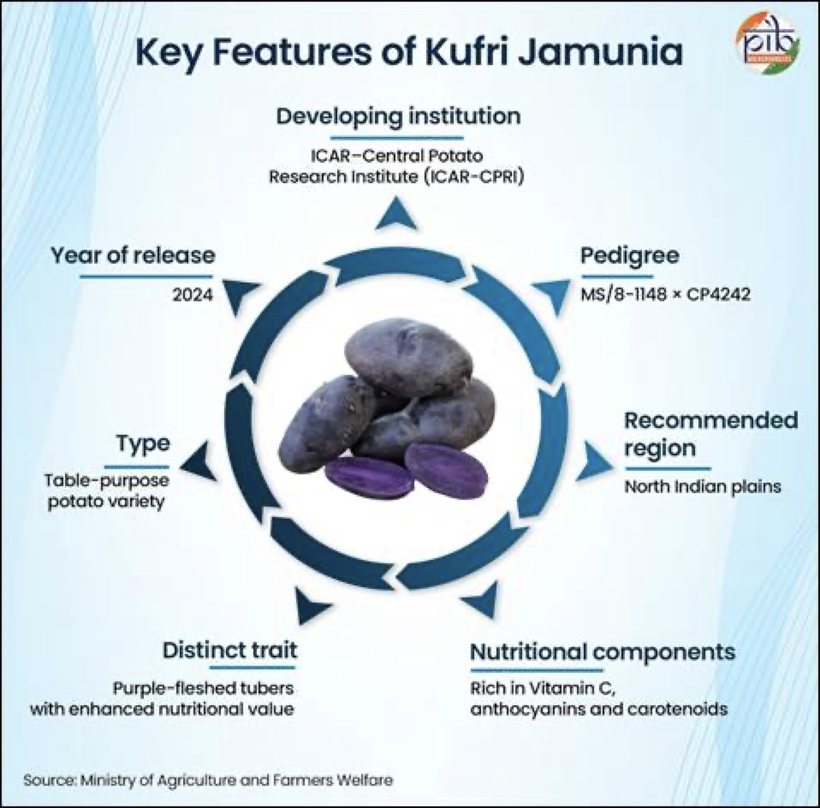
Developer, pedigree, region and type — the standard Prelims hooks for any new variety. Image courtesy PIB Backgrounders (source: Ministry of Agriculture & Farmers Welfare); reproduced with credit for educational use.
▤ Variety at a Glance — Kufri Jamunia
- Developer: ICAR-CPRI, Shimla (under the Department of Agricultural Research and Education, Ministry of Agriculture & Farmers Welfare).
- Year of release: 2024; pedigree: MS/8-1148 × CP4242.
- Type: table-purpose, medium-maturing variety; medium-tall plants, semi-compact canopy.
- Tubers: dark purple skin, purple flesh; oblong with shallow eyes; mealy texture; 10–12 medium-to-large tubers per plant.
- Yield: 32–35 t/ha under recommended practices; about 49 t/ha in station trials at 90 days; marketable yield nearly 90%.
- Dormancy: medium, about 6–8 weeks (tubers do not sprout quickly); good storage with low rotting and weight loss.
- Recommended region: North Indian plains — Punjab, Haryana, Uttarakhand (plains), Uttar Pradesh, Rajasthan, Madhya Pradesh, Gujarat, Chhattisgarh, Bihar, West Bengal, Odisha and Assam.
The nutritional profile (flesh, unless stated)
42.75 mgVitamin C / 100 g
42.05 mgAnthocyanins / 100 g
80.66 mgAnthocyanins / 100 g (skin)
161 µgCarotenoids / 100 g fresh wt
32.23 ppmIron
22.77 ppmZinc
- Anthocyanins: water-soluble flavonoid pigments that give purple, red and blue colours; they act as antioxidants, and their hue varies with pH.
- Carotenoids: fat-soluble yellow-orange pigments; some (e.g., beta-carotene) are provitamin A.
- Skin matters: the skin holds nearly twice the anthocyanin of the flesh, so eating it unpeeled raises intake.
- Uses: curries, parathas, dosa/idli batter, and processed products such as anthocyanin-rich flour, suji and daliya for bakery items and soups.
States suited to cultivation
Figure 3 — States suitable for Kufri Jamunia
Twelve States across the Indo-Gangetic plains, central India and the East — the country’s main potato belt. Map courtesy PIB Backgrounders (source: ICAR); reproduced with credit for educational use.
Why it matters
- Food-based nutrition: potato is eaten across income groups, so higher micronutrient content reaches people without changing diets.
- Farm value: a niche, premium product with processing potential (coloured flour, snacks) can lift farm incomes.
- Storage: medium dormancy and low rotting reduce post-harvest losses — a chronic problem in a crop prone to price crashes after harvest.
The critical view
- Cooking losses: vitamin C and anthocyanins are heat- and water-sensitive; nutrition “on paper” may shrink on the plate after boiling and frying.
- Bioavailability: iron and zinc content does not equal absorption; potato is a modest source compared with pulses or millets.
- Seed bottleneck: adoption depends on quality seed potato; India’s formal seed supply covers only a small share of demand.
- Market acceptance: traders and processors favour familiar white/yellow types; purple varieties need separate supply chains and price premiums.
- Scale vs. diet diversity: single-crop biofortification complements, but cannot replace, dietary diversity, sanitation and maternal-health interventions.
Institutions & terms to know
- ICAR: registered society (est. 1929 as the Imperial Council of Agricultural Research) under DARE.
- Dormancy: the period after harvest during which tubers do not sprout, even in favourable conditions.
- Marketable yield: the share of produce of saleable size and quality.
- ppm: parts per million — 1 ppm = 1 mg per kg.
✎ Mains Practice Question
Biofortification is often described as a sustainable, food-based strategy to combat hidden hunger. Discuss with examples of biofortified crops released in India, and examine the challenges in scaling up their adoption and consumption. 15 marks · 250 words
Defence & SecurityGeneral Studies Paper III (with GS-II IR)
02
Exercise AUSTRAHIND 2026: India–Australia Army Exercise Begins at Thiruvananthapuram
ConciseGS-III · Security — Defence Cooperation; GS-II · IR — India–Australia, Indo-PacificPrelims-orientedPIB · Ministry of Defence · 19 Oct 2026
The 5th edition of AUSTRAHIND, the joint military exercise between the Indian Army and the Australian Army, opened at the Foreign Training Node, Thiruvananthapuram (Kerala) on 19 October 2026, focusing on operations in island and coastal terrain.
Figure 4 — Contingents at the opening of AUSTRAHIND 2026
Contingents of both armies at the Foreign Training Node, Thiruvananthapuram. Image courtesy PIB / Indian Army; reproduced with credit for educational use.
▤ Exercise at a Glance
- Dates: 19 October – 1 November 2026.
- Venue: Foreign Training Node, Thiruvananthapuram; the 4th edition was held at Irwin Barracks, Perth, 13–26 October 2025.
- Strength: about 120 personnel from each army.
- Contingents: India — the Garhwal Rifles with other arms and services; Australia — 13 Brigade.
- Theme: “Joint Sub-Conventional Operations in Island and Coastal Environment under Chapter VII of the UN Mandate”.
- Focus: joint planning, tactical drills, surveillance and reconnaissance, protection of vital installations, HADR response, with aerial and maritime dimensions.
- First: an observer delegation from New Zealand is attending.
Static anchor & significance
- Series: AUSTRAHIND was first held in 2016 and alternates between India and Australia.
- UN Charter, Chapter VII (Articles 39–51): action on threats to the peace, breaches of the peace and acts of aggression — permits enforcement measures, including use of force (Article 42); contrast Chapter VI (peaceful settlement of disputes).
- Partnership: Comprehensive Strategic Partnership (2020) and Mutual Logistics Support Agreement (2020); India–Australia ECTA in force since 29 December 2022; both are Quad members.
- Other India–Australia exercises: AUSINDEX (navies); Australia joined Malabar in 2020; the IAF participates in Australia’s Pitch Black.
- Why island and coastal ops: both countries have large island territories and stakes in HADR and maritime security across the Indo-Pacific; New Zealand’s observers signal a wider Pacific dimension.
- Garhwal Rifles: regimental centre at Lansdowne, Uttarakhand.
✎ Mains Practice Question
India–Australia defence cooperation has moved from symbolic engagement to operational convergence in the Indo-Pacific. Discuss with reference to recent bilateral and minilateral military exercises. 10 marks · 150 words