
In-Depth PIB Analysis2 Items
Core TopicImportantConcise
Governance & Social Justice — HealthGS Paper II
01National HPV Vaccination Campaign Crosses 1 Crore Doses
Economy — Energy & InfrastructureGS Paper III
02Small Hydro Power Development Scheme (2026–31)
Governance & Social Justice — HealthGeneral Studies Paper II
01
National HPV Vaccination Campaign Crosses 1 Crore Doses: Where India Stands on Cervical Cancer Elimination
GS-II · Health — Issues relating to Health, Government Policies; GS-III · S&T — BiotechnologyPrelims + MainsPIB · Ministry of Health & Family Welfare · 21 Nov 2026
Within nine months of its launch in February 2026, the National HPV Vaccination Campaign has given over 1 crore doses of the Human Papillomavirus (HPV) vaccine to 14-year-old girls. That is about 87% of the annual target group, as reported by the Ministry. For cervical cancer, the real test is still sustained coverage combined with screening.
Basics First — What Is HPV, and How Does It Cause Cancer?
HPV is a common DNA virus (family Papillomaviridae) spread mainly through intimate skin-to-skin contact. There are more than 200 types. Most infections clear on their own within one to two years.
- High-risk types 16 and 18 cause about 70% of cervical cancers worldwide. Low-risk types 6 and 11 cause genital warts.
- Persistent high-risk infection can turn cervical cells precancerous and then cancerous, usually over 15–20 years. This long window is why both vaccination and screening work.
- HPV also causes some oropharyngeal (throat), anal, penile, vulvar and vaginal cancers — so it is not only a women’s-health issue.
- How the vaccine works: it uses virus-like particles (VLPs) — the empty outer protein shell (L1 protein) of the virus. VLPs carry no viral DNA, so they cannot cause infection but still trigger strong antibodies.
◈ Types of HPV Vaccines — A Prelims Favourite
- Bivalent (e.g. Cervarix) — protects against types 16, 18.
- Quadrivalent (e.g. Gardasil; India’s Cervavac) — types 6, 11, 16, 18.
- Nonavalent (Gardasil 9) — nine types: 6, 11, 16, 18, 31, 33, 45, 52, 58.
- Cervavac: India’s first indigenous quadrivalent HPV vaccine, developed by the Serum Institute of India with support from the Department of Biotechnology (DBT) and BIRAC; approved by the DCGI in July 2022. (The release does not say which vaccine the campaign uses.)
Static Anchor — Cervical Cancer: The Burden
- Cervical cancer is the fourth most common cancer among women worldwide (WHO) and the second most common cancer among Indian women, after breast cancer.
- GLOBOCAN 2022 estimates about 1.27 lakh new cases and nearly 80,000 deaths a year in India — roughly one in five cervical cancer deaths worldwide.
- Screening gap: NFHS-5 (2019–21) found that only about 1.9% of women aged 30–49 had ever been screened for cervical cancer.
▤ Campaign at a Glance
- Programme: National HPV Vaccination Campaign, launched February 2026.
- Nodal Ministry: Ministry of Health & Family Welfare, with States/UTs under the National Health Mission.
- Beneficiaries: girls aged 14 years. Annual target group of about 1.2 crore, based on Registrar General of India (RGI) 2021 population projections.
- Regimen: single dose, free and voluntary, with parental consent, at designated Government health facilities.
- Digital backbone: U-WIN — registration, slot booking, beneficiary tracking and digital certificates.
- Safety: sessions supervised by trained Medical Officers. Sites are linked to 24×7 centres to manage rare Adverse Events Following Immunisation (AEFI).
- Progress reported: 1 crore+ doses; about 87% cumulative coverage. Six States at 100% of their identified targets; 12 States above 80% (Ministry data).
Figure 1 — The milestone at a glance (official infographic)
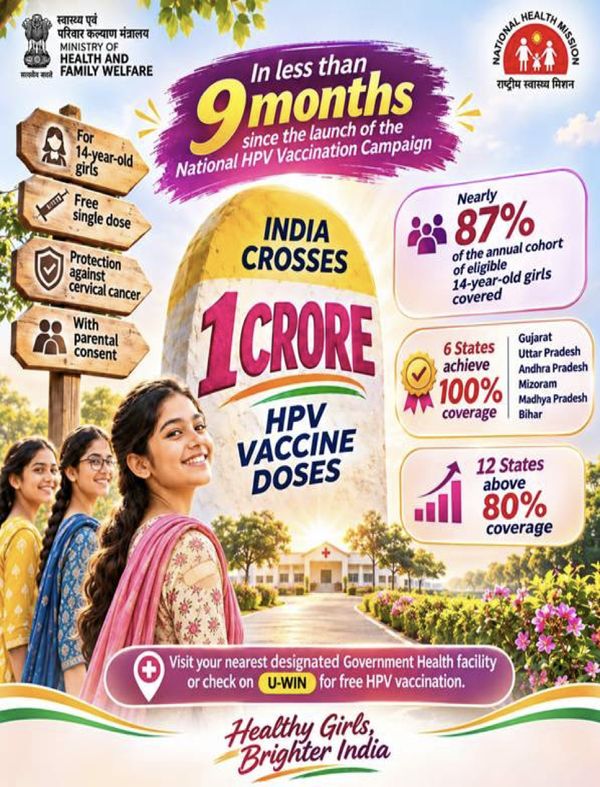
Single-dose, free, voluntary vaccination for 14-year-old girls with parental consent, booked via U-WIN. Image courtesy Ministry of Health & Family Welfare / PIB; reproduced with credit for educational use.
State-wise Picture
Figure 2 — Coverage of identified target population, selected States/UTs (%)
0%25%50%75%100%Gujarat100%Uttar Pradesh100%Andhra Pradesh100%Mizoram100%Madhya Pradesh100%Bihar100%Assam95.63%Telangana95.28%Karnataka93.16%Uttarakhand90.17%Chhattisgarh86.21%Rajasthan85.23%Keralam77.02%Tamil Nadu76.12%Odisha74.90%DNH & DD (UT)72.99%100% of identified target80–99%70–79%80% mark
Only States named in the release are shown. Coverage is measured against “identified” targets derived from RGI 2021 projections. Data: MoHFW, 21 Nov 2026.
- 100% of identified targets: Gujarat, Uttar Pradesh, Andhra Pradesh, Mizoram, Madhya Pradesh, Bihar.
- Largest absolute numbers: Uttar Pradesh (29.33 lakh), Bihar (13.70 lakh), Gujarat (7.75 lakh).
- Below 80%: Keralam (77.02%), Tamil Nadu (76.12%), Odisha (74.90%) and Dadra & Nagar Haveli and Daman & Diu (72.99%). Some of these States had their own HPV programmes before the national one.
Lineage — How India Got Here
- 2016: early pilots by Delhi and Punjab; Sikkim launched a State-wide school programme in 2018.
- June 2022: the National Technical Advisory Group on Immunisation (NTAGI) recommended adding the HPV vaccine to the Universal Immunisation Programme (UIP) for girls aged 9–14.
- 2022: the WHO endorsed a single-dose schedule for girls aged 9–14. Many countries have since switched to one dose, which cuts cost and makes logistics simpler.
- Interim Budget 2024–25 announced that the Government would encourage HPV vaccination for girls aged 9–14.
- February 2026: national campaign launched for the 14-year cohort, run on U-WIN — the UIP’s digital registry, modelled on CoWIN.
◈ Universal Immunisation Programme (UIP) — Static Recap
- Expanded Programme on Immunisation (1978) → renamed UIP in 1985. It is one of the world’s largest public-health programmes and now covers 12 vaccine-preventable diseases.
- Mission Indradhanush (2014) and Intensified Mission Indradhanush targeted children who were unvaccinated or only partly vaccinated.
- NTAGI is the expert body that advises the Ministry on adding new vaccines.
The Global Goal — WHO’s 90-70-90 Strategy
Figure 3 — WHO’s 90-70-90 targets and where India stands
90%VACCINATEof girls fully vaccinatedwith HPV vaccine by age 15India: campaign for age 14 ✓ underway70%SCREENof women screened with ahigh-performance test by 35 & 45India: ~1.9% ever screened (NFHS-5)90%TREATof women with pre-canceror cancer receive treatmentIndia: depends on screening reachTarget year 2030 → elimination threshold: fewer than 4 cases per 1,00,000 women per year
Vaccination is the first of three pillars; screening is India’s largest gap. WHO Global Strategy (Nov 2020); screening figure from NFHS-5.
The WHO Global Strategy to Accelerate the Elimination of Cervical Cancer (November 2020) defines elimination as fewer than 4 cases per 1,00,000 women a year. It sets three targets to be met by 2030, so that every country is on the path to elimination within this century.
Why It Matters
- Prevention over cure: vaccinating at 14 protects girls before most of them are exposed to the virus. It is far cheaper than treating cancer later.
- Equity: a free public programme reaches girls whose families could not pay private-market prices.
- Scale and digital tools: U-WIN allows district-level tracking of gaps and shows that vaccination at this scale can be done beyond infancy.
- SDG link: SDG 3.4 — reduce early deaths from non-communicable diseases by one-third by 2030.
The Critical View
- Vaccination is one pillar out of three: its effect on cancer rates will show only after 15–20 years. Without wider screening (VIA, HPV-DNA tests) and treatment, women who are already adults gain nothing from it.
- Narrow age group: only 14-year-olds are covered, while WHO and NTAGI recommend 9–14. There is no catch-up drive for older adolescents, who will miss out.
- Boys left out: several countries now vaccinate both sexes. This adds herd protection and guards against HPV-related cancers in men.
- Which denominator? Coverage is measured against identified targets based on RGI 2021 projections. With no census update yet, “100%” may not mean every eligible girl.
- Hesitancy and misinformation: a vaccine linked to sexual transmission meets social resistance. Sustained Information, Education & Communication (IEC) work and strong AEFI handling are essential.
- Hard-to-reach girls: out-of-school girls, migrants and remote areas need more outreach than a facility-based model gives.
- Long-term funding: each year a new cohort turns 14. Vaccine supply and money must be assured every year, ideally through domestic production.
Way Forward
- Bring HPV vaccination fully into the routine UIP, expand to the 9–14 age band, and hold a one-time catch-up drive.
- Scale up screening under the National Programme for Prevention and Control of NCDs (NP-NCD) through Ayushman Arogya Mandirs, moving to HPV-DNA testing and self-sampling.
- Link vaccination and screening records to the Ayushman Bharat Health Account (ABHA) so each woman can be followed up over time.
- Run school-based delivery and community IEC through ASHAs, ANMs and teachers, and consider gender-neutral vaccination later on.
▤ Prelims Pointers
- HPV is a DNA virus. The vaccine uses virus-like particles, not live or killed virus.
- Cervavac = indigenous quadrivalent vaccine (types 6, 11, 16, 18) — Serum Institute, with DBT–BIRAC.
- WHO elimination threshold: <4 per 1,00,000 women; targets 90-70-90 by 2030.
- U-WIN = digital registry for routine immunisation; NTAGI = expert advisory body on vaccines.
✎ Mains Practice Question
India’s National HPV Vaccination Campaign has reached high coverage in a short time. Discuss its significance for cervical cancer elimination, and examine why vaccination alone may not be enough to meet the WHO’s 90-70-90 targets. 15 marks · 250 words
Economy — Energy & InfrastructureGeneral Studies Paper III
02
Harnessing Small Hydro Power: The SHP Development Scheme 2026–31 and India’s Untapped Potential
GS-III · Infrastructure — Energy; Environment — Conservation, EIA; GS-I · Geography — Distribution of ResourcesPrelims + MainsPIB Backgrounder · Ministry of New & Renewable Energy · 22 Nov 2026
A new PIB backgrounder sets out the case for small hydropower (SHP) and the SHP Development Scheme (FY 2026–27 to 2030–31), which aims to add about 1,500 MW. India has tapped only about a quarter of its estimated 21,134 MW SHP potential. Most of the rest lies in the Himalayan and North-Eastern States, which are also ecologically fragile.
Basics First — How Hydropower Works
Hydropower turns the potential energy of water stored at a height into kinetic energy as it falls. The falling water spins a turbine connected to a generator. Output depends on the flow (discharge, Q) and the head (H) — the height the water falls: P ≈ ρ·g·Q·H·η, where η is efficiency.
- Storage (reservoir) projects: a large dam stores water; output can be controlled, but people are displaced and land is submerged.
- Run-of-river projects: divert part of the river’s flow with little or no storage. Most SHPs are of this type, along with canal-based and dam-toe plants.
- Pumped storage: pumps water uphill when power is in surplus and releases it at peak demand — a “water battery”.
- Turbine choice depends on head: Pelton (high head, hilly streams), Francis (medium), Kaplan (low head, canals).
Figure 4 — How a run-of-river small hydro project works
River (natural flow)1. Weir / intakediverts part of flow2. Desilting tankremoves sediment3. Water conductorchannel / tunnel4. Forebaybalances flow5. Penstock → turbinehead drives generator6. Tailracewater back to riverDiversion stretch: river flow reduced between intake and tailrace→ needs minimum environmental flows (e-flows)Little or no storage · small land footprint · output depends on seasonal river flow
Most SHPs divert water rather than store it; the dewatered stretch between intake and tailrace is the main ecological concern.
◈ What Counts as “Small Hydro” in India
- Small hydro: projects up to 25 MW. These fall under the Ministry of New & Renewable Energy (MNRE). Projects above 25 MW fall under the Ministry of Power.
- Sub-classes (MNRE): micro (up to 100 kW), mini (101 kW–2 MW), small (2–25 MW).
- Renewable status: SHP has long been counted as renewable energy. In March 2019, the Cabinet also declared large hydro renewable and introduced a Hydropower Purchase Obligation (HPO).
- History: India’s first hydropower plant was a small one — Sidrapong, Darjeeling (1897, 130 kW). Shivanasamudra (Karnataka, 1902) followed.
▤ Scheme at a Glance
- Name: Small Hydro Power (SHP) Development Scheme.
- Approving authority: Union Cabinet (approved 18 March 2026).
- Nodal Ministry: MNRE.
- Tenure: FY 2026–27 to FY 2030–31.
- Outlay: ₹2,584.60 crore.
- Coverage: projects of 1–25 MW nationwide, with priority to hilly, North-Eastern and border regions.
- Support — NE States & international border districts: ₹3.6 crore/MW or 30% of project cost, whichever is lower; ceiling of ₹30 crore per project.
- Support — other locations: ₹2.4 / 1.78 / 2.054 crore/MW (depending on size and location) or 20% of project cost, whichever is lower; ceiling of ₹20 crore per project.
- Pipeline support: ₹30 crore to help central and State agencies prepare Detailed Project Reports (DPRs) for at least 200 projects.
- Stated targets: about 1,500 MW new capacity, about ₹15,000 crore investment and about 51 lakh person-days of construction jobs; preference for indigenous equipment (Government projections).
Potential vs Utilisation
Figure 5 — Small hydro potential vs utilisation (as of September–October 2026)
Capacity (MW)5,182 used21,134 MWUtilised: 24.5% · Untapped: 15,952 MWSites (number)1,202 used7,133 sitesUtilised: 16.9% · Untapped: 5,931 sitesScheme target of ~1,500 MW ≈ 9% of the 15,952 MW untapped potential
About a quarter of capacity and a sixth of identified sites are harnessed. Data: MNRE / NITI Aayog via PIB.
- Estimated potential: 21,134 MW across 7,133 sites. Harnessed: about 5,182 MW from 1,202 sites (about 25%), as of 30 September 2026.
- Untapped: about 15,952 MW. The scheme’s 1,500 MW target would cover roughly one-tenth of this gap.
Where the Potential Lies — Regional Geography
Figure 6 — Region-wise SHP potential and the leading States
38%26%14%14%8%21,134MW totalNorthern 8,030Southern 5,490North-Eastern 2,995Western 2,912Eastern 1,707Top 10 States by SHP potential (MW)Karnataka3,726Himachal Pradesh3,460Arunachal Pradesh2,065Uttarakhand1,664Jammu & Kashmir1,312Chhattisgarh1,098Madhya Pradesh820Maharashtra786Keralam647Tamil Nadu604
The North alone holds 38% of potential; Karnataka and Himachal Pradesh together account for about a third of the national total. Bar colours match the region. Data: MNRE via PIB.
- Northern (8,030 MW): Himachal Pradesh (3,460 MW) leads the region, followed by Uttarakhand (1,664), Jammu & Kashmir (1,312) and Ladakh (396). Steep slopes and perennial, snow-fed rivers give high heads, but use is only moderate.
- Southern (5,490 MW): Karnataka (3,726 MW) alone is about 68% of the region. Then come Keralam (647) and Tamil Nadu (604). Western Ghats streams and strong grids give it the highest utilisation.
- North-Eastern (2,995 MW): Arunachal Pradesh (2,065 MW) holds about 69%, followed by Meghalaya (230), Assam (202), Nagaland (182), Mizoram (169), Manipur (100) and Tripura (47). Suited to off-grid supply for remote and tribal areas.
- Western (2,912 MW): Chhattisgarh (1,098 MW), Madhya Pradesh (820), Maharashtra (786). Installed capacity is 730 MW. Mostly canal-based and dam-toe sites, which are cheaper to build.
- Eastern (1,707 MW): Bihar (527), West Bengal (392), Odisha (286), Sikkim (267), Jharkhand (228).
Why It Matters
- Firm, flexible power: unlike solar and wind, hydro can supply power round the clock and respond quickly to demand. This helps balance the grid as more variable renewables come online.
- Decentralised supply: plants close to where power is used cut transmission losses. This is valuable in hilly, border and remote areas far from the main grid.
- Smaller footprint: compared with large dams, SHPs need little land and cause negligible displacement.
- Climate goals: SHP supports India’s target of 500 GW non-fossil capacity by 2030 and its net-zero by 2070 pledge.
- Strategic and local value: power for border villages (e.g. under the Vibrant Villages Programme), local jobs and a market for domestic turbine makers.
The Critical View
- Fragile Himalaya: many small projects lined up on the same river (cascades) can dry out long stretches of riverbed. The 2013 Kedarnath floods and the February 2021 Chamoli disaster — which destroyed the 13.2 MW Rishiganga small hydro project — show the risks.
- Light regulation: under the EIA Notification, 2006, hydro projects below 25 MW need no prior environmental clearance. There is also no mandatory cumulative impact assessment for river basins.
- Environmental flows: diverting water harms fish, aquatic ecology and downstream users unless minimum e-flows are kept.
- Seasonal output: run-of-river plants depend on monsoon and snowmelt. Their utilisation is often low in lean seasons, and glacier retreat adds long-term uncertainty.
- Cost and viability: SHP tariffs often cannot compete with solar. Remote sites face grid-connection costs, forest clearance delays and silt damage to turbines.
- Modest scale: 1,500 MW over five years is small next to India’s renewable additions. SHP adds variety to the mix rather than making a big difference to it.
Way Forward
- Basin-level planning: require cumulative impact and carrying-capacity studies for clustered SHPs, with enforceable e-flow standards.
- Low-impact sites first: favour canal-based, dam-toe and retrofit projects that use existing infrastructure.
- Community models: village-level micro-hydro and mini-grids in the North-East, with local ownership and benefit-sharing.
- Hybrid systems: pair SHP with solar and battery storage to make up for lean seasons, and use the DPR fund to build a pipeline of projects that can get loans.
▤ Prelims Pointers
- SHP = up to 25 MW, under MNRE. Above 25 MW falls under the Ministry of Power.
- Micro ≤100 kW; mini 101 kW–2 MW; small 2–25 MW.
- Highest SHP potential among States: Karnataka (3,726 MW), then Himachal Pradesh (3,460 MW); among regions: Northern.
- Pelton turbine = high head; Kaplan = low head. India’s first hydro plant: Sidrapong, Darjeeling (1897).
✎ Mains Practice Question
Small hydropower is often presented as a low-impact source of decentralised clean energy. Examine its potential for India’s energy transition, and discuss the ecological concerns its expansion raises in the Himalayan region. 15 marks · 250 words