
In-Depth PIB Analysis2 Items
Core TopicImportantConcise
Economy, Governance & Ease of Doing BusinessGS Paper III
01National Single Window System — Five Years
Society, Health & CultureGS Paper I & II
0211th Ayurveda Day & the Ayush Ecosystem
Economy, Governance & Ease of Doing BusinessGeneral Studies Paper III
01
National Single Window System completes five years: what a single window for business approvals actually does
GS-III · Economy — Industrial Policy, Ease of Doing Business; GS-II · e-GovernancePrelims + MainsPIB · Ministry of Commerce & Industry (DPIIT) · 22 Sep 2026
The National Single Window System, the Centre's common digital counter for business approvals, marked five years on 22 September 2026 — a useful moment to ask what "single window" means in a federal state where the clearances an investor needs sit with two different levels of government.
◈ The basics — what problem a single window solves
Setting up a factory in India has never required one permission. It requires a stack: incorporation, industrial licence where applicable, environmental and forest clearance, fire and factory licences, labour registrations, power and water connections, trade licence.
- The federal split is the root cause. Industry, labour and electricity sit in the Concurrent List; land, water, public health, trade and local bodies are State subjects under the Seventh Schedule. So one project attracts Central, State and municipal approvals, each with its own portal, form and document set.
- "Single window" is an interface, not a transfer of power. It does not take away any regulator's authority to approve or reject. It collects the application once, routes it electronically to whichever department is legally competent, and lets the applicant track it.
- Earlier attempts were sectoral or State-level — Invest India's facilitation desk, State single-window Acts, the Shram Suvidha and PARIVESH portals for labour and environment. NSWS is the attempt to sit above them as a common front end.
▤ NSWS at a Glance
- Launched: 22 September 2021; completes five years in 2026.
- Nodal body: Department for Promotion of Industry and Internal Trade (DPIIT), Ministry of Commerce & Industry.
- Nature: a digital platform, not a statutory regulator — approvals continue to be granted by the competent Ministry, Department or State authority.
- Coverage: 32 Central Ministries/Departments and 34 States and Union Territories on board.
- Approvals available: over 327 Central and 3,452 State approvals.
- Charges: registration on the portal is free; statutory fees of the concerned authority are paid through it.
- Business identity: PAN is used as the Single Business ID; authorised representatives authenticate through Digital Signature Certificate, and sole proprietors through DigiLocker.
Figure 1 — Five years of the National Single Window System
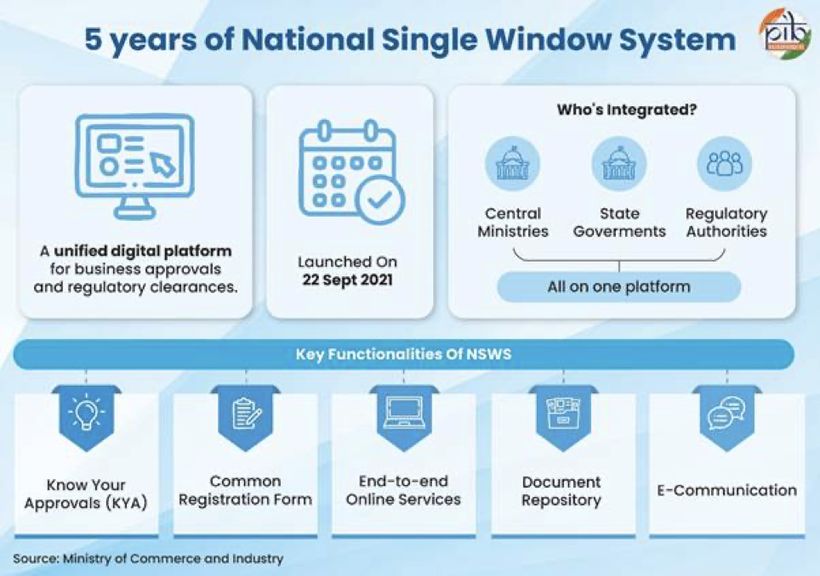
The platform in one frame — launch date, who is integrated, and the five functional modules. Image courtesy Press Information Bureau, Ministry of Commerce & Industry, 22 September 2026; reproduced with credit for educational use.
The five modules an aspirant should be able to name
- Know Your Approvals (KYA): an advisory questionnaire that maps the proposed activity, sector and location to the list of approvals likely to be needed. The Government states the guidance is advisory and not legal advice.
- Common Registration Form: captures information once through a single interface and allows it to be reused across applications; a separate State Registration Form links to State single-window systems.
- Applicant Dashboard: submission, real-time status tracking, renewals and responses to departmental queries in one place.
- Document Repository: one-time upload, reuse across multiple approvals.
- E-Communication Module: queries and clarifications exchanged online with Ministries and States, replacing counter visits and correspondence.
Figure 2 — The NSWS approval pathway
Registeremail + mobileKnow YourApprovalsCommonRegistration FormApply + paystatutory feeNSWS routes the application electronically to the competent authorityCentral Ministry /Department backendState single-windowsystem / regulatorDashboardDocumentRepositoryE-CommunicationThe platform carries the paperwork; the statutory power to approve stays with the regulator.
One submission, many regulators — the single window is a routing layer over an unchanged legal architecture.
What the Government reports after five years
- An annual average of over 3.06 lakh applications received and more than 2.26 lakh approvals facilitated each year (as on 21 September 2026).
- Over 5.69 lakh business entities onboarded — proprietorships, companies, LLPs and foreign entities.
- Approvals routed include company incorporation, industrial licences, startup recognition, FDI approvals and registration under the Contract Labour (Regulation and Abolition) Act, 1970.
- The portal is also the common gateway for the National Green Hydrogen Mission, the Ethanol Policy, the Vehicle Scrapping Policy and the Indian Footwear and Leather Development Programme.
Figure 3 — States offering the most integrated approvals on NSWS
Assam335Karnataka327Tamil Nadu223Manipur190Number of State approvals integrated with NSWS (Source: DPIIT, September 2026)
Integration depth varies sharply across States — the count measures approvals connected, not clearance speed.
Recent integrations — the examinable additions
- Industrial Entrepreneur Memorandum (IEM) and Industrial Licence (IL) — the filings under the Industries (Development and Regulation) Act, 1951 — migrated fully to NSWS in October 2025 and March 2026 respectively, with auto-population from government databases and instant acknowledgements.
- Foreign Investment Facilitation Portal (FIF Portal) integrated, so FDI proposals on the Government (approval) route come through the same window.
- Production Investment Business Registration module (November 2025) lets Indian companies generate Sponsorship Letters inviting foreign professionals under the e-B-4 visa.
- PESO — the Petroleum and Explosives Safety Organisation — has integrated all 74 of its licensing modules, the first department with complete transaction-level integration.
◈ Static background you will be tested on
- The Doing Business era ended. The World Bank discontinued its Doing Business report in 2021 after a data-irregularities review; its successor, B-READY (Business Ready), scores regulatory framework, public services and operational efficiency separately — a design that rewards exactly this kind of back-end integration.
- Competitive federalism instrument: DPIIT's Business Reform Action Plan (BRAP) ranks States on reform implementation, and the National Single Window is its natural digital expression.
- Deregulation lineage: abolition of most industrial licensing in 1991 left licences only in a short reserved list (defence aerospace and warlike equipment, industrial explosives, tobacco products, certain hazardous chemicals). IEM is the information filing for everything outside that list.
- Governance framing: the Government situates NSWS within "Minimum Government, Maximum Governance" and the broader decriminalisation drive (Jan Vishwas Act, 2023) and National Single Window–Jan Vishwas–PM GatiShakti trio.
The critical view
- Counting approvals is not measuring time. The headline metrics report applications received and approvals facilitated, not median clearance time or rejection rates — the variables that actually determine investor experience.
- A front end over unreformed back ends. Where the department's internal process remains manual, the portal adds a layer without compressing the timeline. PESO's full transaction-level integration is flagged as a first precisely because most integrations are shallower.
- Federal unevenness. With State approvals ranging from a few dozen to over 300, an investor's experience still depends heavily on the State, which weakens the "single" in single window.
- Advisory, not binding. KYA guidance carries no legal protection: an investor who follows it and still misses an approval bears the consequence.
- Digital access. Reliance on DSC, PAN authentication and document uploads suits organised firms more than the small and informal enterprises that face the heaviest compliance burden relative to turnover.
✎ Mains Practice Question
"A single-window system can simplify the interface with the regulator without simplifying the regulation itself." Examine this statement in the context of India's National Single Window System, and suggest measures to convert procedural integration into genuine reduction in compliance burden. 15 marks · 250 words
Society, Health & CultureGeneral Studies Papers I & II
02
11th Ayurveda Day: mainstreaming a traditional system into public health, and the evidence question that follows
GS-II · Health & Governance — Schemes, Regulation; GS-I · Indian HeritagePrelims + MainsPIB · Ministry of Ayush · 22 Sep 2026
Ayurveda Day is observed on 23 September, and the eleventh edition is framed around the theme "Ayurveda for a Healthier Tomorrow" — the occasion for a stocktake of how far a classical system has actually been embedded in India's public health architecture.
◈ The basics — Ayurveda as a knowledge system
Ayurveda (ayu, life + veda, knowledge) is traced to the Vedic corpus, with the Rigveda and Atharvaveda carrying its earliest references. Its stated purpose is preventive as much as curative.
- Foundational aim: Swasthasya swasthya rakshanam, aturasya vikara prashamanam — preserve the health of the healthy, relieve the disorder of the sick.
- Conceptual core: health as equilibrium among the doshas (bio-energies), agni (metabolic fire), dhatus (tissues) and malas (wastes), together with atma, manas and the indriyas.
- Classical texts: the Charaka Samhita (internal medicine, the Kayachikitsa tradition) and the Sushruta Samhita (surgery, Shalya tantra), with the later Ashtanga Hridaya of Vagbhata completing the Brihat-trayi.
- The Ayush family: Ayurveda, Yoga & Naturopathy, Unani, Siddha, Sowa-Rigpa and Homoeopathy. A separate Ministry of Ayush was carved out of the Department of Ayush in November 2014.
- Date logic: the observance was earlier tied to Dhanvantari Jayanti (Dhanteras) and hence moved with the lunar calendar; it is now fixed to 23 September, aligned with the autumnal equinox.
▤ National Ayush Mission at a Glance
- Type: Centrally Sponsored Scheme of the Ministry of Ayush, working alongside the National Health Mission of the Ministry of Health & Family Welfare.
- Funds released: over ₹6,406.99 crore to States and UTs between 2014-15 and 2025-26.
- Ayushman Arogya Mandirs (Ayush): 12,260 functional as on 19 September 2026, against a target of 12,500.
- Co-location under NHM: Ayush services offered in 13,249 public health facilities — 6,302 PHCs, 3,191 CHCs, 475 district hospitals and 3,281 other facilities (as on 30 December 2025).
- Human resources supported: salaries for 25,322 Ayush doctors and 5,666 Ayush paramedics; a BAMS graduate can serve as a Community Health Officer at a sub-centre-level Ayushman Arogya Mandir.
- Education: 593 Ayurveda colleges with 45,245 UG and 5,673 PG seats (as on 13 March 2026); 17 Ayush colleges approved under NAM, 12 of them Ayurveda-focused.
- Budget 2026-27: ₹4,408 crore for the Ministry of Ayush, including three new All India Institutes of Ayurveda and an upgrade of the WHO Global Traditional Medicine Centre, Jamnagar.
Figure 4 — National Ayush Mission — key highlights, FY 2022-23 to 2024-25
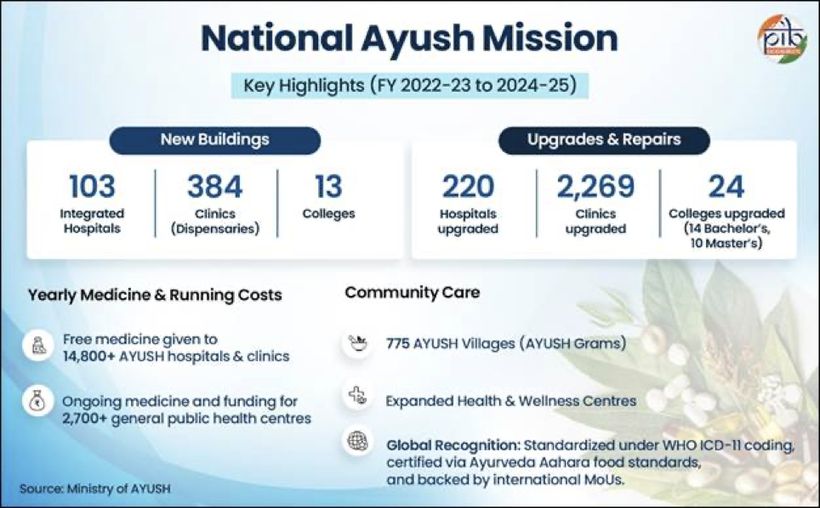
Construction, upgradation and community-care outputs reported under the Mission. Image courtesy Press Information Bureau, Ministry of Ayush, 22 September 2026; reproduced with credit for educational use.
Figure 5 — Four pillars of Ayurveda mainstreaming
Integrating Ayurveda with the public health systemService deliveryAyushman ArogyaMandirs (Ayush)Co-location in PHC/CHCeSanjeevani Ayush OPDEducation593 Ayurveda colleges45,245 UG seats5,673 PG seatsNCISM regulationResearch & qualityCCRAS · AYURGYANAYUR SWASTHYADrugs & Cosmetics Acte-Aushadhi · GMPGlobal integrationWHO ICD-11 moduleGTMC, JamnagarDelhi DeclarationM-3 / M-4 Ayush visasEach pillar advances only as fast as the evidence base beneath it.
Infrastructure, manpower, regulation and diplomacy have moved together; clinical validation is the slower fourth leg.
Access: telemedicine, insurance and coding
- eSanjeevani, the Health Ministry's free national telemedicine platform, has served over 50 crore patients and carries a dedicated Ayush OPD vertical.
- Insurance: in 2024 the IRDAI required insurers to offer products or add-ons covering all systems of medicine, including Ayurveda, under board-approved underwriting policies.
- In February 2026 the All India Institute of Ayurveda (AIIA), New Delhi signed a common empanelment MoU with the General Insurance Council, empanelling it with all 32 general insurers for cashless treatment — the first such universal arrangement for an Ayush institution. A dedicated Ayush insurance helpline was launched alongside.
- WHO ICD-11: the inclusion of a traditional-medicine module lets clinicians record Ayurveda, Siddha and Unani diagnoses in standard codes — a precondition for comparable data, insurance reimbursement and epidemiological research.
Research architecture and regulation
- AYURGYAN (2021-22): supports R&D and capacity building; of ₹17.79 crore across 34 projects, Ayurveda accounts for ₹9.38 crore across 17 projects, several building safety-and-efficacy dossiers for single botanicals.
- AYUR SWASTHYA Yojana (2021-2026): assistance to government and non-profit Ayush bodies; 28 Centres of Excellence established, 22 of them Ayurveda-centric.
- CCRAS, one of five autonomous research councils under the Ministry, works through 30 institutes and runs the SPARK studentship to seed research aptitude among UG students; it has partnered AICTE's Anuvadini AI to translate its research into 13 Indian languages.
- Drug regulation: Ayurvedic medicines fall under the Drugs and Cosmetics Act, 1940 and Rules, 1945 — GMP compliance, pharmacopoeial standards, inspection and testing, with an Ayush vertical inside CDSCO and the e-Aushadhi portal for licensing.
- Food regulation: FSSAI, with the Ministry of Ayush, notified standards for Ayurveda Aahara, defining a product list drawn from classical texts and bringing traditional foods into a licensed, labelled category.
Figure 6 — Strengthening the Ayurvedic medicine supply chain
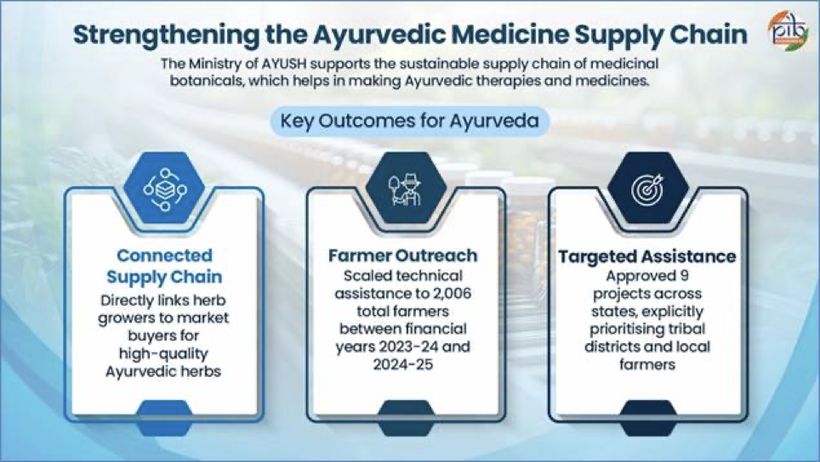
Grower-to-buyer linkage, farmer outreach and projects prioritising tribal districts. Image courtesy Press Information Bureau, Ministry of Ayush, 22 September 2026; reproduced with credit for educational use.
Figure 7 — Keralam as a global hub for Ayurveda tourism
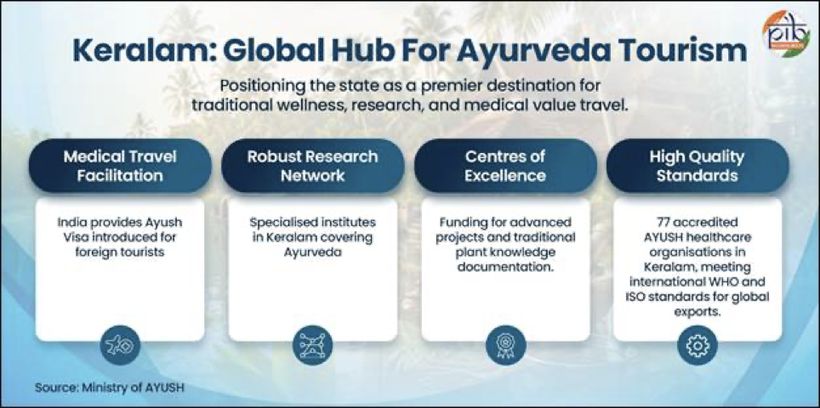
Medical value travel, research institutes, Centres of Excellence and accredited facilities. Image courtesy Press Information Bureau, Ministry of Ayush, 22 September 2026; reproduced with credit for educational use.
The global push
- 27 country-to-country MoUs on traditional medicine, 57 institute-to-institute MoUs, 16 MoUs for Ayush Academic Chairs, 46 Ayush Information Cells in 43 countries, and 104 fellowships for foreign nationals.
- The Second WHO Global Summit on Traditional Medicine (New Delhi, December 2025) drew delegates from over 100 countries and adopted the Delhi Declaration, urging members to integrate traditional medicine into primary health care through evidence-based methods.
- The WHO Global Traditional Medicine Centre at Jamnagar, Gujarat, serves as the research and policy hub; BRICS has set up an Expert Working Group on Traditional, Complementary and Integrative Medicine following the 16th Health Ministers' Meeting at Chandigarh.
The critical view
- Evidence asymmetry. Infrastructure, seats and MoUs have scaled far faster than randomised clinical evidence; a research output measured in dozens of publications is thin against the size of the delivery system it must justify.
- Integration versus mixopathy. The IMA and sections of the medical profession have opposed cross-system practice and the surgical training notification of 2020; deploying BAMS graduates as Community Health Officers keeps this contest alive.
- Drug safety. Heavy-metal content in some rasashastra formulations, adulteration with undeclared allopathic ingredients, and weak post-market surveillance remain documented concerns; regulation of advertising claims under the Drugs and Magic Remedies (Objectionable Advertisements) Act, 1954 has been unevenly enforced.
- Sustainability and benefit sharing. Rising demand for medicinal botanicals pressures wild populations and raises access-and-benefit-sharing questions under the Biological Diversity Act, 2002 for knowledge held by tribal and local communities.
- Insurance in practice. A regulatory mandate to offer cover is not the same as uptake; sub-limits, empanelment gaps and standard treatment guidelines will determine whether cashless Ayush care is real.
✎ Mains Practice Question
India has expanded Ayush infrastructure, education and international engagement at considerable speed. Discuss the institutional steps taken to mainstream Ayurveda into the public health system, and critically examine whether the evidence and regulatory base has kept pace. 15 marks · 250 words