
In-Depth PIB Analysis4 Items
Core TopicImportantConcise
Polity, Governance & Internal SecurityGS Paper II & III
01Tackling Cyber Fraud — DoT's ASTR, Sanchar Saathi & DIP
Science & TechnologyGS Paper III
02India's First Indigenous Expendable Turbo Jet Engine — DRDO GTRE03India's Space Launch Programme — 12 Missions, SPADEX, NISAR, NGLV04Aditya-L1 Achievements & Chandrayaan-3 Scientific Results
Polity, Governance & Internal SecurityGeneral Studies Paper II & III
01
Measures to Combat Cyber Fraud: ASTR, Sanchar Saathi & the Digital Intelligence Platform
GS-II · Governance — Cybersecurity, Statutory MechanismsGS-III · Internal Security — Cyber Threats & Telecom RegulationPrelims + MainsPIB · Department of Telecommunications (DoT) · MHA
India's Department of Telecommunications has built a three-layer architecture — ASTR, Chakshu/Sanchar Saathi, and the Digital Intelligence Platform — to choke off cyber fraud at its source: the telecom network itself.
◈ Background & Context
Cyber fraud in India has overwhelmingly relied on misused mobile SIM connections — fake identities obtaining bulk SIMs that are then used for financial fraud, OTP interception, and phishing calls.
The Government's response has shifted from case-by-case police action (which is reactive and slow) to network-level pre-emption by the telecom regulator.
The constitutional and legal backdrop is important: "Police" and "Public Order" are State subjects under Entry 1 and Entry 2 of List II (State List) of the Seventh Schedule. Cybercrime is allocated to the Ministry of Home Affairs (MHA) under the Government of India (Allocation of Business) Rules, 1961. DoT's tools operate in the telecom space — they disconnect misused connections — and share intelligence with I4C (MHA) rather than prosecuting crimes directly.
- Who governs what: DoT controls telecom infrastructure; MHA handles cybercrime investigation; State Police agencies prosecute offenders.
- The gap being filled: Even if police investigate a fraud after the fact, the mobile connection used is often deactivated or ported. ASTR and Chakshu act upstream — disconnecting misused SIMs before or during active fraud cycles.
- Legal basis: The Telecom Act, 2023 and the subscriber verification framework give DoT power to direct telecom service providers (TSPs) to disconnect non-compliant connections.
▤ Scheme at a Glance — Key Mechanisms
- ASTR (AI & Big Data Analytics Tool): Developed by DoT; identifies suspicious mobile connections using artificial intelligence and big-data analytics — cross-referencing subscriber data, biometric records, and usage patterns.
- Reverification trigger: Flagged connections are sent for reverification by TSPs; those that fail reverification are disconnected.
- Disconnections via ASTR (as on 15 Jul 2026): Over 88 lakh mobile connections disconnected after failing reverification.
- Sanchar Saathi — Chakshu facility: A citizen-facing portal where users report suspected fraud communications (calls, SMS, WhatsApp). DoT uses the crowd-sourced data in aggregate — not acting on individual complaints — to identify misuse patterns.
- Disconnections via Sanchar Saathi (as on 15 Jul 2026): Based on 11.18 lakh citizen reports, 50.90 lakh mobile connections have been disconnected.
- Digital Intelligence Platform (DIP): A bi-directional data-sharing hub between DoT, TSPs, I4C (MHA), SEBI-regulated entities, and other stakeholders — enabling real-time intelligence exchange on misuse of telecom resources for cyber-crimes and financial frauds.
- SEBI integration: SEBI has issued advisories to its regulated entities to onboard DIP; DoT has conducted dedicated sessions — more than 50 SEBI-regulated entities now on-boarded.
- Nodal ministry: Department of Telecommunications (DoT), Ministry of Communications.
- Partner agency (cybercrime): Indian Cyber Crime Coordination Centre (I4C), MHA.
Figure 1 — India's Three-Layer Telecom-Based Cyber Fraud Architecture
Layer 1: ASTRAI + Big Data analyticsscans subscriber records88 lakh disconnectedLayer 2: Sanchar SaathiCitizen reports (Chakshu)Crowd-sourced intelligence50.90 lakh disconnectedLayer 3: DIPBi-directional data sharingDoT ↔ I4C ↔ SEBI entities50+ SEBI entities on-boardedTSPs (Telecom Service Providers) directed to Disconnect / ReverifyAirtel · Jio · Vi · BSNL and others act on DoT intelligenceOutcomeFraudulent SIMs cut off before crime cycle completesCombined: ~1.39 crore+ connections disconnected
India's cyber fraud countermeasure operates upstream — cutting fraudulent mobile connections at the network layer rather than waiting for police investigation.
Key Institutions & Terms to Know
- I4C (Indian Cyber Crime Coordination Centre): Apex body under MHA for coordinating cyber crime response across agencies and State police forces. Established in 2018, operationalised 2020.
- Sanchar Saathi: DoT's multi-purpose citizen portal — also handles CEIR (stolen phone blocking), TAFCOP (checking SIMs on one's ID), and Chakshu (fraud reporting).
- DIP (Digital Intelligence Platform): A secure, inter-agency intelligence hub — allows banks, SEBI entities, TSPs, and law enforcement to flag and cross-check data on misused telecom resources in near real-time.
- ASTR: Artificial Intelligence and Facial Recognition powered Telecom Sim Subscriber verification — uses AI to detect fake/fraudulent subscriber identities at scale.
- Seventh Schedule — List II: "Police" and "Public Order" are State List subjects, which is why DoT (a Central body) cannot prosecute cyber criminals — it can only manage the telecom layer and share intelligence with States and MHA.
- Telecom Act, 2023: Replaced the Indian Telegraph Act, 1885; gives DoT statutory backing for subscriber verification and disconnection orders.
Critical View & Implementation Concerns
- Downstream accountability gap: DoT disconnects SIMs but SEBI-regulated entities and banks must separately pursue financial recovery; no single-window victim redress yet exists.
- SIM swapping and OTP fraud: Fraudsters are increasingly using legitimate-looking KYC documents via agents; AI-based tools like ASTR face adversarial adaptation as criminals improve document forgery.
- Jurisdictional fragmentation: With Police as a State subject, inter-State cybercrime requires coordination across multiple State CIDs, the CBI, and I4C — a multi-agency challenge that DIP partially addresses but doesn't fully resolve.
- SEBI-DoT integration is new: 50+ entities onboarded is a start, but SEBI has over 100 registered entities (brokers, depositories, AMCs) — full saturation is yet to be achieved.
- Crowd-sourced data reliability: Chakshu depends on citizen vigilance; false positives (legitimate numbers reported as fraudulent) could result in wrongful disconnections without a robust appeal mechanism.
✎ Mains Practice Question
The Department of Telecommunications has developed tools such as ASTR and the Digital Intelligence Platform to combat cyber fraud. In light of the constitutional division of cybercrime jurisdiction between the Centre and States, critically examine the efficacy and limitations of a telecom-centric approach to cybersecurity governance in India. 15 marks · 250 words
Science & TechnologyGeneral Studies Paper III
02
India's First Indigenous 350 kg-Thrust Expendable Turbo Jet Engine Successfully Developed by DRDO's GTRE
GS-III · S&T — Defence Technology, IndigenisationPrelims + MainsPIB · DRDO · Ministry of Defence · 22 Jul 2026
DRDO's Gas Turbine Research Establishment has delivered India's first domestically designed expendable turbo jet engine of the 350 kg-thrust class — a milestone in a technology domain mastered by only a handful of nations worldwide.
◈ Background & Context
Jet engine technology is among the most demanding engineering disciplines globally — requiring advanced metallurgy, ultra-precision manufacturing, and materials that withstand extreme temperatures and stresses.
For decades, India relied on imported engines for its cruise missiles and unmanned platforms, limiting strategic autonomy.
The Gas Turbine Research Establishment (GTRE), a DRDO lab in Bengaluru, has been India's primary centre for gas turbine development. It is also known for the Kaveri engine programme — a more powerful engine for fighter aircraft.
The new turbo jet engine is in a different class: expendable (used once, in missiles or loitering munitions) and compact, at the 350 kg-thrust rating.
- Strategic context: Expendable turbo jets power single-use platforms such as cruise missiles, target drones, and loitering munitions — a fast-growing category in modern warfare.
- Make-in-India for defence: The engine was manufactured and assembled by Azad Engineering, Hyderabad, a private sector aerospace company identified by GTRE as the industry partner.
- Delivery date: Engine realised and delivered on 22 July 2026.
▤ Technical & Institutional Facts at a Glance
- Engine class: Expendable Turbo Jet — designed for single-use aerospace platforms (cruise missiles, target drones, loitering munitions).
- Thrust rating: 350 kg (approximately 3.43 kN).
- Designer: Gas Turbine Research Establishment (GTRE), DRDO, Bengaluru.
- Manufacturer: Azad Engineering, Hyderabad (private sector industry partner).
- Programme head (recipient): Dr K Rajalakshmi Menon, Distinguished Scientist & Director General (Aeronautical Systems), DRDO.
- GTRE Director: Dr SV Ramanamurty, Outstanding Scientist.
- DRDO Chairman: Shri Rajesh Kumar Singh, Defence Secretary & Secretary, Dept. of Defence R&D.
- Nodal ministry: Ministry of Defence.
- Significance: Nations with indigenous jet engine capability (of all classes): USA, UK, France, Russia, China, and now India in the expendable class.
Why It Matters — Strategic & Industrial Significance
- Reduced import dependence: India has historically imported turbo jets from countries like Ukraine, France, and Russia for missiles and drones. Indigenous capability reduces this vulnerability — critical given recent global supply chain disruptions.
- Nirbhay & BrahMos lineage: India's Nirbhay cruise missile uses an imported turbo fan engine; this new GTRE engine could provide a domestic alternative for future variants. BrahMos uses a ramjet — a different type, but the indigenisation push covers that programme separately.
- Make-in-India for Defence: The GTRE–Azad Engineering partnership is a model for the government's defence PSU + private industry co-production policy, also exemplified by the LCA Tejas supply chain.
- Dual-use potential: Turbo jet technology in the expendable class has potential applications in target drones (used for training anti-aircraft gunners) and unmanned combat aerial vehicles (UCAVs).
- iDEX & DRDO tech transfer ecosystem: This fits the broader framework where DRDO designs and private industry manufactures — the model being pushed across missile, radar, and propulsion subsystems.
Key Terms to Know (Prelims Hooks)
- Expendable engine: A jet engine designed for one-time use — lighter and cheaper than reusable engines; used in missiles and target drones that are not recovered.
- Turbo jet vs Turbo fan: A turbo jet passes all air through the combustion core (faster, less fuel-efficient); a turbo fan bypasses some air around the core (quieter, more fuel-efficient). Expendable missiles often use turbo jets for compactness.
- GTRE: Gas Turbine Research Establishment — DRDO lab responsible for gas turbine development since 1959. Best known internationally for the Kaveri engine programme (GTX-35VS).
- Azad Engineering: A Hyderabad-based precision aerospace company; supplies components to Safran, GE Aviation, Rolls-Royce, and Boeing — and now a manufacturer for DRDO's propulsion programme.
- Thrust class — 350 kg: This is a lightweight engine; for comparison, the Kaveri targets ~80 kN (about 8,160 kg) for the LCA Tejas. The 350 kg engine is designed for small, fast platforms.
Figure 2 — India's First Indigenous Expendable Turbo Jet Engine (350 kg thrust class)
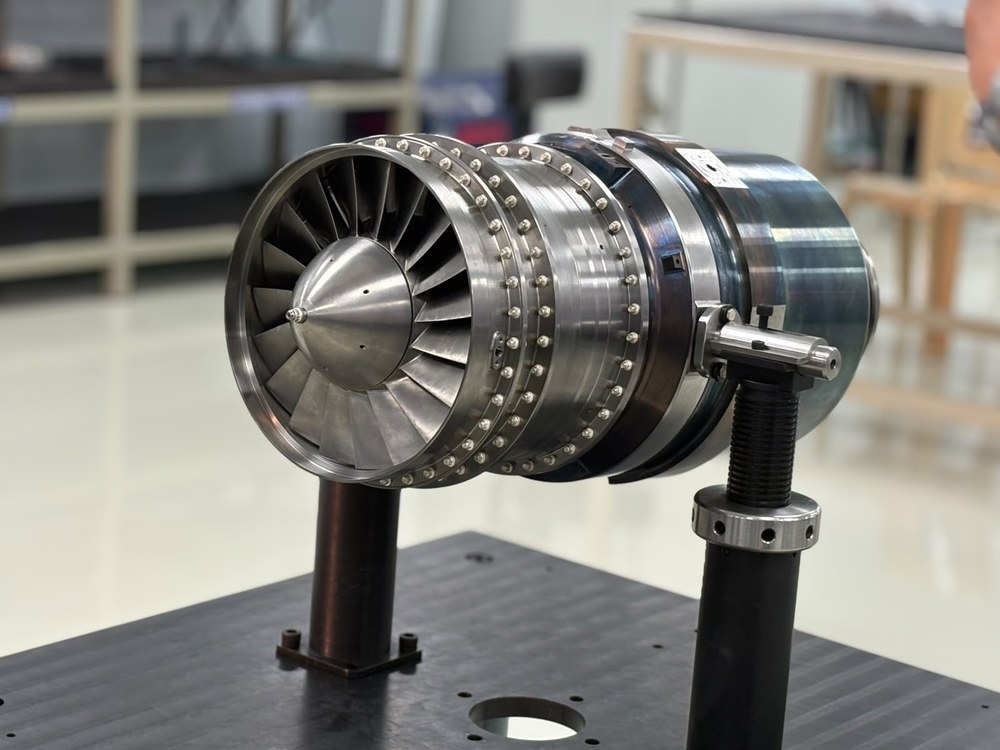
The GTRE-designed, Azad Engineering-manufactured expendable turbo jet engine — compact, precision-machined, and rated at 350 kg thrust. The multi-blade compressor fan (front) draws air into the combustion chamber; the cylindrical casing houses the turbine stages. Image: DRDO/PIB, 22 Jul 2026; reproduced with credit for educational use.
✎ Mains Practice Question
India's indigenous jet engine development has long been considered a strategic deficit. In light of the successful development of the GTRE expendable turbo jet engine, analyse the significance of domestic propulsion technology for India's defence self-reliance and evaluate the challenges that remain in achieving full indigenous capability in advanced aircraft engine design. 15 marks · 250 words
03
India's Space Launch Programme: 12 Missions in 3 Years, Four Operational Launch Vehicles, and the Road to a ₹44 Billion Space Economy
GS-III · S&T — Space Technology, Indigenisation, Space EconomyPrelims + MainsPIB · Department of Space · ISRO · Rajya Sabha Written Reply · 23 Jul 2026
A Parliament question has produced a comprehensive data-rich summary of India's space launch performance from July 2023 to June 2026 — 12 launch vehicle missions, four operational launch vehicles, a landmark 100th launch from Sriharikota, and an ambitious target to grow India's space economy to USD 44 billion by 2033.
◈ Background & Context
India's space programme, managed by the Department of Space (under the PMO) and executed primarily by ISRO, has undergone significant structural changes since 2020. The establishment of IN-SPACe (Indian National Space Promotion and Authorisation Centre) and NewSpace India Limited (NSIL) as a commercial arm has opened the sector to private Non-Government Entities (NGEs).
The period 2023–26 has been India's most productive space phase — marked by first-ever achievements on the Moon, the Sun, and in orbital docking. The data presented to Parliament provides a consolidated view of launch infrastructure, achievements, and next-generation development plans.
- Oversight structure: Department of Space → ISRO (research & development; launch operations) + IN-SPACe (authorisation & promotion) + NSIL (commercial launch services).
- Launch site: Satish Dhawan Space Centre (SDSC SHAR), Sriharikota, Andhra Pradesh — India's primary spaceport with two operational launch pads.
- Period covered in data: July 2023 to June 2026 (3 years).
▤ Key Data at a Glance — 3-Year Launch Record
- Total launch vehicle missions: 12 (July 2023 – June 2026)
- National satellites launched: 11
- International customer satellites launched: 9
- Operational launch vehicles: 4 — PSLV, GSLV, GSLV Mk III (LVM3), SSLV
- Space economy target: USD 44 billion by 2033 (government projection, per IN-SPACe roadmap)
- NSIL revenue: Available in audited financials; NSIL is the commercial launch services arm monetising ISRO's capabilities.
- Launch infrastructure being added: Third Launch Pad at Sriharikota (for NGLV & as standby for 2nd pad) + SSLV Launch Complex at Kulasekarapattinam, Tamil Nadu.
Figure 2 — India's Space Milestones, July 2023 – June 2026
Jul 202320242025Jun 2026Chandrayaan-31st south-pole landingAditya-L1India's solar observatory100th LaunchSriharikota milestoneSPADEXIndia 4th to dock in spaceNISAR on GSLVNASA–ISRO SAR missionCMS-03 (LVM3)Heaviest sat to GTO
Key milestones in India's space programme, Jul 2023–Jun 2026 — Chandrayaan-3, Aditya-L1, SPADEX, NISAR, and landmark satellite launches.
The 7 Landmark Milestones — What Each Means
- Chandrayaan-3 (Aug 2023): India became the first country to soft-land near the south pole of the Moon — a scientifically crucial region suspected to harbour water-ice. The lander-rover (Vikram-Pragyan) operated for one lunar day (~14 Earth days).
- Aditya-L1 (Sep 2023, PSLV-C57): India's first dedicated solar observatory, positioned in a halo orbit around the Sun-Earth Lagrange Point 1 (L1) — approximately 1.5 million km from Earth. Carries 7 payloads studying the solar corona, solar wind, and magnetic fields.
- 100th Launch from Sriharikota: Achieved during this 3-year window — a landmark for India's spaceport, marking decades of cumulative launch activity since SHAR's first launch in 1971.
- SPADEX (Space Docking Experiment): India demonstrated orbital docking/undocking — becoming only the 4th country globally to do so (after USA, Russia, China). Docking is essential for future crewed missions, space stations, and satellite servicing.
- SSLV Development Completed: The Small Satellite Launch Vehicle completed its 3rd developmental flight; technology transfer agreement signed with Indian industry — making SSLV commercially available.
- NISAR Mission (on GSLV): The first joint NASA-ISRO mission — a Synthetic Aperture Radar satellite co-developed by both agencies. Launched on India's GSLV, marking a new level of technological partnership.
- CMS-03 / LVM3 (heaviest satellite): India launched its heaviest satellite to Geostationary Transfer Orbit (GTO) via the LVM3 — and in a subsequent LVM3 launch, placed the heaviest satellite ever from Indian soil for a US commercial customer.
Launch Infrastructure — Present and Planned
- First Launch Pad (FLP), Sriharikota: Operational — used primarily for PSLV.
- Second Launch Pad (SLP), Sriharikota: Operational — used for GSLV, LVM3.
- Third Launch Pad (TLP), Sriharikota: Approved and under development — for Next Generation Launch Vehicle (NGLV); also serves as standby for SLP.
- SSLV Launch Complex (SLC), Kulasekarapattinam, Tamil Nadu: India's second launch site; specifically for SSLV launches and private/NGE launches. Kulasekarapattinam's near-equatorial location (9.08°N) advantages small satellite launches into low-inclination orbits.
Next-Generation Technology Development
- Semi-cryogenic engine (200t thrust): Under development — will use liquid oxygen (LOX) and kerosene (more storable than liquid hydrogen), improving performance and storability vs. the current cryogenic stage.
- Semi-cryogenic booster for LVM3: Will substantially enhance LVM3's payload capacity to GTO.
- Vertical Take-off & Vertical Landing (VTVL): Reusability demonstration for the core stage — India's answer to SpaceX's Falcon 9 booster recovery model.
- LOX-Methane engine: High thrust; methane is considered the propellant of the future for deep-space missions (SpaceX Starship, Rocket Lab also use methane).
- NGLV (Next Generation Launch Vehicle): A partially reusable rocket with LOX-Methane propulsion — India's planned successor to LVM3 for heavy payloads.
- ORV (Orbital Re-entry Vehicle) / Winged Body: A reusable orbital vehicle that launches on an ascent vehicle and lands on a runway — analogous to the Space Shuttle's concept, though smaller.
- Air-breathing propulsion: Uses atmospheric oxygen rather than onboard oxidiser — massively reduces launch mass. ISRO has been testing Scramjet technology since 2016.
IN-SPACe Policy Ecosystem & Private Sector
- NGE access to ISRO facilities: Private entities may now establish temporary test facilities within ISRO premises — reducing time and cost for private launch system development.
- Financial support: IN-SPACe offers grants and incentives for startups and MSMEs in the space sector.
- Space manufacturing clusters: Policy to build a domestic supply chain for space hardware — similar to the defence corridor model.
- NSIL (NewSpace India Limited): A Government of India company under the Department of Space — acts as the commercial arm, offering launch services (PSLV, GSLV, LVM3) to foreign and domestic customers, and managing demand aggregation for satellite communication.
- Space Economy Target: IN-SPACe roadmap projects India's space economy at USD 44 billion by 2033 — compared to an estimated ~USD 8 billion in 2023 (approximately 2–3% of global space economy). This is a government projection, not an achieved figure.
✎ Mains Practice Question
India's space programme has transitioned from a purely scientific endeavour to a strategic and commercial enterprise. Critically evaluate the role of institutions such as IN-SPACe and NSIL in enabling private sector participation, and assess whether India's target of a USD 44 billion space economy by 2033 is achievable given current infrastructure and policy trajectories. 15 marks · 250 words
04
Aditya-L1 and Chandrayaan-3: Scientific Findings and Their Significance for India's Future Space Programme
GS-III · S&T — Space Science, Planetary ExplorationPrelims + MainsPIB · Department of Space · ISRO · Rajya Sabha Written Reply · 23 Jul 2026
Parliament has received a detailed science report on the findings of Aditya-L1 and Chandrayaan-3 — results that have been published in peer-reviewed international journals and are actively shaping India's roadmap for Venus, Chandrayaan-4, and long-term deep space exploration.
◈ Background & Context
Aditya-L1 (launched September 2023) and Chandrayaan-3 (landed August 2023) are India's two most scientifically productive missions in recent years. Both have now yielded published results — moving India from a status of primarily achieving engineering milestones to becoming a producer of primary, high-impact space science data.
Note that Aditya-L1 is a solar physics mission, not a space weather prediction mission — this distinction matters for answers. However, its data contributes to understanding solar behaviour, which indirectly informs space weather research. The government explicitly clarified this in the Parliamentary reply.
- Aditya-L1 orbit: Halo orbit around the Sun-Earth L1 Lagrange point (~1.5 million km from Earth) — provides uninterrupted view of the Sun without eclipses.
- Chandrayaan-3 landing site: Named "Shiv Shakti Point", near the lunar south pole — the first mission to successfully operate at high lunar latitudes.
Aditya-L1 — Key Scientific Achievements
- First-ever CME onset spectroscopy: Aditya-L1 captured the first-ever spectroscopic signatures of the onset phase of a Coronal Mass Ejection (CME) — the moment when a massive chunk of solar plasma begins to eject. CMEs are the primary driver of geomagnetic storms that can disrupt power grids, GPS, and communications on Earth.
- Geomagnetic storm analysis (May & Oct 2024): By combining Aditya-L1's direct particles-and-fields observations with ground-based magnetometer data, scientists explained some of the most intense geomagnetic storms of 2024 — the strongest in two decades.
- Iron fluorescence on the Sun: First comprehensive analysis of photospheric iron fluorescence — recorded across 47 massive X-class solar flares during the peak of Solar Cycle 25 (2024). X-class flares are the most powerful category of solar flares.
- Near-UV solar flare observations: Unprecedented high-resolution details of powerful solar flares in near-ultraviolet (NUV) wavelengths, capturing the first highly detailed view of a rare solar plasma ejection in ultraviolet light.
- Space weather implications: Experience from Aditya-L1 is building India's foundational capability for eventual space weather prediction — critical for protecting satellites, power infrastructure, and astronaut safety.
Chandrayaan-3 — Key Scientific Findings at Shiv Shakti Point
- Only successful polar lander: Chandrayaan-3 remains the only mission to have successfully operated at the lunar polar region — all previous polar attempts (including Russia's Luna-25 in 2023) failed.
- ChaSTE thermal probe — subsurface temperature profile: The probe penetrated 10 cm deep, recording the first-ever in-situ high-latitude temperature profile. Key findings:
- Massive vertical temperature gradient during lunar morning.
- Sub-zero temperatures below 8 cm depth.
- A distinct two-layer "cake-like" regolith structure at ~6 cm — a sharp change in thermal conductivity and diffusivity.
- Water-ice insulation implication: The top 2–6 cm of lunar regolith is hyper-porous but highly cohesive — acting as an effective thermal blanket that insulates potential subsurface water-ice molecules from the extreme temperature swings of the lunar surface.
- APXS elemental composition: The Alpha Particle X-ray Spectrometer on the Pragyan rover found a highly uniform elemental composition within 50 metres of the landing site, with elevated abundances of magnesium-rich minerals. This supports the Lunar Magma Ocean (LMO) hypothesis and suggests deep mantle materials were ejected during the formation of the nearby South Pole-Aitken (SPA) Basin — the largest and oldest impact basin on the Moon.
- RAMBHA-LP Langmuir probe — near-surface plasma: First-ever high-latitude near-surface plasma measurements on the Moon. Recorded electron densities of 300–650 electrons/cm³ and elevated kinetic temperatures of 3,000–8,000 K — confirming that near-surface plasma is energetic, non-thermal, and heavily influenced by solar wind and Earth's geomagnetic tail.
- ILSA seismometer — lunar seismic activity: Recorded over 250 distinct vibration events at Shiv Shakti Point. ~200 correlated to rover/instrument operations; the remaining provide data on local lunar seismic activity — a first for the polar region.
Figure 3 — The Five Lagrange Points of the Sun-Earth System
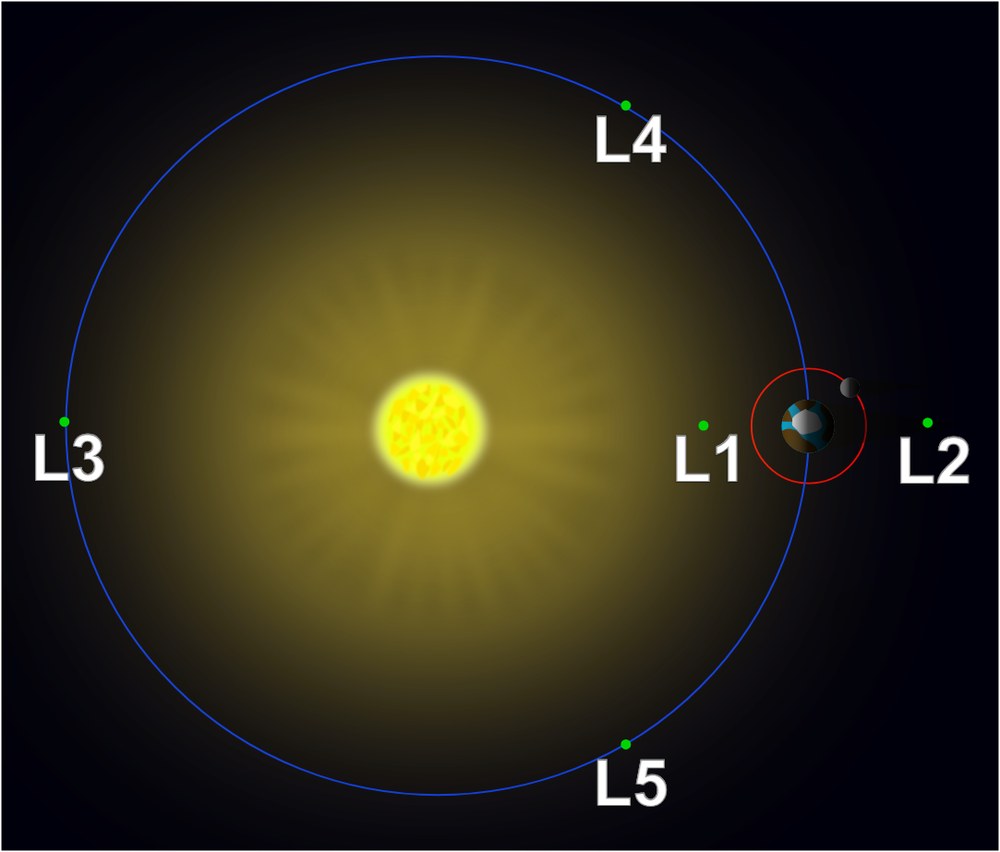
L1 (~1.5 million km sunward of Earth) is where Aditya-L1 orbits in a halo — giving it an uninterrupted view of the Sun. L2 (~1.5 million km anti-sunward) hosts JWST. L3, L4, L5 are the remaining gravitational balance points; L4 and L5 are stable (host the Trojan asteroids of Jupiter). Image: Wikimedia Commons (public domain); reproduced for educational use.
Feeding Into Future Missions
- Venus Orbiter Mission: Deep-space navigation, halo orbit maintenance, and autonomous payload operations from Aditya-L1 are directly informing trajectory planning and thermal management for the Venus mission.
- Chandrayaan-4 (sample return): High-precision landing, sensor fusion, and autonomous hazard avoidance algorithms from Ch-3 are the baseline for sample return mission guidance systems. Chandrayaan-4 aims to collect and return lunar samples to Earth.
- Chandrayaan-5/LuPEX (Lunar Polar Exploration): Joint mission with JAXA (Japan) for deeper exploration of the lunar south pole — building on Ch-3's thermal and regolith findings.
Key Terms for Prelims
- CME (Coronal Mass Ejection): A large cloud of magnetised plasma ejected from the Sun's corona — can cause intense geomagnetic storms when directed at Earth.
- X-class solar flare: The most powerful category of solar flare; can disrupt radio communications, damage satellites, and trigger aurora at low latitudes.
- Lagrange Point L1: A gravitational balance point between the Sun and Earth where a spacecraft can maintain a stable orbit — ~1.5 million km from Earth, allowing continuous solar observation.
- South Pole-Aitken (SPA) Basin: One of the largest known impact craters in the Solar System (~2,500 km diameter, up to 8 km deep) — located at the lunar south pole. Believed to contain ancient mantle material and water-ice.
- LMO (Lunar Magma Ocean) Hypothesis: The theory that the Moon was once entirely covered by a molten magma ocean, which gradually cooled and differentiated — explaining the different rock types seen across the lunar surface.
- Regolith: The layer of loose, unconsolidated rock and dust on the surface of the Moon (and other planetary bodies) — analogous to soil on Earth but formed entirely by meteorite impacts and solar wind.
- ChaSTE: Chandra's Surface Thermophysical Experiment — the thermal probe on Chandrayaan-3's Vikram lander.
- APXS: Alpha Particle X-ray Spectrometer — mounted on the Pragyan rover; determines elemental composition of soil/rocks by bombarding them with alpha particles.
- ILSA: Instrument for Lunar Seismic Activity — a seismometer on the Vikram lander.
- RAMBHA-LP: Radio Anatomy of Moon Bound Hypersensitive ionosphere and Atmosphere — Langmuir Probe; measures near-surface plasma properties.
- NISAR: NASA-ISRO Synthetic Aperture Radar — jointly developed Earth observation satellite using L-band and S-band SAR to monitor land deformation, ice sheets, wetlands, and disaster impacts.
- SPADEX: Space Docking Experiment — ISRO's mission that demonstrated autonomous orbital rendezvous and docking, making India the 4th country to master this technology.
✎ Mains Practice Question
The scientific outcomes of the Chandrayaan-3 mission have provided data that no previous mission — including Apollo and Luna — was able to collect from the lunar polar region. Discuss the significance of these findings in the context of future lunar exploration, water-ice prospecting, and India's long-term space programme roadmap. 15 mar