

In-Depth PIB Analysis2 Items
Core TopicImportantConcise
Economy & AgricultureGS Paper III
01India’s Floriculture Economy — Production, Exports & Policy
Internal Security & DefenceGS Paper III
02‘Ashank’ — ASW Shallow Water Craft Delivered
Economy & AgricultureGeneral Studies Paper III
01
Floriculture as a “Sunrise Industry”: Production Geography, Export Performance and the Policy Architecture
GS-III · Agriculture — Cropping Patterns, Agri-Marketing, Agri-Exports, DiversificationGS-I · Geography — Distribution of Agricultural ActivityPrelims + MainsPIB Backgrounder · Ministry of Agriculture & Farmers Welfare / APEDA data · 23 Nov 2026
A PIB Backgrounder charts the growth of floriculture, which has moved from a niche corner of horticulture to a commercial, export-linked activity. According to the Third Advance Estimates 2025-26, it covers 410 thousand hectares and produces 4,882 thousand tonnes of flowers, and exports reached USD 258.26 million in FY 2025-26. For UPSC, floriculture is a case study in agricultural diversification: high value per hectare, but held back by perishability, logistics and planting-material constraints.
◈ From the Basics (1) — What is floriculture, and where does it sit in agriculture?
Horticulture is the branch of agriculture covering fruits, vegetables, flowers, plantation crops, spices, and medicinal and aromatic plants. Since 2012-13, India’s horticulture output has exceeded foodgrain output in tonnage, which marks a long-term shift towards high-value agriculture.
Floriculture is the part of horticulture that grows flowers and ornamental plants. It covers cultivation from planting to harvest, production of planting material (seeds, cuttings, budding, grafting) and the marketing of flowers and flower-based products.
- Loose flowers: harvested without long stems and sold by weight, for garlands, worship and gajras, e.g., marigold, jasmine, crossandra, tuberose. They make up about 75% of India’s flower output by tonnage.
- Cut flowers: harvested with stems for bouquets and vases, e.g., rose, gerbera, carnation, orchid, lily. Their value per stem is higher and they are export-oriented.
- Other segments: cut foliage, potted and bedding plants, dry flowers and seeds and planting material for propagation and landscaping.
- Policy status: the Government has identified floriculture as a “sunrise industry”, and APEDA describes it as having 100% export-oriented status, which makes export-focused units eligible for EOU-type benefits.
410 th ha
Area under floriculture, 2025-26 (3rd AE)
4,882 th t
Total flower production — 3,653 loose + 1,229 cut
$258.26 mn
Floriculture (incl. seeds) exports, FY 2025-26
31%
Andhra Pradesh’s share of national flower output
From the Basics (2) — Open field vs protected cultivation
India’s agro-climatic diversity lets it grow flowers in almost every season. The production system is chosen to suit the crop and the market it is meant for.
- Open-field cultivation: low-cost and weather-dependent. It is used for marigold, chrysanthemum, tuberose, aster, gaillardia and many roses, mostly for domestic loose-flower markets.
- Protected cultivation: greenhouses, polyhouses and shade-net houses control temperature, humidity and light. This gives uniform quality, year-round supply and the ability to meet international quality and phytosanitary standards, which is essential for export crops such as gerbera and carnation.
- Regional niches: roses in Karnataka and Maharashtra; marigold in Tamil Nadu and Madhya Pradesh; orchids and anthuriums in the North-East, e.g., Sikkim and Mizoram; and tulips trialled in Palampur, Himachal Pradesh.
- Beyond decoration: flowers feed perfumery and cosmetics (jasmine, rose, lavender), pharmaceuticals (calendula, hibiscus, chamomile) and natural dyes (marigold, hibiscus).
Figure 1 — The floriculture value chain: where value is created, and where it is lost
1. Planting materialseeds, cuttings,tissue culturevarieties oftenimported / royalty-paid2. Cultivationopen field: marigold,tuberose, asterprotected: gerbera,carnation, rose3. Post-harvestgrading, pre-cooling,packing, cold chainmost perishable link —biggest value loss4. Marketsmandis, auctions,retail, eventsexports by air(APEDA support)5. Value additionessential oils,natural dyes,dry flowers,pharma, cosmeticsThe PIB Backgrounder’s stated direction: move “from cultivation to value creation” — i.e., strengthen stages 3 and 5
India is strong in stage 2, open-field volume. The gaps lie in stage 1 (quality planting material), stage 3 (cold chain) and stage 5 (processing).
Mapping the Flower Belt — Who produces what
- Concentration: five States account for about 74% of output. They are Andhra Pradesh (31%), Tamil Nadu (14%), Madhya Pradesh (11%), Karnataka (10%) and West Bengal (8%).
- Other major producers: Chhattisgarh, Gujarat, Uttar Pradesh, Maharashtra, Odisha and Telangana.
- North-East: about 4% of national output. Assam leads in both loose and cut flowers, followed by Nagaland (mainly cut flowers). The region’s climate suits orchids and anthuriums, but output remains small.
- Composition: loose flowers 3,653 th t (≈75%) against cut flowers 1,229 th t (≈25%). This reflects a market still driven by religious and social demand.
Figure 2 — Major flower-producing States, 2025-26 (Third Advance Estimates)
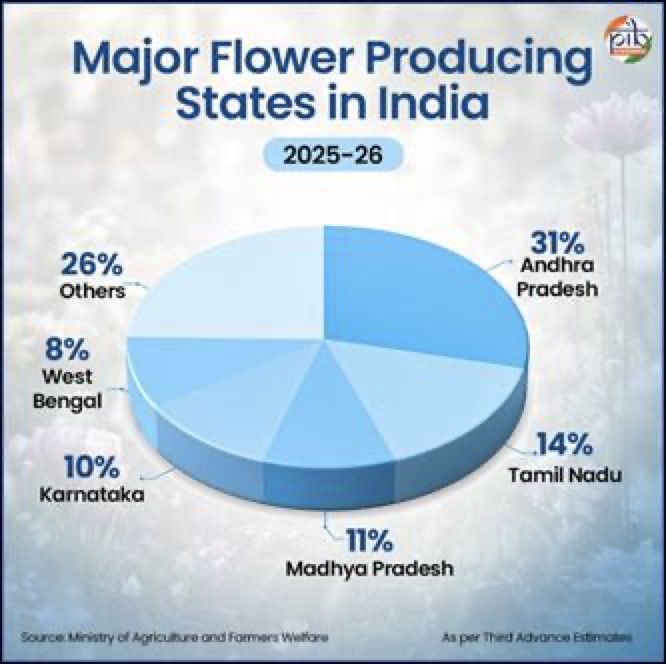
The southern peninsula (AP, Tamil Nadu, Karnataka) alone produces more than half of India’s flowers, largely open-field loose flowers. Image courtesy PIB / Ministry of Agriculture & Farmers Welfare; reproduced with credit for educational use.
India in the Global Flower Market
Floriculture exports, including fruit and vegetable seeds, rose from USD 216.74 million (FY 2021-22) to USD 258.26 million (FY 2025-26). That is about 19% in four years, a compound annual growth rate of roughly 4.5% in nominal dollar terms.
- Top destinations (FY 2025-26): USA ($45.94 mn), Netherlands ($42.18 mn), Bangladesh ($16.51 mn), UAE ($16.35 mn) and Italy ($9.69 mn).
- The Netherlands is the hub of the world flower trade. Its auction system, centred on Aalsmeer, re-exports flowers across Europe. Leading cut-flower exporters such as Kenya, Colombia and Ecuador dominate a market in which India’s share is still small.
- Product-to-market mapping: fresh cut flowers go to Europe, Japan, Australia, West Asia and the USA. Loose flowers go mainly to the Indian diaspora in the Gulf, cut foliage to Europe, and dry flowers to the USA, Europe, Japan, Australia, the Far East and Russia.
- Dry flowers form a major share of exports, because their longer shelf life avoids the cold-chain and air-freight problem.
- North-East first: in February 2025, the first export of anthurium from Mizoram to Singapore was flagged off: 1,024 stems (70 kg) in 50 boxes. It was led by APEDA with Mizoram’s Department of Horticulture.
Figure 3 — Floriculture exports and top destinations (USD million)
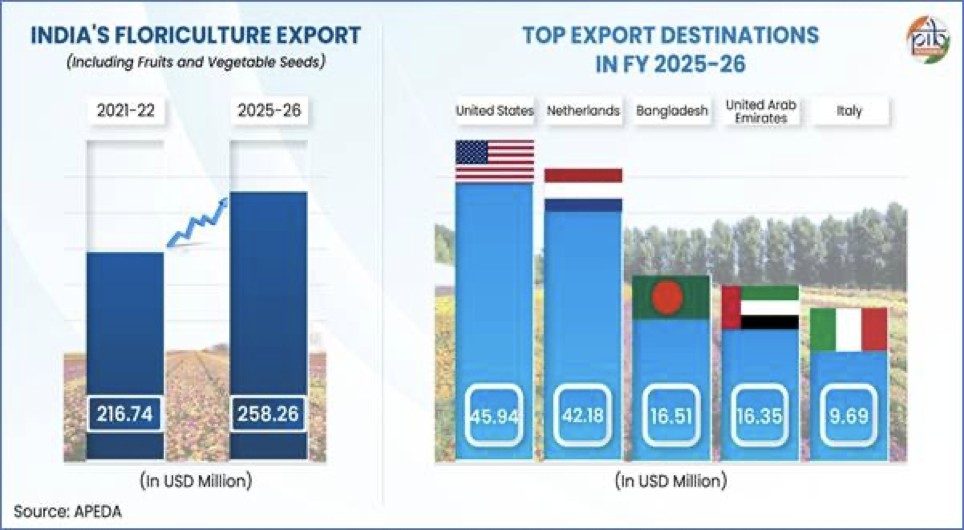
Steady but modest growth. Note that the series includes fruit and vegetable seeds, so it overstates flowers alone. Image courtesy PIB (data: APEDA); reproduced with credit for educational use.
▤ Policy Architecture at a Glance
- Main scheme: the Mission for Integrated Development of Horticulture (MIDH), a Centrally Sponsored Scheme launched in 2014-15.
- Nodal Ministry: Ministry of Agriculture & Farmers Welfare (Department of Agriculture & Farmers Welfare).
- MIDH sub-schemes: National Horticulture Mission (NHM); Horticulture Mission for North East & Himalayan States (HMNEH); National Horticulture Board (NHB); Coconut Development Board (CDB); and the Central Institute for Horticulture (CIH), Nagaland.
- Funding pattern: 60:40 (Centre : State) for NHM in most States, and 90:10 for North-Eastern and Himalayan States. The central-sector components (NHB, CDB and CIH) are 100% centrally funded.
- Credit: NABARD refinances investment in protected cultivation and precision farming.
- Exports: APEDA (Ministry of Commerce & Industry) provides export facilitation, plus concessions on seeds, planting material, equipment and air freight.
- Research: ICAR through the ICAR-Directorate of Floricultural Research (Pune) and the All India Coordinated Research Project on Floriculture; CSIR laboratories; and the horticulture departments of State Agricultural Universities.
- Science missions: the CSIR Floriculture Mission (2021) and the CSIR Aroma Mission (2017). Their figures are given below.
Figure 4 — Who does what: the institutional support system for floriculture
Floriculture: a “sunrise industry”PRODUCTIONMoA&FW · MIDH (2014-15)NHM · HMNEH · NHBCDB · CIH (Nagaland)area expansion, polyhouses,planting material,post-harvest infrastructureCREDITNABARDrefinance for protectedcultivation & precisionfarming+ seed companies’ unitsin flower-growing StatesEXPORTSMoC&I · APEDA (1985 Act)market access, qualitycertification, buyer linksconcessions on seeds,equipment & air freightRESEARCHICAR · CSIR · SAUsICAR-DFR, PuneAICRP on FloricultureCSIR Floriculture MissionCSIR Aroma Mission(CSIR-CIMAP, CSIR-IHBT)
Support is spread across at least four ministries and agencies. The coordination gap between production subsidies and export logistics is a recurring criticism.
Lineage — How horticulture policy evolved
- 1984: National Horticulture Board (NHB) set up to develop commercial horticulture and post-harvest infrastructure.
- 1985: the APEDA Act created the Agricultural and Processed Food Products Export Development Authority. Floriculture is among its scheduled products.
- 2001-02: the Technology Mission for Integrated Development of Horticulture in the North-East, later extended to the Himalayan States (now HMNEH).
- 2005-06: the National Horticulture Mission (NHM) launched, with an area-based, cluster approach for the rest of India.
- 2014-15: MIDH brought these schemes under one umbrella with common guidelines.
- 2017 and 2021: CSIR’s Aroma Mission and Floriculture Mission added a science-to-field layer. The Aroma Mission is linked to the “Purple Revolution”, i.e., lavender cultivation in Jammu & Kashmir.
◈ The CSIR Missions — Reported outcomes (Government figures, as of December 2025)
- CSIR Floriculture Mission (2021): 2,208+ hectares brought under floriculture; 16,220 beneficiaries in 399 clusters across 26 States/UTs; technologies transferred to entrepreneurs.
- CSIR Aroma Mission (2017): aromatic crops on 51,000+ hectares; 4,500+ aroma clusters in 28 States, of which 20 are in tribal areas; 2,096 training programmes reaching 1.22 lakh people, including 10,000 women; 110+ entrepreneurs supported.
- Output claims: the Government reports about 6,000 tonnes of essential oils worth roughly ₹600 crore, and “around 1 crore rural employment opportunities”. The employment figure is an official estimate, and the release does not explain how it was calculated (e.g., whether it counts person-days or individuals).
- Lab to field: the release cites tulip fields in Palampur and eustoma blooms in Sambalpur as examples of research reaching farmers.
Why It Matters
- Income per hectare: flowers earn far more per unit of land than cereals, which makes them suitable for small and marginal holdings. India has about 86% small and marginal farmers (Agriculture Census 2015-16).
- Diversification: floriculture moves farming away from water-intensive cereal monocultures, in line with crop-diversification goals.
- Livelihoods: the work is labour-intensive, especially harvesting, garland-making and packing, with a high share of women’s employment.
- Exports and soft power: floriculture is a value-added agri-export. It has GI-linked brands: Madurai Malli (Tamil Nadu) and Mysore Mallige (Karnataka) are GI-tagged jasmines.
- Allied industries: it supplies aroma, cosmetics, pharma and natural-dye value chains, which links it to MSME growth.
The Critical View
- Modest export base: about $258 mn is small next to global leaders, and growth of about 4.5% a year in nominal terms is steady rather than rapid. The headline figure also includes fruit and vegetable seeds.
- Perishability and cold chain: cut flowers last only days. Gaps in pre-cooling, reefer transport and airport cold rooms cause losses and keep the trade dependent on expensive air freight.
- Planting material dependence: many export varieties are proprietary foreign cultivars that carry royalties. Domestic breeding is thin, despite the protection available under the Protection of Plant Varieties and Farmers’ Rights (PPV&FR) Act, 2001.
- Price volatility: loose-flower prices spike at festivals and crash afterwards, and few organised auction platforms exist outside a handful of cities.
- Standards and non-tariff barriers: phytosanitary rules, pesticide-residue limits and buyer certification such as GAP are hard for small growers to meet.
- Untapped North-East: the region has the best climate for orchids and anthuriums but contributes only about 4% of output, because of connectivity and logistics constraints.
- Sustainability: greenhouses use a lot of water, fertiliser and plastic, and temple and event floral waste is an emerging urban waste problem. It is also an opportunity for circular-economy products such as incense, compost and dyes.
Way Forward
- Integrated cold chain: build farm-gate pre-cooling, perishable cargo centres at airports, and explore sea-freight protocols for cut flowers.
- Domestic breeding: fund ICAR, CSIR and SAU breeding of export-grade varieties, with PPV&FR registration, to cut royalty dependence.
- Organised marketing: set up flower auction centres, include flowers on e-NAM, and organise growers into FPOs to bargain collectively.
- North-East cluster strategy: build dedicated floriculture clusters using horticulture cluster development, linked to air-cargo connectivity.
- Value addition: scale up dry-flower, essential-oil and natural-dye processing, the segments that sidestep perishability.
▤ Prelims Corner — Institutions & terms
- APEDA: a statutory body under the APEDA Act, 1985, under the Ministry of Commerce & Industry. It replaced the Processed Food Export Promotion Council.
- NABARD: established on 12 July 1982 under the NABARD Act, 1981.
- MIDH components: NHM, HMNEH, NHB, CDB, CIH. The Central Institute for Horticulture is at Medziphema, Nagaland.
- PPV&FR Act, 2001: protects plant breeders’ rights and farmers’ rights. It is India’s sui generis system under TRIPS Article 27.3(b).
- Purple Revolution: lavender cultivation under the CSIR Aroma Mission, notably in Doda and Bhaderwah (J&K). The nodal laboratory is CSIR-CIMAP, Lucknow.
- Top flower-producing State: Andhra Pradesh (31%). Top export destination: USA.
✎ Mains Practice Question
Floriculture has been identified as a “sunrise industry”, yet India’s share in global floral trade remains marginal. Examine the structural constraints facing the sector, and suggest measures to turn its agro-climatic advantage into export competitiveness and higher farm incomes. 15 marks · 250 words
Internal Security & DefenceGeneral Studies Paper III
02
‘Ashank’ (Yard 3036) Delivered: The ASW Shallow Water Craft Programme and India’s Littoral Anti-Submarine Shield
GS-III · Security — Security Challenges in Border/Coastal Areas; Indigenisation of TechnologyPrelims + MainsPIB · Ministry of Defence · 23 Nov 2026
Garden Reach Shipbuilders and Engineers (GRSE), Kolkata delivered ‘Ashank’ (Yard 3036) to the Indian Navy at Visakhapatnam on 23 November 2026. It is an Anti-Submarine Warfare Shallow Water Craft (ASW SWC) with over 80% indigenous content, and the sixth of the eight ships GRSE is building under the programme.
◈ From the Basics — Why anti-submarine warfare in shallow water is hard
Anti-submarine warfare (ASW) means detecting, tracking and neutralising enemy submarines. Detection relies mainly on sonar (SOund NAvigation and Ranging): active sonar sends out a ping and listens for the echo, while passive sonar only listens for the noise a submarine makes.
- The littoral problem: in shallow coastal waters, sound bounces off the seabed and surface. High ambient noise (shipping, fishing, marine life) and changing temperature and salinity layers make it harder to tell a submarine from background clutter.
- Why a dedicated craft: large frigates and destroyers have deep draughts and are built for open-ocean (blue-water) operations. A shallow-draught craft can work close inshore, near ports, approaches and chokepoints.
- The ASW toolkit: hull-mounted and towed or variable-depth sonars; lightweight torpedoes; ASW rockets, which fire depth-charge-like projectiles; helicopters; and maritime patrol aircraft such as the P-8I.
- Waterjet propulsion: instead of exposed propellers, waterjets push the vessel by expelling water. This allows a shallower draught, high manoeuvrability and a lower underwater noise signature, all useful for a submarine hunter. The ASW SWCs are among the largest Indian naval warships propelled by waterjets.
▤ Programme at a Glance
- Project: 16 ASW Shallow Water Craft, split equally between two shipyards. Contracts were signed on 29 April 2019.
- Builders: GRSE, Kolkata builds 8 Arnala-class ships, with construction partly at L&T’s Kattupalli yard. Cochin Shipyard Ltd (CSL), Kochi builds 8 Mahe-class ships.
- GRSE contract value: ₹6,311 crore for eight vessels.
- Replaces: the Abhay-class corvettes, customised variants of the Soviet Pauk class, commissioned 1989–91.
- Approximate specifications (Arnala class): length ~77.6 m, displacement ~900 tonnes, draught ~2.7 m.
- Armament and sensors (per the release): lightweight torpedoes, indigenous rocket launchers and advanced sonar systems.
- Roles: underwater surveillance and ASW in coastal waters, coastal surveillance and mine-laying.
- Classification: designed and built to Indian Register of Shipping (IRS) rules.
- Indigenous content: over 80% (MoD).
Figure 5 — GRSE’s eight-ship Arnala-class order: delivery status
ArnalaAndrothAnjadipAgrayAminiAshankShip 7Ship 820252025Dec 2025Mar 2026Nov 202623 Nov 2026pendingpendingFilled = delivered · gold = this release · dashed = yet to be delivered (CSL builds 8 more, Mahe class)
With Ashank, six of GRSE’s eight ships have been delivered. The ships are named after coastal islands and forts, e.g., Arnala off Vasai and Androth and Amini in Lakshadweep. The first delivery came in 2025, later than originally scheduled.
Why It Matters
- Underwater threat in the IOR: more extra-regional submarine deployments in the Indian Ocean Region make coastal ASW a priority, especially near naval bases and major ports.
- Coastal security after 26/11: the ships add to the layered coastal-security architecture of the Navy, Coast Guard and Marine Police by covering the sub-surface dimension.
- Frees blue-water assets: dedicated littoral hunters let frigates and destroyers concentrate on open-ocean missions.
- “Builder’s Navy” and Aatmanirbharta: both the design and the build are Indian. This supports the Positive Indigenisation Lists, the Buy (Indian-IDDM) category of DAP 2020, and shipyard employment and the MSME supply chain.
- Mine warfare: the mine-laying role gives the Navy an area-denial option for its harbour approaches.
Figure 6 — GRSE’s wider naval output: INS Ikshak (J23)
INS Ikshak (J23) is a Sandhayak-class Survey Vessel (Large) built by GRSE, shown here as an example of the yard’s recent naval deliveries. It is not ‘Ashank’. GRSE is building ASW craft, survey vessels and frigates in parallel, which shows the scale of the “Builder’s Navy” push. Image: user-supplied; source to be credited.
The Critical View
- Schedule slippage: the 2019 contracts envisaged earlier deliveries, but the first ship arrived only in 2025. That leaves a capability gap after the Abhay class was retired.
- What “80% indigenous” covers: the figure is usually measured by cost. Some high-technology subsystems, such as parts of propulsion and sensors, may still depend on imports, and the release does not break the figure down.
- Platform limits: a craft of about 900 tonnes has limited endurance and sea-keeping and no embarked helicopter. Its effectiveness depends on being networked with aircraft, helicopters and shore sensors.
- Manpower and sustainment: sixteen new hulls need trained ASW crews, maintenance support and sonar-processing upgrades throughout their service life.
▤ Prelims Corner — Institutions & terms
- GRSE: a Defence PSU under the Ministry of Defence, headquartered in Kolkata.
- Cochin Shipyard Ltd: a Kochi-based Defence PSU. It built India’s first indigenous aircraft carrier, INS Vikrant.
- Indian Register of Shipping (IRS): India’s classification society and a member of the International Association of Classification Societies (IACS).
- Yard number: a shipyard’s internal hull number (here Yard 3036). It is not the commissioned pennant number.
- Delivery vs commissioning: delivery is the shipyard handing the ship to the Navy. Commissioning is the formal induction into service, when the ship gets its “INS” prefix and pennant.
✎ Mains Practice Question
The growing presence of extra-regional submarines in the Indian Ocean has made littoral anti-submarine warfare a priority for India. Discuss the significance of indigenously built shallow-water ASW platforms for India’s coastal security, and the challenges in building a “Builder’s Navy”. 10 marks · 150 words