
In-Depth PIB Analysis2 Items
Core TopicImportantConcise
Tribal Rights & GovernanceGS Paper II
01Forest Rights Act — Third Regional Review Conference, Srinagar
Economy — Agriculture & EnergyGS Paper III
02Agrivoltaics Backgrounder and AWC 2026 Conclusion
Tribal Rights & GovernanceGeneral Studies Paper II — Vulnerable Sections; Paper III — Forests
01
Forest Rights Act at 20: Review Conference in Srinagar Flags 10.45 Lakh Pending Claims and Slow Community Forest Rights
GS-II · Welfare of Scheduled Tribes; Statutory Rights; Gram SabhaGS-III · Forest Governance and ConservationPrelims + MainsPIB · Ministry of Tribal Affairs · 23 Oct 2026
The Ministry of Tribal Affairs (MoTA) held the third and final regional review of the Forest Rights Act, 2006 (FRA) in Srinagar on 23 October 2026, covering Maharashtra, Gujarat, Himachal Pradesh, Uttar Pradesh, Goa, Rajasthan and Jammu & Kashmir. Earlier rounds were held in Bengaluru (10 September) and Kolkata (9 October).
◈ From Basics — Why a Forest Rights Act?
Colonial forest laws, beginning with the Indian Forest Act, 1865 (and later 1878 and 1927), declared vast forests as State property. Communities who had lived in and used these forests for generations were recorded as “encroachers”. The FRA’s Preamble calls this a “historical injustice” and seeks to correct it.
- Full name: the Scheduled Tribes and Other Traditional Forest Dwellers (Recognition of Forest Rights) Act, 2006; in force from 31 December 2007, with Rules in 2008 (amended 2012).
- Who is eligible: Forest-dwelling STs resident before 13 December 2005; Other Traditional Forest Dwellers (OTFDs) must show residence for three generations (75 years).
- Nodal Ministry: Ministry of Tribal Affairs; forests are administered with the Ministry of Environment, Forest and Climate Change.
- Constitutional link: “Forests” moved from the State List to the Concurrent List (Entry 17A) by the 42nd Amendment (1976); the FRA complements the Fifth Schedule and PESA, 1996, which empower Gram Sabhas in tribal areas.
▤ The Rights Under FRA at a Glance
- Individual Forest Rights (IFR): to hold and cultivate forest land occupied before the cut-off date — capped at 4 hectares.
- Community Rights (CR): collection of minor forest produce (ownership included), grazing, fishing and use of water bodies, and access for nomadic and pastoral communities.
- Community Forest Resource Rights (CFRR) — Section 3(1)(i): the right to protect, regenerate, conserve and manage a customary community forest.
- Habitat rights — Section 3(1)(e): for Particularly Vulnerable Tribal Groups (PVTGs) and pre-agricultural communities.
- Development facilities — Section 3(2): diversion of up to 1 hectare of forest land for schools, dispensaries, drinking water and other basic facilities.
- Protection from eviction — Section 4(5): no forest dweller may be evicted until recognition and verification are complete — the basis of J&K’s July 2026 circular.
Figure 1 — How a forest rights claim is decided
Gram Sabhainitiates; passesresolutionForest RightsCommitteeverifies on siteSDLCsub-division level;hears petitionsDLCdistrict level;final decisionTitleentered in revenue& forest recordsState Level Monitoring Committee (Chief Secretary) — oversightThe Gram Sabha, not the Forest Department, is the starting authority (Section 6)A rejection must carry a reasoned order, with the claimant’s right to petition preserved
A three-tier, bottom-up process — the main reason incorporation into land records often lags behind title distribution.
~54 lakh
Claims received nationally (31 Aug 2026)
80.64%
Claims disposed of (43.56 lakh)
25.42 lakh
Titles over ~238 lakh acres
11 of 75
PVTGs with habitat rights recognised
Figure 2 — National status of forest rights claims (lakh, as on 31 August 2026)
Titles — 25.42 (47%)Rejected — 18.13 (34%)Pending — 10.45Of ~54 lakh claims, about one in three has been rejected — hence the Ministry’s call to review rejections with reasoned ordersBar segments drawn to scale
Disposal is high, but the rejection rate and the pendency of over 10 lakh claims are the main concerns.
Figure 3 — Individual titles as a share of individual claims, by State/UT
Gujarat55%Maharashtra52%Rajasthan41%Goa39%Uttar Pradesh24%Himachal Pradesh17%Jammu & Kashmir*13%*J&K: all titles ÷ all claims. Computed from PIB figures; scale: 4 px = 1%
Recognition varies widely — from over half of claims in Gujarat and Maharashtra to about one in eight in Jammu & Kashmir, where FRA has applied only since 2019.
State highlights
- Maharashtra: CFR rights over about 13.87 lakh acres, 7,518 CFR committees; separate village forms (7-E, 12-E) help IFR holders access crop loans, Kisan Credit Cards and insurance.
- Gadchiroli (Maharashtra): 5.16 lakh hectares under CFR rights; non-timber forest produce potential estimated at ₹98 crore a year. The district’s Mendha-Lekha was among the first villages to receive CFR rights (2009).
- Gujarat: satellite verification with the GEER Foundation; PVTGs include Kotwalia, Kolgha, Kathodi, Siddi and Padhar.
- Jammu & Kashmir: 48,287 claims, 6,178 titles, mostly community rights; a circular bars eviction of eligible families before due process — relevant for pastoral communities with seasonal movements.
- Uttar Pradesh: reviewing rejected claims in Sonbhadra and Chandauli; the Buxa PVTG identified in Bijnor.
Convergence and support schemes
- Entry into land records lets title-holders access PM-KISAN, crop loans and livelihood schemes.
- Dharti Aaba Janjatiya Gram Utkarsh Abhiyan (DA-JGUA, 2024): ₹15 lakh per CFR Management Plan, plus ₹1 lakh for technical support.
- Support to Tribal Research Institutes: ₹25 lakh per State for FRA mapping.
- MoTA–MoEFCC joint communication (July 2026): to align CFR Management Plans with Forest Department Working Plans — a long-standing friction point.
- Digital: integration with the National FRA Portal through APIs; FRA courses on iGOT.
The critical view
- High rejection rate: about 18 lakh rejections, often without reasoned orders or communication to claimants.
- Institutional friction: Forest Departments’ Working Plans and CFR plans by Gram Sabhas can conflict; overlapping laws (e.g. compensatory afforestation) complicate rights.
- Weak CFR and habitat recognition: CFR remains a fraction of its estimated potential, and habitat rights cover only 11 of 75 PVTGs.
- Judicial context: in Wildlife First v. Union of India, the Supreme Court’s 2019 order to evict rejected claimants was stayed after States were asked to review rejections. In Orissa Mining Corporation (Niyamgiri), 2013, the Court upheld the Gram Sabha’s role in decisions affecting forest rights.
✎ Mains Practice Question
Nearly two decades after its enactment, the Forest Rights Act, 2006 has recognised individual rights far more readily than community and habitat rights. Examine the reasons and suggest measures to realise the Act’s objective of democratising forest governance. 15 marks · 250 words
Economy — Agriculture & EnergyGeneral Studies Paper III
02
Agrivoltaics: PIB Backgrounder Maps India’s Projects and Potential as the World Conference Concludes; France to Host in 2027
GS-III · Agriculture — Land Use; Energy — RenewablesPrelims + MainsPIB · Backgrounder & MNRE · 23 Oct 2026
A PIB Backgrounder sets out India’s agrivoltaics landscape — 36 operational projects (37.54 MW) and 10 pilots as of August 2025 — while the 7th AgriVoltaics World Conference closed in New Delhi on 23 October 2026, handing the 8th edition (2027) to France. (For the science of agrivoltaics, PM-KUSUM’s components and the critical view, see the PIB Analysis of 22 October 2026.)
Figure 4 — How an agrivoltaic system works
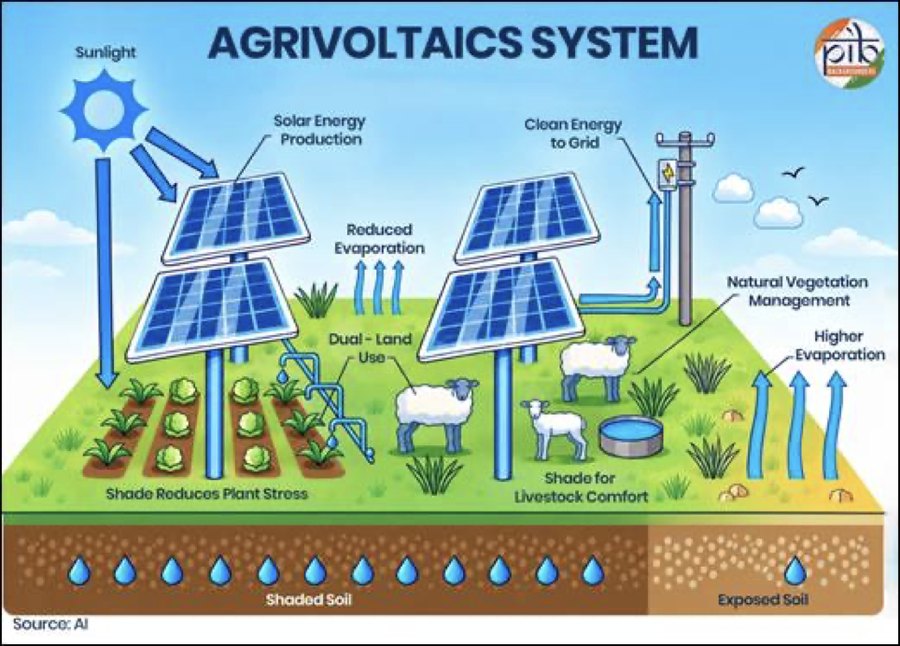
Shaded soil retains moisture while exposed soil loses more through evaporation; livestock can graze under panels too. Infographic courtesy PIB Backgrounders (AI-generated illustration, as labelled by PIB); reproduced with credit for educational use.
◈ From Basics — Reading India’s Land-Use Numbers
- Reporting area: 306.96 million hectares (2023–24), of which about 55% is agricultural land. Land is classified under the nine-fold land-use classification.
- Net Sown Area (NSA): 138.99 Mha — land sown at least once a year. Gross Cropped Area (GCA): 217.88 Mha — counts land sown more than once each time.
- Cropping intensity = GCA ÷ NSA × 100 ≈ 157% — on average, cropped land carries about 1.6 crops a year.
- Agriculture’s weight: livelihood for about 46.1% of the population; agriculture and allied GVA estimated at ₹52.08 lakh crore in 2025–26.
▤ What’s New in the Backgrounder
- Deployment: 36 operational projects, 37.54 MW installed, 10 pilots — using elevated, interspace and tracking designs.
- Potential: estimates range from 3,000 GW to nearly 14,000 GW; GIS screening identified 47.35 Mha of “restricted cropland” as suitable.
- Income: in some cases, annual earnings could rise from about ₹60,000 to over ₹1 lakh per acre.
- Best-suited crops: fruits, vegetables, spices and medicinal plants.
- Centre of Excellence: set up by the National Institute of Solar Energy (NISE), Gurugram, with ICAR–IARI, New Delhi; includes a 100 kW pilot at IARI.
- PM-KUSUM: launched February 2019, central financial assistance of about ₹34,422 crore.
Figure 5 — Advantages of AgriPV for rural development
Four claimed advantages: higher yields, water efficiency, dual income and energy access — benefits that depend on crop choice, design and local conditions. Infographic courtesy PIB Backgrounders (source: IBEF); reproduced with credit for educational use.
State schemes — Prelims hooks
- Mukhyamantri Saur Krushi Vahini Yojana 2.0 (Maharashtra): about 16,000 MW of solar projects on roughly 35,000 acres to supply farm consumers.
- Kisan Suryoday Yojana (Gujarat): daytime power for farming, with a planned window of up to 16 hours (5 am–9 pm).
- Surya Raitha (Karnataka): solar irrigation pumps with income from surplus power sold to the grid.
Conference outcomes
- Focus on implementation: agro-climatic zoning, crop selection, water-use efficiency, financing and farmer-centred models.
- Science partnerships: a session co-convened by ICAR and the International Water Management Institute (IWMI) on shade-tolerant crops and microclimate effects; a GIZ-led session with farmers and FPO federations.
- Global South cooperation: the International Solar Alliance presented the outcomes; the 8th AWC moves to France in 2027.
A balanced reading
- Scale gap: 37.54 MW installed is tiny against a potential measured in thousands of gigawatts — agrivoltaics in India is still at the pilot stage.
- Evidence first: the conference itself stressed location-specific evidence — benefits vary by crop, climate and design.
- Definitions matter: some State schemes (such as feeder-level solar plants) are solar-for-agriculture, not dual-use agrivoltaics; the two should not be confused.
✎ Mains Practice Question
Distinguish between solarisation of agriculture and agrivoltaics. Discuss the role of State-level initiatives and research institutions in scaling up agrivoltaics in India. 10 marks · 150 words