

In-Depth PIB Analysis3 Items
Core TopicImportantConcise
Science, Technology & Internal SecurityGS Paper III
01IMEI tampering & telecom device security
Environment & EcologyGS Paper III
02Tokay Gecko seizure in Assam
Governance, Society & YouthGS Paper II
03MY Bharat crosses 3 crore registrations
Science, Technology & Internal SecurityGeneral Studies Paper III
01
IMEI tampering: why a 15-digit number decides whether a stolen phone can be found
GS-III · Internal Security — Cybersecurity, Communication Networks; GS-II · GovernancePrelims + MainsPIB · Department of Telecommunications · 23 Sep 2026
India's active wireless subscriber base touched 1,204.01 million in July 2026. Every one of those handsets is identified on the network by a single number — and altering that number is what makes a stolen or smuggled device untraceable. The Department of Telecommunications has issued a consolidated advisory on the practice, the law against it, and what users can do.
◈ The basics — start here if the term is new
Think of the IMEI as the chassis number of a car. The SIM identifies the subscriber; the IMEI identifies the handset. Change the chassis number and a stolen car cannot be traced — the same logic applies here.
- What it is: the International Mobile Equipment Identity, a unique 15-digit number that identifies a mobile device on a telecom network.
- Its first eight digits form the Type Allocation Code (TAC), which identifies the device model or type.
- Who allocates it: the GSMA — the Global System for Mobile Communications Association — oversees global allocation of TACs to manufacturers and brand owners, who then assign unique IMEIs to individual devices.
- Dual-SIM phones generally carry two IMEI numbers, one per SIM slot.
- How to see yours: dial *#06#. To verify it, use the Sanchar Saathi portal or app, or SMS KYM <15-digit IMEI> to 14422.
Figure 1 — The device identifier the whole system rests on
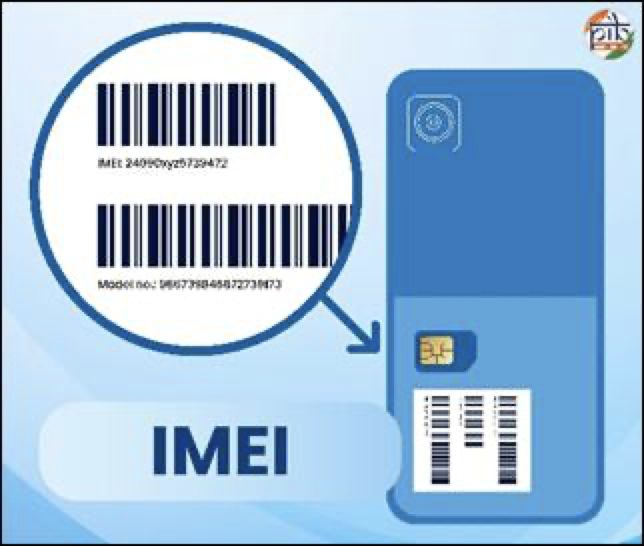
The IMEI is printed on the device and its packaging, and stored in the handset's firmware. Image courtesy Press Information Bureau, Department of Telecommunications, 23 September 2026; reproduced with credit for educational use.
Why tampering matters
- It defeats tracing. A device with an altered identity cannot be reliably matched to its record, so a stolen handset can be resold and used on the network.
- It enables crime at scale. Equipment such as SIM boxes with configurable IMEIs is used to route international calls as local ones and to run fraud and impersonation operations.
- It muddies enforcement. When two devices report the same identity, the network cannot distinguish them, which frustrates lawful interception and investigation alike.
- It undermines consumers. Counterfeit devices sold with cloned IMEIs come with no warranty, no security updates and no recourse.
▤ Who must do what — the lifecycle of accountability
- Manufacturers: register the IMEIs of applicable devices made in India with the Government before first sale, testing, research or other use, through the Device Setu–Indian Counterfeited Device Restriction (ICDR) portal, and assign valid, unique, untampered IMEIs.
- Importers: register IMEIs with the Central Government on the same portal before import, for devices meant for sale, testing, R&D or other purposes.
- Resellers and retailers: deal only in devices with valid and untampered IMEIs; for used devices, verify against the Government's central database of tampered and blacklisted devices (a per-IMEI verification fee applies).
- Brand owners: register their brands on Device Setu–ICDR, linked to the relevant GSMA TAC, and ensure devices carry authentic, authorised IMEIs.
What citizens should avoid — and what they should do
- Avoid: using, procuring or assembling modems, modules, SIM boxes or similar equipment with configurable or tampered IMEIs; obtaining SIMs through fake documents, fraud, cheating or impersonation; passing on SIMs issued in your own name; and using any app or site to modify Calling Line Identity (CLI) or other telecom identifiers.
- Do: buy only from authorised sellers and verify the IMEI; secure the handset with a strong password, PIN or biometric; and get repairs done only at authorised service centres, since tampering often happens during unauthorised repair.
Figure 2 — What to do when a handset is lost or stolen
1 · File policecomplaintkeep a copy2 · Get duplicateSIM from operatorwait 24 hours for SMS3 · Block onSanchar Saathi (CEIR)get a Request ID4 · If recovered,unblock with IDinform police firstUpload the police report and a valid ID proof; the blocked IMEI is then rejected by every network,which is what makes the stolen handset worthless to a buyer.Telecommunications Act, 2023 — Section 42(3)(c) tampering with identifiers · 42(3)(e) SIMs by fraudUp to 3 years' imprisonment, fine up to ₹50 lakh, or both · cognizable and non-bailable under 42(7)
Blocking works on the identifier, not the SIM — which is precisely why tampering with it is criminalised.
◈ Static background you should carry into the exam
- Telecommunications Act, 2023 replaced the Indian Telegraph Act, 1885 and the Indian Wireless Telegraphy Act, 1933. Section 42(3)(c) prohibits tampering with telecommunication identifiers; 42(3)(e) prohibits obtaining SIMs or identifiers by fraud, cheating or impersonation; 42(6) makes abettors liable to the same punishment; 42(7) makes the offences cognizable and non-bailable.
- Sanchar Saathi is DoT's citizen-facing portal. Its modules to know: CEIR (Central Equipment Identity Register) for blocking and tracing lost handsets, TAFCOP for checking how many connections run in your name, KYM (Know Your Mobile) for IMEI verification, and Chakshu for reporting suspected fraud communication.
- Device Setu–ICDR is the registration portal for manufacturers, importers and brand owners.
- TRAI regulations restrict SMS services for the first 24 hours after a re-issued SIM is activated — the reason the blocking request has to wait a day for OTP verification.
- Related institutions: CERT-In under the IT Act, 2000 for incident response; the Indian Cyber Crime Coordination Centre (I4C) and the National Cyber Crime Reporting Portal under the Ministry of Home Affairs; the Digital Personal Data Protection Act, 2023 for personal data.
- Cyber Swachhta Kendra — the botnet cleaning and malware analysis centre — is the device-hygiene counterpart of this ecosystem.
The critical view
- Enforcement is the bottleneck, not the law. Reprogramming tools are cheap and widely available; the grey repair market where most tampering happens is informal and hard to police.
- Cloning versus blocking. A blocked IMEI can be re-cloned onto another handset, and a duplicated IMEI can accidentally block a legitimate user's device — a known false-positive risk in any identifier-based blocklist.
- Friction for the victim. A police report, a duplicate SIM and a 24-hour wait before the OTP works is a demanding sequence for exactly the person who has just lost their phone.
- The surveillance question. A central register mapping devices to identities strengthens recovery and tracing, and simultaneously concentrates data — which is why the safeguards in the DPDP Act and in the interception rules under the 2023 Act matter to the same debate.
- Reseller compliance costs. Per-IMEI verification fees fall hardest on small second-hand dealers, the segment least equipped to absorb them.
✎ Mains Practice Question
The integrity of device identifiers has become a question of national digital security rather than mere consumer protection. Examine the legal and institutional framework India has built against telecom identifier tampering, and assess the challenges in its enforcement. 15 marks · 250 words
Environment & EcologyGeneral Studies Paper III
02
86 live Tokay Geckos seized in Assam: the species, the schedules and the trade behind the case
GS-III · Environment — Wildlife Conservation, Illegal Trade; GS-II · Statutory BodiesPrelims + MainsPIB · Directorate of Revenue Intelligence · 23 Sep 2026
Acting on specific intelligence about an illegal wildlife trade deal, DRI officers intercepted two persons at Bandar Chalia Gaon Ground, Mariani, Assam, on 22 September 2026 and recovered 86 live Tokay Geckos, seized under the Wildlife (Protection) Act, 1972. Both the accused and the geckos were handed to the Mariani Range Forest Office.
Figure 3 — The Tokay Gecko
Blue-grey skin with orange-red spots, a large lidless eye and adhesive toe pads — and a loud "to-kay" call that gives the species its name. Illustrative image.
◈ The basics — know the species
- Scientific name: Gekko gecko. It is among the largest gecko species, nocturnal and arboreal, native to Northeast India, the Sunderbans, Nepal, Bhutan, Bangladesh and across Southeast Asia to Indonesia.
- Habitat: rainforest trees, cliffs and increasingly human dwellings; it feeds on insects and small vertebrates and is a natural pest controller.
- IUCN status: Least Concern globally, but with a declining population trend — a useful reminder that a species can be heavily trafficked without being classed as threatened worldwide.
- Why it is trafficked: unproven claims that its body parts or dried form cure HIV/AIDS, cancer, asthma and diabetes, plus demand in the exotic pet market — exactly the two drivers the DRI release names.
▤ The legal protection — the examinable core
- Domestic: listed under Schedule I of the Wildlife (Protection) Act, 1972 — the highest degree of protection, with the most stringent penalties and no scope for hunting except in narrowly defined circumstances.
- International: listed under Appendix II of CITES, so international trade is permitted only with an export permit and must be shown to be non-detrimental to the species' survival.
- The schedule–appendix distinction is where questions are set: Schedule I is about protection within India; CITES Appendix II is about regulating international trade. A species can be Schedule I domestically and only Appendix II internationally, as here.
- Amendment note: the Wild Life (Protection) Amendment Act, 2022 restructured the schedules — Schedules I and II now cover animals by level of protection, Schedule III plants, and Schedule IV was added specifically to list CITES-listed specimens.
Figure 4 — CITES appendices at a glance
Appendix IThreatened with extinctionCommercial trade bannede.g. tiger, Asian elephantAppendix IINot yet threatened, buttrade must be controlledExport permit required◄ Tokay GeckoAppendix IIIProtected in at least onecountry, which seeks thehelp of other partiesCITES (1973, in force 1975) is administered through the UNEP; India has been a party since 1976.Domestic protection under the Wildlife (Protection) Act, 1972 is a separate and parallel layer.
Appendix placement governs trade; the Indian schedule governs possession and hunting inside the country.
Who enforces — and the Northeast angle
- DRI, the Directorate of Revenue Intelligence, is the apex anti-smuggling intelligence agency under the Central Board of Indirect Taxes and Customs, Department of Revenue, Ministry of Finance. Wildlife trafficking falls to it because trafficked specimens cross customs frontiers.
- WCCB — the Wildlife Crime Control Bureau under the Ministry of Environment, Forest and Climate Change — is the statutory body created by the 2006 amendment to coordinate wildlife crime enforcement; Operation Save Kurma, Operation Turtshield, Operation Lesknow and Operation Wildnet are its named drives.
- Why Assam and Mariani: the Northeast is both a source of the species and a corridor to Myanmar and onward to Southeast Asian markets — the same route that carries pangolin scales, red sand boa and turtles.
- Other bodies: TRAFFIC (the wildlife trade monitoring network) and INTERPOL's environmental crime programme on the international side.
The critical view
- Seizure is not deterrence. Interceptions capture couriers at the bottom of the chain; the financiers and cross-border buyers are rarely reached, and conviction rates in wildlife cases remain low.
- Demand rests on a false premise. The medicinal claims driving the trade have no clinical basis, which makes demand-side awareness campaigns in consumer countries as important as enforcement here.
- Live-animal seizures create a welfare problem. Confiscated specimens need rehabilitation and, ideally, release into suitable habitat — capacity that forest departments often lack.
- Data gaps. A Least Concern global listing masks localised collapse; species-specific population monitoring in India is thin, so offtake cannot be measured against a baseline.
✎ Mains Practice Question
Illegal wildlife trade in India is increasingly driven by demand from outside the country. Examine the adequacy of India's legal and institutional framework to combat it, with reference to the trafficking of lesser-known species. 15 marks · 250 words
Governance, Society & YouthGeneral Studies Paper II
03
Mera Yuva Bharat crosses 3 crore registered youth in under three years
GS-II · Governance — Welfare Schemes for Vulnerable Sections, e-Governance; GS-I · SocietyPrelims + MainsPIB · Ministry of Youth Affairs & Sports · 23 Sep 2026
MY Bharat, the national youth engagement platform of the Department of Youth Affairs, has crossed 3 crore registered youth — a scale milestone for a platform launched on 31 October 2023.
◈ The basics — what MY Bharat is
- Full name: Mera Yuva Bharat, an autonomous body and technology-enabled platform (mybharat.gov.in) under the Department of Youth Affairs, Ministry of Youth Affairs & Sports.
- Launched by the Prime Minister on 31 October 2023 — Rashtriya Ekta Diwas — with the stated aim of giving young Indians a common platform for participation in nation-building.
- What it offers: experiential learning programmes, volunteering, quizzes, leadership initiatives, youth dialogues and community engagement, with an AI-enabled CV Builder recently added.
- Framing: the platform is positioned within Yuva Shakti, Jan Bhagidari and the vision of Viksit Bharat @2047.
▤ The numbers and the calendar
- Growth path: 2 crore + registrations in October 2025 → more than 2.46 crore by August 2026 → 3 crore + now.
- Experiential learning: over 1.22 lakh youth enrolled in nearly 25,000 programmes as of August 2026.
- VBYLD 2027 — the Viksit Bharat Young Leaders Dialogue — began with the Viksit Bharat Quiz on 17 August 2026, open until 30 September 2026; the flagship Viksit Bharat Challenge runs through an Essay Challenge, District Championships and State/UT stages to the national dialogue in New Delhi from 10–12 January 2027.
- Five additional VBYLD tracks: Cultural Track, Design for Bharat, Hack for Social Cause, Youth Entrepreneurs Challenge and Youth Parliament.
- Other initiatives hosted: Nasha Mukt Yuva for Viksit Bharat, Viksit Vibrant Village Programme, Viksit Bharat Youth Parliament, Viksit Bharat Padyatra, Viksit Bharat Yuva Connect and Khelo India Dialogue.
- The 100 Weeks Nasha Mukt Yuva Abhiyan commenced with the Rashtriya Sankalp Samaroh in September 2026.
Static background
- The predecessors it merges with: the Nehru Yuva Kendra Sangathan (NYKS, 1972) and the National Service Scheme (NSS, 1969), the two long-standing arms of government youth mobilisation; 12 January, Swami Vivekananda's birth anniversary, is National Youth Day.
- Policy frame: the National Youth Policy 2014 defines youth as the 15–29 age group; the draft National Youth Policy 2021 proposed a ten-year vision aligned to the SDGs.
- The demographic dividend argument: India's median age is around 28, and the working-age share is projected to peak around the 2040s — which is what gives youth-skilling platforms their macroeconomic significance.
The critical view
- Registration is an input, not an outcome. 3 crore sign-ups against 1.22 lakh enrolled in experiential learning shows the gap between reach and depth of engagement.
- Digital access shapes who participates — rural, female and low-connectivity youth are the hardest to onboard, and registration counts do not reveal that distribution.
- Duplication risk with NYKS and NSS structures unless the platform genuinely integrates rather than layers over them.
- The test is employability and civic outcome — placements, volunteering hours actually served, and community projects completed — none of which is captured by a registration milestone.
✎ Mains Practice Question
Digital platforms have become the preferred instrument for mobilising India's youth for nation-building. Discuss their advantages over traditional institutional structures, and examine whether scale of registration is an adequate measure of success. 10 marks · 150 words