
In-Depth PIB Analysis2 Items
Core TopicImportantConcise
Economy & Digital Public InfrastructureGS Paper III
01UPI — 10 Years of Digital Payments
Environment & EcologyGS Paper III + GS Paper II (IR)
02India's Land Restoration — UNCCD COP17 & Bonn Challenge
Economy & Digital Public InfrastructureGeneral Studies Paper III
01
UPI Completes a Decade: From 21 Banks to the World's Largest Real-Time Payment System
GS-III · Indian Economy — Digital Public Infrastructure, Financial InclusionPrelims + MainsPIB · Ministry of Finance · NPCI · 24 Aug 2026
On 25 August 2026, the Unified Payments Interface (UPI) completes ten years since its public launch — during which annual transaction volume expanded roughly 13,000-fold, and the platform grew from a domestic experiment to nearly half of the world's real-time payment traffic.
◈ Background & Context
India's retail payments were fragmented before 2016: NEFT was batch-based, IMPS required MMID, and cash dominated low-value commerce.
The National Payments Corporation of India (NPCI), set up in 2009 as an umbrella body for retail payment systems under RBI oversight, developed UPI to unify these channels on a single interoperable rail.
- UPI was piloted in April 2016 with 21 member banks, then rolled out publicly in August 2016; the BHIM app followed in December 2016.
- It allows a user to link multiple bank accounts in a single mobile app, send/receive money instantly using a VPA (Virtual Payment Address), and pay merchants via QR codes — 24 × 7, 365 days a year.
- Security rests on two-factor authentication (device + UPI PIN) and end-to-end encryption.
▤ UPI at a Glance — Key Facts
- Launched: August 2016 (pilot: April 2016) by NPCI under RBI oversight
- Nodal body: National Payments Corporation of India (NPCI)
- Transaction volume FY 2016–17: 1.78 crore | FY 2025–26: 24,162 crore (~13,000× growth)
- Transaction value FY 2016–17: ₹0.07 lakh crore | FY 2025–26: ~₹314 lakh crore (~4,000× growth)
- Banks live on UPI: 44 (FY 2016–17) → 703 (FY 2025–26) → 741 (July 2026)
- Monthly peak (July 2026): 2,366 crore transactions; ₹29.87 lakh crore in value
- Global share: ~49% of world's real-time payment transaction volume (IMF, June 2025)
- Countries live: 11 — UAE, France, Bhutan, Nepal, Singapore, Sri Lanka, Mauritius, Qatar, Cambodia, Greece, Maldives
- UPI's share in India's digital payments: ~70% of all digital transactions (FY 2023–24)
The Architecture: Why UPI Works
- Interoperability: any bank's UPI app can transact with any other — no closed-loop wallets.
- Open API model: third-party apps (PhonePe, Google Pay, Paytm) plug into the same NPCI rails, fostering competition without fragmentation.
- Tiered access: UPI 123PAY (IVR/feature phones, 2021), UPI Lite (PIN-less low-value, 2022), and UPI Circle (delegated payments, 2024) progressively widened the user base.
- Credit on UPI: RuPay credit cards (2022) and Credit Line on UPI (2023) extended credit access to the payments rail — a structural shift from debit-only usage.
Transaction Mix: Volume vs Value Divergence
Person-to-Merchant (P2M) transactions account for 63% of total volume, reflecting high-frequency low-value retail use. Person-to-Person (P2P) transactions, though only 37% of volume, drive 71% of value — indicating their role in larger fund transfers.
This dual character — mass retail platform and trusted high-value channel — is a UPSC-relevant structural point.
- 86% of P2M transactions are below ₹500 — UPI is deeply embedded in daily commerce.
- 41% of P2P transactions exceed ₹500, showing growing versatility for personal transfers.
Key Milestones in UPI's Evolution
- 2019: SEBI permitted UPI as an alternative payment mechanism for IPO applications; crossed 1 billion monthly transactions.
- 2021–22: AutoPay (recurring mandates), UPI 123PAY (feature phones), UPI Lite; FY 2021–22 crossed USD 1 trillion in annual value and 5 billion monthly transactions.
- 2023: Credit Line on UPI introduced — pre-sanctioned bank credit linked as a funding account.
- 2024: UPI Circle (delegated payments); tax payment limit raised to ₹5 lakh per transaction; Aadhaar Face Authentication for PIN onboarding.
- 2025: On-device authentication via fingerprint/face unlock; Aadhaar-based onboarding simplified for first-time users and senior citizens.
- June–July 2026: UPI went live in Cambodia and Greece (cross-border remittances); Maldives' 'Favara' instant payment system linked with UPI.
UPI's Global Footprint
Figure 1 — Countries Where UPI is Operational (as of August 2026)
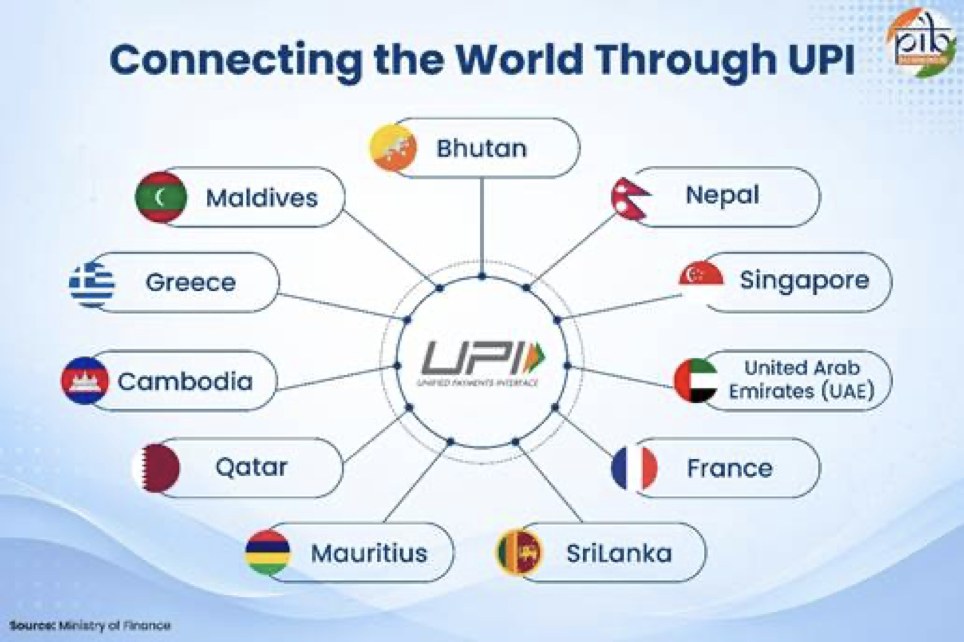
UPI is live in 11 countries for acceptance and/or cross-border remittances. Image: Ministry of Finance / PIB; reproduced with credit for educational use.
UPI's Growth Trajectory: 10-Year Chart
Figure 2 — UPI Annual Transaction Volume (FY 2016–17 to FY 2025–26)
06,00012,00018,000Crore TxnsFY17FY18FY19FY20FY21FY22FY23FY24FY25FY2624,162 CrAnnual Transaction Volume (Crore Transactions) | Source: NPCI / PIB
From 1.78 crore in FY 2016–17 to 24,162 crore in FY 2025–26 — a ~13,000-fold rise in a decade.
Critical View: Strengths and Gaps
- Merchant-side concentration: PhonePe and Google Pay together hold over 80% of UPI transaction volume, raising antitrust and systemic-risk concerns. NPCI's 30% market-share cap remains unenforced.
- Zero MDR challenge: Since January 2020, UPI transactions carry zero Merchant Discount Rate. While this accelerated adoption, it has stressed the commercial sustainability of smaller payment service providers.
- Feature-phone inclusion: UPI 123PAY was designed to reach ~300 million feature-phone users, but uptake has been limited by last-mile digital literacy barriers.
- Cross-border depth vs breadth: UPI is "live" in 11 countries, but in several cases only for inbound remittances or a narrow class of transactions — not full merchant QR acceptance. True bilateral interoperability remains work in progress.
- Fraud and grievance redressal: The volume surge has also raised fraud incidence. Strengthening the ombudsman framework and consumer grievance turnaround times is an ongoing policy challenge.
Institutions & Terms to Know (Prelims)
- NPCI: National Payments Corporation of India — umbrella body for retail payments; a not-for-profit owned by a consortium of banks under RBI guidance.
- NPCI International Payments Limited (NIPL): Wholly owned subsidiary of NPCI for international deployment of UPI and RuPay.
- VPA: Virtual Payment Address — e.g. user@bankname — the UPI identifier that masks bank account details.
- BHIM: Bharat Interface for Money — government-developed UPI app launched December 2016.
- PSP: Payment Service Provider — banks and fintech apps acting as Remitter PSP or Beneficiary PSP on the UPI rails.
- IMF recognition: IMF's June 2025 report "Growing Retail Digital Payments: The Value of Interoperability" acknowledged UPI as the world's largest real-time payment system by volume.
- India Stack: The layered Digital Public Infrastructure — Aadhaar (identity) → UPI (payments) → DigiLocker (documents) — of which UPI is the payments layer.
✎ Mains Practice Question
"The Unified Payments Interface (UPI) represents not just a technological achievement but a structural shift in India's financial inclusion architecture." Critically examine this claim, highlighting both the successes and the unresolved challenges of UPI after a decade. 15 marks · 250 words
Environment & EcologyGeneral Studies Paper III + IR (Paper II)
02
India Reports 21.76 mn ha Restored in 2011–2020 at UNCCD COP17; Reaffirms 26 mn ha Bonn Challenge Target by 2030
GS-III · Environment — Land Degradation, Sustainable DevelopmentGS-II · IR — Multilateral Environmental AgreementsPrelims + MainsPIB · MoEFCC · 24 Aug 2026
At the 17th Conference of the Parties (COP17) to the United Nations Convention to Combat Desertification (UNCCD) in Ulaanbaatar, Mongolia, India disclosed that it restored 21.76 million hectares of degraded land between 2011 and 2020, generating approximately 1.22 billion person-days of employment.
◈ Background & Context
Land degradation — encompassing soil erosion, loss of organic matter, deforestation, waterlogging and desertification — affects about one-third of global land area and directly threatens food security, rural livelihoods and carbon sinks.
India is one of the countries significantly affected: an estimated 96–120 million hectares of land is under various degrees of degradation.
- The UNCCD (established 1994) is one of the three Rio Conventions alongside the UNFCCC and CBD. It focuses on land degradation, desertification and drought — particularly in drylands.
- The Bonn Challenge (launched 2011) is a global pledge to restore 150 million ha of degraded and deforested land by 2020 and 350 million ha by 2030. India made an initial pledge in 2015, later enhanced to 26 million ha by 2030.
- Land Degradation Neutrality (LDN) — the idea of no net loss in healthy, productive land — is a target embedded in SDG 15.3.
▤ India's Restoration Metrics at a Glance
- Bonn Challenge pledge: 26 million hectares restored by 2030 (enhanced from initial 2015 commitment)
- Restoration achieved (2011–2020): 21.76 million hectares (per Second Progress Report)
- Employment generated: ~1.22 billion person-days
- Land-use systems covered: forests, agriculture, soil and water conservation, other land-use systems
- Next reporting cycle: 2021–2025, in collaboration with ICFRE Centre of Excellence on Sustainable Land Management and IUCN
- Nodal Ministry: Ministry of Environment, Forest and Climate Change (MoEFCC)
- Convention: UNCCD COP17, Ulaanbaatar, Mongolia (August 2026)
India's Programmes Driving Land Restoration
- Green India Mission (GIM): One of the eight National Missions under the National Action Plan on Climate Change (NAPCC); targets increasing forest/tree cover, ecosystem services and carbon sinks by 5 million ha, and improving quality of forest cover on another 5 million ha.
- CAMPA (Compensatory Afforestation Fund Management and Planning Authority): Channels funds collected from project developers who divert forest land, into compensatory afforestation and ecosystem restoration.
- Nagar Van Yojana: Targets creation of 1,000 urban forests in cities and towns — extends restoration into urban and peri-urban landscapes.
- Watershed Development: Programmes under PMKSY (Pradhan Mantri Krishi Sinchayee Yojana) and MGNREGS integrate water harvesting and soil conservation with livelihood support.
- Agroforestry: National Agroforestry Policy 2014 promotes tree integration on farmlands — a restoration approach with simultaneous food security and income benefits.
Lineage: Key Conventions and Their Progression
- UNCCD (1994) → Established the 10-Year Strategy 2008–2018 → replaced by 2018–2030 Strategy with LDN as the central goal.
- Bonn Challenge (2011, Germany + IUCN) → New York Declaration on Forests 2014 escalated ambition → AFR100, Initiative 20×20 are regional complements.
- India's NDC (Nationally Determined Contribution) under the Paris Agreement includes a target to create an additional carbon sink of 2.5–3 billion tonnes of CO₂ equivalent through forest and tree cover by 2030 — restoration is the delivery mechanism.
Critical View
- Measurement methodology: The 21.76 mn ha figure covers area "brought under restoration" — this includes schemes where interventions were initiated, not necessarily where ecological health has been fully recovered. The quality and permanence of restoration is harder to verify than area figures.
- Convergence challenge: Land restoration in India is spread across at least eight central ministries (Agriculture, Rural Development, Tribal Affairs, Jal Shakti, Environment, etc.) with no single nodal agency. Convergence at the landscape level remains an acknowledged implementation gap.
- Finance gap: India called for "diversified, adequate, predictable and sustained" international finance for land restoration at COP17 — an implicit acknowledgement that domestic budgetary support alone is insufficient to meet the 26 mn ha target.
- LDN accounting: India has not yet submitted a formal LDN target to the UNCCD — the restoration data and the LDN framework are parallel tracks that need integration.
Process Diagram: India's Restoration Architecture
Figure 3 — India's Multi-Sector Land Restoration Framework
India's Commitments26 mn ha by 2030 (Bonn Challenge) · NDC Carbon Sink TargetGreen IndiaMission (GIM)+10 mn ha forestCAMPACompensatoryAfforestation FundNagar VanYojana1,000 Urban ForestsWatershed DevPMKSY + MGNREGSSoil & WaterAgroforestryNational Policy 2014Farm + Tree CoverReported Outcomes (2011–2020)21.76 mn ha Restored1.22 billion person-days of employment generatedSource: PIB / MoEFCC / UNCCD Second Progress Report (2011–2020)
India's restoration outcomes flow from convergence across at least five national missions and programmes under different central ministries.
Institutions & Terms to Know (Prelims)
- UNCCD: United Nations Convention to Combat Desertification (1994) — one of the three Rio Conventions. Secretariat in Bonn.
- Bonn Challenge: A global pledge (launched 2011) to restore degraded/deforested land — 150 mn ha by 2020, 350 mn ha by 2030.
- LDN: Land Degradation Neutrality — SDG 15.3 target; aim: by 2030 the amount of degraded land does not increase from the baseline.
- IUCN: International Union for Conservation of Nature — co-launched the Bonn Challenge; partner in India's next reporting cycle.
- ICFRE: Indian Council of Forestry Research and Education — houses the Centre of Excellence on Sustainable Land Management, partner in India's 2021–2025 reporting.
- NAPCC: National Action Plan on Climate Change — eight missions, of which Green India Mission addresses forest restoration.
- SDG 15.3: "By 2030, combat desertification, restore degraded land and soil, including land affected by desertification, drought and floods, and strive to achieve a land-degradation-neutral world."
✎ Mains Practice Question
India's Bonn Challenge commitment and land restoration achievements have both environmental and socio-economic dimensions. Analyse the challenges of translating India's restoration pledges into verifiable on-ground outcomes, with reference to institutional convergence, financing and monitoring. 15 marks · 250 words