
In-Depth PIB Analysis2 Items
Core TopicImportantConcise
Science & Technology · EconomyGS Paper III
01India’s Space Economy: $9 bn → $40–45 bn
Internal SecurityGS Paper III
02Naxal-Free India: Ending Left-Wing Extremism
Science & Technology · EconomyGeneral Studies Paper III
01
India’s Space Economy: From a State Monopoly to a Private-Sector-Led Ecosystem
GS-III · S&T — Awareness in the Field of Space; Indian Economy — Investment Models, Industrial PolicyPrelims + MainsPIB · Department of Space · Release ID 2340845
At the 5th India International Space Conclave 2026 (New Delhi, 23–24 November), the Government said India’s space economy — valued at about USD 9 billion today — is expected to grow to USD 40–45 billion in less than a decade, with the number of space firms rising from single digits to 400–500 after the sector was opened to private players.
◈ Basics — What Is the “Space Economy”?
The space economy is the full range of activities and resources that create value by exploring, understanding, managing and using space. It is usually split into two segments, and the second is far larger than the first.
- Upstream — building and launching things: launch vehicles, satellite manufacturing, ground stations, propulsion, components.
- Downstream — using what is in orbit: satellite communication and DTH broadcasting, navigation (NavIC/GPS), earth observation and remote-sensing data, weather services.
- Indirect value — the efficiencies space data creates across sectors (crop insurance, disaster warning, infrastructure planning, fisheries advisories). The Government argued this “savings and outcomes” value should also be counted.
◈ Static Background — Six Decades of India’s Space Programme
- 1962 — INCOSPAR (Indian National Committee for Space Research) set up under the Department of Atomic Energy, led by Vikram Sarabhai; first sounding rocket from Thumba (21 November 1963).
- 15 August 1969 — ISRO formed; 1972 — Space Commission and Department of Space (DoS) created, with ISRO under DoS. DoS reports directly to the Prime Minister.
- 1975 — Aryabhata, India’s first satellite (launched by the USSR); 1980 — SLV-3 puts Rohini into orbit, making India a space-launching nation.
- 1992 — Antrix Corporation, ISRO’s first commercial arm; March 2019 — NewSpace India Limited (NSIL), a CPSE under DoS, to commercialise ISRO technologies and operate demand-driven satellite missions.
- June 2020 — the space sector opened to private players; IN-SPACe (Indian National Space Promotion and Authorisation Centre, HQ Ahmedabad) created as a single-window body to promote, authorise and supervise non-government space activities.
- October 2021 — Indian Space Association (ISpA), the industry body, launched; April 2023 — Indian Space Policy 2023 spells out the roles of DoS, ISRO, NSIL, IN-SPACe and private industry.
- February 2024 — FDI rules liberalised: up to 74% automatic for satellite manufacturing and operations, up to 49% automatic for launch vehicles and spaceports, 100% automatic for components and sub-systems (higher limits via the government route).
- October 2024 — Cabinet approves a ₹1,000 crore Venture Capital Fund for space start-ups under IN-SPACe.
Figure 1 — The new architecture of India’s space sector (Indian Space Policy 2023)
Department of SpacePolicy · reports to the PMISRO (1969)R&D, new technologies,exploration, humanspaceflightNSIL (2019)Commercial arm (CPSE):tech transfer, launchservices, satellitesIN-SPACe (2020)Single window: promotes,authorises, supervisesprivate activityPrivate industry & start-ups (~400–500 firms) · represented by ISpA (2021)Launch vehicles · satellites · ground segment · earth-observation data · applications
The 2023 Policy separates the roles: ISRO moves to research, NSIL handles commerce, IN-SPACe regulates and hand-holds, and private firms take over operational work.
▤ The Announcement at a Glance
- Event: 5th India International Space Conclave 2026, organised by ISpA, New Delhi, 23–24 November 2026; theme — “Shaping the Future of Space through Innovation, Governance, Human Potential and Global Collaborations”.
- Report released: “Space Economy 2036: The India Blueprint”.
- Current size: about USD 9 billion.
- Stated target: USD 40–45 billion in under a decade (government projection) — in line with IN-SPACe’s Decadal Vision of about USD 44 billion by 2033.
- Ecosystem: from single-digit start-ups to roughly 400–500 companies (as stated by the Government).
- Private milestones cited: Skyroot Aerospace — maiden orbital launch-vehicle flight on 18 July 2026, a multi-mission launch agreement and unicorn status; Agnikul Cosmos — advanced propulsion and privately built rocket engines.
- Nodal bodies: Department of Space, ISRO, IN-SPACe, NSIL.
Figure 2 — Size of the opportunity (USD billion)
0153045~9Today (2026)40–45Target (< a decade)Governmentprojection~4.5–5×
A four- to five-fold jump in under ten years needs annual growth of roughly 18–22% — far above the global space economy’s pace.
Key arguments made at the Conclave
- Space as a cross-cutting input: space applications now serve almost every ministry — infrastructure, railways, defence, health, education. The PM Gati Shakti National Master Plan (2021), built on BISAG-N geospatial layers, was cited as an example: better planning, fewer delays, lower costs and leakages.
- Demand problem = awareness problem: the Government said weak domestic demand is largely due to low awareness of practical uses; it pointed to a whole-of-government approach to raise uptake.
- Sovereignty and collaboration: indigenous sources, technology and projects should be strengthened while staying open to international partnerships — the two are not seen as contradictory.
- Private R&D funding: industry was urged to invest more, attract foreign capital, and channel CSR money into research — a push for “scientific philanthropy”.
▤ Linked Frontier-Tech Institutions — Prelims Hooks
- National Quantum Mission (NQM) — approved 2023, outlay about ₹6,003.65 crore, 2023–24 to 2030–31. The Government reports 1,000 km of secure quantum communication achieved in three years, against a target of 2,000 km over eight years.
- Anusandhan National Research Foundation (ANRF) — set up under the ANRF Act, 2023, replacing the SERB; meant to seed and steer research in universities and labs.
- Research, Development and Innovation (RDI) Fund — a ₹1 lakh crore corpus (approved 2025) giving long-term, low- or nil-interest finance for private-sector R&D in sunrise sectors.
- CSR — mandated under Section 135, Companies Act 2013; Schedule VII already allows contributions to specified research institutions.
Why it matters
- Strategic autonomy: assured, home-grown access to launch, navigation and earth-observation is a security asset, as shown by the dependence risks of foreign GNSS and imagery in conflict.
- Commercial opportunity: the global small-satellite and launch market is growing fast; India’s low-cost engineering gives it a competitive edge.
- Governance dividend: space data drives crop estimation (FASAL), PMFBY claims, disaster early warning, land records (SVAMITVA uses drones and CORS networks), and fisher advisories.
- Freeing ISRO: moving routine launches and satellite building to industry lets ISRO focus on Gaganyaan, the Bharatiya Antariksh Station and deep-space missions.
The critical view
- Small global share: India accounts for roughly 2% of a global space economy estimated at over USD 600 billion; scaling up needs sustained exports, not just domestic orders.
- No space law yet: India still lacks a comprehensive space activities Act covering liability, insurance, licensing and dispute resolution; a draft Space Activities Bill (2017) was never enacted, and the Policy alone does not give investors legal certainty.
- Demand dependence: most demand still comes from the State; private firms need the Government as an anchor customer and assured procurement.
- Capital intensity and long gestation: deep-tech hardware needs patient capital; the ₹1,000 crore VC fund is modest compared with funding needs.
- Infrastructure bottlenecks: launch pads, test facilities and spectrum are largely government-controlled; access rules and pricing need to be transparent.
- Measuring the target: projections depend on how “space economy” is defined — including indirect benefits can inflate figures; independent valuation would help credibility.
- Sustainability: more satellites mean more space debris; India’s Debris-Free Space Missions (DFSM) goal for 2030 must bind private operators too.
✎ Mains Practice Question
India’s space sector reforms since 2020 have shifted the role of the State from “operator” to “enabler”. Examine the institutional changes involved and discuss the regulatory and market challenges India must address to achieve a significant share of the global space economy. 15 marks · 250 words
Internal SecurityGeneral Studies Paper III
02
Naxal-Free India: How the State Ended Left-Wing Extremism — and What Must Come Next
GS-III · Internal Security — Linkages between Development & Spread of Extremism; Security Forces & their MandateGS-II · Tribal Welfare — Fifth Schedule, PESA, FRAPrelims + MainsPIB Backgrounder · Ministry of Home Affairs · Release ID 2340727
The Government says India became effectively free of Left-Wing Extremism (LWE) on 31 March 2026 — the deadline it had set on 24 August 2024. A new PIB backgrounder sets out how a six-decade insurgency was ended through a combined strategy of security, development and rehabilitation, and outlines the next phase: consolidation and preventing a relapse.
◈ Basics — What Is Left-Wing Extremism?
Left-Wing Extremism (popularly Naxalism or Maoism) is an armed movement that rejects parliamentary democracy and seeks to seize state power through a “protracted people’s war”, drawing on Mao Zedong’s doctrine that political power grows out of the barrel of a gun.
- Origin: a peasant uprising at Naxalbari (Darjeeling district, West Bengal) in May 1967, led by Charu Majumdar, Kanu Sanyal and Jangal Santhal — hence “Naxalite”.
- 1969 — the CPI (Marxist–Leninist) is formed; the movement then splinters into dozens of groups through the 1970s–90s.
- 21 September 2004 — the People’s War Group (PWG) and the Maoist Communist Centre of India (MCCI) merge to form the CPI (Maoist); it was banned as a terrorist organisation under the Unlawful Activities (Prevention) Act, 1967 in 2009.
- The “Red Corridor”: at its peak the movement spread across forested, mineral-rich tribal belts from Bihar–Jharkhand through Odisha and Chhattisgarh (Bastar) to Andhra Pradesh–Telangana and Maharashtra (Gadchiroli).
- From 2006 onwards, the Union Government repeatedly described Naxalism as India’s “single biggest internal security challenge” — wider in spread than the insurgencies in J&K and the Northeast.
Figure 1 — From Naxalbari (1967) to a Naxal-free India (2026)
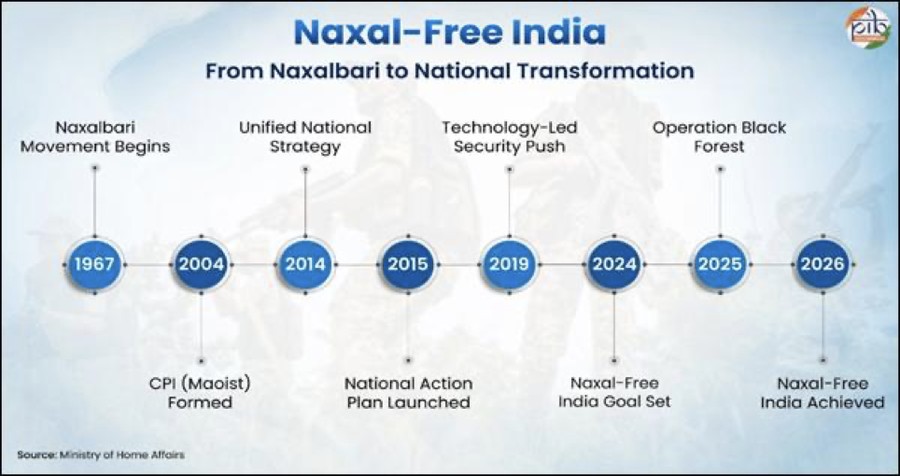
Six decades in eight milestones — the policy turn came with the 2015 National Policy and Action Plan. Image courtesy PIB / Ministry of Home Affairs, 24 November 2026; reproduced with credit for educational use.
◈ Static Background — Root Causes & the Constitutional Framework
The Planning Commission’s Expert Group on “Development Challenges in Extremist Affected Areas” (2008, chaired by D. Bandyopadhyay) and the Second ARC’s 7th Report (“Capacity Building for Conflict Resolution”, 2008) traced LWE to governance and development deficits, not just law and order.
- Land alienation and displacement by mining, dams and industry without fair rehabilitation.
- Denial of forest rights — tribal communities criminalised for using forests they had depended on for generations.
- Weak state presence — no roads, schools, health centres, banks or functioning local government in remote forest areas.
- Exploitation by moneylenders, contractors and middlemen (for example in tendu-leaf trade), and poor implementation of land reforms.
- “Police” and “public order” are State subjects (Entries 1 & 2, List II, Seventh Schedule); the Centre supports States with CAPFs and funds, and under Article 355 must protect States against internal disturbance.
- Fifth Schedule (Article 244(1)) — special administration of Scheduled Areas, with the Governor and Tribes Advisory Councils.
- PESA Act, 1996 — extends Panchayati Raj to Fifth Schedule areas, giving the Gram Sabha powers over minor forest produce, land and local resources.
- Forest Rights Act, 2006 — recognises individual and community rights of forest dwellers; per the backgrounder, 21,26,273 title deeds have been distributed.
The pre-2014 picture: peak violence, no unified policy
- 2004–2014 — 17,542 violent incidents, 1,913 security-force deaths and 5,019 civilian deaths.
- 2010 — the worst year: 1,936 incidents and 1,005 fatalities (including 720 civilians); the Dantewada (Tadmetla) attack that April killed 76 security personnel.
- About 92% of Maoist weapons had been looted from police armouries, according to the backgrounder.
- States acted largely in silos; responses were incident-driven. State-backed civil militias such as Salwa Judum (2005) were struck down by the Supreme Court in Nandini Sundar v. State of Chhattisgarh (2011), which barred arming tribal youth as Special Police Officers.
▤ The Strategy at a Glance
- Framework: National Policy and Action Plan to address LWE (2015) — a whole-of-government approach coordinated by the Ministry of Home Affairs (LWE Division).
- Four prongs: strengthening the security apparatus; rapid development; ensuring rights and entitlements; managing perception.
- Operational doctrine: SAMADHAN (2017) — Smart leadership, Aggressive strategy, Motivation and training, Actionable intelligence, Dashboard-based KPIs and KRAs, Harnessing technology, Action plan for each theatre, No access to financing.
- Security Related Expenditure (SRE) Scheme — ₹3,877.98 crore released since 2014–15 (operations, training, rehabilitation, ex-gratia).
- Special Infrastructure Scheme (SIS) — ₹1,761 crore sanctioned for special forces, intelligence branches and fortified police stations.
- Special Central Assistance (SCA) for the most affected districts — about ₹4,318.52 crore released since 2017 to fill critical public-infrastructure gaps.
- Deadline: “Naxal-free by 31 March 2026”, announced 24 August 2024; the Government says it was met.
Figure 2 — Three mutually reinforcing strands of the strategy
1. Restore faithin the StateCamps, FPS, CAPF–Statecoordination, choke funding,surrender & rehabilitation2. ExpandinfrastructureRoads, mobile towers, rail,banks, post offices,schools, hospitals3. Deliver welfarewith dignityFRA titles, EMRS, PM-JANMAN,Dharti Aaba, adaptivelast-mile deliverySecurity creates space for development → development builds trust → trust speeds welfarespacetrust
The Government presents the three strands as a chain, not a sequence — each strengthens the others.
Strand 1 — Building the security grid
- 668 new security camps (against 169 before 2014), 615 Fortified Police Stations, 68 night-landing helipads, 400 bullet- and blast-proof vehicles, 5 hospitals for forces.
- Layered forces: CRPF’s CoBRA (Commando Battalion for Resolute Action, raised 2008–09), Chhattisgarh’s District Reserve Guard (DRG) of local recruits, State STFs, Jharkhand Jaguar, and Andhra Pradesh’s Greyhounds (1989) — trained jointly under a clear command structure.
- Technology: UAVs, drones, satellite imagery, AI-based analytics, call-log and mobile-data analysis, and social-media monitoring for real-time tracking.
- Doctrine: “Trace, Target, Neutralise”. The Government says all Politburo and Central Committee members of the CPI (Maoist) have been neutralised — 41 since 2014.
Figure 3 — Major anti-Naxal operations since 2022
Operation Black Forest (April 2025) broke a key Maoist stronghold; Operation Double Bull cleared Gumla, Lohardaga and Latehar (Jharkhand). Image courtesy PIB / Ministry of Home Affairs, 24 November 2026; reproduced with credit for educational use.
Choking the support system — the money trail
- A dedicated NIA vertical targets Naxal financing (extortion, levies on contractors and minor forest produce trade).
- Assets of over ₹92 crore targeted — NIA seized ₹40+ crore, ED attached ₹12 crore (under the PMLA, 2002), State agencies confiscated ₹40 crore (as of December 2025).
- 112 LWE cases with the NIA and 100 charge sheets filed (as of June 2026).
Figure 4 — Crackdown on Naxal financing
“No access to financing” — the final letter of SAMADHAN — in numbers. Image courtesy PIB / Ministry of Home Affairs, 24 November 2026; reproduced with credit for educational use.
Surrender and rehabilitation — “a red carpet for those who lay down arms”
- Immediate grant: ₹5 lakh for higher-ranked cadres, ₹2.5 lakh for others; ₹10,000 a month stipend for 36 months.
- Extra incentives: ₹50,000 on surrender (doubled for group surrenders) and compensation for weapons deposited; housing under PMAY, skilling, and free schooling up to Class XII for cadres’ children.
- About 8,526 cadres had surrendered by November 2026, per the backgrounder; villages that expelled Naxal influence and elected panchayats received development grants.
Strands 2 & 3 — Infrastructure and welfare
15,189 km
roads under RRP & RCPLWEA
9,561
mobile towers commissioned
96%
villages with mobile coverage (44,728 of 46,592)
1,804
bank branches (Apr 2015–Mar 2026)
- Roads: two LWE-specific schemes — Road Requirement Plan (RRP-I, 2009) and the Road Connectivity Project for LWE Affected Areas (RCPLWEA, 2016); the Border Roads Organisation was brought in where contractors would not bid.
- Rail: Dalli Rajhara–Rowghat (95 km) completed; Rowghat–Jagdalpur (140 km) approved; Dantewada–Manuguru (153 km) sanctioned; Kirandul–Jagdalpur doubling (150 km) nearing completion.
- Financial inclusion: 1,321 ATMs, 74,720 banking correspondents and 6,025 post offices (April 2015–March 2026).
- Health: a 240-bed super-speciality hospital at GMC Jagdalpur under PMSSY (inaugurated 18 May 2026); 11 CAPF field hospitals opened to local people.
- Education & skills: 259 Eklavya Model Residential Schools sanctioned (179 functional), 47 ITIs, 49 Skill Development Centres; 90,000+ youth and women trained; 37,655 youth on the Tribal Youth Exchange Programme since 2014.
- Adaptive governance: Aadhaar camps; 294 post offices in Bastar sited by terrain survey; cash wages and offline attendance allowed under the rural employment guarantee (now VB-G RAM G); Swachh Bharat funds routed via Village Sanitation Committees; offline issue of Ayushman Bharat cards.
- Tribal-focused schemes: Aspirational Districts Programme (2018); PM-JANMAN (2023) for the 75 PVTGs; Dharti Aaba Janjatiya Gram Utkarsh Abhiyan (2024) for saturating tribal villages with basic infrastructure.
◈ Case Study — Bastar, Chhattisgarh
- Bastariya Battalion (2017) — 1,143 personnel, about 400 local youth from Bijapur, Sukma and Dantewada; local recruitment improved intelligence and trust.
- 3,240+ km of roads and 889 mobile towers across seven Bastar districts; a rehabilitation plan for about 3,000 surrendered cadres (initial ₹20 crore).
- Shaheed Veer Gunda Dhur Seva Dera (May 2026) — about one-third of CAPF camps to become Integrated Development Centres; the first at Netanar, birthplace of Gunda Dhur, leader of the 1910 Bhumkal rebellion against British rule in Bastar.
- Cultural integration: Bastar Pandum and the Bastar Olympics brought lakhs of tribal youth and artists into public life.
The results — as reported by the Government
Figure 5 — LWE violence: the peak, the turning point and today
01,0002,0001,9361,0052010 (peak)870310201433122026*IncidentsFatalities*2026 figures up to 29 July 2026 (part-year)
LWE-affected districts fell from 126 (2014) to zero by March–April 2026, and the “most affected” from 35 to zero — per Ministry of Home Affairs data.
The next phase — consolidating the gains (since June 2026)
- Seva Dera Kendras: one-third of camps in LWE-free areas becoming citizen-service centres — a Jan Suvidha Kendra plus community, social and economic development (processing and branding of minor forest produce such as mahua, tamarind and tendu). Pilot with NID Ahmedabad for five Bastar camps, funded from the SCA scheme.
- Welfare-saturation survey by an independent agency in seven districts of south Chhattisgarh, to map gaps in education, health and basic services.
- Victims of Naxal violence included among beneficiaries of assistive devices under the Seva Sankalp Abhiyan.
- The Government reports that no CRPF personnel lost their lives on duty in the past year — the first such year in 47 years.
The critical view — ending an insurgency vs. ending its causes
- Risk of relapse: insurgencies in India (Mizoram, Punjab, Tripura) ended durably only when grievances were politically resolved; residual cadres and urban support networks can revive violence if attention fades.
- Root causes remain: land alienation, mining-led displacement and weak PESA implementation persist; several States have yet to fully operationalise PESA rules, and FRA claim rejections remain high in some regions.
- Human-rights accountability: allegations of fake encounters, arbitrary arrests of villagers and the Salwa Judum experience show that legitimacy depends on due process and independent oversight.
- Security footprint after victory: converting camps to service centres is a welcome step; demilitarising daily life and handing governance back to civil administration and Gram Sabhas is the real test.
- Data and verification: “zero affected districts” is an official classification; independent evaluation of outcomes — learning levels, health, incomes — would strengthen the claim.
- Resource governance: as mineral-rich forests open up, consent of Gram Sabhas, fair compensation and environmental safeguards will decide whether peace holds.
▤ Prelims Pointers
- CoBRA is a specialised unit of the CRPF; Greyhounds is an elite force of Andhra Pradesh (1989); DRG is a Chhattisgarh Police unit.
- SAMADHAN (2017) — MHA doctrine against LWE; SRE, SIS and SCA are the three MHA funding schemes.
- RCPLWEA (2016) is implemented through the PMGSY framework of the Ministry of Rural Development.
- Bhumkal rebellion (1910), Bastar — led by Gunda Dhur of the Dhurwa tribe.
- PVTGs — 75 groups, the focus of PM-JANMAN.
✎ Mains Practice Question
“Left-Wing Extremism was as much a development deficit as a security threat.” In the light of India’s declaration of being Naxal-free, analyse the strategy that weakened LWE and suggest measures to prevent its resurgence in the erstwhile affected regions. 15 marks · 250 words