
In-Depth PIB Analysis4 Items
Core TopicImportantConcise
Governance & Social JusticeGS Paper II · III
01DDU-GKY 2.0 — Placement-Linked Rural Skilling at 12
Indian EconomyGS Paper III
0212 Years of Make in India — Scorecard & Gaps
Science & TechnologyGS Paper III
03BioE3 & Sugar-Based PLA Bioplastic
Water Resources & International RelationsGS Paper I · II · III
04India–Netherlands & the Kalpasar Project
Governance, Welfare Schemes & Social JusticeGeneral Studies Paper II · III
01
DDU-GKY at 12: How DDU-GKY 2.0 Shifts Rural Skilling from “Training Numbers” to “Lasting Jobs”
GS-II · Welfare Schemes for Vulnerable SectionsGS-III · Employment, Inclusive GrowthPrelims + MainsPIB · Ministry of Rural Development · Backgrounders, 24 Sep 2026
The Deen Dayal Upadhyaya Grameen Kaushalya Yojana (DDU-GKY) completes 12 years on 25 September 2026. Its upgraded version, DDU-GKY 2.0, rewrites the definition of success — from “trained and placed” to “placed and retained”.
◈ Static Background — Start from the Basics
What is skilling? It is giving a person a job-ready ability — say, operating a sewing machine, electrical wiring or patient care — so that he or she can earn a wage or run an enterprise. For a rural family dependent on a single harvest, one skilled member means a second, non-farm income.
Why rural youth? India’s youth population is projected by the Government to touch about 345 million by 2036. Yet formal training remains thin — the Economic Survey 2023-24, citing PLFS data, noted that only about 4.4% of the young workforce (15–29 years) was formally skilled.
- Constitutional anchor: Article 41 (right to work, within economic capacity), Article 43 (living wage) and Article 46 (promotion of educational and economic interests of SCs, STs and weaker sections) — all Directive Principles.
- Legislative competence: “Vocational and technical training of labour” falls in Entry 25, Concurrent List (List III) — hence the Centre–State partnership model.
- Two skilling tracks: wage employment (DDU-GKY, under MoRD) and self-employment (RSETIs, also under MoRD); the general skilling track (PMKVY) sits with the Ministry of Skill Development & Entrepreneurship (created November 2014).
▤ Scheme at a Glance
- Launched: 25 September 2014 (birth anniversary of Pandit Deendayal Upadhyaya, observed as Antyodaya Diwas).
- Nodal Ministry: Ministry of Rural Development (MoRD); the skilling arm of DAY-NRLM (Deendayal Antyodaya Yojana – National Rural Livelihoods Mission).
- Upgraded guidelines: DDU-GKY 2.0 notified in May 2025; first rollout year 2025-26.
- Target group: rural youth aged 15–35 years from poor households; placement-linked, free residential/non-residential training.
- Mandatory social inclusion: SC/ST 50% · Women 33% · Persons with Disabilities 5%.
- Implementation chain: MoRD (policy & funding) → State Rural Livelihoods Missions (SRLMs) → Project Implementing Agencies (PIAs) that run training centres.
- Budget 2026-27: ₹750 crore allocated.
- Regional earmarks: 10% of allocation for the North-Eastern States; a Special Area Allowance of an additional 10% of base training cost per candidate for hard-to-reach areas.
Lineage — Where DDU-GKY Comes From
- 1999 — SGSY (Swarnjayanti Gram Swarozgar Yojana): self-employment through SHGs; its “Special Projects” component funded placement-linked skilling.
- June 2011 — NRLM (Aajeevika): SGSY restructured into a demand-driven livelihoods mission; the skilling component was run as Aajeevika Skills.
- 2011 — Himayat (J&K) and 2013 — Roshni (LWE districts): special skilling windows that were later folded under DDU-GKY.
- 2014 — DDU-GKY: rebranded and redesigned with a placement mandate, geo-tagged biometric attendance and a standard 576-hour minimum course.
- 2025 — DDU-GKY 2.0: placement redefined, post-placement support and migration support expanded, full digital lifecycle.
Figure 1 — DDU-GKY 2.0: the five design shifts
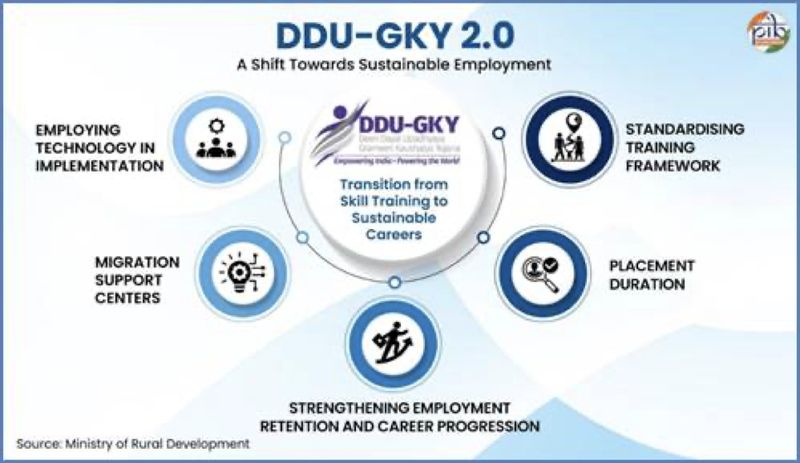
The revised framework reorganises the scheme around the journey “training → placement → retention → career progression”. Infographic courtesy PIB / Ministry of Rural Development; reproduced with credit for educational use.
What Changes Under DDU-GKY 2.0
1. Standardised training. The 576-hour minimum is retained, but split into 396 hours of domain training and 180 hours of mandatory non-domain training. The idea: a job needs technical skill and the soft skills to keep it.
Figure 2 — Anatomy of a 3-month (576-hour) DDU-GKY 2.0 course
Domain (job-specific) training — 396 h0 h576 hNon-domain: 180 hEnglish Communication — 60 hEmployability & Life Skills — 60 hComputer & Digital Literacy — 30 hEntrepreneurship — 30 hBar lengths drawn to scale (hours as stated in the DDU-GKY 2.0 framework)
Nearly one-third (31%) of every course is now non-domain — communication, workplace, digital and entrepreneurial capability.
2. Placement redefined. Earlier, a “placement” meant 3 months of continuous employment. Under 2.0 it means at least 6 months, counting continuous or non-continuous work across wage, self- and gig employment — a recognition of how rural youth actually work today.
3. Paying for retention, not just placement. Candidates are tracked for 12 months after placement, and support is tied to staying in work.
Figure 3 — The post-placement support ladder
₹1,270 × 6 months = ₹7,620 transition support, then ₹5,000 for staying employed 365 days (maximum break of 60 days); upskilling/reskilling is offered after 12 months. Infographic courtesy PIB / Ministry of Rural Development; reproduced with credit for educational use.
- 4. Migration Support Centres (MSCs): set up by SRLMs in both home and destination States — accommodation help, counselling, alumni networks, employer liaison. Annual funding per centre raised from ₹10 lakh to up to ₹30 lakh.
- 5. Job Melas: at Gram Panchayat and block level, with outcomes tracked for a year on Kaushal Panjee (the rural skills registry). Funding up to ₹50,000 (GP fair, linked to 100 placements) and ₹1 lakh (block fair, 200 placements).
- 6. End-to-end digital platform: PIA onboarding → project evaluation → candidate management → assessment & certification → finance → placement tracking; face-authentication attendance, a public candidate portal showing PIA performance ratings, and integration with the Skill India Digital Hub (SIDH).
Figure 4 — DDU-GKY 1.0 vs 2.0: the rules that changed
ParameterEarlierDDU-GKY 2.0Placement3 months continuousemployment6 months; continuous or non-continuous;wage, self & gig work countedTraining design576-hour minimum576 h = 396 domain + 180 standardisednon-domain hoursMigration supportMSC funding ₹10 lakh/yrUp to ₹30 lakh/yr per MSC, in homeand destination StatesTechnologyGeo-tagged, time-stampedbiometric attendanceFull-lifecycle digital platform; faceauthentication; SIDH integration
Only provisions for which the “earlier” position is officially stated are compared.
Special Windows Within DDU-GKY 2.0
- Roshni: for Left-Wing Extremism (LWE)-affected districts notified by the Ministry of Home Affairs; residential training compulsory; 40% coverage of women; now extended to Aspirational Districts.
- Himayat: for Jammu & Kashmir and Ladakh; covers both rural and urban youth, BPL and APL; supports wage, self and gig employment; 100% centrally funded, run through dedicated Mission Management Units.
▤ The Numbers — Cumulative Since 2014-15
18.47 lakh
youth trained
12.43 lakh
placed (~67%)
9.71 lakh
women trained (~53%)
31
States/UTs covered
- 749 approved projects · 760 active training centres · 455+ PIAs · 36 sectors · 800+ job roles.
- 6.34 lakh women placed — about 65% of women trained.
- Early 2.0 rollout (2025-26): Goa formed the first 2.0 batches; Andhra Pradesh began training 12,000+ candidates within 3 months; J&K commenced training for 91% of its allocation.
- Note: a companion PIB release gives 18.45 lakh trained / 12.35 lakh placed (as of June 2026); the backgrounder’s later “as on date” figures are used above.
Figure 5 — From training to placement (cumulative, lakh candidates)
All candidates — trained18.47All candidates — placed12.43Women — trained9.71Women — placed6.34Source: Ministry of Rural Development data in the PIB backgrounder (24 Sep 2026); bars to scale
Roughly one in three trained candidates does not show up as “placed” — the gap DDU-GKY 2.0 is designed to close.
Four Pathways Seen in the Field
The Ministry’s case stories illustrate four distinct outcomes that an aspirant can cite as examples:
- Interrupted education → first job: a young woman from Nagaland trained in tourism & hospitality and joined a Bengaluru hotel’s F&B service.
- Domestic job → overseas career: a youth from Siwan, Bihar (introduced via his mother’s JEEViKA SHG) trained as an Assistant Electrician, started at ₹10,500/month in Baddi and later earned about ₹35,000/month in Dubai.
- Job → return enterprise: a woman from Charaideo, Assam trained as a Sewing Machine Operator, worked in Tiruppur, then invested ₹50,000 savings in a tailoring centre at home (annual income ~₹1.10 lakh).
- Disability inclusion: a differently-abled youth from Jharkhand trained in the Healthcare Multipurpose trade and was placed as a General Duty Assistant in Nashik.
Companion Scheme — RSETIs (Self-Employment Track)
- Origin: modelled on RUDSETI, set up in 1982 at Ujire (Karnataka) by the SDME Trust with Syndicate Bank and Canara Bank; scaled nationally by MoRD from 2009.
- Design: bank-sponsored, one per district; free residential training for rural youth aged 18–50, followed by handholding and credit linkage.
- Scale: 647 RSETIs in 634 districts across 33 States/UTs; 63.47 lakh trained, 45.60 lakh settled — about 94% in self-employment, ~6% in wage jobs.
The Critical View
- Placement ratio: ~67% cumulative placement against the scheme’s long-standing expectation that PIAs place a clear majority of trainees; verification of placements by private PIAs has historically been a weak link.
- Quality of jobs: many placements are near entry-level wages in distant cities; high living costs drive early drop-outs — the very problem retention incentives now target.
- Migration stress: rural–urban migration of young women raises safety, housing and social-security concerns; MSCs are a response but depend on SRLM capacity in destination States.
- Scale vs. money: ₹750 crore (2026-27) is modest against a youth cohort of hundreds of millions; 18.47 lakh trainees in 12 years is small relative to the need.
- Fragmentation: overlapping skilling schemes across ministries (PMKVY, DDU-GKY, RSETI, sectoral schemes) complicate certification and tracking — hence the value of NSQF-aligned courses and SIDH integration.
- Positive design logic: paying for outcomes over 12 months rather than for training inputs aligns incentives of PIAs with those of the trainee.
◈ Institutions & Terms — Prelims Hooks
- PIA — Project Implementing Agency (private/NGO/public training partner).
- SRLM — State Rural Livelihoods Mission, the State-level arm of DAY-NRLM.
- Kaushal Panjee — rural skills registry portal for mobilisation and placement tracking.
- SIDH — Skill India Digital Hub, the national skilling platform of MSDE.
- NSQF — National Skills Qualifications Framework (notified 2013), grading skills by levels.
✎ Mains Practice Question
Placement-linked skilling schemes have often produced training numbers faster than durable employment. Examine how DDU-GKY 2.0 seeks to address this gap and identify the challenges that remain. 15 marks · 250 words
Indian Economy — Industry & ManufacturingGeneral Studies Paper III
02
Make in India at 12: Output Has Scaled Up — The Harder Tests Are Value Addition, Jobs and Share in GDP
GS-III · Industrial Policy, Growth, EmploymentPrelims + MainsPIB · Ministry of Commerce & Industry · Backgrounder, 24 Sep 2026
Make in India, launched on 25 September 2014, turns 12. The Government’s backgrounder reports large production gains across electronics, defence, steel and pharma; the analytical question is whether this has changed the structure of the economy.
◈ Static Background — Why Manufacturing Matters
The basic idea: agriculture employs many but pays little; services pay well but need high education. Manufacturing is the classic bridge — it absorbs semi-skilled labour at higher productivity, the path followed by Japan, South Korea and China.
- 1948 & 1956 — Industrial Policy Resolutions: State-led industrialisation; licensing and reservation.
- 1991 — New Industrial Policy: delicensing, FDI opening — the LPG reforms.
- 2011 — National Manufacturing Policy: targets of 25% share of GDP and 100 million jobs by 2022; created NIMZs (National Investment & Manufacturing Zones).
- 2014 — Make in India: adopted the same ambitions; nodal body DIPP, renamed DPIIT (Department for Promotion of Industry and Internal Trade) in 2019.
- 2020 — Atmanirbhar Bharat and PLI schemes; 2025-26 Budget — a National Manufacturing Mission announced.
▤ Initiative at a Glance
- Launched: 25 September 2014; lion logo; motto “Minimum Government, Maximum Governance”.
- Nodal Department: DPIIT, Ministry of Commerce & Industry.
- Four pillars: New Processes (ease of doing business) · New Infrastructure (corridors, clusters) · New Sectors (FDI opening) · New Mindset (government as facilitator).
- Coverage: originally 25 sectors; under Make in India 2.0, 27 sectors — 15 manufacturing + 12 services.
- Stated goal: India as a global hub for manufacturing, design and innovation (Government objective).
Figure 6 — The 27 sectors under Make in India 2.0
Prelims hook: services such as Medical Value Travel, Legal and Environmental Services are part of the list — Make in India is not manufacturing-only. Infographic courtesy PIB / Ministry of Commerce and Industry; reproduced with credit for educational use.
The Scorecard — What the Data Show
- Manufacturing GVA (constant prices) grew at a CAGR of 10.88% between 2022-23 and 2025-26 under the revised national-accounts series.
- IIP–Manufacturing rose 7.0% in April–July 2026 over the same period of 2025.
- Electronics: production up from ~₹1.9 lakh crore (2014-15) to ~₹13.11 lakh crore (2025-26) — nearly 7×; growth of 15.8% in 2025-26 alone.
- Mobile phones: ~₹18,000 crore → ~₹6.27 lakh crore (more than 30-fold); India is the world’s 2nd-largest mobile manufacturer by volume.
- Defence: indigenous production ₹46,429 crore (2014-15) → record ₹1.78 lakh crore (2025-26), an increase of ~283%.
- Steel: crude steel 81.7 MT → 170.0 MT (2014-15 to 2025-26); India has been the world’s 2nd-largest crude steel producer since 2018.
- Automobiles: 31.03 million vehicles in 2024-25 (~33% above 2014-15).
- Pharma: 3rd globally by volume, 11th by value (as per the release); turnover ₹4,71,898 crore (2024-25). Medical devices: ~₹28,000 crore → ₹41,500 crore (2019-20 to 2024-25).
- Railways: 54,809 coaches in 2014-24 (avg. 5,481/yr vs <3,300/yr in 2004-14); 1,674 locomotives and 6,677 LHB coaches in 2025-26.
- Capital goods: ₹2,87,233 crore → ₹5,69,900 crore (2019-20 to 2024-25), nearly 2×.
Figure 7 — How many times output grew (growth multiple, from officially stated values)
Electronics (2014-15→25-26)6.9×Defence (2014-15→25-26)3.8×Crude steel (2014-15→25-26)2.1×Capital goods (2019-20→24-25)2.0×Medical devices (2019-20→24-25)1.5×Vehicles, units (2014-15→24-25)1.3×Off the scale: mobile phones~₹18,000 cr → ~₹6.27 lakh cr (>30×)Multiples computed from values in the PIB backgrounder; base years differ, so compare with care.Nominal ₹ values for electronics, defence, capital goods and devices; volumes for steel and vehicles.
Growth is sharply uneven — assembly-led electronics and procurement-led defence lead; mass-employment sectors are not in the top tier of this chart.
Moving Up the Value Chain — Beyond Final Assembly
- Complex pharma: Trastuzumab Emtansine — world’s first biosimilar antibody-drug conjugate (breast cancer); Docaravimab–Miromavimab — first anti-rabies monoclonal antibody combination; Miqnaf (nafithromycin) — India’s first indigenously developed macrolide antibiotic in three decades (bacterial pneumonia); Desidustat — new chemical entity for anaemia in chronic kidney disease.
- Rare-earth permanent magnets: a pilot plant for Nd-Fe-B (neodymium-iron-boron) magnets set up at ARCI, Hyderabad in March 2026 — magnets critical for EV motors, wind turbines and electronics, where global supply is highly concentrated in China.
- Capital goods: machinery that makes machines — a better marker of industrial depth than final-goods output.
Figure 8 — The enabling architecture
Note the date difference: the infographic cites PLI production and sales of ₹20.41 lakh crore+ (Dec 2025); the backgrounder text updates this to ₹22.66 lakh crore (June 2026). Infographic courtesy PIB / Ministry of Commerce & Industry; reproduced with credit for educational use.
▤ Key Enablers — Facts to Remember
- FDI: 100% via automatic route in most sectors; cumulative inflows USD 843 billion (2014-15 to 2025-26), 169% higher than the preceding 12 years.
- National Single Window System (NSWS) (launched 2021): 327+ Central and 3,452 State approvals across 34 States/UTs; ~3.06 lakh applications a year; 5.69 lakh entities onboarded.
- India Industrial Land Bank (IILB): GIS platform mapping 4,220 industrial parks over ~6.98 lakh hectares (May 2026).
- PM GatiShakti National Master Plan (October 2021): the Network Planning Group (NPG) has evaluated 396 projects worth ~₹18.66 lakh crore; 256 sanctioned, 198 under implementation (Aug 2026).
- PLI schemes: 14 sectors, total outlay ₹1.97 lakh crore; by June 2026 — ₹2.40 lakh crore investment, ₹22.66 lakh crore production & sales, ₹15.20 lakh crore exports, 14 lakh+ jobs (Government data).
- Startup India (January 2016): ~2.54 lakh DPIIT-recognised startups.
The Critical View
- Structural share: manufacturing’s share of GVA has stayed broadly in the mid-to-high teens, well short of the 25% target inherited from the 2011 policy.
- Jobs: the 100 million manufacturing jobs goal remains distant; PLI’s 14 lakh jobs are small against the annual inflow of young workers — output growth has been capital- and assembly-intensive.
- Value addition: electronics output is dominated by final assembly; components (displays, chips, PCBs) remain largely imported — hence the Electronics Component Manufacturing Scheme (2025) and India Semiconductor Mission.
- Nominal vs real: several multiples above are in nominal rupees; part of the rise is inflation, not volume.
- Business environment: India rose from 142nd (2015) to 63rd (2020) in the World Bank’s Doing Business ranking before the report was discontinued in 2021; its successor is B-READY. Compliance burden, contract enforcement and land acquisition remain frictions.
- Strategic dependence: critical minerals and rare-earth magnets expose supply chains — addressed through the National Critical Mineral Mission (2025) and magnet initiatives.
✎ Mains Practice Question
Twelve years after its launch, Make in India shows impressive output growth in select sectors, yet manufacturing’s share in GVA and employment has not shifted proportionately. Critically analyse the reasons and suggest measures to deepen domestic value addition. 15 marks · 250 words
Science & Technology — BiotechnologyGeneral Studies Paper III
03
From Sugarcane to Bioplastic: Commercial Launch of PLA Under the BioE3 Policy
GS-III · Biotechnology, Environment (Pollution)Prelims + MainsPIB · Ministry of Science & Technology (DBT) · 24 Sep 2026
The Union Ministry of Science & Technology formally launched the commercial use of Polylactic Acid (PLA)-based bio-based biodegradable plastic made from sugar feedstock, with a ₹75 crore BIRAC grant for a 100 TPA pilot R&D facility under the BioE3 framework.
◈ Static Background — Plastics & Bioplastics Explained Simply
Conventional plastics (polyethylene, PET, polypropylene) are made from crude oil or natural gas. They are cheap and durable — and that durability is the problem: they persist for decades and fragment into microplastics.
Bioplastics is an umbrella term. Two separate questions decide what a plastic is: (a) what is it made from? (bio-based vs fossil-based) and (b) how does it end its life? (biodegradable vs non-biodegradable).
- Bio-based but NOT biodegradable: bio-PE (from sugarcane ethanol) — chemically identical to ordinary polyethylene.
- Fossil-based but biodegradable: PBAT — made from petrochemicals, yet compostable.
- Bio-based AND biodegradable: PLA and PHA (polyhydroxyalkanoates).
- Prelims trap: “bio-based” does not automatically mean “biodegradable”.
▤ Initiative at a Glance
- What: commercial launch of PLA-based bio-based biodegradable plastic; 100 TPA (tonnes per annum) pilot-scale R&D facility for specialised PLA grades and PLA co-polymers.
- Funding: ₹75 crore grant from BIRAC (Biotechnology Industry Research Assistance Council) under the Department of Biotechnology (DBT).
- Industry partner: Balrampur Chini Mills Ltd. (a sugar company); facility at its integrated complex at Kumbhi (Lakhimpur Kheri district), Uttar Pradesh.
- Policy umbrella: BioE3 — Biotechnology for Economy, Environment and Employment.
- Pilot’s role: techno-economic data, process know-how, customer validation, indigenisation and scale-up to the company’s commercial PLA plant.
- Context figure: India’s bioeconomy stated to have grown from ~US$10 billion (2014) to nearly US$195 billion (Government figure).
How PLA Is Made — Field to Film to Compost
PLA is a polyester built from lactic acid — the same molecule produced when milk turns into curd. Sugar is fermented by microbes into lactic acid, which is converted into a ring-shaped molecule called lactide and then chained into long polymer molecules (ring-opening polymerisation).
Figure 9 — The PLA value chain (a circular bio-based loop)
1. Sugarcane /biomass2. Sugarfeedstock3. Microbialfermentation4. Lacticacid5. Lactide →polymerisation6. PLA resin &co-polymers7. Packaging, films,fibres, cutlery,3D printing8. Industrialcomposting →CO₂ + waterCO₂ re-absorbedby the next cropSchematic process diagram; composting refers to controlled industrial conditions, not open dumping.
PLA opens a sugar-to-materials value chain — DBT describes it as a new chain “beyond ethanol” for the sugar industry.
The BioE3 Policy — Static Anchor
- Approved: by the Union Cabinet in August 2024; implemented by DBT.
- Core idea: high-performance biomanufacturing — using microbes, cells and enzymes to make chemicals, materials, food and medicines.
- Six thematic sectors: bio-based chemicals & enzymes; functional foods & smart proteins; precision biotherapeutics; climate-resilient agriculture; carbon capture & utilisation; futuristic marine & space research. PLA falls under the first.
- Infrastructure pillars: Biomanufacturing hubs, Bio-AI hubs and Biofoundries.
- Stated target: a US$300 billion bioeconomy by 2030 (Government projection).
- Funding companion: Bio-RIDE scheme (2024), merging DBT’s research and BIRAC’s industry-support schemes.
Why It Matters
- Plastic burden: CPCB estimated India’s plastic waste at about 4.1 million tonnes a year (2020-21).
- Regulatory push: Plastic Waste Management Rules, 2016; ban on identified single-use plastic items from 1 July 2022; carry-bag thickness 120 microns (from 31 Dec 2022); EPR guidelines (2022); the 2024 amendment defined “biodegradable plastics” and requires CPCB certification and labelling.
- Farm–industry link: India is among the world’s two largest sugar producers; after ethanol blending, PLA offers a second high-value outlet for cane.
- Import substitution: global PLA capacity is concentrated in a few producers abroad; domestic capability supports “Vocal for Local” goals.
- Waste-to-wealth: the Ministry stressed region-specific biomass (bagasse, crop residue, agri-waste) as future feedstock.
The Critical View
- “Biodegradable” needs conditions: PLA breaks down reliably only in industrial composting (~58 °C, high humidity, microbial activity). In soil, rivers or seas it degrades very slowly and can behave like conventional plastic.
- Composting infrastructure gap: without segregated collection and industrial composters, PLA ends up in landfills — or contaminates PET recycling streams.
- Food vs materials: cane is water-intensive; diverting food crops to plastics raises land and water trade-offs — second-generation (residue-based) feedstocks are the sustainable path.
- Cost and properties: PLA is costlier than polyethylene and is brittle with low heat resistance — the reason the pilot focuses on co-polymers.
- Global context: talks on a legally binding UN plastics treaty (INC process) remain unfinished; substitution alone cannot replace reduce–reuse measures.
◈ Institutions & Terms — Prelims Hooks
- DBT — Department of Biotechnology, set up in 1986 under the Ministry of Science & Technology.
- BIRAC — a Section 8, not-for-profit PSU of DBT (est. 2012) that funds biotech start-ups and industry R&D.
- BRIC — Biotechnology Research and Innovation Council (2023), an apex body subsuming DBT’s autonomous institutes.
- IS/ISO 17088 — standard specifying requirements for compostable plastics.
- TPA — tonnes per annum (capacity unit).
✎ Mains Practice Question
Distinguish between “bio-based” and “biodegradable” plastics. In the context of the BioE3 policy, assess whether sugar-based polylactic acid (PLA) can meaningfully address India’s plastic waste problem. 15 marks · 250 words
Water Resources, Geography & International RelationsGeneral Studies Paper I · II · III
04
India–Netherlands Water Partnership: Dutch Expertise for Gujarat’s Kalpasar Project
GS-I · Geography — Coasts, RiversGS-II · Bilateral RelationsGS-III · Water Resources, InfrastructurePrelims + MainsPIB · Ministry of Jal Shakti · 24 Sep 2026
On the sidelines of the 9th India International Water Week (IIWW) 2026 in New Delhi, India and the Netherlands signed two tripartite MoUs for technical cooperation and capacity building on the Kalpasar Project — a proposed freshwater reservoir in the Gulf of Khambhat, Gujarat.
◈ Static Background — The Geography First
The Gulf of Khambhat (Cambay) is a funnel-shaped inlet of the Arabian Sea between the Saurashtra peninsula and mainland Gujarat. Its funnel shape amplifies tides — spring tidal ranges exceed 10 metres, among the highest on India’s coast — which also makes it a candidate site for tidal energy.
- Rivers draining into the gulf: Sabarmati, Mahi, Dhadhar and Narmada (the Tapi reaches the sea just south, near Surat).
- The problem: Saurashtra is semi-arid and drought-prone, with coastal salinity ingress, while monsoon river water flows unused into the sea.
- Existing responses: Sardar Sarovar Dam on the Narmada and the SAUNI Yojana, which lifts surplus Narmada water into Saurashtra’s reservoirs.
Figure 10 — Where Kalpasar would sit
A ~30 km dam across the gulf, commonly described as linking Ghogha (Bhavnagar) and Hansot (Bharuch), would convert the upper gulf into a freshwater lake. Alignment shown is indicative. Base geography: Natural Earth 1:10m (public domain); rivers and coastline plotted to real coordinates.
▤ Project & Agreement at a Glance
- Kalpasar concept: a freshwater reservoir in the Gulf of Khambhat formed by a dam across the gulf, storing runoff of the Sabarmati, Mahi and Dhadhar, supplemented by Narmada water.
- Origin: conceived in the 1980s; an earlier tidal-power component was later set aside in favour of water storage.
- MoUs (tripartite): Central Water Commission (CWC) + Kalpasar Department, Government of Gujarat + Dutch institutions Deltares and TU Delft.
- Scope of cooperation: technical review, hydraulic & hydrological modelling, coastal and structural engineering, climate resilience, capacity building, knowledge transfer and digital applications.
- Sequence: discussed during the Prime Minister’s visit to the Netherlands (May 2026) → Letter of Intent signed 16 May 2026 → Indian delegation visit (July 2026) → MoUs at IIWW, 24 Sep 2026.
- Framework: the India–Netherlands Strategic Partnership on Water (agreed 2021).
Why the Netherlands? — The Dutch Water Story
Roughly a quarter of the Netherlands lies below sea level in the delta of the Rhine, Meuse and Scheldt. Centuries of dykes, polders and pumping have made Dutch engineers the global reference for living with water.
Figure 11 — The Netherlands on the North Sea
The Afsluitdijk lies across the former Zuiderzee inlet in the north of the country, closing it off from the North Sea — the lake north-east of Amsterdam is the IJsselmeer it created. Map as supplied (BBC News country-profile map); reproduced with credit for educational use.
1932
Afsluitdijk completed
~32 km
length of the dam
IJsselmeer
freshwater lake created
~30 km
proposed Kalpasar dam
- Afsluitdijk (1932): the ~32 km closure dam of the Zuiderzee Works, which turned a saltwater inlet into the freshwater IJsselmeer — the closest parallel to Kalpasar. It is now being renewed after nearly a century, including provisions for fish migration.
- Delta Works: storm-surge barriers built after the 1953 North Sea flood.
- Room for the River: a later shift from “fighting water” to giving rivers space — a lesson in ecological design.
- Deltares is an independent Dutch institute for applied research in water and subsurface; TU Delft is the Delft University of Technology.
The Critical View
- Sediment: the gulf carries a very high silt load; a closed reservoir risks rapid siltation and reduced storage.
- Salinity: the impounded water starts saline; flushing it to fresh quality takes years and careful sluice management.
- Ecology: intertidal mudflats, mangroves and estuarine fisheries depend on tidal exchange; migratory fish and birds could be affected — the reason the Dutch side stressed ecology and fish migration.
- Livelihoods and economy: fishing communities, and tide-dependent activity such as the Alang–Sosiya ship-breaking yard and gulf ports, need safeguards.
- Cost and time: a mega-project conceived four decades ago, repeatedly re-studied; transparent EIA and public consultation will be essential.
◈ Institutions & Terms — Prelims Hooks
- Central Water Commission (CWC): apex technical body for water resources, set up in 1945; under the Department of Water Resources, River Development & Ganga Rejuvenation, Ministry of Jal Shakti (formed 2019).
- India International Water Week (IIWW): held by the Ministry of Jal Shakti since 2012; 2026 is the 9th edition.
- Tripartite MoU: an agreement among three parties — here a Central body, a State department and a foreign institution.
✎ Mains Practice Question
Coastal reservoirs are increasingly proposed as a solution to water scarcity in semi-arid coastal regions. Evaluate the Kalpasar project in Gujarat in this light, drawing lessons from the Dutch experience with the Afsluitdijk. 10 marks · 150 words