
In-Depth PIB Analysis3 Items
Core TopicImportantConcise
Polity, Governance & Social JusticeGS Paper II
01e-Shram Portal — 5 Years & One-Stop Solution
Internal Security, Defence & GovernanceGS Paper III
02ICGS Ajit — Goa Shipyard, Coast Guard & Indigenous Shipbuilding03PRAGATI Platform — 53rd Meeting: Infrastructure, AgriStack, Cyber Fraud
Polity, Governance & Social JusticeGeneral Studies Paper II
01
5 Years of e-Shram Portal: From National Registry to Unified Social Security Platform
GS-II · Social Justice — Labour Welfare, Digital GovernancePrelims + MainsPIB · Ministry of Labour & Employment · 25 Aug 2026
Completing five years on 26 August 2026, the e-Shram Portal has evolved from a worker identification database into an integrated social security and employment platform — a model test for how technology can reach India's vast unorganised workforce.
◈ Background & Context
India's unorganised sector employs an estimated 90% of its workforce — a population that has historically been invisible to the social security architecture designed around formal employment.
The absence of a unified identity for these workers meant welfare schemes, launched by multiple ministries, failed to converge at the last mile.
- Pre-e-Shram, no single national database existed for agricultural labourers, construction workers, domestic workers, street vendors, migrant workers, or gig workers.
- The COVID-19 migrant crisis (2020) exposed the cost of this data gap acutely — relief could not be targeted because workers had no portable identity.
- The e-Shram Portal was launched on 26 August 2021 by the Ministry of Labour and Employment, developed by the National Informatics Centre (NIC).
▤ Scheme at a Glance
- Launched: 26 August 2021 (Portal); 21 October 2024 (One-Stop Solution)
- Nodal Ministry / Department: Ministry of Labour and Employment
- Developed by: National Informatics Centre (NIC)
- Database: National Database of Unorganised Workers (NDUW) — first Aadhaar-authenticated national registry
- Identity issued: 12-digit Universal Account Number (UAN) per worker
- Eligibility: Workers aged 16+, in the unorganised sector; not an income-tax payer; not a member of EPFO or ESIC
- Registration cost: Nil; available via self-registration, CSCs, State Seva Kendras, and district-level field officers
- Welfare integration: 15 social security and welfare schemes on one platform (One-Stop Solution)
- Language access: Multilingual in 22 languages (Bhashini platform, 2025)
- Total registrations (as on 18 Aug 2026): 31.89 crore (government-reported figure)
Evolution: Registry → Unified Service Platform
- Phase 1 (2021): National worker registry — UAN, Aadhaar eKYC, basic occupational and demographic data capture.
- Phase 2 (Oct 2024 — One-Stop Solution): Integrated welfare delivery — workers can view eligible schemes, access accidental and life insurance, enrol in PM-SYM pension, link to NCS employment portal and Skill India Digital Hub for skilling.
- Key schemes accessible: PM-SYM, PMSBY (accident insurance: ₹2 lakh cover), PMJJBY (life insurance: ₹2 lakh cover), NSAP, ONORC, PMAY-G, and others.
- PM-SYM pension: ₹3,000/month minimum assured pension at age 60 for eligible registered workers.
- Gig and platform workers: ~11.5 lakh registered as of date — a significant step toward extending social security to the platform economy.
Registration Data — Who Has Enrolled?
Figure 1 — e-Shram Registration Snapshot (as on Aug 2026)
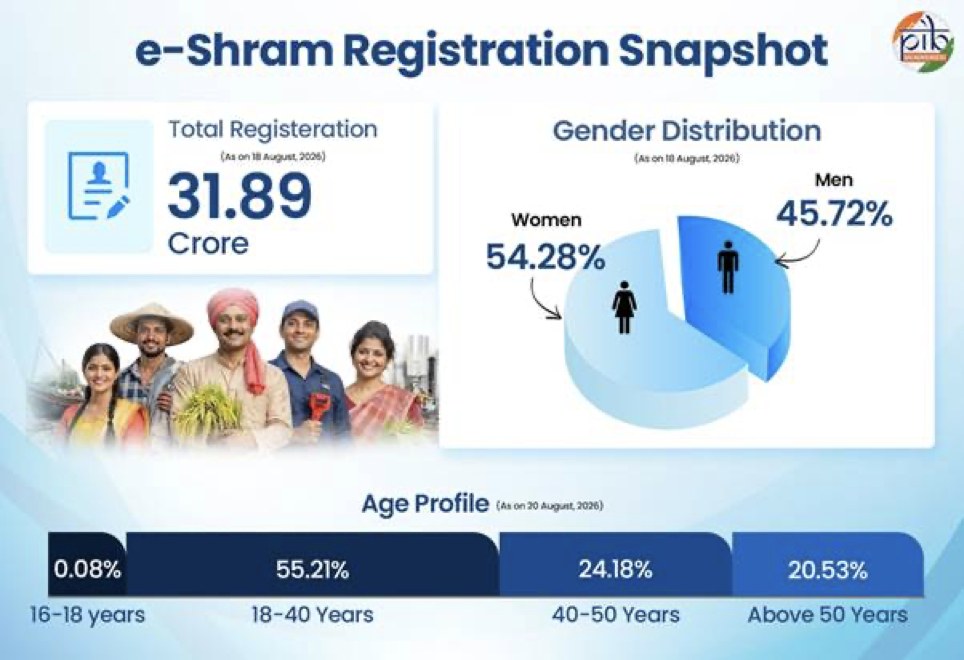
31.89 crore workers registered; women form the majority (54.28%); 18–40 age cohort is 55.21% of registrants. Image courtesy PIB / Ministry of Labour & Employment; reproduced for educational use.
Figure 2 — 5 Years of e-Shram: Evolution & Key Enhancements
Registry (2021) → Unified service platform (2024): 15 schemes, pension, employment and skilling access consolidated. Image courtesy PIB / Ministry of Labour & Employment; reproduced for educational use.
Lineage & Policy Context
- The Code on Social Security, 2020 provided the statutory basis for extending social security to unorganised, gig, and platform workers — e-Shram is the digital infrastructure for that mandate.
- Pre-cursor efforts: the Unorganised Workers' Social Security Act, 2008 created the legal obligation but lacked delivery architecture; e-Shram addresses that gap.
- The UAN issued by e-Shram is intended to serve as a portable welfare identity — analogous to the EPFO UAN for formal-sector workers.
- The One-Stop Solution (2024) aligns with the Union Budget 2024–25 vision of a single digital labour services platform.
Critical View
- Registration ≠ benefit delivery: 31.89 crore registrations are a registry count, not a measure of scheme uptake. Independent assessments have noted a significant gap between registration and actual welfare access.
- ESIC/EPFO exclusion: The eligibility bar (non-EPFO/ESIC member) correctly targets the uncovered, but informal workers who briefly entered formal employment may fall between systems.
- Gig worker coverage: At ~11.5 lakh platform-worker registrations against an estimated 7–8 crore gig economy participants, coverage remains thin — the Code on Social Security Rules for platform workers are yet to be fully notified.
- Data quality and updation: A one-time registration system without a robust update mechanism risks stale data, limiting its utility for crisis response (a stated objective).
- State convergence: The BOCW data-sharing provision for construction workers depends on State governments acting on the information — coordination remains uneven across States.
Institutions & Terms to Know (Prelims)
- NDUW — National Database of Unorganised Workers; the registry at the core of e-Shram.
- UAN (e-Shram) — 12-digit Aadhaar-linked portable identity for unorganised workers; different from EPFO's UAN.
- PM-SYM — Pradhan Mantri Shram Yogi Maan-Dhan; voluntary contributory pension for unorganised workers, targeting ₹3,000/month at 60.
- PMSBY / PMJJBY — Accident / life micro-insurance schemes accessible via e-Shram.
- BOCW Boards — Building and Other Construction Workers' Welfare Boards (State-level) — e-Shram shares construction worker data with these.
- Bhashini — Government's AI-driven language translation platform, enabling 22-language access on e-Shram.
- CSC — Common Service Centre; primary registration channel in rural areas.
- Code on Social Security, 2020 — Parent legislation mandating social security extension to unorganised, gig, and platform workers.
✎ Mains Practice Question
The e-Shram Portal completes five years as India's primary instrument for building a social security ecosystem for unorganised workers. Critically examine the design achievements and implementation gaps of the portal, and assess whether a registration-based database alone is sufficient to realise the objectives of the Code on Social Security, 2020. 15 marks · 250 words
Internal Security, Defence & GovernanceGeneral Studies Paper III
02
ICGS Ajit Handed Over to Indian Coast Guard: Indigenous Fast Patrol Vessel with 65%+ Domestic Content
GS-III · Internal Security — Coastal Security, Defence IndigenisationPrelims + MainsPIB · Ministry of Defence · Goa Shipyard Limited · 25 Aug 2026
Goa Shipyard Limited has formally handed over ICGS Ajit, a Fast Patrol Vessel built with over 65% indigenous content, to the Indian Coast Guard — a concrete data point in India's Atmanirbhar Bharat shipbuilding trajectory.
◈ Background & Context
India's coastline of 11,098.81 km (including island territories, as officially revised in 2025) and an Exclusive Economic Zone of 2.37 million sq km place heavy demands on the Indian Coast Guard's patrol and surveillance capacity.
Historically, a significant share of Coast Guard vessels were procured from foreign yards, creating supply-chain dependence and eroding domestic shipbuilding capability.
- The government's push for defence indigenisation — through the Defence Acquisition Procedure (DAP) 2020, Defence Production and Export Promotion Policy (DPEPP) 2020, and iDEX — has progressively raised local content requirements for defence platforms.
- Goa Shipyard Limited (GSL) is a Schedule A Defence Public Sector Undertaking under the Ministry of Defence, with a history of building patrol vessels, fast attack craft, and offshore patrol vessels for the Coast Guard and Navy.
▤ Platform at a Glance — ICGS Ajit (Yard 1277)
- Type: Fast Patrol Vessel (FPV)
- Builder: Goa Shipyard Limited (GSL), a Defence PSU
- Inducting service: Indian Coast Guard
- Length / Beam: 51.43 m × 8 m
- Displacement: 330 tonnes (at 2.5 m draught)
- Propulsion: Twin marine diesel engines with Controllable Pitch Propellers (CPP) — first in this FPV class
- Top speed: >27 knots
- Endurance: 1,500 nautical miles
- Crew: 6 officers + 35 sailors
- Indigenous content: >65%
- Key systems: Advanced Integrated Machinery Control System
Operational Roles
- Fisheries protection and EEZ surveillance
- Coastal patrolling and anti-smuggling operations
- Anti-piracy operations
- Search and Rescue (SAR) missions
Significance — Indigenisation & Blue Economy
- The Controllable Pitch Propeller (CPP) system — a first for this class — allows variable blade pitch without changing shaft speed, improving fuel efficiency and manoeuvrability. Its inclusion signals a rise in domestic manufacturing complexity.
- GSL's indigenisation record supports the government's target of India becoming a global shipbuilding hub — the Ministry of Ports, Shipping and Waterways has a goal of placing India among the top 10 shipbuilding nations by 2030.
- The 'Sagar Samvad' vision (National Shipping Board) includes a plan for 100 new ships to reduce India's estimated $75 billion annual foreign freight outgo — domestic shipyards like GSL are central to that strategy.
Institutions & Terms to Know (Prelims)
- GSL — Goa Shipyard Limited; Schedule A DPSU under MoD (upgraded from Schedule B in 2026); located in Vasco da Gama, Goa.
- Indian Coast Guard (ICG) — Armed force under MoD; responsible for maritime law enforcement, SAR, and pollution control within India's EEZ and territorial waters.
- EEZ — Exclusive Economic Zone; 200 nautical miles from the baseline; India has sovereign rights over resources within its 2.37 million sq km EEZ.
- FPV — Fast Patrol Vessel; smaller, faster patrol craft optimised for inshore and littoral operations, as distinct from Offshore Patrol Vessels (OPVs).
- CPP — Controllable Pitch Propeller; blades can be rotated about their axis to change pitch while underway, enabling efficient performance across speed ranges without reversing shaft rotation.
- DAP 2020 — Defence Acquisition Procedure 2020; mandates minimum indigenous content thresholds for defence procurements; highest preference for 'Make in India' categories.
✎ Mains Practice Question
India's coastal security architecture depends on the Indian Coast Guard's ability to operate effectively across a 7,516 km coastline and a vast Exclusive Economic Zone. Examine the role of Defence PSUs like Goa Shipyard Limited in advancing indigenous shipbuilding, and assess whether the current policy framework is adequate to make India a global shipbuilding hub. 15 marks · 250 words
03
53rd PRAGATI Meeting: PM Reviews ₹30,000 Crore Infrastructure Projects, AgriStack and Cyber Fraud Response
GS-II · Governance — E-Governance, Infrastructure ImplementationPrelims + MainsPIB · Prime Minister's Office · 25 Aug 2026
The 53rd PRAGATI meeting reviewed six infrastructure projects worth over ₹30,000 crore across nine states, while also surfacing two newer governance agendas — leveraging AgriStack for AI-driven agricultural decision-making, and coordinated response to cyber fraud including 'digital arrest' scams.
◈ Background & Context
PRAGATI (Pro-Active Governance and Timely Implementation) is an ICT-enabled multi-modal platform launched in March 2015. It is designed for direct, real-time review of infrastructure and social sector projects by the Prime Minister with senior central and state government officials.
- The platform integrates data from CPGRAMS (grievance redressal), the Project Monitoring Group (PMG), and Ministry/State programme data, enabling simultaneous review without physical travel.
- PRAGATI meetings are held roughly every two months; 52 earlier meetings had cumulatively reviewed projects worth several lakh crore rupees across all sectors.
- The 53rd meeting took place at Seva Teerth and covered the Railway, Road, and Power sectors.
▤ PRAGATI at a Glance
- Full form: Pro-Active Governance and Timely Implementation
- Launched: March 2015
- Purpose: PM-chaired ICT platform to resolve inter-agency bottlenecks and monitor implementation of key projects
- Architecture: Integrates CPGRAMS, PMG data, and programme dashboards
- 53rd Meeting reviewed: 6 infrastructure projects; Railway, Road and Power sectors; 9 states; cumulative investment >₹30,000 crore
- Other agenda items: AgriStack (Digital Agriculture Mission) and cyber fraud / digital arrest response
Key Directions Issued at the 53rd Meeting
- End-to-end project view: Projects must be monitored as integrated wholes — progress in individual packages should translate into commissioning the full project, not just completing sections in isolation.
- Common utility corridors: Ministries and states are to explore shared infrastructure corridors (telecom, power, water) within major transport project corridors at the planning stage itself.
- Speed with quality: Modern technologies and stronger quality assurance protocols at every stage of implementation; speed cannot compromise structural or service quality.
- AgriStack + AI: PM emphasised leveraging AI and digital technologies to extract greater value from the agricultural data ecosystem — from input planning to post-harvest processing — enabling evidence-based policy and better farmer targeting.
- Cyber fraud / digital arrest: Sustained awareness campaigns for senior citizens, youth and other vulnerable groups; capacity-building of enforcement personnel; coordinated inter-agency action against emerging fraud modes.
AgriStack — What Is It?
- AgriStack is India's Digital Public Infrastructure for agriculture, under the Digital Agriculture Mission (approved Cabinet 2024).
- It comprises three layers: Farmers' Registry (linked to Aadhaar and land records), Crop Sown Registry, and Digital Crop Survey.
- It is designed to enable targeted subsidy delivery, credit access, crop insurance claims, and eventually AI-powered agronomic advisory — the last mile use case PM emphasised at this meeting.
- Concerns have been raised by farmer groups and civil society about data privacy, potential misuse of land-holding data, and exclusion risks for un-linked farmers.
Digital Arrest Scam — Governance Lens
- 'Digital arrest' is a cyber fraud in which perpetrators impersonate law-enforcement or government officials online and coerce victims — often senior citizens — into paying money under threat of fictitious legal action.
- The government response framework includes the Indian Cyber Crime Coordination Centre (I4C) under MHA, the 'Sanchar Saathi' portal, and bulk disconnection of fraudulent SIM cards and accounts.
- PM's direction for inter-agency coordination and sustained public awareness reflects the scale of the problem — the National Cyber Crime Reporting Portal (NCRP) has seen rapid growth in reported cases.
Institutions & Terms to Know (Prelims)
- PRAGATI — PM-chaired ICT platform for real-time project monitoring; first meeting March 2015.
- CPGRAMS — Centralised Public Grievance Redress and Monitoring System; feeds into PRAGATI review.
- PMG — Project Monitoring Group; Cabinet Secretariat body tracking stalled large projects.
- AgriStack / Digital Agriculture Mission — DPI for agriculture; Farmers' Registry + Crop Sown Registry + Digital Crop Survey.
- I4C — Indian Cyber Crime Coordination Centre; MHA body for coordinating cyber crime response.
- NCRP — National Cyber Crime Reporting Portal (cybercrime.gov.in); citizen-facing grievance mechanism.
- Digital arrest — Cyber fraud variant; impersonation of law enforcement to extort payments; not a legally recognised form of arrest.
✎ Mains Practice Question
The PRAGATI platform represents a significant experiment in technology-mediated executive coordination for infrastructure delivery. Assess its design logic, outcomes, and limitations as a governance tool, and examine how the integration of AgriStack into such review mechanisms could transform agricultural policy implementation in India. 15 marks · 250 words