

In-Depth PIB Analysis2 Items
Core TopicImportantConcise
Economy, Agriculture & Food SecurityGS Paper III
01India's Sugar Industry — Sector, Ethanol & Price Hike
Environment, Ecology & International ConventionsGS Paper III
02India at UNCCD CoP17 — Rangelands & Pastoralist Rights
Economy, Agriculture & Food SecurityGeneral Studies Paper III
01
India's Sugar Industry: Sector Overview, Ethanol Role, and the Current Price Hike
GS-III · Economy — Agriculture, Food Security, EnergyPrelims + MainsPIB · Ministry of Food & Consumer Affairs · PIB Backgrounder · Release ID 2303478
India's sugar sector — the world's second-largest — is navigating a short-term price spike caused by crop disease, festive demand and global supply tightening, even as the structural story of sustained production growth, farmer welfare and ethanol integration remains broadly positive.
◈ Background & Context
Sugarcane is India's second-largest cash crop after cotton and an anchor of the rural economy across Uttar Pradesh, Maharashtra, and Karnataka.
The industry is tightly regulated: the government fixes the minimum farm-gate price (FRP), mandates buffer stocks, and controls exports and ethanol diversion to balance consumer, farmer, and industry interests simultaneously.
- Nearly 5 crore farmers grow sugarcane; about 5 lakh workers are employed in mills and allied industries.
- India is the world's second-largest sugarcane producer (after Brazil) and the largest consumer of sugar.
- Top producing states: Uttar Pradesh (largest) and Maharashtra (second), followed by Karnataka.
▤ Sector at a Glance
- Sugarcane production (2025-26): 500 MMT — up ~43.5% from 348.44 MMT in 2015-16 (Third Advance Estimate, MoAFW)
- Area under cultivation: 58.87 lakh hectares (up from 49.27 lakh ha in 2015-16)
- Annual sugar production: ~300–340 lakh MT (LMT); 2025-26 estimate revised to ~306 LMT (initial: 343 LMT)
- Annual domestic consumption: ~280–290 LMT
- Exports (2025-26): 8 lakh MT — compared to just 0.47 lakh MT in 2016-17
- FRP for 2026-27 season: ₹365/quintal (basic recovery rate 10.25%) — up ₹135 from ₹230/quintal in 2016-17
- Major export destinations: Sri Lanka, West Asia, East Africa
- Farmer dues paid (as of Aug 20, 2026): 97% of dues for 2025-26 season already cleared
Figure 1 — India's Sugarcane Production: 2015-16 vs 2025-26
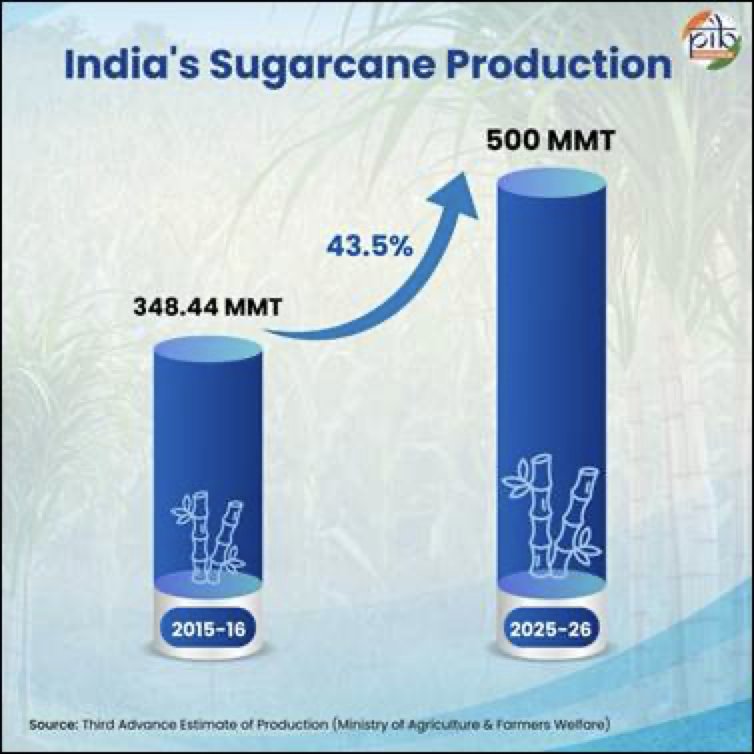
Production grew 43.5% in a decade, driven by area expansion and improved varieties. Image courtesy PIB/MoAFW; reproduced with credit for educational use.
The FRP Mechanism — How Farmers Are Protected
The Fair and Remunerative Price (FRP) is the statutory minimum price sugar mills must pay for sugarcane, fixed by the Cabinet Committee on Economic Affairs (CCEA) each year. It is based on the recommendations of the Commission for Agricultural Costs and Prices (CACP).
- FRP is linked to a basic recovery rate (sugar extracted per unit of cane crushed). If actual recovery exceeds the basic rate, farmers receive a premium; if below, mills absorb the loss.
- Some states additionally announce a State Advised Price (SAP) — always higher than FRP — e.g., UP's SAP for 2025-26 was ₹400/quintal vs FRP of ₹340/quintal.
- The gap between SAP and FRP has historically been a source of cane arrear disputes between mills and farmers in UP and Maharashtra.
The Ethanol Blending Programme — Sugar's Second Life
India's National Biofuel Policy targets 20% ethanol blending with petrol (E20) by 2025-26. Sugar mills can divert sugarcane juice, syrup or molasses to produce ethanol — monetising surplus cane and reducing dependency on crude oil imports.
- Sugar diverted for ethanol has declined from ~12% in 2022-23 to ~9% in 2025-26, as grain-based ethanol (maize) now accounts for nearly three-fourths of total ethanol output.
- Ethanol diversion helps mills pay farmers faster — ethanol sales generate payments within 15–20 days, vs over 12 months for sugar sales.
- The ethanol programme has structurally reduced the arrear problem: 97% of 2025-26 dues already paid to farmers as of August 20, 2026.
- Ethanol feedstock hierarchy: Sugarcane juice/syrup (highest sugar yield) → B-heavy molasses → C-heavy molasses (lowest yield). Government toggles permitted feedstocks based on domestic sugar stock positions.
Figure 2 — India's Sugar Exports: 2016-17 vs 2025-26
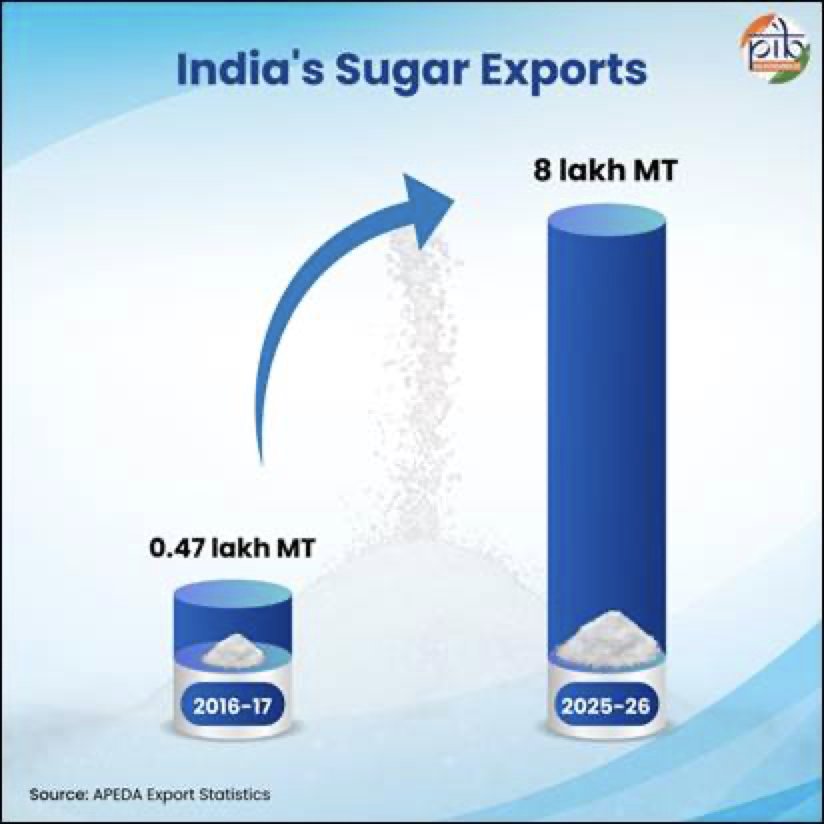
Export volumes grew more than 17-fold in a decade, reflecting surplus production and policy support. Image courtesy PIB/APEDA; reproduced with credit for educational use.
Why Sugar Prices Spiked — Short-Term vs Structural
Retail sugar prices rose from ₹48.18/kg (July 20, 2026) to ₹55.70/kg (August 20, 2026) — a 15.6% jump in one month — even as the annual trend had been just ~3% p.a. between August 2024 and July 2026. The government attributes the spike to a convergence of supply and demand factors:
- Crop damage: Red Rot fungal disease and Top Borer pest infestation; waterlogging from excess rainfall cut production to ~306 LMT vs an initial estimate of 343 LMT.
- Festive demand surge: Onam, Raksha Bandhan and the approaching festival season drove buying.
- Global deficit: The world sugar deficit for 2026-27 is estimated at ~33 lakh MT; international prices rose from $474/tonne (June 30) to $552/tonne (August 20) — over 16% in under two months.
- Speculation and hoarding: The government has noted that some mills and traders have contributed to artificial scarcity.
Government Response — Short-Term Interventions
- Stock limits: Sugar dealers capped at 400 tonnes (Aug 1 – Nov 30, 2026); bulk consumers barred from holding more than 15 days' consumption from September 1, 2026.
- Joint verification drives: Central + state teams conducting physical stock checks at mills to detect hoarding.
- Duty-free raw sugar import: 10 lakh MT permitted to augment domestic supply.
- Early crushing: Mills and states advised to start the new season from October 15 — expected to push October sugar output from the usual 3–4 LMT to over 10 LMT, improving festive-season availability.
Critical View — What the PIB Backgrounder Leaves Unsaid
- The SAP-FRP gap remains a structural flashpoint: UP mills with high SAP obligations but volatile prices face recurring arrear crises that the ethanol windfall has only partially resolved.
- Allowing duty-free sugar imports is a double-edged measure — it moderates prices for consumers but depresses international prices, potentially hurting India's export competitiveness the next season.
- The shift toward grain-based ethanol reduces pressure on sugar but raises food-versus-fuel concerns as maize diverted to ethanol could affect poultry and animal feed costs.
- The global supply tightening (Brazil drought, EU crop shortfalls) means India's import-dependent buffer strategy may face higher procurement costs than anticipated.
✎ Mains Practice Question
The Indian sugar sector is simultaneously a driver of rural livelihoods, a contributor to energy security through ethanol blending, and a source of recurring consumer price volatility. Critically examine the structural tensions in India's sugar policy and suggest a sustainable framework that balances farmer welfare, consumer interests, and energy transition goals. 15 marks · 250 words
Environment, Ecology & International ConventionsGeneral Studies Paper III
02
India at UNCCD CoP17: Community-Led Restoration of Rangelands and Pastoralist Rights
GS-III · Environment — Land Degradation, International ConventionsGS-II · IR — Multilateral DiplomacyPrelims + MainsPIB · Ministry of Environment, Forest & Climate Change · Release ID 2303391
At UNCCD CoP17 in Ulaanbaatar, India called for placing pastoralist communities at the centre of rangeland restoration — combining traditional knowledge with satellite science — and for accessible global finance to support developing countries on the path to Land Degradation Neutrality.
◈ Background & Context
The United Nations Convention to Combat Desertification (UNCCD) is one of the three Rio Conventions (alongside UNFCCC and CBD). It addresses land degradation, desertification and drought — problems that disproportionately affect dryland communities in developing countries. CoP17 is the convention's 17th Conference of Parties.
- CoP17 venue & dates: Ulaanbaatar, Mongolia, 17–28 August 2026; hosted by Mongolia, which is among the countries most severely affected by desertification (~77% of its land already degraded).
- CoP17 theme: "Restoring Land. Restoring Hope."
- Special context: 2026 is the UN International Year of Rangelands and Pastoralists (IYRP), declared by the UNGA and championed by Mongolia.
- India's Environment Minister Bhupender Yadav addressed the Ministerial Dialogue on "Restoration of Rangelands and the Well-being of Pastoralist Communities."
Figure 3 — Mongolia: Host of UNCCD CoP17 (Ulaanbaatar)
Mongolia hosts CoP17 — landlocked between Russia and China, its steppes and grasslands typify the rangeland degradation UNCCD seeks to address. Image courtesy BBC; reproduced with credit for educational use.
▤ Key Conventions & Terms at a Glance
- UNCCD: Established 1994; 197 Parties; secretariat in Bonn, Germany. Covers ~40% of Earth's land area (drylands).
- Land Degradation Neutrality (LDN): UNCCD's 2018–2030 Strategic Framework goal — no net loss of healthy land by 2030; achieved by combining avoidance, reduction, and restoration of degraded land.
- Rangelands: Cover over half of Earth's land surface; sustain ~500 million people's direct livelihoods; provide one-sixth of global nutrition. Distinct from forests — they are open ecosystems (grasslands, savannas, shrublands, steppes).
- Pastoralists: Communities whose livelihoods depend on mobile livestock rearing across rangelands; increasingly displaced by settlement, agricultural encroachment and climate change.
- Global finance announced at CoP17: A USD 1.3 billion package for global rangeland restoration was launched at CoP17 by multilateral stakeholders.
India's Position — Key Arguments Made
- Custodians, not beneficiaries: Minister Yadav called for pastoralists to be placed at the centre of restoration efforts — "Successful restoration begins with pastoralists as custodians, not merely beneficiaries."
- Traditional knowledge + modern science: India argued that combining traditional pastoral practices with satellite-based tools (Desertification and Land Degradation Atlases) makes restoration ecologically sound, economically viable and socially inclusive.
- Tenure security as a precondition: Recognising grazing rights and community forest resource rights under the Forest Rights Act is essential for communities to invest in restoration.
- South–South cooperation: India offered to share its experience and solutions with other developing countries through South–South frameworks.
- Finance demand: India called for "dedicated, accessible financing for rangeland restoration" as developing countries advance toward LDN targets.
India's Rangeland Landscape — Facts for Prelims
- India's rangelands span Himalayan pastures, Central Indian savannas, the arid Thar and Kachchh, and the southern sholas.
- ~10 million hectares of permanent pastures and grazing lands in India; deep-rooted grasses here contribute to soil carbon storage and groundwater recharge.
- Orans of Rajasthan: Sacred groves revered and protected by local communities; ~25,000 such community-protected groves cover ~0.6 million hectares nationally. They also protect Great Indian Bustard habitat, and many are now protected under statutory provisions.
- Cheetah reintroduction: India has reintroduced the cheetah and proposes expanding its range into grasslands like Banni grassland in Gujarat — a rangeland restoration measure with co-benefits for biodiversity.
- Satellite tools used: ISRO's Desertification and Land Degradation Atlas of India maps degraded land at district level, used as a planning basis for restoration.
Critical View — Gaps and Tensions
- India's stated commitment to community rights for pastoralists sits in tension with domestic practices: encroachment on common lands and diversion of grazing lands for other uses continues in many states, undermining pastoral livelihoods on the ground.
- The Forest Rights Act (FRA) recognises community forest resource rights in theory; implementation has been inconsistent, and forest department resistance to grazing rights remains a documented concern.
- The USD 1.3 billion global package announced at CoP17 is less than 0.1% of what experts estimate is needed for meaningful global rangeland restoration — the financing gap remains structural.
- Cheetah reintroduction is a high-profile initiative, but critics question whether it addresses the broader grassland governance deficit or mainly serves conservation optics.
✎ Mains Practice Question
Rangelands are among the world's most neglected ecosystems despite supporting the livelihoods of hundreds of millions of pastoralists and providing critical ecosystem services. Analyse India's approach to rangeland conservation and the role of community rights frameworks in making such conservation durable. 15 marks · 250 words