
In-Depth PIB Analysis2 Items
Core TopicImportantConcise
Environment & EcologyGS Paper III
01Project Cheetah — nine cubs at Kuno; population reaches 62
Polity & GovernanceGS Paper II
02MoSPI State Dashboard on eSankhyiki — subnational statistics
Environment & EcologyGeneral Studies Paper III
01
Project Cheetah: Two New Litters at Kuno Take India’s Cheetah Population to 62
GS-III · Environment — Conservation, Species ReintroductionPrelims + MainsPIB · Ministry of Environment, Forest & Climate Change · 26 Nov 2026
Two litters born at Kuno National Park in October and November 2026 added nine cubs, taking India’s cheetah count to 62. Of these, 43 were born in India. Two of the National Action Plan’s success milestones were reached: breeding by the India-born (F1) generation and birth in the wild.
◈ From the Basics — The Cheetah and Its Disappearance from India
- The animal: the cheetah (Acinonyx jubatus) is the fastest land mammal. It is a daytime, open-country hunter that relies on speed rather than strength, so it loses kills to leopards, tigers and hyenas.
- Two lineages: the Asiatic cheetah (A. j. venaticus) once ranged across India and now survives only in Iran, in very small numbers. Project Cheetah uses African cheetahs (A. j. jubatus), since Iran did not supply animals.
- Extinction in India: hunting, the capture of cheetahs for coursing (hunting with trained cheetahs), and loss of grasslands and prey wiped it out. India declared the cheetah extinct in 1952, the only large mammal lost from independent India.
- Conservation status: IUCN — Vulnerable (the Asiatic subspecies is Critically Endangered); CITES Appendix I; Schedule I of the Wild Life (Protection) Act, 1972, as amended in 2022.
Figure 1 — PIB graphic marking the nine cubs born at Kuno, October–November 2026
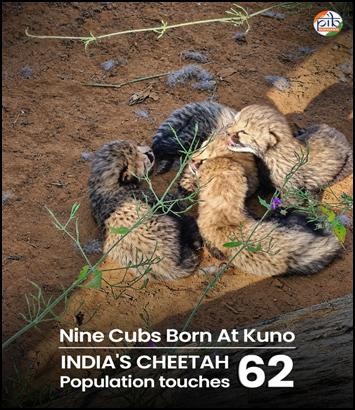
These are the litters of KJP21 (five cubs, 5 Oct) and KOMG 3 (four cubs, 20 Nov). Image courtesy Press Information Bureau, Government of India; reproduced with credit for educational use.
What happened — the two litters
- 5 October 2026 — KJP21: a 32-month-old India-born female had five cubs, sired by a male from Botswana. She is the third India-born female to breed, after Mukhi and KGP12. The litter brings the Botswana bloodline into the India-born population.
- 20 November 2026 — KOMG 3: a 30-month-old female from Botswana had four cubs. She is the first Botswana female to give birth in India, after more than four months free-ranging.
- Born in the wild: KOMG 3’s litter is only the second recorded birth in the wild, i.e. outside the fenced Closed Natural Areas (CNAs), since the project began in 2022.
- Count: the population now stands at 62, of which 43 (about 70%) are India-born. The Government notes that very young cubs make up part of this number and that their survival is not yet assured.
▤ Scheme at a Glance — Project Cheetah
- Launched: 17 September 2022, with the release of eight Namibian cheetahs into quarantine enclosures at Kuno.
- Nodal Ministry / implementing agency: MoEFCC through the National Tiger Conservation Authority (NTCA), a statutory body under the WPA, 1972 (Sec. 38L). It works with the Wildlife Institute of India (WII), Dehradun and the Madhya Pradesh Forest Department.
- Framework: the Action Plan for Introduction of Cheetah in India (January 2022), prepared by WII, NTCA and the MP Forest Department. It follows the IUCN Guidelines on Reintroductions and Other Conservation Translocations (2013).
- Founder stock: 8 from Namibia (Sept 2022), 12 from South Africa (Feb 2023) and 9 from Botswana (28 Feb 2026; six females, three males), a total of 29. This was the first intercontinental translocation of a large wild carnivore.
- Sites (all in Madhya Pradesh): Kuno NP (Sheopur); Gandhi Sagar WLS (first males moved in April 2025); and Veerangana Durgavati Tiger Reserve (Sagar), where cheetahs were released in October 2026.
- Stated target: a self-sustaining metapopulation of 60–70 cheetahs by 2032 across about 17,000 sq km of the Kuno–Gandhi Sagar landscape (government objective).
- Community component: over 450 “Cheetah Mitras” in 80 villages, about 380 direct jobs, a 5% share of eco-tourism revenue for nearby villages, and eco-development works in 100+ villages (as reported by the Government).
Figure 2 — Lineage of Project Cheetah: from extinction to an India-born generation
1952DeclaredextinctJan 2020SC allowsAfrican cheetahon trial basisJan 2022Action PlanSep 20228 fromNamibiaFeb 202312 from S. AfricaApr 20252nd site:Gandhi SagarNov 20251st F1 litter (Mukhi)Feb 20269 fromBotswanaOct 20263rd site: VDTRNov 202662 cheetahs(43 India-born)Blue = founder imports · Green = range expansion / local breeding · Gold = legal & planning stepsVDTR = Veerangana Durgavati Tiger Reserve (Sagar, MP)
The project has moved from importing founders to breeding at home. The next test is cub survival, followed by breeding in the second (F2) generation.
Figure 3 — Where the population comes from (numbers from the PIB release)
FOUNDERS IMPORTED (29)Namibia (2022)8South Africa (2023)12Botswana (2026)9POPULATION, NOVEMBER 2026 (62)India-born: 43 (~70%)Imported: 19Total 62
Scale: 7 px per animal. The 19 is derived (62 − 43). Since 29 founders were brought in, about 10 imported animals are no longer alive or no longer counted.
Why these births matter — the Action Plan’s milestones
The Action Plan measures success in stages, not by headcount alone. Its short-term criteria included ~50% survival of the introduced cheetahs in the first year, home ranges established in Kuno, births in the wild, and cubs surviving beyond one year.
Over the longer run, a self-sustaining population must breed generation after generation.
- F1 breeding: India-born females breeding (Mukhi in Nov 2025, then KGP12 and KJP21) shows the animals can complete a full life cycle locally.
- Wild births: a birth outside the enclosures shows mothers can hide, feed and defend cubs among leopards and other predators.
- Genetic depth: drawing founders from three countries widens a narrow founder gene pool, lowering the risk of inbreeding depression (weaker fertility and disease resistance).
- Global role: Africa’s cheetah populations are fragmented, largely confined to fenced reserves. India offers additional range within a global metapopulation (connected sub-populations managed together).
How the science works — terms to know
- Soft release: animals spend time in quarantine bomas and then Closed Natural Areas (CNAs) before being let into the open landscape, so they adjust to terrain, prey and climate. A hard release means freeing animals directly.
- Monitoring: satellite/radio collars, camera traps and daily tracking. Prey is counted by distance sampling along fixed line transects.
- Flagship and umbrella species: protecting the cheetah means restoring grasslands, open forests and semi-arid scrub, which shelters many other species.
- Prey base: chital (about three-quarters of recorded kills), sambar, nilgai, chinkara, blackbuck and the chousingha (four-horned antelope), which is found only in India and Nepal.
◈ Static Anchors — The Sites
- Kuno National Park (Sheopur, MP): set up as a wildlife sanctuary in 1981 and upgraded to a National Park in 2018. It lies on the northern Vindhyan range and is drained by the Kuno river, a tributary of the Chambal.
- Kuno’s backstory: it was prepared as a second home for the Asiatic lion from Gir. In 2013 the Supreme Court ordered the lions’ translocation and halted the cheetah plan. In January 2020 the Court allowed African cheetahs on an experimental basis. The lion translocation has still not happened.
- Village relocation: moving 24 villages (1,545 families) earlier freed about 6,258 ha of habitat, which raises resettlement and livelihood questions.
- Gandhi Sagar WLS: in Mandsaur–Neemuch, around the Gandhi Sagar dam on the Chambal.
- Veerangana Durgavati TR: spans Sagar, Damoh and Narsinghpur and includes the old Nauradehi WLS, one of the original candidate sites for cheetahs.
The critical view — what the release does not say
- Mortality: deaths of founders and cubs have continued. Causes have included infections under radio-collars when cheetahs grew winter coats during the Indian monsoon (2023), heat stress, fights, predation, road accidents and, in October 2026, firearm pellet injuries found on a cheetah outside the park, which led to a probe.
- Transparency: activists have criticised the non-disclosure of post-mortem reports. Independent scientific review would strengthen public confidence.
- Carrying capacity and prey: experts have questioned whether Kuno has enough area and prey density for a growing population. That makes dispersal and prey augmentation essential rather than optional.
- Managed vs. wild: many animals, including young cubs, are still in enclosures. A population that depends on fencing, supplementary prey and veterinary care is not yet truly wild and self-sustaining.
- Conflict as range grows: as cheetahs move into farmland and village grazing land, livestock losses and conflict rise. Community benefit-sharing has to keep pace.
- Opportunity cost: critics argue the same money and attention could go to native grassland species such as the Great Indian Bustard and the Indian wolf, or to the pending lion translocation. Supporters reply that the cheetah is the umbrella that brings grasslands into focus.
✎ Mains Practice Question
“A reintroduction succeeds not when animals arrive but when they reproduce on their own.” In light of Project Cheetah, evaluate the ecological, scientific and social challenges of reintroducing large carnivores in India. 15 marks · 250 words
Polity & GovernanceGeneral Studies Paper II
02
MoSPI Launches a State Dashboard on eSankhyiki to Widen Access to State-Level Statistics
GS-II · Governance — e-Governance, Transparency, FederalismGS-III · Economy — Data for PlanningPrelims + MainsPIB · Ministry of Statistics & Programme Implementation · 26 Nov 2026
The Ministry of Statistics and Programme Implementation (MoSPI) has added a State Dashboard to its eSankhyiki portal. It brings 283 State-level indicators into theme-wise profiles. This is a dissemination step under the new VISTAR scheme’s focus on subnational statistics.
◈ From the Basics — India’s Official Statistical System
- Constitutional basis: Census is a Union subject (Entry 69, List I). Statistics on Union matters fall under Entry 94, List I. Statistics on State and Concurrent matters fall under Entry 45, List III. So statistics is a shared Centre–State responsibility.
- MoSPI: created in 1999. In 2019 the Central Statistics Office (CSO) and the National Sample Survey Office (NSSO) were merged into the National Statistical Office (NSO).
- National Statistical Commission (NSC): set up in 2005 by government resolution on the Rangarajan Commission’s (2001) recommendation. It is non-statutory.
- Collection of Statistics Act, 2008: the legal basis for surveys and for keeping individual information confidential.
- States: each State has a Directorate of Economics & Statistics (DES), which compiles GSDP and district data. Their capacity varies widely.
- National Statistics Day: 29 June, the birth anniversary of P.C. Mahalanobis, founder of the Indian Statistical Institute.
▤ At a Glance — eSankhyiki & the State Dashboard
- eSankhyiki: MoSPI’s one-stop portal for official statistics, launched in 2024. It offers search, interactive charts, metadata, machine-readable downloads and APIs.
- Scale now: 43 statistical products, 1,109 datasets and over 139 million records.
- State Dashboard: 283 indicators drawn from 21 statistical products across 10 themes, including agriculture, education, work and wages, and gender and inclusion.
- Features: view by State × theme or compare a theme across States; filters and charts; downloadable data, metadata and visuals.
- Partner: developed with the Institute for Competitiveness. More indicators will be added over time (stated plan).
Lineage — the VISTAR scheme
- VISTAR (Viksit Bharat Initiative for Statistical Transformation, Analytics & Research): a Central Sector Scheme approved by the Union Cabinet on 4 November 2026. It has an outlay of ₹4,371.10 crore for FY 2026-27 to 2030-31.
- Three components: Comprehensive Statistical Operations & Strengthening of Ecosystem; Support for Statistical Strengthening (SSS), which builds State/UT capacity for district-level statistics; and the Economic Census, with the 8th Economic Census due.
- Stated aims: a real-time, interoperable, “AI-ready” statistical system with more surveys, (government objective).
- Related platforms: MoSPI’s GoIStats app, and NITI Aayog’s National Data & Analytics Platform (NDAP, 2022). NDAP is a separate cross-ministry data platform and a common Prelims confusion.
Why it matters
- Federal planning: health, agriculture, education and policing are mostly State subjects. Comparable State data supports evidence-based State budgets and Finance Commission work.
- From availability to use: official numbers often sit in scattered reports and PDFs. Theme-wise profiles with metadata make them usable for legislators, researchers, journalists and students.
- Open data: it is in line with the National Data Sharing and Accessibility Policy (NDSAP), 2012 and with open-government practice.
The critical view
- A display is only as good as its data: the dashboard repackages existing indicators. It does not fix outdated survey frames, such as reliance on Census 2011, or sample sizes too small for reliable district estimates.
- Timeliness and credibility: past debates over delayed or withheld releases (e.g., the 2017-18 consumer expenditure survey) and over GDP methodology show that institutional independence matters as much as technology.
- State capacity gap: many State DESs are short of staff and skills. The SSS component has to close this gap, or district data will stay patchy.
- Privacy and governance: wider APIs and “AI-ready” datasets need strong anonymisation under the Digital Personal Data Protection Act, 2023 regime.
✎ Mains Practice Question
Timely, granular and accessible subnational statistics are essential for cooperative federalism and evidence-based policy. Discuss the challenges facing India’s official statistical system and the extent to which digital dissemination platforms can address them. 10 marks · 150 words