
In-Depth PIB Analysis2 Items
Core TopicImportantConcise
Economy, Finance & WelfareGS Paper III
01PM Jan Dhan Yojana — 12 Years
Defence, Internal Security & IndigenisationGS Paper III
02INS Samarthak — First Indigenous Multi-Purpose Vessel
₹Economy, Finance & WelfareGeneral Studies Paper III
01
PM Jan Dhan Yojana Completes 12 Years: From Household Banking to the JAM Trinity
GS-III · Economy — Financial Inclusion, BankingPrelims + MainsPIB · Ministry of Finance · 27 Aug 2026
Launched on 28 August 2014, the Pradhan Mantri Jan Dhan Yojana has grown into the world's largest financial inclusion programme — 59.09 crore accounts, ₹3.17 lakh crore in deposits, and the foundational pillar of India's direct-benefit delivery architecture.
◈ Background & Context
Before PM-JDY, India's financial exclusion was stark: hundreds of millions of adults — concentrated in rural areas, among women, and within lower-income households — had no bank account and therefore no access to formal credit, insurance or government transfers.
The 2011 Socio-Economic Caste Census estimated that only 59% of rural households had a bank account.
PM-JDY was conceived as a mission-mode intervention to break this cycle — not by building more bank branches alone, but by deploying Business Correspondents (Bank Mitras), integrating Aadhaar for KYC, and enabling mobile-linked accounts to reach the last mile.
- Original mandate (2014): one basic savings account per household.
- Revised mandate (2018): one account for every unbanked adult — widening the individual coverage norm.
- Nodal body: Department of Financial Services, Ministry of Finance.
- Implementing agencies: Scheduled Commercial Banks, Regional Rural Banks, Co-operative Banks, and Business Correspondents.
▤ Scheme at a Glance
- Launch date: 28 August 2014 (12th anniversary: 28 August 2026)
- Nodal Ministry: Ministry of Finance (Department of Financial Services)
- Approving authority: Union Cabinet
- Coverage: All Indian nationals — no upper age limit; no minimum balance requirement
- Accounts (as on 19 Aug 2026): 59.09 crore — up from 14.72 crore in March 2015 (4× growth)
- Deposits: ₹3,16,514 crore (~20× growth from ₹15,670 crore in March 2015)
- Female beneficiaries: 32.92 crore (≈55.7% of total accounts)
- Rural/semi-urban accounts: 45.95 crore (≈77.8% of total)
- Average deposit per account: ₹5,356 (3.4× rise over 12 years)
- RuPay debit cards issued: 41.29 crore
- Benefit structure: Zero-balance account · RuPay card · Accident insurance (₹2 lakh) · Overdraft (up to ₹10,000) · DBT eligibility · Access to PM-JJBY, PM-SBY, APY and MUDRA
- Overdraft eligibility: After 6 months of satisfactory operation; one account per household
Figure 1 — Benefits Architecture of PM Jan Dhan Yojana
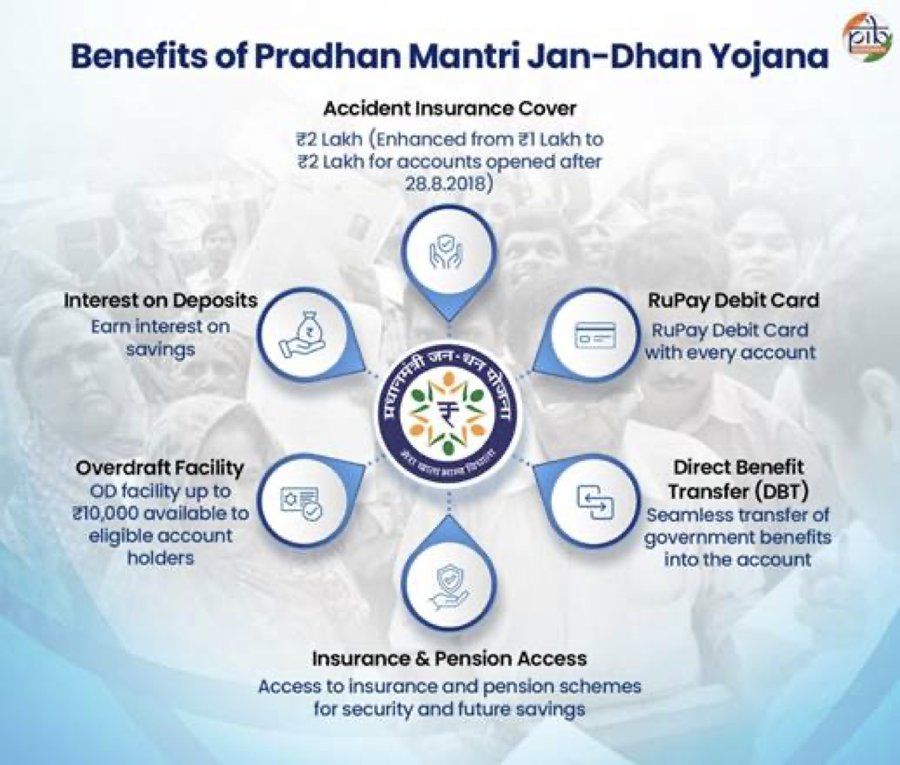
The six benefit pillars that transform a zero-balance savings account into a composite financial security instrument. Image: Press Information Bureau, Government of India; reproduced for educational use.
Figure 2 — Growth in PMJDY Accounts, 2015–2026 (in crore)
Account base grew ~4× over 12 years; steepest jump (2015–18) reflects the saturation drive; growth moderating as near-universal coverage is approached. Image: Ministry of Finance / PIB; reproduced for educational use.
Lineage — From Basic Banking to the JAM Architecture
- Predecessor: No Frills Accounts (2005, RBI) — functionally similar zero-balance accounts but never achieved scale; coverage remained thin and accounts were largely dormant.
- 2014 shift: PM-JDY added mission-mode targets, DBTL linkage, and RuPay cards — turning a passive bank product into an active welfare conduit.
- JAM Trinity: Jan Dhan (bank account) + Aadhaar (identity) + Mobile (connectivity) = a real-time, paperless, diversion-proof transfer pipeline. PMJDY is the J in JAM.
- DBT integration: PM-JDY accounts have been the channel for pandemic-era PM-GKAY food security transfers, PM-Kisan instalments, LPG subsidies, MGNREGA wages, and student scholarships — eliminating the "leakage via middlemen" that the Rajiv Gandhi critique (1985) had identified.
- 2018 expansion: Scope widened from household to individual coverage; overdraft limit raised; accident insurance enhanced from ₹1 lakh to ₹2 lakh for new accounts.
Why It Matters — The Problem Being Solved
- Financial exclusion is a poverty trap: without a formal account, households cannot save safely, cannot access credit, and cannot receive government transfers without an intermediary's cut.
- Women are disproportionately excluded — PM-JDY's 56% female account share represents a structural shift in women's financial autonomy.
- Rural dormancy was the core failure of pre-2014 schemes; PM-JDY addressed this by embedding accounts into the DBT ecosystem, giving account holders an immediate reason to transact.
- The scheme is now the entry point for the entire Jan Suraksha insurance ladder (PM-JJBY at ₹2 lakh life cover; PM-SBY at ₹2 lakh accident cover) and Atal Pension Yojana.
Critical View — Implementation Risks & Ongoing Gaps
- Dormancy: A persistent concern — RBI data have historically shown a significant share of Jan Dhan accounts with zero or near-zero balances. The government argues rising average deposits (₹5,356) reflect improving activation, but independent granular data remain limited.
- Over-counting risk: Multiple accounts per individual (migrant workers, rural-to-urban shift) can inflate headline numbers. The 2018 pivot to individual coverage complicates deduplication.
- Last-mile credit gap: The overdraft facility (₹10,000) is theoretically available but take-up has been modest — banks are reluctant to extend unsecured credit to thin-file borrowers, limiting PMJDY's role as a credit access tool.
- Business Correspondent viability: BC networks are economically fragile — many BCs earn below minimum wage on commission structures; high attrition undermines rural service continuity.
- Gender caveats: Account ownership ≠ account control; evidence from SHG literature suggests male household members frequently control Jan Dhan accounts nominally held by women.
Key Terms & Institutions (Prelims Hooks)
- RuPay: India's domestic card payment network operated by NPCI; interoperable with ATMs and most PoS terminals; insulates India from Visa/Mastercard fee exposure.
- NPCI: National Payments Corporation of India — the statutory body (under Payment and Settlement Systems Act, 2007) that operates UPI, RuPay, IMPS and NACH.
- Business Correspondent (Bank Mitra): An agent of a bank authorised to carry out limited banking services at sub-branch level — account opening, deposits, withdrawals, DBT disbursals.
- DBT (Direct Benefit Transfer): Framework since 2013 routing subsidies and entitlements straight to Aadhaar-seeded bank accounts, cutting the classic "last-mile leakage".
- PM-JJBY: Pradhan Mantri Jeevan Jyoti Bima Yojana — ₹2 lakh life insurance at ₹436/year premium, linked to Jan Dhan accounts.
- PM-SBY: Pradhan Mantri Suraksha Bima Yojana — ₹2 lakh accidental death/disability cover at ₹20/year.
- APY: Atal Pension Yojana — defined-benefit pension for unorganised sector workers, entry via Jan Dhan accounts.
- MUDRA: Micro Units Development & Refinance Agency — PMJDY account holders with visible savings pattern are eligible for collateral-free MUDRA Shishu loans (up to ₹50,000).
✎ Mains Practice Question
The Pradhan Mantri Jan Dhan Yojana is often described as the foundational pillar of India's Direct Benefit Transfer architecture. Critically examine the scheme's achievements in expanding financial inclusion and identify the structural gaps that still limit its potential as a poverty-reduction instrument. 15 marks · 250 words
Defence, Internal Security & IndigenisationGeneral Studies Paper III
02
Samarthak: Indian Navy's First Indigenous Multi-Purpose Vessel Delivered by L&T
GS-III · Defence — Indigenisation, Maritime SecurityPrelims + MainsPIB · Ministry of Defence · 27 Aug 2026
On 28 August 2026, the Indian Navy took delivery of Samarthak — the country's first indigenously built Multi-Purpose Vessel (MPV) — from Larsen & Toubro's Kattupalli shipyard, marking a significant step in naval self-reliance under the Aatmanirbhar Bharat framework.
◈ Background & Context
The Indian Navy has historically relied on imported or semi-indigenously built specialist vessels for multi-role tasks such as trial support, surveillance, and disaster relief.
The MPV category — vessels engineered to switch seamlessly between divergent missions without structural modification — was identified as a gap in the Navy's force structure.
Larsen & Toubro's Kattupalli shipyard (near Chennai, Tamil Nadu) was selected as the builder, reflecting the government's push to develop domestic private-sector shipbuilding capacity alongside the public-sector shipyards (Mazagon Dock, Cochin Shipyard, Garden Reach).
- Indigenous content: >75% — a key Aatmanirbhar Bharat benchmark for defence procurement.
- Name meaning: Samarthak = "The Proponent" or "The Enabler" — reflecting the vessel's role as a mission-support platform.
- Builder: Larsen & Toubro Ltd., Kattupalli Shipyard, Tamil Nadu.
- Delivery date: 28 August 2026.
▤ Platform at a Glance
- Vessel type: Multi-Purpose Vessel (MPV) — trial, evaluation and support platform
- Indigenous content: Over 75%
- Builder: L&T, Kattupalli Shipyard (private sector)
- Nodal Ministry: Ministry of Defence
- Primary roles: Maritime trial & evaluation platform; maritime surveillance and reconnaissance; offshore patrolling; HADR (Humanitarian Assistance & Disaster Relief) support
- Policy context: Aatmanirbhar Bharat in defence; Defence Acquisition Procedure (DAP) 2020 — Buy Indian (IDDM) category
Figure 3 — India's Indigenous Shipbuilding Ecosystem: Key Institutions & Policy Layers
India's Naval Indigenisation ArchitectureMinistry of Defence · Defence Acquisition Procedure (DAP) 2020Buy Indian (IDDM) · Buy & Make Indian · Buy Global-Make IndianPublic Sector ShipyardsMazagon Dock Shipbuilders (MDL)Cochin Shipyard Limited (CSL)Garden Reach Shipbuilders & Engineers (GRSE)Goa Shipyard Limited (GSL)Private Sector ShipyardsL&T Kattupalli (Tamil Nadu) ★ SamarthakPipavav Defence (Gujarat)Reliance Naval & EngineeringABG ShipyardTarget: 75%+ indigenous content across new warship programmes · Aatmanirbhar Bharat
India's naval shipbuilding spans both public and private sectors; Samarthak is among the first major platforms to be delivered by a private yard with >75% indigenous content.
Lineage — Indigenisation Journey of the Indian Navy
- 1960s–1980s: Near-total import dependence — frigates, submarines and corvettes sourced from the USSR and UK.
- INS Nilgiri (1972): India's first indigenously designed warship (Leander-class frigate), built at Mazagon Dock — a symbolic but limited start.
- Project 15 (Delhi class, 1997) and Project 17 (Shivalik class, 2010): Progressively higher indigenous content in destroyers and frigates.
- INS Vikrant (2022): First indigenous aircraft carrier; >76% indigenous content — a benchmark for the Samarthak era.
- Defence Indigenisation Lists (2020–2024): MoD progressively banned imports of 300+ items, creating a mandatory domestic supply chain for the private sector.
- Samarthak (2026): Marks entry of the MPV category into the indigenous portfolio; also notable as a private-yard delivery, not a public-sector one.
Why It Matters — Strategic & Economic Significance
- India is one of the world's top five defence importers; reducing import dependence directly addresses a strategic vulnerability (supply disruption in conflict).
- HADR capability in the vessel directly supports India's role as the "Net Security Provider" in the Indian Ocean Region — a stated doctrine since 2015.
- The trial-and-evaluation role supports development of new indigenously designed weapons and sensors — a force-multiplier for future programmes.
- Building at a private yard (L&T Kattupalli) validates the DAP 2020 framework's bet on the private sector and creates competitive pressure on public-sector shipyards.
Critical View
- 70%+ indigenous ≠ 70% Indian design: Indigenous content calculations often include sub-assemblies sourced domestically but designed abroad under technology transfer. The design-IPR gap remains significant.
- L&T's defence shipbuilding viability: Private shipyards need a steady order pipeline to stay viable; a single MPV does not constitute a sustainable business. Without follow-on orders, skilled workforce and infrastructure investments are stranded.
- HADR vs. military readiness tension: Multi-purpose vessels can do many things adequately but excel at none; purists in naval strategy argue that purpose-built platforms perform better in contested environments.
- Kattupalli's capacity: The yard has faced labour and logistical challenges previously; sustained output will require sustained investment.
Key Terms (Prelims Hooks)
- MPV (Multi-Purpose Vessel): A naval platform designed without fixed specialisation — can perform surveillance, trial support, HADR, and patrol in rotation.
- HADR: Humanitarian Assistance and Disaster Relief — a formal naval mission category, particularly relevant for India's island territories (Andaman & Nicobar, Lakshadweep) and IOR neighbours.
- DAP 2020: Defence Acquisition Procedure 2020 — the framework governing defence procurement; introduces "Buy Indian (IDDM)" as the most preferred category, requiring a minimum percentage of indigenous design and manufacture.
- IDDM: Indigenously Designed, Developed and Manufactured — the highest indigenisation category in DAP 2020; 50% indigenous content minimum.
- Kattupalli Shipyard: Located near Chennai, Tamil Nadu; operated by L&T Shipbuilding; one of India's largest private-sector integrated ship-repair and shipbuilding facilities.
- Aatmanirbhar Bharat in Defence: Policy thrust from 2020 — four positive indigenisation lists, negative import lists, and FDI liberalisation to 74% automatic route in defence manufacturing.
✎ Mains Practice Question
India's defence indigenisation programme has achieved symbolic milestones but faces structural challenges in transitioning from import substitution to genuine technological self-reliance. Examine this statement in the context of recent naval shipbuilding achievements. 10 marks · 150 words