
In-Depth PIB Analysis2 Items
Core TopicImportantConcise
Polity, Governance & Social JusticeGS Paper II
01Khelo India — Scheme, Games Ecosystem & India at Commonwealth Games 2026
Health, Society & Human DevelopmentGS Paper II
02National Viral Hepatitis Control Programme — Progress & Public Health Architecture
Polity, Governance & Social JusticeGeneral Studies Paper II
01
The Making of a Sporting Nation: Khelo India, TOPS and India's Global Rise
GS-II · Governance — Welfare Schemes & Social PolicyGS-III · Economy — Human Capital & Sports InfrastructurePrelims + MainsPIB · Ministry of Youth Affairs & Sports
India's sustained push to become a top-10 sporting nation by 2036 — anchored in the Khelo India Scheme, the Target Olympic Podium Scheme and a record Ministry budget — has delivered measurable gains from grassroots talent pipelines through to Olympic and Paralympic podiums.
◈ Background & Context
India's sporting history at the international level was long characterised by isolated individual brilliance rather than systemic depth. At the 1996 Atlanta Olympics, Leander Paes's bronze was the country's first Olympic medal in 44 years.
The structural shift began only after the 2010 Commonwealth Games, when infrastructure deficiencies were starkly exposed alongside the Games themselves.
- India's first Olympic medal tally of more than two came only at Tokyo 2020 (7 medals), powered partly by athletes supported through schemes launched post-2014.
- The Ministry of Youth Affairs and Sports has its roots in the Department of Sports under the Ministry of Education, made independent only in 1982 (Asian Games year).
- The National Sports Policy 2001 had identified talent identification, infrastructure and funding as the three structural gaps — Khelo India directly addresses all three.
- India's demographic dividend — 65% of population below 35 — makes this the most consequential window for sporting investment in the country's history.
▤ Scheme at a Glance — Khelo India
- Launched: 2017 (Union Budget announcement); operational 2018
- Nodal Ministry / Department: Ministry of Youth Affairs and Sports
- Approving authority: Union Cabinet
- Outlay (infrastructure): ₹3,176 crore approved across 349 projects (as of July 2026)
- Ministry Budget 2026–27: ₹4,479.88 crore — up from ₹1,219 crore in 2013–14
- Coverage: Athletes across all States and Union Territories, from grassroots to elite level
- Benefit structure: Khelo India Athletes (KIAs) receive coaching, equipment, medical care and a monthly out-of-pocket allowance; TOPS Core Athletes receive ₹50,000/month stipend + foreign training support; TOPS Development Athletes receive ₹25,000/month
- Stated targets (government projection): Top-10 sporting nation by 2036; Top-5 by 2047
Lineage — What Khelo India Replaced and What Changed
- Predecessor schemes merged: Khelo India absorbed three pre-existing programmes — the Rajiv Gandhi Khel Abhiyan (infrastructure), the Urban Sports Infrastructure Scheme (urban facilities) and the National Sports Talent Search Scheme (talent ID).
- Key structural change: Instead of three separate administrative silos with separate budgets and nodal departments, Khelo India created a unified ecosystem covering infrastructure → identification → training → competition → elite pathway, under one scheme umbrella.
- TOPS lineage: The Target Olympic Podium Scheme (TOPS) was launched in September 2014 and revamped in April 2018 with a dedicated technical support team for holistic athlete assistance. It runs parallel to Khelo India as the elite-end intervention.
- KIRTI (new addition): The Khelo India Rising Talent Identification initiative adds AI-backed talent assessment (9–18 years) via 174 Talent Assessment Centres, with 1,87,921 assessments completed.
The Khelo India Games Ecosystem — Chronological Expansion
- 2018: Khelo India School Games launched in New Delhi — the first national platform for school-age athletes.
- 2019: Renamed Khelo India Youth Games (KIYG) after the Indian Olympic Association joined; became the flagship competition under the umbrella.
- 2020: Khelo India University Games (KIUG) and Khelo India Winter Games (KIWG) added — expanding to university athletes and winter disciplines.
- 2023: Khelo India Para Games (KIPG) launched — dedicated para-sport competitive pathway.
- 2025: Khelo India Beach Games (KIBG) and Khelo India Water Sports Festival added — covering coastal and aquatic sports.
- 2026: Khelo India Tribal Games (KITG) debuted — promoting sporting talent from tribal communities.
- Total participation since 2018: 63,000+ athletes across all editions.
Figure 1 — Khelo India Games Ecosystem (PIB Infographic)
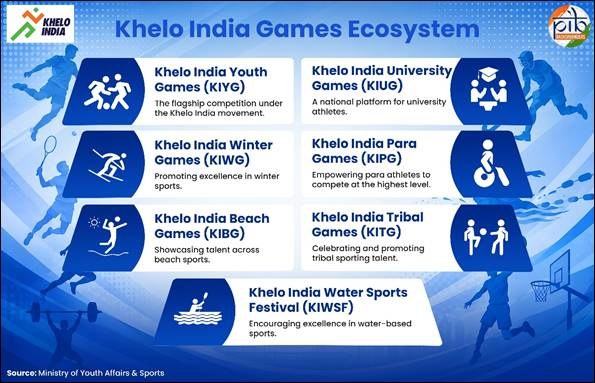
Seven distinct competitions now constitute the Khelo India Games umbrella — from youth and university to para, beach, water sports and tribal games. Image courtesy PIB · Ministry of Youth Affairs & Sports; reproduced with credit for educational use.
Figure 2 — Khelo India At a Glance: Key Statistics (July 2026)
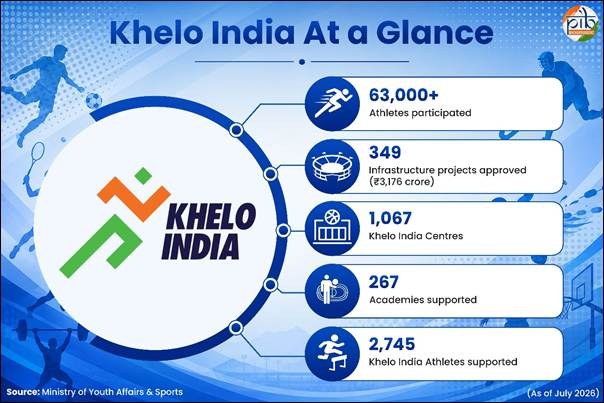
As of July 2026: 63,000+ athletes participated; 349 infrastructure projects (₹3,176 crore); 1,067 Khelo India Centres; 267 academies supported; 2,745 Khelo India Athletes receiving direct support. Image courtesy PIB · Ministry of Youth Affairs & Sports; reproduced with credit for educational use.
India's Medal Trajectory at Major Multi-Sport Events
Figure 3 — India's Medal Tally: Olympics, Paralympics & Asian Games (2014–2024)
0102030405769107276419295769107Rio 2016Tokyo 2020Paris 2024Incheon2014Jakarta2018Hangzhou2023OlympicsOlympicsOlympicsAsianAsianAsianOlympicsParalympicsAsian Games★ = RecordIndia's International Medal Tally — 2014 to 2024
India's Paralympic medal haul grew 7× from Rio 2016 (4) to Paris 2024 (29). Asian Games 2023 at Hangzhou delivered India's all-time best tally of 107 medals. Olympic performance has plateaued at 6–7 medals across Tokyo and Paris, pointing to the next frontier for elite investment.
Commonwealth Games 2026 — Glasgow
- Edition & venue: 23 July – 2 August 2026, Glasgow, Scotland — India's 19th CWG appearance (debut: 1934).
- Format: 74 nations, 10-sport programme (including 6 fully integrated Para Sports), 4 venues.
- India contingent: 124 athletes — 78 male, 46 female.
- Medal tally (as of 27 July 2026): 4 medals — 1 Gold, 2 Silver, 1 Bronze.
- Jhandu Kumar — Bronze, Para Powerlifting (opened India's account).
- Rishikanta Singh — Silver, Men's 60 kg Weightlifting (set a new CWG record in snatch).
- Mirabai Chanu — Gold, Weightlifting (her third consecutive CWG title; India's first gold at Glasgow 2026).
- Muthupandi Raja — Silver, Men's 65 kg Weightlifting.
- Historical context: India won 64 medals at Glasgow 2014, 66 at Gold Coast 2018, and 61 at Birmingham 2022. Weightlifting has been India's most consistent CWG medal source across editions.
Critical Analysis — Strengths, Gaps and Implementation Risks
- Positive: The shift from isolated excellence to systemic infrastructure marks a genuine structural transformation — KIRTI's AI-backed assessment and TOPS's athlete-specific support are best-practice models internationally.
- Budget concern: Though the ₹4,479.88 crore Ministry allocation is a record, India's per-capita sports budget remains far below South Korea, China or Australia — nations that dominate Olympic tallies through decades of sustained investment at similar income levels.
- Women's participation: Only 46 of 124 athletes (37%) in Glasgow are women, though the target is parity. Structural barriers — from infrastructure in rural areas to societal constraints — remain underaddressed.
- Olympic plateau: Despite improved systems, India's Olympic tally has stayed at 6–7 medals across two consecutive Games. The gap between Asian Games depth and Olympic performance suggests medal conversion at the highest level requires further elite-end investment in track-and-field, swimming and combat sports.
- Sports goods manufacturing: The ₹500 crore Budget 2026–27 allocation for domestic sports goods manufacturing addresses a long-standing import dependency — but policy delivery timelines remain to be established.
Key Terms & Institutions for Prelims
- SAI (Sports Authority of India): The nodal body under the Ministry for training centres, hostels and elite coaching — established 1984.
- Indian Olympic Association (IOA): Apex national body for Olympic sports; affiliated to the International Olympic Committee.
- KIRTI: Khelo India Rising Talent Identification — uses AI and standardised assessment for 9–18 age group.
- TOPS Core / Development Group: Core athletes receive ₹50,000/month; Development athletes (junior) receive ₹25,000/month.
- KIC: Khelo India Centre — 1,067 grassroots training nodes established nationwide.
- KIA: Khelo India Athlete — currently 2,745 athletes receiving direct support (coaching, equipment, medical, allowance).
- Commonwealth Games lineage: Formerly British Empire Games (1930); renamed Commonwealth Games in 1978.
✎ Mains Practice Question
The Khelo India Scheme represents a structural shift in India's approach to sports development — from individual patronage to ecosystem building. Critically evaluate the design of the Khelo India framework and assess how it addresses the historically identified gaps of talent identification, infrastructure and funding. What additional measures are needed for India to achieve its 2036 target of becoming a top-10 sporting nation? 15 marks · 250 words
Health, Society & Human DevelopmentGeneral Studies Paper II
02
India's Fight Against Viral Hepatitis: NVHCP, Universal Screening and the Road to Elimination
GS-II · Social Justice — Health Policy & Government SchemesPrelims + MainsPIB · Ministry of Health & Family Welfare
India's National Viral Hepatitis Control Programme (NVHCP), launched in 2018, has screened approximately 21.06 crore beneficiaries and treated around 6.12 lakh Hepatitis B and C patients across 1,153 treatment sites by March 2026 — making it one of the largest public-health elimination drives in the developing world.
◈ Background & Context: The Hepatitis Burden
Hepatitis — inflammation of the liver — is caused by five distinct virus types (A, B, C, D, E). Types B and C are of greatest public health concern as they can cause chronic infection, leading to liver cirrhosis and hepatocellular carcinoma (liver cancer).
Globally, the WHO estimates 1.1 million deaths annually from viral hepatitis — more than HIV/AIDS.
- India's burden: Based on 2021 HIV Sentinel Surveillance data, approximately 0.85% of the sampled population tested positive for Hepatitis B (roughly 1 in 118 persons) and 0.29% for Hepatitis C (roughly 1 in 345 persons).
- Hepatitis B transmission routes: Perinatal (mother-to-child at birth), sexual contact, contaminated blood/needles. Most chronic carriers were infected at birth.
- Hepatitis C: Primarily blood-borne; no vaccine exists. However, it is now curable with direct-acting antiviral (DAA) drugs — a major pharmaceutical breakthrough since 2013.
- Hepatitis A and E: Primarily water/food-borne; cause acute (not chronic) infection; more outbreak-prone in conditions of poor sanitation; monitored through the Integrated Disease Surveillance Programme (IDSP).
- WHO target: Eliminate viral hepatitis as a public health threat by 2030 — aligned with SDG 3 (Good Health and Well-being).
▤ Scheme at a Glance — National Viral Hepatitis Control Programme (NVHCP)
- Launched: 2018 (World Hepatitis Day, 28 July)
- Nodal Ministry: Ministry of Health and Family Welfare
- Scope: All five hepatitis viruses (A, B, C, D, E)
- Core interventions: Free screening, diagnostics and treatment for Hepatitis B and C nationwide
- Treatment sites: 1,153 dedicated treatment sites across the country (as of March 2026)
- Beneficiaries screened: ~21.06 crore
- Patients treated: ~6.12 lakh (Hepatitis B & C combined)
- IT infrastructure: Paperless recording and reporting through the NVHCP-MIS portal
- Helpline: 1800-11-6666 (shared with the National Tuberculosis Elimination Programme)
Figure 4 — National Viral Hepatitis Program: Key Statistics (PIB Infographic)
As of March 2026: approximately 21.06 crore beneficiaries screened; ~6.12 lakh Hepatitis B and C patients treated; treatment available across 1,153 sites nationwide. Image courtesy PIB · Ministry of Health & Family Welfare; reproduced with credit for educational use.
Programme Architecture — How NVHCP Works
- Prevention: Universal immunisation covers Hepatitis B birth dose for all newborns; Hepatitis B immunoglobulin (HBIG) given within 24 hours of birth to newborns of Hepatitis B-positive mothers — the most critical window to prevent perinatal transmission.
- Screening convergence: The Reproductive, Maternal, Newborn, Child, Adolescent Health and Nutrition (RMNCH+A) programme ensures universal screening of all pregnant women for Hepatitis B.
- High-risk group screening: The National AIDS Control Programme (NACP) screens high-risk groups (injecting drug users, men who have sex with men, sex workers) for both Hepatitis B and C — given the shared transmission routes with HIV.
- Molecular testing: Existing CB-NAAT machines under the National TB Elimination Programme (NTEP) are leveraged for hepatitis molecular testing — reducing capital expenditure.
- Blood safety: Blood transfusion services are linked with Hepatitis B/C positive donor management systems to prevent iatrogenic transmission.
- Drug logistics: Free generic DAA drugs (e.g. sofosbuvir-based regimens for Hepatitis C) are provided through public health facilities — enabled by compulsory licensing and domestic generic manufacturing.
Lineage and SDG Alignment
- India signed the WHO Global Health Sector Strategy on Viral Hepatitis (2016–2021) — which set elimination targets aligned with the 2030 SDG framework.
- The 2018 NVHCP launch was timed with World Hepatitis Day (28 July) — observed annually since 2010 in honour of Nobel laureate Baruch Blumberg, who discovered the Hepatitis B antigen.
- The shift from district hospitals to Community Health Centres (CHCs) and Primary Health Centres (PHCs) marks a critical decentralisation of treatment access — following the Sabka Saath, Sabka Vikas principle of universal inclusion.
- India's approach mirrors global best-practice models (Egypt, Australia, Georgia) where generic drug accessibility and national screening drives achieved near-elimination of Hepatitis C within a decade.
Critical View — Challenges and Gaps
- Coverage gap: 21.06 crore screened against an estimated population of 140+ crore suggests significant sections — particularly in remote tribal and forested areas — remain unreached.
- Treatment cascade: Screening 21.06 crore but treating only 6.12 lakh raises questions about the linkage-to-care rate — the percentage of screen-positive individuals who successfully enter treatment. This data is not publicly disclosed in granular form.
- Hepatitis D: Hepatitis D (Delta) virus, which only infects those already with Hepatitis B, has no dedicated treatment under NVHCP. HDV co-infection dramatically worsens liver outcomes.
- Vaccine hesitancy and adult cohorts: Adult vaccination catch-up for Hepatitis B — essential for healthcare workers and adults born before the Universal Immunisation Programme included Hep B (added in 2002 under UIP) — remains insufficiently tracked.
- Seroprevalence data gaps: India lacks a dedicated national hepatitis serosurvey; the 2021 data is drawn from HIV Sentinel Surveillance, limiting its representativeness.
Key Terms for Prelims
- Seroprevalence: The proportion of a population that tests positive for specific antibodies or antigens in a blood (serum) survey — a measure of past or current infection in the community.
- DAA (Direct-Acting Antivirals): Hepatitis C drugs that target specific viral proteins; cure rates exceed 95% in 8–12 weeks. Sofosbuvir is the most widely used in India's public health system.
- HBIG (Hepatitis B Immunoglobulin): Passive immunity administered to high-risk newborns alongside the birth dose vaccine — neutralises the virus during the critical perinatal window.
- IDSP (Integrated Disease Surveillance Programme): The nodal surveillance system that monitors outbreak-prone diseases including Hepatitis A and E.
- Baruch Blumberg: Discovered the Hepatitis B surface antigen (HBsAg, also called the Australia antigen) in 1965 — awarded the Nobel Prize in Physiology or Medicine in 1976; World Hepatitis Day (28 July) marks his birthday.
✎ Mains Practice Question
India's National Viral Hepatitis Control Programme has achieved significant screening milestones but faces challenges in the treatment cascade and subnational coverage. Analyse the design of NVHCP, its convergence with other national health programmes, and the structural and social barriers that limit the programme's reach. What reforms are needed for India to meet the WHO's 2030 viral hepatitis elimination targets? 15 marks · 250 words