
In-Depth PIB Analysis3 Items
Core TopicImportantConcise
Indian Economy & InfrastructureGS Paper III
01Bharat Maritime Insurance Pool (BMIP)02World Tourism Day 2026 & Digital Tourism
Environment, Energy & EcologyGS Paper III
03India’s First Port-based e-Methanol Plant, Kandla
Indian Economy & InfrastructureGeneral Studies Paper III
01
Bharat Maritime Insurance Pool: India’s First Sovereign-Backed Domestic Marine Insurance Pool
GS-III · Economy — Infrastructure (Ports & Shipping), InsurancePrelims + MainsPIB · Ministry of Ports, Shipping & Waterways · Backgrounder, 27 Sep 2026
India moves about 95% of its trade by value through the sea, yet has relied almost entirely on foreign insurers — chiefly Western P&I clubs — to cover its ships and cargo. The BMIP is the Government’s attempt to close that strategic gap.
◈ Background & Context
Marine insurance is a legal and commercial precondition for shipping: no port or charterer accepts a vessel without cover. Indian shipowners have depended on international Protection & Indemnity (P&I) clubs, leading to an estimated annual outflow of USD 45–60 million in P&I premiums alone.
- Trigger: conflict in the Red Sea and tensions near the Strait of Hormuz led foreign insurers to raise premiums sharply or withdraw war-risk cover.
- Vulnerability: coverage decided abroad can be withdrawn suddenly or shaped by the sanctions and foreign-policy choices of other states.
- Capacity gap: India lacked institutional depth in marine underwriting and claims handling, which remained concentrated in London and Switzerland.
▤ Scheme at a Glance
- Corpus / underwriting capacity: ₹13,906.50 crore (≈ USD 1.5 billion).
- Sovereign guarantee: ₹12,980 crore (≈ USD 1.4 billion) — a contingent liability of the Union.
- Timeline: approved 18 April 2026; launched 12 May 2026.
- Tenure: 10 years, extendable to 15 years.
- Nodal Ministries: Ministry of Ports, Shipping & Waterways and Ministry of Finance.
- Pool Administrator: General Insurance Corporation of India (GIC Re).
- Risks covered: Hull & Machinery, Cargo, Protection & Indemnity, and War Risk (incl. piracy, terrorism, hostile seizure).
- Eligibility: Indian-flagged vessels; vessels owned, managed or controlled by Indian entities; and cargo vessels bound to or from India.
- Governance: a Governing Body (oversight) and an Underwriting Committee (risk discipline).
Figure 1 — Key features of the BMIP
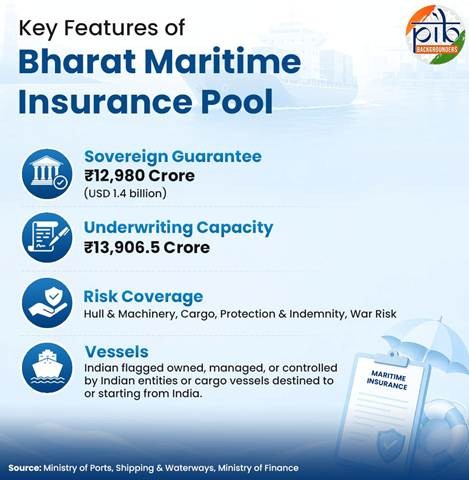
Sovereign guarantee, capacity, risk classes and eligibility in one view. Image courtesy PIB (Ministry of Ports, Shipping & Waterways; Ministry of Finance); reproduced with credit for educational use.
How the pool works
The BMIP is a co-insurance and reinsurance arrangement, not a new insurer. Member domestic insurers issue policies using combined capacity, and the risk is then shared across all members in proportion to the capacity each has committed.
Figure 2 — Risk-sharing and claims waterfall under the BMIP
Policy issuedby a member insurer(e.g., New India Assurance)Risk reinsuredacross all Pool members,pro rata to committed capacityClaim arisesloss / liability eventTier 1 · Claims up to USD 100 mnPaid from the pool’s accumulatedreserves and reinsurance recoveriesTier 2 · Larger claimsSovereign guarantee (₹12,980 cr) activatesonly after pool reserves are fully exhausted— the Union’s contingent liability
The guarantee is a backstop of last resort: the pool’s own reserves and reinsurance absorb losses first.
Early operations (as reported by the Government)
- First policy (12 May 2026): a Hull & Machinery War policy issued by New India Assurance to Hoger Offshore and Marine Pvt Ltd for a vessel transiting conflict zones.
- First P&I policy (30 July 2026): issued to the Shipping Corporation of India by New India Assurance.
- Beyond shipowners: cargo-war cover for importers and commodity firms (e.g., Vedanta Sterlite Copper, Balrampur Chini Mills).
- Uptake to 7 September 2026: 3,000 Cargo War, 92 Hull War-risk and 3 P&I policies.
- Premiums: the Government states war-risk premiums have fallen by about 35–40% from the peak of the West Asia conflict.
Lineage — India’s earlier insurance pools
- Indian Market Terrorism Risk Insurance Pool (2002): created after 9/11 when global reinsurers withdrew terror cover; administered by GIC Re — the closest template for BMIP.
- Indian Nuclear Insurance Pool (2015): built to cover operator and supplier liability under the Civil Liability for Nuclear Damage Act, 2010; also GIC Re-managed.
- What is new: a large explicit sovereign guarantee, and entry into P&I — a segment long dominated by mutual clubs abroad.
- Wider package: sits alongside the Maritime Development Fund and shipbuilding assistance announced since the 2025–26 Budget, and the Maritime Amrit Kaal Vision 2047.
Why it matters
- Strategic autonomy: reduces exposure to cover withdrawal driven by foreign sanctions regimes or geopolitics.
- Energy security: keeps crude and LNG imports insured through high-risk corridors.
- Balance of payments: retains premium income domestically.
- Institution-building: develops domestic underwriting, claims and legal expertise, with the stated long-term aim of making India a regional marine-insurance hub in the Indian Ocean Region.
The critical view
- P&I is still nascent: only 3 of over 3,000 policies are P&I — the segment that defines dependence on foreign clubs. War-risk cargo dominates uptake.
- International acceptance: P&I cover must be recognised by foreign port states and charterers, including for certificates under liability conventions (e.g., oil-pollution and bunker conventions). Credibility will be tested at the first large claim.
- Concentration risk: the pool is anchored in public-sector insurers; a single catastrophic event could stress both reserves and the Union budget.
- Fiscal exposure: the ₹12,980 crore guarantee is a contingent liability; pricing discipline is needed so that the guarantee does not become a routine subsidy.
- Reinsurance depth: very large P&I claims (wreck removal, pollution) are normally shared through global pooling; domestic capacity alone may be thin.
▤ Institutions & terms to know
- P&I club: a mutual association of shipowners covering third-party liabilities — crew injury, pollution, wreck removal, cargo damage.
- Hull & Machinery: cover for physical damage to the ship’s structure and propulsion.
- War-risk cover: excluded from standard policies; priced separately for “listed” high-risk areas.
- GIC Re: India’s national reinsurer; administrator of the terrorism, nuclear and now maritime pools.
- Maritime profile: 12 Major and 217 Non-Major ports; 1,668 MMT cargo in 2025–26; Indian-flag fleet of 1,609 ships (14.33 million GT) as of mid-2026.
✎ Mains Practice Question
“For a trading nation, dependence on foreign marine insurers is a strategic vulnerability.” Examine how the Bharat Maritime Insurance Pool seeks to address this, and discuss the challenges in building a credible domestic marine insurance capacity. 15 marks · 250 words
02
World Tourism Day 2026: India’s Tourism Economy and the Push for Digital Public Infrastructure
GS-III · Economy — Tourism, Services, InfrastructureGS-I · Culture & HeritagePrelims + MainsPIB · Ministry of Tourism · 26 Sep 2026
This year’s World Tourism Day theme puts digital technology and AI at the centre of tourism policy — and India used the occasion to launch a “National Digital Tourism Stack”, extending its DPI model to the sector.
◈ Background & Context
World Tourism Day is observed on 27 September, marking the adoption of the UNWTO Statutes in 1970; it has been celebrated since 1980 by UN Tourism (renamed from UNWTO in 2024). The 2026 global host is El Salvador.
- Theme 2026: “Digital Agenda and Artificial Intelligence to Redesign Tourism”.
- Global scale (2024): travel and tourism contributed about US$10.9 trillion (10% of global GDP) and supported 357 million jobs.
▤ Initiatives at a Glance
- National Digital Tourism Stack: an open digital public infrastructure to make tourism offerings discoverable, accessible and trustworthy.
- Dekho Apna Desh 2.0: promotes tourism-ready, lesser-known destinations to spread tourist footfall more evenly.
- Nodal Ministry: Ministry of Tourism (central event at Bharat Mandapam, New Delhi).
- MoUs with industry: on destination visibility, digital outreach and community participation under the Incredible India framework.
- Google India MoU (June 2026): AI and data-driven promotion, plus digital-skills training for Ministry officials.
5.22%
Tourism share of GDP (latest TSA estimate)
8.46 cr
Tourism jobs, 2023–24 (6.94 cr in 2019–20)
₹2.77 lakh cr
Foreign exchange earnings, 2025 (₹63,978 cr in 2021)
2.53 cr
Foreign Tourist Visits, 2025
The digital layer
- e-Visa: began in 2014 for 43 countries; now available to 172 countries through 88 entry ports. Around 78% of visas are now issued electronically, and about 95% of e-Visa applications are processed within 72 hours.
- Incredible India Digital Platform: AI-powered trip personalisation; links to OTAs and ASI monument ticketing.
- NIDHI+ (National Integrated Database of Hospitality Industry): online registration and classification of tourism service providers — 63,740 accommodation units listed as of 23 Sep 2026.
- Tourist Helpline 1363: 24×7, multilingual, including distress assistance.
Figure 3 — Expansion of India’s e-Visa facility
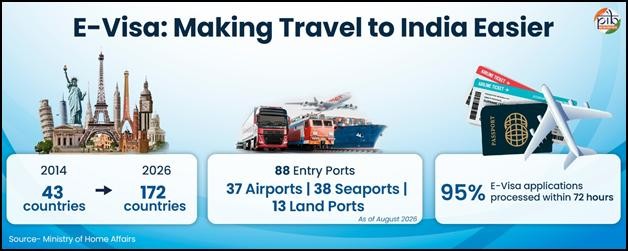
From 43 to 172 countries in about a decade. Image courtesy PIB (source: Ministry of Home Affairs); reproduced with credit for educational use.
Schemes to know
- Swadesh Darshan (2014–15): theme-based circuits — 76 projects, over ₹5,295 crore, 15 circuits.
- Swadesh Darshan 2.0: shift from circuits to a destination-centric, sustainable model — 53 projects worth ₹2,207.08 crore.
- Challenge Based Destination Development (CBDD): sub-scheme of SD 2.0 — 37 projects, ₹687.99 crore.
- PRASHAD (2014–15): Pilgrimage Rejuvenation and Spiritual, Heritage Augmentation Drive — 54 projects, ₹1,726.18 crore.
- SASCI (tourism): 100% central assistance for iconic destinations of global standard — 40 projects in 23 States.
- Capacity Building for Service Providers (CBSP): includes Hunar Se Rozgar Tak; Paryatan Mitra / Paryatan Didi (2024) trains frontline providers.
Figure 4 — Skilling the tourism workforce
Placement of about 36,000 out of 1.68 lakh trained implies a placement rate near 21%. Image courtesy PIB (source: Ministry of Tourism); reproduced with credit for educational use.
The critical view
- Flattering base year: growth from 2021 is measured off a pandemic trough; comparison with 2019 is the fairer test.
- Visits ≠ arrivals: Foreign Tourist Visits count each State visited, so they exceed Foreign Tourist Arrivals; India’s share of global international arrivals remains small relative to its size.
- Carrying capacity: surges in Himalayan and pilgrimage destinations raise concerns over overtourism, waste and fragile ecology — the rationale for dispersing footfall.
- Data governance: a tourism DPI will aggregate traveller data; safeguards under the Digital Personal Data Protection Act, 2023 will matter.
- Skilling outcomes: the placement-to-training ratio under CBSP suggests the need to link training more closely to industry demand.
✎ Mains Practice Question
Can digital public infrastructure do for tourism what it did for payments in India? Critically examine the potential and limitations of technology-led tourism promotion in balancing growth with sustainability. 15 marks · 250 words
Environment, Energy & EcologyGeneral Studies Paper III
03
Kandla e-Methanol Plant: India Bids for a Place in the Green Shipping-Fuel Market
GS-III · Energy, Infrastructure (Ports), Climate ChangePrelims + MainsPIB · Ministry of Ports, Shipping & Waterways · 26 Sep 2026
Shipping is one of the hardest sectors to decarbonise. A foundation stone laid at Deendayal Port, Kandla, marks India’s first attempt to produce a synthetic green marine fuel at a port and sell it to international ships.
▤ Project at a Glance
- Location: Deendayal Port Authority (DPA), Kandla, Gujarat.
- Capacity: 150 tonnes per day of e-methanol.
- Investment: ₹2,300 crore, in modular phases.
- Partners: DPA and Assam Petro-Chemicals Ltd (APCL, Namrup), in a 76:24 capital ratio.
- Phase I: 50 TPD, ₹1,200 crore, targeted for January 2027.
- Phase II: +100 TPD, ₹1,100 crore, targeted for March 2027.
- Feedstock: renewable power, water and biogenic CO₂.
- Market: bunkering for vessels on the Asia–Europe trade corridor.
- Stated outcomes: over 3,500 direct and indirect jobs; production cost of about US$750/tonne against a global rate of about US$1,300/tonne (Government projections).
Figure 5 — The e-methanol value chain at Kandla
Renewable power + water→ electrolyserGreen hydrogen (H₂)Biogenic CO₂carbon of biological(non-fossil) originMethanol synthesisCO₂ + 3H₂ → CH₃OH + H₂O150 TPD at full capacityStorage & bunkeringat Deendayal Port, KandlaMethanol-capable shipsAsia–Europe corridor
e-Methanol is “green” only if both inputs are: renewable-powered hydrogen and non-fossil carbon.
Why methanol for ships
- Liquid at ambient temperature: easier to store and bunker than hydrogen or ammonia, and usable in dual-fuel engines already in service.
- Regulatory pull: the IMO’s 2023 GHG Strategy targets net-zero shipping emissions by or around 2050, and the EU’s FuelEU Maritime rules raise the cost of fossil bunkers on Europe-bound routes.
- Market signal: major liners, including Maersk, have ordered methanol dual-fuel vessels, creating demand for green supply at hub ports.
Linkages and context
- National Green Hydrogen Mission (2023): e-methanol is a green-hydrogen derivative; DPA contributes green hydrogen, land and desalinated water.
- Green Tug Transition Programme and Harit Sagar guidelines: part of the port-sector decarbonisation push.
- Maritime ambition: the Government plans 100 new ships in five years and aims to place India among the top five ship-owning nations by 2047.
- Net Zero 2070: India’s long-term target announced at COP26 (Glasgow, 2021).
The critical view
- Scale: 150 TPD (~50,000 tonnes a year) is small against global bunker demand; it is a pilot-scale entry, not yet a hub.
- Cost claim: the US$750/tonne figure is a projection; e-fuel costs depend heavily on electrolyser prices and round-the-clock renewable power.
- Tight timelines: commissioning both phases by early 2027 is ambitious for a first-of-its-kind plant.
- Certification: buyers will require robust lifecycle-emission certification of both hydrogen and CO₂ sources to qualify under international rules.
- Water stress: Kutch is arid; reliance on desalination adds cost and brine-disposal concerns.
✎ Mains Practice Question
Discuss the significance of green marine fuels such as e-methanol for India’s ambition to become both a maritime power and a green-energy exporter. What challenges must be addressed to scale up their production? 15 marks · 250 words