
In-Depth PIB Analysis4 Items
Core TopicImportantConcise
Social Justice & Welfare SchemesGS Paper II
01PM-AJAY: Scheme for SC Empowerment
Economy & InfrastructureGS Paper III
02Green Highways: Greening the NH Network03GARC Testing Upgrade under PM E-DRIVE
Science & TechnologyGS Paper III
Social Justice & Welfare SchemesGeneral Studies Paper II
01
PM-AJAY: One Umbrella for Villages, Livelihoods and Hostels for Scheduled Castes
GS-II · Welfare Schemes for Vulnerable Sections; Government PoliciesPrelims + MainsPIB · Ministry of Social Justice & Empowerment · Backgrounder, 28 Sep 2026
PM-AJAY merged three older schemes for Scheduled Castes into a single, 100% centrally sponsored programme in 2021–22. A new mobile app and portal now aims to move its planning, fund release and monitoring fully online.
◈ Static Background — Constitutional Basis for SC Welfare
- Article 341: the President notifies the list of Scheduled Castes for each State/UT; Parliament alone can modify it by law.
- Article 46 (DPSP): the State shall promote the educational and economic interests of SCs and STs and protect them from social injustice.
- Article 17: abolishes untouchability; given effect by the Protection of Civil Rights Act, 1955 and the SC/ST (Prevention of Atrocities) Act, 1989.
- Article 338: National Commission for Scheduled Castes (separated from the joint SC/ST commission by the 89th Amendment, 2003).
- Population: SCs are 16.6% of India’s population — about 20.1 crore (Census 2011).
- Planning lineage: the Special Component Plan (1979–80), renamed the Scheduled Castes Sub-Plan (SCSP) in 2006, earmarked plan funds in proportion to the SC population.
▤ Scheme at a Glance
- Full name: Pradhan Mantri Anusuchit Jaati Abhyuday Yojna.
- Launched: FY 2021–22; 100% centrally sponsored.
- Nodal Ministry: Ministry of Social Justice & Empowerment.
- Merged schemes: Pradhan Mantri Adarsh Gram Yojana (PMAGY), Special Central Assistance to SCSP, and Babu Jagjivan Ram Chhatrawas Yojana (BJRCY).
- Three aims: reduce poverty through employment and skills; improve socio-economic indicators in SC-dominated areas; raise literacy and enrolment.
- Village eligibility: ≥40% SC population and total population ≥500.
- Individual priority (GIA): families with annual income up to ₹2.5 lakh.
- Digital tools: PM-AJAY Mobile App and PM-AJAY Portal for end-to-end, real-time workflow.
Figure 1 — From three schemes to one: the PM-AJAY architecture
ERSTWHILE SCHEMESCOMPONENTS TODAYPMAGYmodel villages (2009–10)SCA to SCSPlivelihood grants to StatesBJRCYhostels for SC studentsPM-AJAYFY 2021–22100% centrally sponsoredAdarsh Gram18,093 villages declaredGrants-in-Aid₹1,730+ cr (FY22–FY26)Hostels785 hostels completed
Each old scheme maps onto one component: PMAGY → Adarsh Gram, SCA to SCSP → grants-in-aid, BJRCY → hostels.
Progress by component
- Adarsh Gram: 47,243 villages covered, benefiting over 47.79 lakh people; 27,032 Village Development Plans prepared and 46,944 works completed. 18,093 villages declared Adarsh Grams as on 8 September 2026.
- Grants-in-Aid: over ₹1,730 crore released to States (FY 2021–22 to 2025–26) for livelihood, skilling and infrastructure projects, reaching 2.5 lakh+ individual and group beneficiaries.
- Hostels: 785 hostels completed; ₹61.46 crore sanctioned for 2026–27 for two hostels (one each for girls and boys) housing 264 students.
Figure 2 — PM-AJAY: key milestones
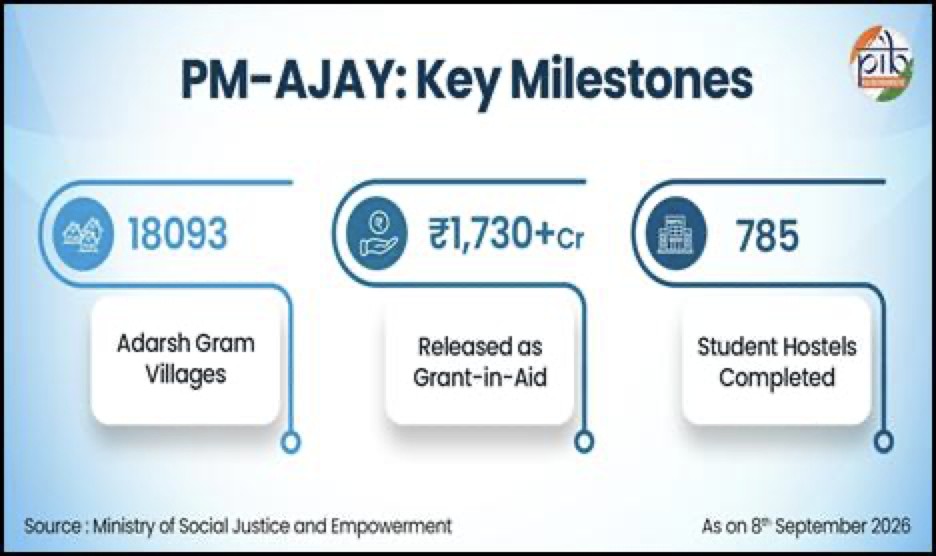
Headline outputs as on 8 September 2026. Image courtesy PIB (source: Ministry of Social Justice and Empowerment); reproduced with credit for educational use.
The digital layer
The PM-AJAY Portal is meant to replace paper-based processing with a real-time digital workflow — linking fund release to physical progress and giving officials a single view from the village to the national level.
Figure 3 — What the PM-AJAY Portal does
Milestone-linked fund flows, three-tier dashboards and an MIS for grants-in-aid. Image courtesy PIB (source: Ministry of Social Justice and Empowerment); reproduced with credit for educational use.
The critical view
- Coverage vs completion: only about 38% of covered villages (18,093 of 47,243) have been declared Adarsh Grams so far.
- Scale of grants: ₹1,730 crore over five years is modest for a population of about 20 crore; much SC welfare depends on State budgets and wider central allocations.
- Hostel gap: sanctioning two hostels (264 seats) for a year is small against demand from rural SC students in higher education.
- Outputs vs outcomes: reporting counts villages, works and hostels, but not changes in income, learning or health — the scheme’s stated goals.
- Area targeting: the 40% SC-population threshold misses SC households in mixed villages and in urban areas.
- Digital divide: app-based workflows depend on the capacity of gram panchayats and district staff to use them.
✎ Mains Practice Question
Consolidating fragmented schemes into umbrella programmes improves administrative efficiency but may dilute focus. Examine this statement with reference to PM-AJAY, and suggest how its outcomes for Scheduled Castes can be better measured. 15 marks · 250 words
Economy & InfrastructureGeneral Studies Paper III
02
Green Highways: Can India’s Road Boom Grow Its Green Cover Too?
GS-III · Infrastructure (Roads); Environment — Conservation, PollutionPrelims + MainsPIB · Ministry of Road Transport & Highways · Backgrounder, 28 Sep 2026
India’s National Highway network has grown by about 61% since 2014. The Government says it is now pairing expansion with plantation targets, survival benchmarks, recycled materials and satellite monitoring of green cover.
◈ Static Background
- National Highways: declared under the National Highways Act, 1956; developed by MoRTH through NHAI (set up under the NHAI Act, 1988), NHIDCL and State PWDs.
- Road network: India has the world’s second-largest road network; NHs carry a far larger share of traffic than their share of road length.
- Green Highways (Plantation, Transplantation, Beautification and Maintenance) Policy, 2015: set aside 1% of the civil cost of NH projects for plantation and maintenance.
- Compensatory afforestation: required when forest land is diverted under the Forest (Conservation) Act, 1980 (now the Van (Sanrakshan Evam Samvardhan) Adhiniyam); funds are managed under the CAMPA Act, 2016.
▤ Policy at a Glance — Green Highways Policy, 2015
- Aims: a framework for NH plantation; trees and shrubs as sinks for air pollutants and dust; arrest soil erosion on embankment slopes; moderate wind and radiation; create local employment.
- Implementers: Self Help Groups, private agencies, State Forest Departments, Forest Corporations and contractors.
- Monitoring: a Plantation Cell through NHAI regional offices, now supplemented by drone and satellite monitoring.
- Scale: over 3.61 crore saplings planted along about 1.32 lakh km of NHs in the last five years (as of July 2026).
- Methods: Miyawaki dense plantations; tree transplantation and compensatory afforestation where felling is unavoidable.
Figure 4 — Network growth and NHAI’s new plantation compliance rule
National Highway length (km)201491,287Mar 20261,46,572≈ +61%NHAI guidelines (Sep 2026): when plantation counts as complete≥ 80%of plantation RoW covered≥ 90%sapling survival at inspectionProvisionalcompletion certificate+The same 90% survival benchmark applies through the Operations & Maintenance period,with timely replacement of saplings that die.
Tying survival, not just planting, to project completion is the key shift. RoW = Right of Way, the land legally required for a highway.
Beyond planting: materials and biodiversity
- Recycled and waste-derived inputs: fly ash and pond ash in embankments; Reclaimed Asphalt Pavement (RAP), C&D waste, plastic waste, steel slag and crumb rubber in suitable works.
- Bio-bitumen: a farm-residue-based binder developed by CSIR labs (see Item 03).
- Pollinator corridors: the “Trees for Bees” campaign along the Delhi–Amritsar–Katra Expressway uses flowering native species for year-round nectar and pollen.
- State example: Andhra Pradesh planted about 18 lakh seedlings along NHs in 2010–2025 and targets 3.86 lakh more in 2026–27.
- Incentives: NHAI’s Green Highways Excellence Awards (instituted 2025) give the highest weight to plantation survival.
The critical view
- Saplings are not trees: planting counts cannot replace the ecological value of mature trees felled for widening; carbon and shade benefits take decades.
- Survival data: independent verification of survival rates is limited; the new 90% rule will need credible third-party audits.
- Species choice: avenue planting has often favoured fast-growing or ornamental exotics over native, site-specific species.
- Fragile terrain: in the Himalaya and Western Ghats, the bigger issues are slope cutting, landslides and habitat fragmentation, which plantation does not address.
- Wildlife crossings: animal underpasses and overpasses (as on NH-44 through the Pench landscape) matter as much as roadside greenery.
✎ Mains Practice Question
“Growth need not come at the expense of green cover.” Critically evaluate India’s Green Highways approach in reconciling rapid road expansion with environmental sustainability. 15 marks · 250 words
03
GARC Chennai Upgrades EV, Crash and ADAS Testing under PM E-DRIVE
GS-III · Industry — Automobiles, EVs; Infrastructure; S&TPrelims + MainsPIB · Ministry of Heavy Industries · 28 Sep 2026
The Global Automotive Research Centre (GARC) at Oragadam, Chennai, has been allocated ₹221.13 crore under PM E-DRIVE to build testing capacity for EV batteries, crash safety, ADAS and heavy commercial vehicles.
◈ Static Background — Vehicle Testing in India
- Homologation: certifying that a vehicle model meets national standards for safety, emissions and road-worthiness before sale.
- Rule 126, Central Motor Vehicles Rules, 1989: designates authorised testing agencies — including ARAI (Pune), ICAT (Manesar), GARC (Chennai) and NATRAX (Indore).
- NATRiP: the National Automotive Testing and R&D Infrastructure Project created GARC, ICAT Manesar and NATRAX.
- AIS standards: Automotive Industry Standards, notified by MoRTH; AIS-156 covers safety of EV traction batteries in two- and three-wheelers; AIS-004 Part 3 covers electromagnetic compatibility (EMC).
- Bharat NCAP (2023): India’s star rating programme for car crash safety — needs high-quality crash test facilities.
▤ PM E-DRIVE at a Glance
- Full name: PM Electric Drive Revolution in Innovative Vehicle Enhancement.
- Ministry: Ministry of Heavy Industries; GARC works under the National Automotive Board.
- Outlay: ₹10,900 crore, including ₹780 crore to upgrade testing agencies.
- Tenure: operational up to 31 March 2028.
- Other components: demand incentives for e-2Ws, e-3Ws, e-trucks and e-ambulances, support for e-buses, and public EV charging.
- Predecessor: FAME India scheme (FAME-I 2015, FAME-II 2019).
₹221.13 cr
Allocated to GARC
₹780 cr
For all testing agencies under PM E-DRIVE
3,000 fps
Full HD crash imaging (4K up to 750 fps)
Facilities being added or upgraded
- EV and battery testing to AIS-156, and EV EMI/EMC testing to AIS-004 Part 3 Rev.1.
- Heavy Commercial Vehicle testing and powertrain laboratory upgrade.
- Advanced passive safety — crash dummies and calibration equipment; high-speed imaging to capture deformation, occupant movement and airbag deployment.
- ADAS testing with instruments and soft targets (dummy vehicles and pedestrians for collision-avoidance tests).
- Status: purchase orders placed for almost all equipment; installation has begun.
Why it matters — and the gaps
- Safety: the 2022 e-scooter fires led to stricter AIS-156 battery norms; domestic testing capacity is needed to enforce them.
- Speed to market: more labs cut homologation queues for EV and ADAS models.
- Road safety: India records about 1.7 lakh road deaths a year; better crash testing supports safer vehicle design.
- Gaps: much of the advanced test equipment is imported; utilisation and skilled staff will decide whether the capacity pays off.
✎ Mains Practice Question
Discuss the role of indigenous testing and certification infrastructure in India’s transition to electric and technologically advanced vehicles. How does PM E-DRIVE address this need? 10 marks · 150 words
Science & TechnologyGeneral Studies Paper III
04
Bio-Bitumen: Turning Rice Straw into Road Binder
GS-III · S&T — Indigenous Technology; Environment — Stubble Burning; InfrastructurePrelims + MainsPIB · Ministry of Road Transport & Highways / Ministry of Science & Technology · 28 Sep 2026
A CSIR technology that converts post-harvest rice straw into bio-oil — blended with petroleum bitumen for road building — was transferred to industry in January 2026. It targets two problems at once: bitumen imports and stubble burning.
◈ Static Background
- Bitumen: a sticky, black mixture of hydrocarbons obtained from crude-oil refining; it binds aggregates in flexible (asphalt) pavements. India imports nearly 50% of its requirement.
- Pyrolysis: thermal decomposition of organic matter at high temperature in the absence of oxygen, yielding bio-oil, combustible gas and biochar.
- Stubble burning: burning of paddy residue after the kharif harvest, mainly in Punjab and Haryana (October–November), is a major contributor to winter air pollution in the NCR.
- Developers: CSIR-Central Road Research Institute (CRRI), New Delhi, and CSIR-Indian Institute of Petroleum (IIP), Dehradun.
- Technology transfer: licensing of research know-how and IP from labs to public or private users for commercial production.
Figure 5 — From rice straw to bio-bitumen
A 20–30% bio-oil blend can replace an equal share of the petroleum-based binder. Image courtesy PIB (source: Ministry of Science & Technology); reproduced with credit for educational use.
Figure 6 — One process, several value streams
Rice strawpelletsPyrolysishigh heat,no oxygenBio-oil → bio-binderblended with bitumen for roadsGaseous fuelenergy for the processBio-pesticide fractionsagricultural useHigh-grade carbonbatteries, water purification
Multiple saleable outputs improve the economics of collecting straw that would otherwise be burnt.
Key points
- Technology: “Bio-Bitumen via Pyrolysis: From Farm Residue to Roads”, transferred in January 2026.
- Field trial: a 100-metre stretch laid on the Jorabat–Shillong Expressway (NH-40), Meghalaya.
- Next step: integration into national highway construction standards is planned.
- Government claim: India is the first country to scale bio-bitumen to industrial and commercial levels within the same year.
Significance and challenges
- Import substitution: replacing 20–30% of petroleum binder cuts crude-linked imports and price exposure.
- Air quality: gives farmers a market for paddy straw, complementing in-situ (Happy Seeder) and ex-situ (biomass power, 2G ethanol) residue management.
- Performance risk: long-term behaviour under heavy traffic, heat and monsoon moisture needs multi-season data; 100 metres is a pilot.
- Supply chain: straw is seasonal and bulky; collection, baling and storage costs decide viability.
- Standards: contractors will adopt it only once it is written into IRC/MoRTH specifications.
✎ Mains Practice Question
Bio-bitumen from crop residue has been presented as a solution to both import dependence and stubble burning. Examine its potential and the challenges in scaling it up. 10 marks · 150 words