
In-Depth PIB Analysis3 Items
Core TopicImportantConcise
Economy — Tourism & the North-EastGS Paper III
0114th International Tourism Mart — Tawang
Science & TechnologyGS Paper III
02India’s Cloud Ecosystem — MeghRaj, Data Centres & Sovereignty
Environment & Urban Climate ActionGS Paper II · III
03ARISE Cities Forum — Delhi Declaration for COP31
Economy — Tourism & the North-EastGeneral Studies Paper III
01
14th International Tourism Mart Returns to Tawang: Building a Tourism Economy for the North-East
ImportantGS-III · Economy — Tourism, Infrastructure, Inclusive GrowthGS-I · Geography & Culture of the North-EastPrelims + MainsPIB · Ministry of Tourism · 29 Oct 2026
The 14th International Tourism Mart (ITM) opened at Tawang, Arunachal Pradesh (29–31 October 2026), returning there after 13 years. It drew a record 43 international buyers from 22 countries, as domestic tourist visits to the North-East rose about 58% — from 95.65 lakh (2019) to 1.51 crore (2025).
◈ Key Terms Explained — From Basics
- Tourism mart: a B2B (business-to-business) event where sellers — hotels, tour operators, States — meet buyers such as international and domestic travel agencies to strike deals. The ITM, organised by the Ministry of Tourism, is held annually in a North-Eastern State; the first was in 2012.
- Domestic tourist visits: the count of visits (not unique persons) recorded in a State; one person visiting twice counts twice.
- Experiential and community-based tourism: travel built around local culture, food, crafts and homestays, so that income reaches local households.
- Carrying capacity: the number of visitors a destination can sustain without damaging its environment or community life — critical in fragile Himalayan areas.
- Permits: Indian visitors to Arunachal need an Inner Line Permit (under the Bengal Eastern Frontier Regulation, 1873); foreign tourists need a Protected Area Permit.
◈ Static Background — Tawang
- Tawang Monastery: founded in the 17th century; among the largest Buddhist monasteries in India, of the Gelug school; birthplace region of the 6th Dalai Lama.
- People: predominantly the Monpa community.
- Access: the Sela Tunnel (opened 2024, at about 13,000 ft) provides all-weather road connectivity to Tawang.
- History: the 14th Dalai Lama entered India through this region in 1959.
Figure 1 — Tourism projects sanctioned in the North-East, by scheme (₹ crore)
Swadesh Darshan 1.01,309 (16)SASCI790 (9)Swadesh Darshan 2.0564 (17)PRASHAD258 (9)Challenge Based (CBDD)139 (9)Figures in brackets = number of projects
Bars drawn to scale. Chart recreated by Legacy IAS from Ministry of Tourism figures; ten tourism air routes in the region are also supported under RCS-UDAN.
▤ Schemes in the Chart — What Each Does
- Swadesh Darshan (2014–15): theme-based tourist circuits; Swadesh Darshan 2.0 (2023) shifted to destination-centric, sustainable development.
- PRASHAD: Pilgrimage Rejuvenation and Spiritual, Heritage Augmentation Drive — infrastructure at pilgrimage and heritage sites.
- Challenge Based Destination Development (CBDD): competitive selection of destinations under SD 2.0.
- SASCI: Special Assistance to States for Capital Investment — interest-free 50-year loans to States, including a window for developing iconic tourist centres to global scale.
- Dekho Apna Desh (2020) promotes domestic travel; a National Digital Tourism Stack aims to improve digital visibility of local providers.
Why It Matters — and the Constraints
- Livelihoods: tourism is labour-intensive and can diversify incomes in a region with limited manufacturing.
- Act East and border development: visitors bring economic activity to frontier areas, complementing the Vibrant Villages Programme.
- Constraints: connectivity gaps, permit procedures, limited hotel stock, monsoon landslides and patchy digital connectivity.
- Sustainability: fragile ecology and distinct tribal cultures require carrying-capacity planning, waste management and community ownership to avoid over-tourism.
✎ Mains Practice Question
Tourism can be a growth engine for India’s North-Eastern Region, but its expansion must respect ecological and cultural fragility. Discuss the opportunities and the safeguards required. 10 marks · 150 words
Science & TechnologyGeneral Studies Paper III
02
India’s Cloud Ecosystem: Building Secure, Scalable Computing for Digital Governance and AI
Core TopicGS-III · S&T — IT, Computers; Economy — Digital Infrastructure; Security — DataPrelims + MainsPIB Backgrounder · MeitY · 29 Oct 2026
With over 109 crore internet subscribers and average wireless data use of about 25.5 GB a month per user, India’s demand for computing is surging. A PIB backgrounder sets out how cloud computing, data centres and initiatives such as MeghRaj and the IndiaAI Mission are building a domestic digital foundation — and why data sovereignty matters.
◈ Static Background — What Is Cloud Computing?
Cloud computing delivers computing resources — servers, storage, databases, networking and software — over the internet, on demand, with users paying for what they use instead of owning equipment.
- Five essential characteristics (as defined by the U.S. NIST, the standard reference): on-demand self-service, broad network access, resource pooling, rapid elasticity (scale up or down quickly), and measured service (pay per use).
- Virtualisation: software (a hypervisor) splits one physical server into many virtual machines — the technology that makes cloud sharing possible.
- Hyperscalers: very large cloud providers operating global networks of data centres.
- Edge computing: processing data close to where it is generated (e.g. a factory or phone tower) to reduce latency; it complements the cloud.
- Data sovereignty: the principle that data are subject to the laws of the country where they are collected or stored; data localisation requires certain data to be stored within national borders.
Figure 2 — How cloud computing works
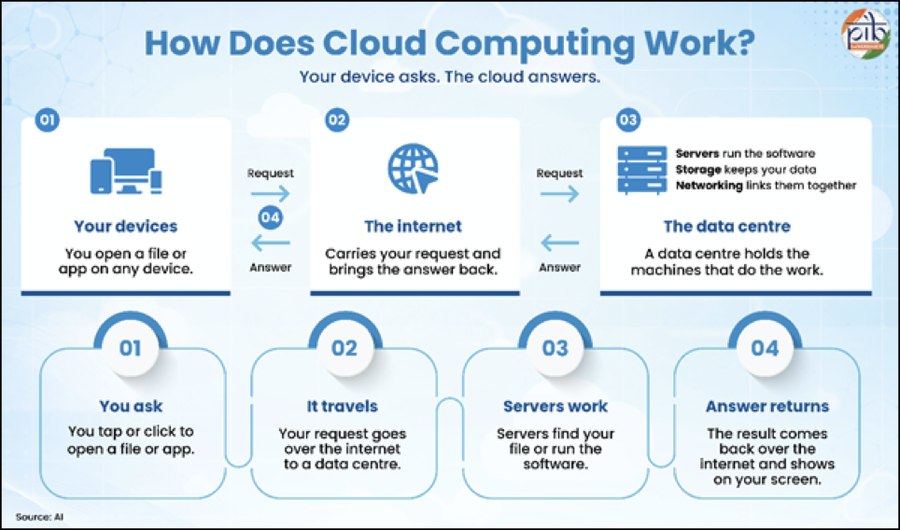
Device → internet → data centre → answer back. Infographic courtesy PIB / MeitY, 29 October 2026; reproduced with credit for educational use.
Service Models — the “Cloud Stack”
Figure 3 — Types of cloud services
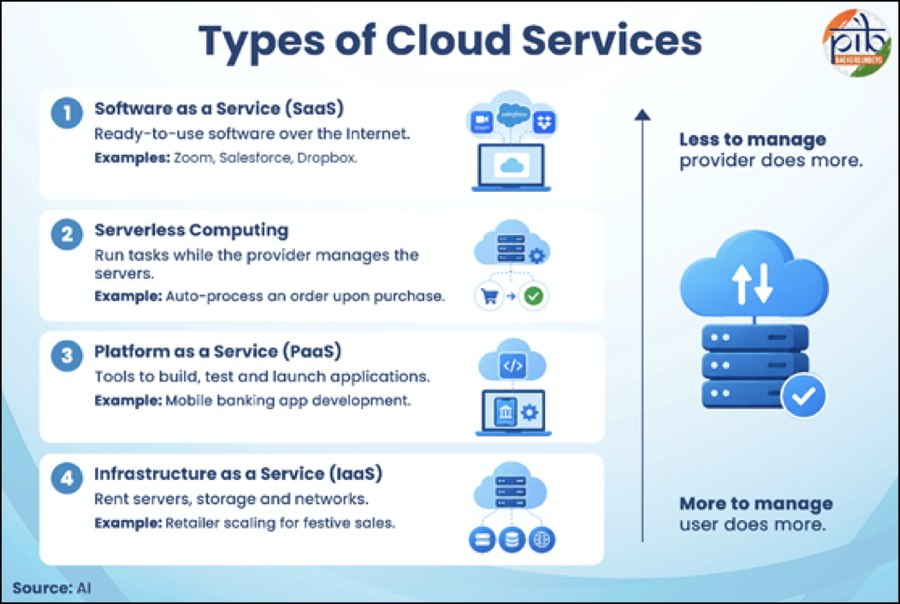
Moving up the stack, the provider manages more and the user less. Infographic courtesy PIB / MeitY, 29 October 2026; reproduced with credit for educational use.
- IaaS (Infrastructure as a Service): rent virtual servers, storage and networks — e.g. a retailer scaling for festive sales.
- PaaS (Platform as a Service): tools to build, test and deploy applications without managing servers — e.g. developing a banking app.
- SaaS (Software as a Service): ready-made software used through a browser or app, maintained by the provider — e.g. video conferencing, online file storage.
- Serverless computing: code runs only when triggered, with the provider managing servers — servers still exist, but are invisible to the developer.
Deployment Models
Figure 4 — Public, private and hybrid clouds
A fourth model, the community cloud, is shared by organisations with common needs. Infographic courtesy PIB / MeitY, 29 October 2026; reproduced with credit for educational use.
▤ India’s Cloud Infrastructure at a Glance
- MeghRaj (GI Cloud): launched by MeitY in 2014; MeghRaj 2.0 offers IaaS, PaaS and SaaS to government; adopted by 2,330 government departments (September 2026), hosting platforms such as DigiLocker, MyGov and the National Scholarship Portal. Private providers are empanelled by MeitY after security audits.
- NIC: the National Informatics Centre runs 4 National Data Centres and 24 Mini Data Centres for government hosting.
- Data centres: capacity of 1.57 GW (August 2026), projected near 8 GW by 2030; hubs in Mumbai–Navi Mumbai, Chennai, Hyderabad, Bengaluru, Delhi-NCR and Jamnagar; about $70 billion of investment under way.
- IndiaAI Mission: outlay of ₹10,371.92 crore; over 45,000 GPUs onboarded as a shared compute facility.
- Skills: FutureSkills PRIME (MeitY–NASSCOM, 2021) and NIELIT centres train cloud, AI and cybersecurity professionals.
- Governance support: the National e-Governance Division (NeGD) appraises e-governance projects’ architecture and security.
Figure 5 — India’s data-centre capacity (GW of IT load)
August 20261.572030 (projected)~8About a five-fold rise in four yearsData-centre size is measured in electrical power (MW/GW), not storage
Bars drawn to scale. Chart recreated by Legacy IAS from MeitY figures.
Law and Data Sovereignty
- DPDP Act, 2023 — cross-border transfers: the Act follows a negative-list approach — personal data may be transferred abroad except to countries the Centre restricts by notification; stricter sectoral rules continue to apply.
- Sectoral localisation: the RBI’s 2018 directive requires payment-system data to be stored only in India.
- Why it matters: foreign laws can give overseas authorities access to data held by their companies; domestic infrastructure strengthens legal control over sensitive data.
The Critical View
- Energy and water: data centres are power- and cooling-intensive; their growth must be matched with renewable power and efficient cooling, measured by Power Usage Effectiveness (PUE).
- Market concentration: a few global hyperscalers dominate; vendor lock-in and dependence on foreign providers raise strategic questions.
- Cybersecurity: concentration of data creates high-value targets, as recent breaches have shown; cloud contracts need strict security and audit clauses.
- Regional imbalance: capacity clusters near submarine-cable landing points and big cities; dispersal needs reliable power and fibre.
- Balanced view: shared cloud infrastructure lowers costs for governments, start-ups and researchers, and is a prerequisite for India’s AI ambitions.
✎ Mains Practice Question
Cloud computing and data centres are emerging as critical national infrastructure. Discuss India’s initiatives to build a domestic cloud ecosystem and the challenges of balancing data sovereignty, cost and sustainability. 15 marks · 250 words
Environment & Urban Climate ActionGeneral Studies Papers II & III
03
Delhi Declaration 2026: Cities of the Global South Seek a Bigger Role in Climate Governance Ahead of COP31
Core TopicGS-III · Environment — Climate Change, International NegotiationsGS-II · Urban Local Bodies (74th Amendment)Prelims + MainsPIB · Ministry of Housing & Urban Affairs · 29 Oct 2026
The second ARISE Cities Forum in New Delhi ended with the Delhi Declaration on Local Action for Global Climate Goals, setting out ten commitments that cities and local governments of the Global South will carry to COP31 in Antalya, Türkiye — urging that mayors and local bodies be treated as partners in climate decision-making.
◈ Static Background — Why Cities Matter for Climate
- Emissions and risk: cities account for a large majority of global energy-related CO₂ emissions and concentrate exposure to heat, floods and water stress.
- Multilevel governance: national pledges (NDCs under the Paris Agreement, 2015) are largely implemented through local services — transport, buildings, waste, water; “localising NDCs” means translating them into city plans.
- India’s urban local bodies: the 74th Amendment (1992) added Part IXA and the Twelfth Schedule (18 subjects, including urban planning, water supply, urban forestry and protection of the environment).
- Policy links: National Mission on Sustainable Habitat under the NAPCC (2008); Smart Cities Mission and AMRUT (2015); Mission LiFE.
- Organisers: ICLEI — Local Governments for Sustainability (founded 1990), which coordinates the Local Governments and Municipal Authorities (LGMA) constituency at the UNFCCC; the National Institute of Urban Affairs (NIUA) under MoHUA.
Figure 6 — 2026, a “Triple COP” year: the three Rio Conventions
UNFCCCClimate changeCOP31Antalya, TürkiyeConvention: 1992CBDBiodiversityCOP17Yerevan, ArmeniaConvention: 1992UNCCDLand & desertificationCOP17MongoliaConvention: 1994Linked to the 1992 Rio Earth Summit — the Declaration seeks synergy across all three
Diagram drawn by Legacy IAS from UN convention information.
▤ The Forum and the Declaration
- Event: ARISE Cities Forum 2026, New Delhi, 27–28 October; organised by ICLEI South Asia with NIUA, supported by MoHUA; 200+ participants from 50+ cities in 18+ countries.
- Theme: “From Bharat to Antalya — Commit. Implement. Deliver.”
- Ten commitments include: advancing the agenda to COP31; adaptation and synergies across conventions; circularity (zero waste); an energy-transition outcome that recognises sub-national delivery towards the 1.5°C pathway; just transitions; multilevel climate finance; independent science and data; a joint space for multilevel action; Global South urban leadership; and youth and community leadership.
- Also launched: a Delhi Biodiversity Map developed by ICLEI South Asia.
Analysis
- The finance gap: cities rarely have direct access to international climate funds; most finance flows to national governments. “Institutionalising multilevel finance” targets this.
- Capacity at home: many Indian urban local bodies have limited own revenue and technical staff; Twelfth Schedule functions are unevenly devolved, constraining city-level climate action.
- Formal status: local governments participate in the UNFCCC as observers through the LGMA constituency; they have no negotiating role — the Declaration seeks greater recognition within this structure.
- India’s urban priorities: heat action plans, flood resilience, electric public transport, waste management and urban greening are areas where local action produces measurable results.
✎ Mains Practice Question
National climate pledges are ultimately implemented in cities. Discuss the role of urban local bodies in achieving India’s climate goals and the institutional and financial constraints they face. 15 marks · 250 words