

In-Depth PIB Analysis2 Items
Core TopicImportantConcise
International RelationsGS Paper II
01PM Modi's State Visit to Uzbekistan
Economy & AgricultureGS Paper III
02Per Drop More Crop — Micro-Irrigation Scheme
International RelationsGeneral Studies Paper II
01
PM Modi's State Visit to Uzbekistan — Comprehensive Strategic Partnership Deepened
GS-II · IR — India & Central Asia, Bilateral RelationsPrelims + MainsPIB · PMO · 31 August 2026
Prime Minister Narendra Modi's state visit to Uzbekistan — the first by an Indian PM in several years — produced a wide-ranging outcomes document, a state honour, and a reaffirmation of the India–Uzbekistan Comprehensive Strategic Partnership, signalling India's deepening engagement with Central Asia.
◈ Background & Context
India's relationship with Uzbekistan dates to the early post-Soviet period.
The two countries share civilisational and cultural ties, particularly through the shared heritage of the Mughal period — Babur, the founder of the Mughal Empire, hailed from the Fergana Valley in present-day Uzbekistan. Diplomatic relations were established in 1991.
- Uzbekistan is a landlocked, doubly-landlocked country (does not border any sea-access state) — making India's connectivity projects in the region especially relevant.
- India and Uzbekistan are both members of the Shanghai Cooperation Organisation (SCO).
- The partnership was elevated to a Comprehensive Strategic Partnership in 2022 during the SCO Samarkand summit.
- Tashkent has a historical significance for India — the Tashkent Agreement (1966) was signed here after the Indo-Pakistani War of 1965.
Figure 1 — Uzbekistan: Location and Neighbours
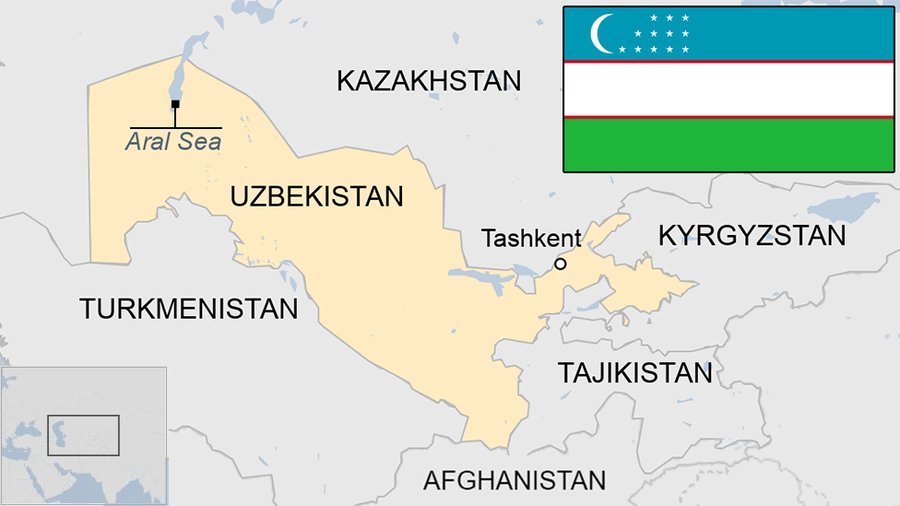
Uzbekistan is doubly landlocked — it borders no ocean-access state — making multimodal connectivity (INSTC, Chabahar) critical for India's trade linkages. Image reproduced with credit for educational use.
Key Outcomes of the Visit
- MoUs and Agreements: Multiple MoUs were signed covering defence cooperation, digital infrastructure, health, education, and trade facilitation.
- Connectivity: Both sides reaffirmed commitment to the International North–South Transport Corridor (INSTC) and the significance of Chabahar Port for Afghanistan-transit trade and Central Asian connectivity.
- SCO Context: The visit reinforced India's Central Asia strategy within the SCO framework and the Global South narrative.
- Cultural & Educational: PM Modi visited Tashkent State University of Oriental Studies and laid a wreath at the Shastri Memorial — a nod to the 1966 Agreement.
- Trade: Both sides discussed expanding the bilateral trade basket, reducing dependence on third-country intermediaries, and establishing direct payment mechanisms.
▤ Scheme at a Glance — Bilateral Framework
- Partnership Level: Comprehensive Strategic Partnership (since 2022)
- SCO Membership: Both India and Uzbekistan are full SCO members
- Connectivity Framework: INSTC (International North–South Transport Corridor)
- Key Port: Chabahar Port (Iran) — India's gateway to Central Asia bypassing Pakistan
- Highest Honour Conferred: "Oliy Darajali Do'stlik" Order (Order of Highest Friendship) — awarded to PM Modi by President Mirziyoyev
- Historical Anchor: Tashkent Agreement (10 January 1966) — Lal Bahadur Shastri, who died in Tashkent the same day
The "Oliy Darajali Do'stlik" Order
- Uzbekistan's highest state honour for foreign leaders, conferred by President Shavkat Mirziyoyev.
- PM Modi dedicated the award to India's 1.4 billion citizens and described it as a symbol of the enduring friendship between the two civilisations.
- He framed the honour as carrying added responsibility for India to work with Uzbekistan as Global South partners.
- Prelims hook: "Do'stlik" means "Friendship" in Uzbek. The order is the highest honour for foreign leaders; the highest domestic order is the "O'zbekiston Qahramoni" (Hero of Uzbekistan).
India's Central Asia Connect — Why It Matters for UPSC
- Geographic challenge: Pakistan denies India overland access to Afghanistan and Central Asia; Chabahar and the INSTC are India's workarounds.
- SCO as a platform: India uses the SCO to engage Central Asian states on trade, counter-terrorism, and connectivity without the bilateral frictions that characterise its Pakistan and China relationships.
- Energy & Resources: Central Asia holds significant reserves of oil, gas, uranium, and rare-earth minerals; India has strategic interests in diversifying its energy supply chain.
- Counter-terror: The RATS (Regional Anti-Terrorist Structure) of the SCO coordinates among member states — relevant to India's internal security concerns emanating from Afghanistan post-2021.
Critical View
- India's trade with Central Asia remains well below potential — intermediary routes through Russia and China dominate, and INSTC operationalisation has been slow.
- Progress on direct payment mechanisms (rupee-som trade) faces the challenge of currency convertibility and correspondent banking gaps.
- Uzbekistan's own economic reforms under President Mirziyoyev have reduced its historical dependence on Russia; India needs to capitalise on this window before Chinese infrastructure investment dominates.
- The Global South framing is rhetorically useful but needs to be backed by concrete concessional financing and capacity-building commitments.
✎ Mains Practice Question
India's Central Asia policy has been described as "geographically ambitious but logistically constrained." In this context, evaluate the significance of PM Modi's state visit to Uzbekistan and critically assess India's connectivity and strategic options in the Central Asian region. 15 marks · 250 words
Economy & AgricultureGeneral Studies Paper III
02
Per Drop More Crop (PDMC) — India's Micro-Irrigation Drive Explained from Basics
GS-III · Agriculture — Water Use Efficiency, Irrigation SchemesPrelims + MainsPIB · Ministry of Agriculture & Farmers Welfare · 29 August 2026
India uses over 80% of its freshwater for agriculture, yet less than half the net sown area has irrigation facilities — a paradox that the Per Drop More Crop scheme tries to resolve through subsidised micro-irrigation, now covering 115 lakh hectares.
◈ Background & Context — The Water Crisis in Indian Agriculture
Indian agriculture is overwhelmingly dependent on flood or furrow irrigation — a method that wastes large quantities of water through evaporation, runoff, and deep percolation.
With groundwater levels declining in key agricultural states (Punjab, Haryana, Rajasthan, Gujarat), and erratic monsoons compounding the problem, improving water-use efficiency is a national priority.
- India has 4% of global freshwater resources but supports 17% of the world's population and 15% of global livestock.
- Agriculture accounts for roughly 80–85% of India's total water withdrawal.
- Groundwater provides about 65% of irrigation water; over-extraction has depleted aquifers in the Indo-Gangetic Plain and peninsular India.
- Micro-irrigation delivers water directly to the root zone through drip or sprinkler systems, typically achieving 30–70% water savings over flood irrigation.
▤ Scheme at a Glance — Per Drop More Crop (PDMC)
- Nodal Ministry: Ministry of Agriculture & Farmers Welfare
- Type: Centrally Sponsored Scheme (CSS)
- Current Umbrella: Pradhan Mantri Rashtriya Krishi Vikas Yojana (PM-RKVY) since 2022–23
- Financial Assistance: Up to 5 hectares per beneficiary; 55% for small & marginal farmers, 45% for others
- Central Outlay (last 3 years): ₹8,123.24 crore released
- PM-RKVY Sanction (2025–26): ₹8,957.72 crore (total); ₹3,226.36 crore for PDMC
- Coverage (July 2026): 115 lakh hectares (~8.11% of net sown area)
- Re-eligibility: Same land eligible for fresh assistance after 7 years
- Stated goal: Increase water-use efficiency and farm incomes at field level
Lineage — How the Scheme Evolved
- 2006: Centrally Sponsored Scheme (CSS) for Micro Irrigation — the starting point.
- 2010–11: Upgraded to National Mission on Micro Irrigation (NMMI).
- 2014–15: Merged into National Mission on Sustainable Agriculture (NMSA) under "On Farm Water Management" (OFWM).
- 2015–16 to 2021–22: Named Per Drop More Crop (PDMC) and implemented as a core component of Pradhan Mantri Krishi Sinchayee Yojana (PMKSY).
- 2022–23 onwards: Placed under restructured PM-RKVY — which merged nine schemes into one umbrella.
- UPSC tip: The PMKSY → PM-RKVY shift is a frequent source of exam confusion. PDMC is the constant; its umbrella has changed.
Types of Micro-Irrigation — The Technical Basics
PDMC supports two broad categories of micro-irrigation systems, each suited to different crop types and field conditions.
Figure 2 — Types of Micro-Irrigation Systems under PDMC (Ministry of Agriculture)
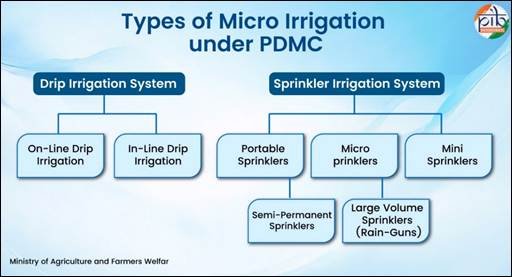
Drip irrigation delivers water at the root zone; sprinkler systems simulate rainfall for high-density crops. Rain-guns can discharge up to 32,000 litres per hour for large-area coverage. Image: Ministry of Agriculture & Farmers Welfare, PIB; reproduced for educational use.
Drip Irrigation — How It Works
- Water is delivered slowly and directly to the root zone through small outlets (emitters) mounted on thin lateral pipes.
- On-line drip: Drippers installed along the pipe wherever a plant is located — suitable for crops with irregular spacing (orchards, vineyards).
- In-line drip: Drippers built into the pipe at fixed intervals — uniform water delivery, used for row crops with even spacing.
- Fertigation: Fertilisers dissolved in the irrigation water and delivered directly to the root zone — reduces fertiliser wastage by 11–19% and improves nutrient uptake efficiency.
Sprinkler Systems — Varieties and Uses
- Portable Sprinklers: Moveable main and sub-main pipes; suitable for plains and undulating terrain; versatile for multiple crops.
- Micro Sprinklers: Low-radius; used for leafy vegetables, nurseries, and seedling hardening; also modifies micro-climate near plants.
- Mini Sprinklers: For close-growing crops — groundnut, potato, onion, ginger; also used for frost protection.
- Semi-Permanent Sprinklers: Main and lateral pipes permanently buried; only nozzles on riser pipes are moveable — lower operating cost.
- Rain-Guns (Large Volume Sprinklers): Discharge 10,000–32,000 litres per hour; radius 24–36 m; require high-pressure pumps; for large-area coverage in short time.
Institutional Architecture
- National level: National Stewardship Council (NSC) — strategic direction and guidance.
- State level (three-tier):
- State Level Sanctioning Committee (SLSC) — plan approval.
- Inter-Departmental Working Group (IDWG) — cross-departmental coordination.
- District Level Implementation Committee (DLIC) — field execution and coordination.
- New Flexibility (2026): States can now exceed the earlier 20% cap (40% for NE/Himalayan states) on funds for water conservation structures (diggis, farm ponds) under "Other Interventions."
Measured Outcomes (Independent Studies)
- NITI Aayog evaluation (2020–21): Income gains of 10–69%; water use efficiency improved 30–70%.
- Economic Survey 2020–21: Water savings 20–48%; energy savings 10–17%; labour cost reduction 30–40%; fertiliser savings 11–19%; crop yield increase 20–38%.
- IIM Ahmedabad study (2023, six states): Farmers adopt micro-irrigation primarily to address declining groundwater, suit crop-specific needs, and secure long-term benefits.
- 2025–26 progress: 12.30 lakh farmers benefited; ~20% women beneficiaries; top states — Maharashtra, Karnataka, Andhra Pradesh, Tamil Nadu, Gujarat, Rajasthan.
Case Study — From Flood to Drip in Andhra Pradesh
- Farmer LAM Srinivasa Rao of Palnadu district adopted drip irrigation in his 2-acre acid lime orchard.
- Yield: rose from 90 to 105 quintals/acre.
- Cultivation cost: fell from ₹3.0 lakh to ₹2.4 lakh.
- Net income: increased from ₹1.5 lakh to ₹2.85 lakh — an additional ₹1.35 lakh per cycle.
Critical View
- Coverage of 115 lakh hectares represents only 8.11% of net sown area — the pace of adoption remains slow relative to the scale of the water crisis.
- Small and marginal farmers (who hold 86% of holdings but only 47% of cultivated area) face upfront costs and technical capacity barriers even with subsidies.
- Drip and sprinkler systems need regular maintenance; post-installation support is weak in many states.
- The shift from PMKSY to PM-RKVY introduces state-level flexibility but also risks dilution of dedicated micro-irrigation focus if states reallocate funds to other components.
- Fertigation adoption is growing but is limited by access to soluble fertilisers and farmer awareness in rain-fed regions.
✎ Mains Practice Question
India faces a paradox of being water-stressed while losing a large proportion of irrigation water to inefficiency. Critically evaluate the Per Drop More Crop (PDMC) scheme as a policy response to this challenge, examining its design, coverage, institutional architecture, and the gaps that limit its transformative potential. 15 marks · 250 words