

In-Depth PIB Analysis2 Items
Core TopicImportantConcise
Polity, Governance & Social JusticeGS Paper II
01Prevention of Insults to National Honour (Amendment) Bill, 2026
Science & Technology · Internal SecurityGS Paper III
02INS Nipun — Second Indigenous Diving Support Vessel Delivered
Polity, Governance & Social JusticeGeneral Studies Paper II
01
Vande Mataram Gets Statutory Protection — The National Honour Amendment Bill, 2026
GS-II · Polity — Constitutional Provisions, LegislationPrelims + MainsPIB · Ministry of Home Affairs · 30 July 2026
Parliament moved to equalise the legal standing of the National Song (Vande Mataram) with the National Anthem (Jana Gana Mana) by amending the Prevention of Insults to National Honour Act, 1971 — closing a 75-year-old statutory gap that the Constituent Assembly had flagged but never addressed.
◈ Background & Context
The Prevention of Insults to National Honour Act, 1971 was enacted on 23 December 1971 and extends to the whole of India. It provides statutory protection to three national symbols: the Indian National Flag, the Constitution of India, and the National Anthem, Jana Gana Mana.
The National Song, Vande Mataram, was conspicuously absent from the Act's penal coverage despite its acknowledged stature.
- Original Section 3 (pre-amendment): Criminalised intentionally preventing the singing of Jana Gana Mana or causing a disturbance to any assembly engaged in singing it. Punishment: imprisonment up to three years, or fine, or both.
- Section 3A (added 2003): Mandates a minimum one-year imprisonment for second or subsequent convictions under Sections 2 or 3.
- The statutory gap: No provision of the 1971 Act expressly criminalised interference with the singing of Vande Mataram — leaving the National Song in a zone of symbolic recognition without commensurate legal protection.
▤ Bill at a Glance
- Bill title: Prevention of Insults to National Honour (Amendment) Bill, 2026
- Parent Act amended: Prevention of Insults to National Honour Act, 1971
- Section amended: Section 3 (substituted in full by Clause 2 of the Bill)
- New scope: Extends protection to both the National Anthem (Jana Gana Mana) and the National Song (Vande Mataram)
- Conduct covered: Intentionally (a) preventing the singing of either, or (b) causing disturbance to any assembly engaged in such singing
- Punishment: Imprisonment up to three years, or fine, or both (unchanged)
- Repeat offenders: Minimum one-year imprisonment under existing Section 3A now applies to Vande Mataram disruptions as well
- Nodal Ministry: Ministry of Home Affairs
The Historical Basis: Constituent Assembly, 24 January 1950
On 24 January 1950 — the day before the Constitution came into force — the Constituent Assembly took a formal resolution on the National Song.
The then-President of the Assembly, Dr. Rajendra Prasad, placed on record that Vande Mataram, which had served as the rallying song of the independence movement, should be honoured equally with Jana Gana Mana and accorded equal status.
That resolution expressed intent but created no enforceable right; the 2026 amendment converts that 75-year-old intent into statute.
Vande Mataram — Static Background
- Author: Bankim Chandra Chatterjee (1838–1894), a Bengali novelist and the first Deputy Collector of the Bengal Civil Service.
- First publication: The song was first published in the literary journal Bangadarshan on 7 November 1875.
- Novel incorporation: It was later embedded in Chatterjee's landmark novel Anandamath (1882), set during the Sannyasi Rebellion of the late 18th century. The novel fictionalised the conflict between Indian monks and the colonial revenue system in Bengal.
- Musical setting: Rabindranath Tagore set Vande Mataram to music and first sang it publicly at the 1896 session of the Indian National Congress, held in Calcutta — Tagore composed the specific raga-based melody that became canonical.
- Political mobilisation: The song was first used as a political slogan during the Swadeshi Movement on 7 August 1905, the day the Partition of Bengal (1905) came into effect. The Swadeshi agitation, centred on boycott of British goods and promotion of indigenous enterprise, made Vande Mataram its anthem.
- Constitutional status: India has a National Anthem (Jana Gana Mana) and a National Song (Vande Mataram). The Constitution does not itself designate either; both designations rest on Constituent Assembly resolutions of January 1950.
- Meaning: "Vande Mataram" translates as "Mother, I bow to thee" — the "mother" being the motherland.
What Changes — Before and After
- Before 2026: Disrupting Jana Gana Mana → criminal offence. Disrupting Vande Mataram → no specific penal provision.
- After 2026: Disrupting either Jana Gana Mana or Vande Mataram → identical offence, identical punishment, identical repeat-offender surcharge.
- Institutional parity: The amendment reflects a formal legislative acknowledgement that both symbols carry equivalent national standing, aligning penal law with the 1950 Constituent Assembly resolution.
Critical View
- Symbolic vs. operational impact: Few prosecutions have ever been brought under Section 3 of the 1971 Act for Anthem-related disruptions. The amendment's practical effect may therefore be more symbolic than operational — extending a provision that is itself rarely invoked.
- Freedom of expression concerns: Civil liberties discourse has historically queried whether penal provisions around patriotic symbols adequately protect dissent. The amendment expands the ambit of such provisions; critics may argue this could chill legitimate protest.
- Historical controversy: Vande Mataram has a more contested political history than Jana Gana Mana. Some communities objected to certain verses as having religious connotations, a debate prominent at the time of Independence. The amendment treats the song as an undifferentiated legal unit, sidestepping this textual complexity.
Figure 1 — Legal Protection of National Symbols: The 1971 Act & 2026 Amendment
Pre-2026 (Act of 1971)Post-2026 (Amendment)SYMBOLS PROTECTEDSYMBOLS PROTECTED🏳 National Flag (S.2)📜 Constitution of India (S.2)🎵 Jana Gana Mana — Anthem (S.3)Vande Mataram — No coverage🏳 National Flag (S.2)📜 Constitution of India (S.2)🎵 Jana Gana Mana — Anthem (S.3)🎵 Vande Mataram — Song (S.3) ✓
The 2026 Amendment fills the only gap in national-symbol coverage — Vande Mataram now carries identical penal protection to Jana Gana Mana under Section 3.
✎ Mains Practice Question
The Prevention of Insults to National Honour (Amendment) Act, 2026 extends statutory protection to Vande Mataram. Examine the historical and constitutional basis for this amendment, and critically analyse the balance between the protection of national symbols and the right to freedom of expression under Article 19 of the Constitution. 15 marks · 250 words
Science & Technology · Internal Security & DefenceGeneral Studies Paper III
02
INS Nipun Delivered to the Indian Navy — Expanding Indigenous Deep-Sea Dive Capability
GS-III · Science & Technology — Defence, IndigenisationPrelims + MainsPIB · Ministry of Defence · 30 July 2026
Hindustan Shipyard Limited delivered the second indigenously built Diving Support Vessel, Nipun, to the Indian Navy at Visakhapatnam on 30 July 2026 — a vessel designed for deep-sea saturation diving, submarine rescue, and salvage operations, carrying approximately 75% indigenous content.
◈ Background & Context
A Diving Support Vessel (DSV) is a specialised naval platform equipped to support underwater operations that go beyond the reach of standard surface-supplied or scuba diving — particularly deep-sea saturation diving, which allows divers to live and work at pressure over extended periods.
The Indian Navy operates in the Indo-Pacific, including the Andaman Sea and the deep littoral waters of the western seaboard, where such niche capability is operationally critical.
- Saturation diving: A technique that allows divers to live at the pressure of their working depth for days to weeks, reducing decompression stops. Essential for operations below 50 metres — including submarine rescue, pipeline repair, and wreck salvage.
- First DSV: Nipun is the second vessel of its class. The first DSV in this series, also built by Hindustan Shipyard Limited, preceded it. The name "Nipun" (Sanskrit: adept, well-versed in a discipline) signals specialised competence.
- Visakhapatnam delivery: Hindustan Shipyard Limited (HSL), headquartered at Visakhapatnam (Andhra Pradesh), is a Government of India undertaking under the Ministry of Defence. It is one of India's oldest shipyards, originally established in 1941 as a commercial repair facility and nationalised in 1952.
▤ Vessel at a Glance
- Vessel name: Nipun (Sanskrit — "one who is adept and well-versed in a particular discipline")
- Type: Diving Support Vessel (DSV), second of class
- Builder: Hindustan Shipyard Limited (HSL), Visakhapatnam
- Classification: Indian Register of Shipping (IRS) — designed and constructed to IRS Classification Rules
- Delivery date: 30 July 2026, Visakhapatnam
- Indigenous content: Approximately 75% (per government statement)
- Primary capability: Deep Sea Saturation Diving; side diving stage for surface operations
- Remotely Operated Vehicles (ROVs): Fitted to support diver monitoring and salvage
- Mother Ship function: Serves as the support platform (Mother Ship) for the Deep Submergence Rescue Vehicle (DSRV) to evacuate personnel from distressed submarines
Key Technologies on Board
- Deep Sea Saturation Diving System: An onboard hyperbaric complex — living chambers, transfer under pressure (TUP) bells, and life-support systems — that allows divers to remain at operational depth for days. This is a niche technology held by very few navies globally.
- Side Diving Stage: A deployment mechanism that lowers divers from the ship's side directly into the water column at controlled rates, essential for surface-supply diving operations at moderate depths.
- Remotely Operated Vehicles (ROVs): Unmanned underwater vehicles operated via tether, used for visual inspection, monitoring divers, and light salvage work at depths beyond safe diver range.
- DSRV Mother Ship Capability: The Deep Submergence Rescue Vehicle is a small submarine-like craft that can mate with a distressed submarine's escape hatch and evacuate crew. Nipun carries, maintains, and deploys the DSRV, making it the primary submarine rescue platform.
Hindustan Shipyard Limited — Static Background
- Founding: Established in 1941 at Visakhapatnam by industrialist Walchand Hirachand as a commercial vessel repair yard — making it one of India's first major private industrial enterprises.
- Nationalisation: Taken over by the Government of India in 1952 and placed under the Ministry of Defence.
- Strategic role: One of four government-owned shipyards engaged in naval construction (alongside Mazagon Dock Shipbuilders, Garden Reach Shipbuilders & Engineers, and Goa Shipyard). HSL has focused historically on logistic vessels, diving support platforms, and submarine refit.
- Indian Register of Shipping (IRS): The statutory body that classifies and surveys Indian-flagged vessels and offshore platforms. Vessels built to IRS rules meet internationally benchmarked structural and safety standards — a requirement for naval vessels intended for extended operations.
Indigenisation Context — Aatmanirbhar Bharat in Naval Construction
- Policy framework: The government's Aatmanirbhar Bharat Abhiyan (Self-Reliant India Mission, 2020) set targets for indigenisation across defence procurement. The Ministry of Defence has issued multiple Positive Indigenisation Lists — catalogues of items that can only be procured domestically — covering 509+ items by 2024.
- Naval indigenisation trajectory: India has progressively moved from licence-built foreign designs (INS Vikrant aircraft carrier, P-75 submarines) toward fully indigenous design-and-build projects. Nipun represents the niche-capability end of this spectrum — saturation diving systems being a globally restricted technology.
- 75% indigenous content: The 75% figure is significant in the context of deep-sea diving platforms, where saturation diving systems and hyperbaric chambers have historically been imported from European or American suppliers (Divex, Kirby Morgan, etc.). Achieving 75% indigenous content in this domain indicates meaningful domestic manufacturing depth.
Critical View
- Fleet adequacy: The Indian Navy operates in waters stretching from the Persian Gulf to the Malacca Strait. Two DSVs across this theatre may be insufficient for simultaneous deep-sea operations, submarine emergencies, and peacetime salvage commitments.
- Technology depth vs. declared percentages: Indigenous content percentages in defence platforms often reflect value share rather than technology complexity. The degree to which critical saturation diving systems — historically a foreign-dominated niche — are now genuinely manufactured in India merits scrutiny.
- Submarine fleet risks: India operates an ageing conventional submarine fleet (Sindhughosh/Kilo-class dating to the 1980s–90s alongside the newer Scorpène P-75 class). The DSRV and its Mother Ship fill a real operational gap as these platforms age and the risk of incidents rises.
Figure 2 — INS Nipun: Commissioning Ceremony, Visakhapatnam, 30 July 2026
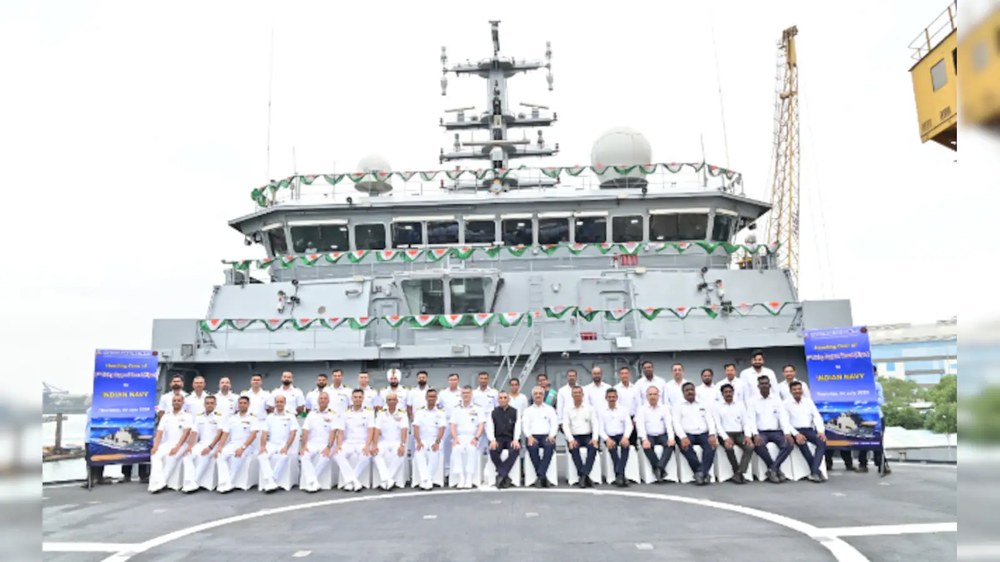
Indian Navy officers and Hindustan Shipyard Limited personnel at the delivery ceremony of INS Nipun, the second indigenous Diving Support Vessel, at Visakhapatnam. Image courtesy PIB / Ministry of Defence; reproduced with credit for educational use.
Figure 3 — Deep-Sea Dive Operations: Capability Architecture of a Diving Support Vessel
NIPUN — Diving Support VesselHSL-built · IRS-certified · 75% IndigenousSaturation DivingHyperbaric livingchambers; TUP bellops to great depthROVs on BoardUnmanned vehiclesfor diver monitoring& salvage supportDSRV Mother ShipCarries, deploys &supports rescuesubmersible fordisabled submarinesOperational Outcome: Niche Deep-Sea Capability for the Indian Navy in the Indo-PacificSubmarine rescue · Wreck salvage · Deep-sea infrastructure support · Mine clearance assistance
Nipun integrates three distinct niche capabilities — making it a multi-role deep-sea platform rather than a single-mission vessel.
✎ Mains Practice Question
Examine the strategic significance of indigenously built specialised naval platforms such as Diving Support Vessels in the context of India's maritime security doctrine and the Aatmanirbhar Bharat initiative. What are the key challenges in achieving genuine indigenisation in niche defence technologies? 15 marks · 250 words