
Published on Dec 1, 2025
Daily Current Affairs
Current Affairs 01 December 2025

Content
- Routine Gridlocks & Parliament’s Institutional Health
- How Antibiotic Misuse Is Fuelling a Crisis in ICUs Across India
- Rupee’s Fall Is ‘Real’ This Time: Beyond the Headline Number
- Ditwah: How Tropical Cyclones Are Named
- Polluter Pays: Developing Nations Call for a ‘Meat Tax’ on High-Income Countries
Routine Gridlocks & Parliament’s Institutional Health
Why is it in News?
- Winter Session begins under concerns of possible Special Intensive Revision (SIR) of electoral rolls and persistent parliamentary disruptions.
- Editorials warn that routine gridlocks, declining debate quality, and shrinking sittings are eroding Parliament’s institutional health.
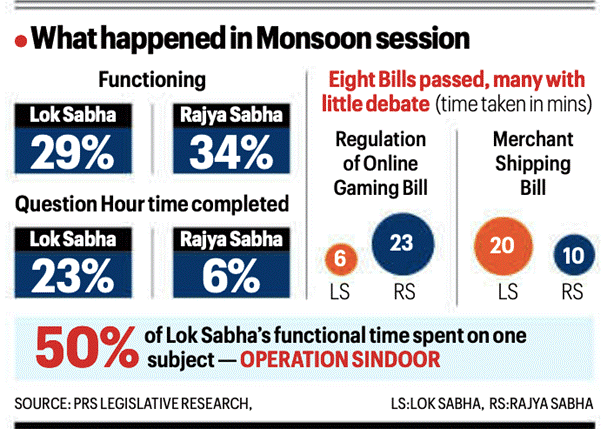
- Monsoon Session saw alarmingly low productivity: Lok Sabha 29%, Rajya Sabha 34%; Question Hour disrupted massively.
- Former Lok Sabha Secretary-General P. D. T. Achary warns diminishing deliberation is undermining the constitutional purpose of Parliament.
Relevance
GS 2 – Polity & Governance
- Declining productivity of Parliament; weakening deliberative democracy.
- Articles 107–111 (legislative procedure), Article 118 (rules of procedure).
- Executive accountability erosion: Question Hour dilution, minimal scrutiny.
- Parliamentary Committees declining → weak legislative oversight.
- Issues of federalism and political polarisation affecting legislative functioning.
GS 2 – Parliament & Democratic Institutions
- Institutional decline: low sittings, disruptions, majoritarian tendencies.
- Anti-defection law reducing debate autonomy.
- Role of LoP, floor coordination failures, legislative planning deficits.
Basics: Role & Purpose of Parliament
- Legislature’s core functions: lawmaking, executive accountability, financial oversight, deliberation.
- Article 107–111: legislative procedure; Article 118: rules of procedure.
- Question Hour, Zero Hour, Committees: designed to anchor accountability.
- Parliamentary norms: deliberation, consensus-building, scrutiny of government.
Declining Productivity
- Monsoon Session 2024: LS 29%, RS 34% functioning; Question Hour barely operated.
- Sharp fall from historic norms: Sessions in 1950s–70s averaged 120+ sittings, now often ~60–70 sittings/year.
- 17th Lok Sabha (2019–24): worst average in decades; RS fared slightly better but also downward.
Routine Disruptions Becoming Norm
- Disruptions no longer exception; increasingly weaponized tactics by both treasury & opposition benches.
- Loss of debate time: Eight Bills passed with little or no debate (some under 10 minutes).
- “Operation Sindoora” data: 50%+ of LS time spent on disruptions.
Breakdown in Floor Coordination
- Erosion flows from failure of dialogue between Leader of the House & Leader of Opposition.
- Pre-legislative consultation is minimal → Bills rushed.
- All-party meetings have become symbolic, not substantive.
Declining Scrutiny of Bills
- Only 13–15% of Bills sent to Parliamentary Standing Committees in recent years (down from 60%+ a decade ago).
- Bills increasingly passed without clause-by-clause debate.
- Examples: Online Gaming Bill, Merchant Shipping Bill passed with less than 10 minutes of debate.
Majoritarianism vs. Parliamentary Spirit
- With strong majority governments, tendency to treat Parliament as legitimising body, not deliberative body.
- Opposition protests → Government bypasses debate via guillotine, voice vote, short notices.
Question Hour Dilution
- Most crucial accountability tool; its repeated suspension directly reduces executive oversight.
- Data: Only 23% (LS) & 36% (RS) Question Hour utilization in Monsoon Session.
Institutional Consequences
- Weakening parliamentary norms → rising executive dominance.
- Bills passed without scrutiny risk constitutional infirmities, litigations, and policy incoherence.
- Public trust erodes; Parliament becomes “acclamation chamber” not deliberative institution.
Structural Reasons Behind Gridlocks
- Polarized politics, absence of consensus-building culture.
- Anti-defection law reduces inner-party debate; MPs have little autonomy.
- Televised sessions incentivize disruptions for media visibility.
- Poor legislative planning: late circulated Bills, minimal notice.
Need for Institutional Reforms
- Mandatory minimum sittings (UK-style: 120 days).
- Revive Business Advisory Committee & ensure cross-party coordination.
- Mandatory Committee reference for all non-emergency Bills.
- Reform anti-defection law to allow intra-party dissent.
- Time-bound debate mechanism like UK’s “Westminster Hall debates”.
Comparative Perspective
- Arend Lijphart: consensus democracies require negotiation → India drifting to majoritarianism.
- Mansbridge: deliberative democracy thrives on transparency & debate → absent in current legislature.
- Garrett & Tsebelis: strong executives without veto players reduce scrutiny → India fits this pattern.
Conclusion
- Parliamentary gridlocks reflect deep institutional decay, not episodic political friction.
- Declining deliberation, shrinking sittings, and minimal scrutiny threaten executive accountability and constitutional balance.
- Reviving Parliament requires structural reforms + political will to restore dialogue, debate, and democratic deliberation.
How Antibiotic Misuse Is Fuelling a Crisis in ICUs Across India
Why is it in News?
- New data from ICMR and tertiary hospitals show sharp rise in antimicrobial resistance (AMR) in ICUs across India.
- Nearly 2.6 lakh deaths in India in 2021 linked to AMR.
- Hospitals are overprescribing antibiotics; many prescriptions not based on microbiological evidence.
- ICUs reporting patients who no longer respond to even last-line antibiotics.
Relevance
GS 2 – Health
- Public health crisis due to AMR; hospital governance & regulation.
- Role of ICMR: surveillance, stewardship frameworks.
- Gaps in healthcare infrastructure, diagnostics, sanitation, infection control.
GS 3 – Science & Technology
- Microbiology basics: AMR, superbugs, ICU pathogens (Klebsiella, Acinetobacter).
- Need for diagnostic capacity, lab ecosystem strengthening, rapid tests.
GS 3 – Disaster Management / Public Health Emergency
- AMR as a slow-moving disaster → mortality burden (2.6 lakh deaths).
- ICU vulnerabilities, HAIs, systemic risk to healthcare systems.
What is Antimicrobial Resistance (AMR)?
- Microorganisms (bacteria, viruses, fungi) evolve to resist drugs meant to kill them.
- Caused by overuse/misuse of antibiotics in humans, animals, and environment.
- Leads to “superbugs” that standard drugs cannot kill → prolonged illness, mortality, higher costs.
- WHO lists AMR as top 10 global health threats.
Scale of the Crisis in ICUs
- ICUs facing multi-drug resistant and pan-drug resistant bacteria.
- Patients deteriorate because even carbapenems/colistin often ineffective.
- Hospitals report rising infections by Klebsiella, Acinetobacter, Pseudomonas—major ICU pathogens.
- Clinicians frequently forced to give multiple antibiotic combinations, sometimes blindly.
Why Antibiotic Misuse Is Rising ?
- Empirical prescribing: Doctors prescribe antibiotics without culture tests due to time constraints.
- Diagnostic gaps: Poor infection control, inadequate lab support in many hospitals.
- Patient pressure: Many expect antibiotics even for viral illnesses.
- Defensive medicine: Doctors act to avoid complications or litigation.
- Lack of stewardship: Only 20–30% hospitals have functional antimicrobial stewardship committees.
Key Findings From ICMR Data
- Resistance reported to even reserve/last-line antibiotics (carbapenems, colistin).
- Hospitals now using the “watch group” — antibiotics with higher resistance risk — more frequently.
- Only 6% of antibiotics prescribed in the survey were “definitive treatment” (infection confirmed).
- 94% prescriptions were empirical — based on symptoms rather than lab confirmation.
- Indicates structural diagnostic weakness in Indian hospitals.
ICU-Specific Challenges
- ICU patients have: ventilators, catheters, central lines → high risk of infection.
- Overcrowded ICUs → easier transmission of resistant bacteria.
- Higher antibiotic exposure → faster mutation and survival of resistant strains.
- Resistant bacteria persist in hospital environment (beds, instruments, staff clothing).
Consequences of Rising AMR
- Higher mortality: India among the highest AMR-related deaths globally.
- Increased treatment costs: longer ICU stays, expensive reserve drugs.
- Greater risk of healthcare-associated infections (HAIs).
- Reduced effectiveness of life-saving procedures: transplants, cancer therapy, surgeries.
Structural Issues Fueling the Problem
- Inadequate infection control: Poor sanitation, overcrowding, lack of dedicated IC personnel.
- Antibiotics available without prescription in many parts of India.
- Weak regulation of antibiotics in animal agriculture.
- Poor hand hygiene compliance among healthcare workers.
- Underinvestment in public hospitals → limited diagnostic capacity.
What ICMR Suggests ?
- Strengthen infection control so doctors are not forced to prescribe antibiotics “just in case”.
- Mandatory hospital antibiotic stewardship programmes.
- Ensure protocol-based prescribing and daily review of antibiotic need.
- Create AMR surveillance networks across states.
Diagnosis vs. Infection Control: The Core Problem
- Doctors often confuse colonization (bacteria present but not causing illness) with infection → unnecessary treatment.
- Without culture tests, symptoms alone often misleading.
- Real solution lies in good infection control, not more antibiotics.
Comparative Perspective
- Stuart Levy (AMR scholar): resistance rises wherever selective pressure is high → ICUs are ground zero.
- O’Neill Report (2016): warned AMR could cause 10 million deaths/year by 2050; India a major hotspot.
- Paul Farmer: inequality magnifies infectious disease crisis → seen clearly in India’s public hospitals.
Conclusion
- India’s ICUs are facing a public health emergency driven by antibiotic misuse and weak diagnostic systems.
- Over-prescription, poor infection control, and rising drug-resistant pathogens create a vicious cycle that standard antibiotics can no longer break.
- Strengthening diagnostics, stewardship, and infection control is essential to prevent AMR from becoming India’s next major health crisis.
Beyond the Headline Number: Rupee’s Fall Is ‘Real’ This Time
Why is it in News?
- The rupee breached ₹89/$, closing at ₹89.46 — its lowest ever.
- But unlike previous episodes, the rupee has also depreciated against euro, pound, yen, yuan and not just the dollar.
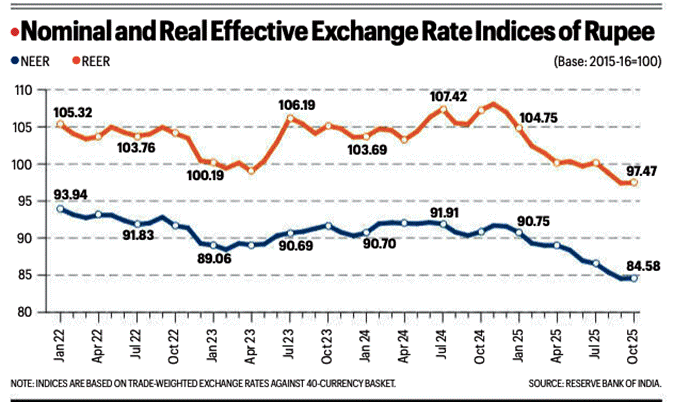
- The Real Effective Exchange Rate (REER) shows “real depreciation”, driven by inflation differentials and global currency movements.
- IMF reclassified India’s exchange-rate regime from “floating” to “stabilised arrangement”—indicating higher RBI intervention.
Relevance
GS 3 – Economy
- Exchange rate concepts: NER, NEER, REER; competitiveness; inflation impact.
- External sector vulnerabilities: trade deficit, capital flows, global currency cycle.
- IMF classification shift → exchange-rate management issues.
- RBI’s role: intervention, reserve use, stabilised arrangement.
GS 3 – Growth & Inflation
- High domestic inflation → real depreciation vs nominal depreciation.
- Impact on imports (fuel, electronics), corporate debt, household inflation.
Key Terms
1. Nominal Exchange Rate (NER)
- Market exchange rate: price of rupee against another currency.
2. Effective Exchange Rates (EERs)
- NEER: Weighted average of rupee against a basket of 40 currencies.
- REER: NEER adjusted for inflation differentials → indicates “true competitiveness”.
3. Appreciation vs. Depreciation
- NEER ↑ → rupee strengthens nominally.
- REER ↑ → rupee overvalued; REER ↓ → rupee undervalued/competitive.
What’s Different This Time?
- Rupee’s fall is broad-based:
- Against USD: 86.84 → 89.46
- Against Euro: 105.74 → 118.27
- Against Pound: 108.61 → 118.17
- Against Yen: 0.56 → 0.57
- Indicates global weakness of INR, not just USD strength.
- Rupee has depreciated across almost all major currencies.
Effective Exchange Rates Reveal the Real Picture ?
NEER
- NEER has declined since 2023, especially post-2024.
- Indicates nominal rupee weakening against the 40-currency basket.
REER
- REER has fallen below 2018–19 levels, meaning:
- Rupee is currently undervalued in real terms.
- Real depreciation exceeds nominal fall because domestic inflation is high.
Why REER Matters More ?
- REER reflects inflation-adjusted competitiveness.
- Even if nominal depreciation is mild, high domestic inflation → real depreciation.
- India’s CPI inflation (~5.4% since May 2025) versus lower inflation in US, EU, Japan etc. widens the gap.
- Thus, REER drop signals genuine loss of purchasing power and export competitiveness shift.
Inflation: Key Driver of “Real” Depreciation
- India’s CPI inflation > trading partners for most of 2024–25.
- Higher inflation domestically → rupee must fall more to maintain competitiveness.
- However, this time depreciation outpaced even inflation impact → structural weakness.
RBI’s Exchange Rate Management
- IMF’s reclassification: India now follows a “stabilised arrangement” →
- RBI intervenes actively to prevent sharp volatility.
- Heavy use of reserves to smooth market movements.
- Implication:
- Rupee’s fall is broader than RBI’s ability to defend.
- After long stability around ₹82–₹83 (2022–2024), structural pressures are showing.
Structural Reasons Behind Rupee Weakness
- Widening trade deficit (oil, electronics, gold imports).
- Weak FPI inflows, outflows from debt and equity.
- Lower export growth, especially in merchandise.
- Strong US dollar due to high US rates until mid-2024.
- China’s yuan depreciation dragging Asian currencies.
- Geopolitical risks and capital flight to safe havens.
Rupee’s Fall Since May 2025
- Sharpest decline among major Asian currencies.
- NEER & REER both dropping together → rare event, reflects deeper weakness.
- Indicates simultaneous nominal and real depreciation, unlike past episodes when RBI absorbed most shocks.
Key Point from Chart
- From June 2022 onward:
- NEER has fallen moderately.
- REER has fallen sharply, especially post-May 2025.
- This combination (nominal fall + high domestic inflation) → rupee now undervalued.
Implications
- Exports: may get a short-term boost, but structural issues limit gains.
- Imports: costlier fuels, electronics, fertilisers → inflationary pressures.
- Corporate debt: higher burden for firms with dollar-denominated loans.
- Government finances: oil subsidies, fertiliser bill may rise.
- Household impact: imported goods and foreign travel more expensive.
Outlook: What Next?
- IMF notes rupee is moving towards greater flexibility.
- If US Fed cuts rates slowly, USD will stay strong → pressure persists.
- RBI likely to intervene only to smoothen volatility, not defend specific levels.
- Structural reforms (exports, manufacturing, energy imports) needed to stabilise rupee long-term.
Conclusion
- Rupee’s depreciation is broad-based and inflation-adjusted, indicating a real loss of value, not just USD strength.
- Both NEER and REER declining together mark a structural weakening, driven by inflation, trade deficit, and soft capital flows.
- Without addressing economic fundamentals, rupee’s slide will continue despite RBI’s stabilisation efforts.
Ditwah: How Are Tropical Cyclones Named?
Why is it in News?
- Cyclone Ditwah, located near Tamil Nadu’s coast, is weakening into a deep depression.
- Raises questions on how cyclones get their names, especially in the Indian Ocean region.
Relevance
GS 1 – Geography
- Tropical cyclones: formation, basins, regional naming protocols.
- North Indian Ocean cyclone system: Arabian Sea & Bay of Bengal.
GS 3 – Disaster Management
- IMD as RSMC for cyclone naming, warnings, advisories.
- Operational role of naming in communication, preparedness, risk reduction.
- WMO/ESCAP Panel functioning; country submissions; naming rules.
What Are Tropical Cyclone Names?
- Assigned by Regional Specialized Meteorological Centres (RSMCs) and Tropical Cyclone Warning Centres (TCWCs).
- For the North Indian Ocean (Arabian Sea + Bay of Bengal), naming is done by WMO/ESCAP Panel on Tropical Cyclones (PTC).
Who Decides the Names?
- WMO/ESCAP Panel on Tropical Cyclones (PTC) formed in 2000.
- Member countries originally:
- Bangladesh, India, Maldives, Myanmar, Oman, Pakistan, Sri Lanka, Thailand.
- Later expanded to include more countries (e.g., UAE, Yemen, Qatar, Iran, etc.).
- Each country submits a list of names.
How the Naming System Works ?
- Names are chosen on a rotational and sequential basis from contributions of all member countries.
- Each country submits multiple names, enough for many years.
- All nations must follow rules set by the panel.
Criteria for Cyclone Names
- Must be short, simple, and easy to pronounce.
- Should reflect the region’s culture, history, ecology, etc.
- Must not be offensive to any member country.
- Should not relate to:
- Religious beliefs
- Political leaders or parties
- Controversial or sensitive contexts
Example: Cyclone Ditwah
- “Ditwah” was submitted by Yemen.
- Fits the WMO guidelines: culturally relevant, short, non-offensive, easy to pronounce.
Why Naming Matters (Operational Importance) ?
- Clear communication for:
- Forecasting
- Disaster preparedness
- Public warnings
- Prevents confusion when multiple cyclones occur simultaneously.
- Improves recall and community-level awareness.
Naming for North Indian Ocean vs. Other Basins
- Unlike Atlantic or Pacific (where lists repeat every few years),
- Indian Ocean names are used only once.
- Once a name is used for a cyclone, it cannot be reused.
India’s Role
- IMD (New Delhi) is the Regional Specialized Meteorological Centre for the region.
- Responsible for:
- Issuing advisories
- Assigning names from the approved list
- Maintaining cyclone records
Conclusion
- Tropical cyclone names in the Indian Ocean are assigned by the WMO/ESCAP panel using lists submitted by regional countries.
- Names must be simple, culturally appropriate, and non-offensive; once used, they are not repeated.
- Cyclone Ditwah, named by Yemen, follows this global naming protocol.
Polluter Pays: Developing Nations Call for ‘Meat Tax’ on High-Income Countries
Why is it in News?
- At COP30, 28 low-income countries (Africa + Pacific) issued the Belém Declaration demanding a GHG pricing mechanism (“meat tax”) on high-income countries’ industrial livestock sector.
- They argue overconsumption of meat in rich nations → disproportionate GHG emissions, especially methane.
- They demand 20% of revenues from the tax to be directed to the Loss and Damage Fund.
Relevance
GS 3 – Environment & Climate Change
- Polluter pays principle applied to food systems & livestock emissions.
- Methane (CH₄), N₂O emissions; agriculture’s GHG footprint (~33% globally).
- Loss and Damage Fund financing debates; COP negotiation issues.
- Sustainable diets, overconsumption, ecological footprint.
GS 2 – International Relations
- Climate equity: developing vs developed country responsibilities.
- Global negotiations (COP30, Belém Declaration) and South-South coalitions.
- Transition pathways for high-income economies.
What Is a ‘Meat Tax’ Proposal?
- A GHG pricing mechanism targeting industrial livestock in high-income economies.
- Based on polluter pays principle → those causing higher emissions must compensate climate-vulnerable nations.
- Intended to reduce overconsumption-driven emissions and support climate adaptation in developing nations.
Why Agriculture Is Under Scrutiny
- Food systems contribute ~33% of global GHG emissions.
- Livestock = majority of agri emissions, dominated by methane (CH₄).
- High emission footprint:
- Beef: 70 kg CO₂e/kg
- Pork: 12 kg CO₂e/kg
- Chicken: 9.9 kg CO₂e/kg
- Legumes: 2 kg/kg
- Nuts: 0.4 kg/kg
What the Belém Declaration Seeks
- High-income countries + major economies (OECD, EU, China) to:
- Introduce emission pricing on industrial meat.
- Transfer ≥20% revenue to the Loss and Damage Fund.
- Apply the polluter pays principle beyond fossil fuels → food systems.
- Push for inclusion of “animal protein overconsumption transition” in future COP agendas.
Who Are the Signatories?
- 28 nations across Africa and the Pacific (Nigeria, Uganda, Fiji, Vanuatu, PNG, Kiribati, Liberia, etc.).
- Represent 14 million highly climate-vulnerable people.
- Supported by 80+ NGOs and international organisations.
Rationale Behind the Demand
a) Disproportionate Emissions
- High-income nations consume 4–5x the recommended meat intake (EAT-Lancet).
- OECD average: 71.4 kg/person/year
- China: 62 kg
- Developing countries: 26.6 kg
- Climate impact from Northern industrial livestock far exceeds that of smallholder livestock systems in the South.
b) Inequity in Climate Burden
- Developing countries criticized for methane emissions (e.g., India) though:
- Their systems are low-input, multi-purpose, subsistence-based.
- Emissions per animal are generally lower than industrial Western systems.
- Industrial livestock systems in rich countries → high feed demand, deforestation, high energy inputs, manure CH₄, N₂O emissions.
c) Rising Livestock Demand Unsustainable
- FAO projection:
- Global herd size to rise 50% by 2050 (from 2012 baseline).
- Breaks alignment with Net Zero 2050.
Why High-Income Countries Are Targeted ?
- Meat consumption levels exceed sustainable thresholds by large margins.
- Industrial livestock expansion linked to:
- Large land use
- Forest loss
- High methane and nitrous oxide emissions
- High water/energy footprint
- Benefits of a meat tax:
- Lower production incentives
- Shift to plant-based diets
- Reduced land use
- Higher carbon sequestration through rewilding/restoration
How the Tax Revenue Will Be Used ?
- At least 20% to Loss and Damage Fund:
- Compensation for countries facing sea-level rise, storms, floods, droughts
- Especially for small island developing states (SIDS)
- Remaining revenue (country-dependent) could be used for:
- Climate mitigation policies
- Dietary transition programs
- Sustainable agriculture support
Key Arguments by Developing Nations
- Overconsumption in rich nations = major cause of food-related emissions.
- Food-related climate crisis is not just a developing-world problem.
- Meat consumption and fossil fuel use have similar entrenched inequity patterns.
- Industrial livestock must be treated like fossil fuels in emission accounting.
Counterarguments & Challenges
- Industrial meat lobby denies high emission contribution.
- Concerns about:
- Inflation
- Food affordability
- Sovereignty over dietary choices
- Implementation requires:
- Strong MRV system for livestock emissions
- Agreement on social equity and revenue sharing
- Political acceptance in OECD nations
Conclusion
- The Belém Declaration marks the first collective demand to price GHG emissions from industrial livestock in wealthy nations based on the polluter pays principle.
- Scientific evidence shows agriculture—particularly industrial livestock—is a major driver of global emissions, with high-income consumption patterns disproportionately responsible.
- A meat tax could reduce emissions, correct inequities, fund Loss & Damage support, and accelerate a global shift toward sustainable food systems.