
Published on Feb 7, 2026
Daily Current Affairs
Current Affairs 07 February 2026

Content
- H5N1 AVIAN INFLUENZA (BIRD FLU)
- DEEP TECH START-UPS IN INDIA
- RBI FRAMEWORK FOR COMPENSATION TO CYBERFRAUD VICTIMS
- RBI MONETARY POLICY COMMITTEE (MPC) & POLICY RATES
- AGROFORESTRY IN INDIA
- BLYTH’S TRAGOPAN (Tragopan blythii)
H5N1 AVIAN INFLUENZA (BIRD FLU)
Context
- H5N1 avian influenza detected in dead crows in Chennai, prompting Tamil Nadu authorities to issue advisories, strengthen surveillance, and enforce biosecurity, highlighting periodic zoonotic disease risks in urban ecosystems.
- Detection reiterates need for avian disease monitoring in migratory and urban bird populations, as sporadic outbreaks in India trigger containment protocols under national avian influenza response framework.
Relevance
GS 2 (Health & Governance)
- Public health preparedness, zoonotic disease surveillance, One Health approach, Centre–State coordination in epidemic response.
GS 3 (Environment & Science)
- Zoonotic diseases, wildlife–livestock interface, biodiversity–health linkages, biosecurity and pandemic risk management.
Scientific Basics
Nature of Disease
- Avian Influenza is a zoonotic viral disease caused by Influenza A viruses of family Orthomyxoviridae, primarily infecting birds but occasionally crossing species barriers to infect humans and mammals.
- Influenza A viruses are classified by Hemagglutinin (H1–H16) and Neuraminidase (N1–N9) proteins; H5N1 subtype denotes specific antigenic structure influencing virulence, host range, and immune response.
- Avian influenza viruses are categorised as Low Pathogenic (LPAI) or Highly Pathogenic (HPAI); H5N1 is HPAI, causing systemic infection and high mortality in domestic poultry populations.
- Wild aquatic birds are natural reservoirs, often asymptomatic, facilitating long-distance virus spread through migratory flyways and creating epidemiological links between continents and domestic poultry.
Transmission Mechanism
Spread Dynamics
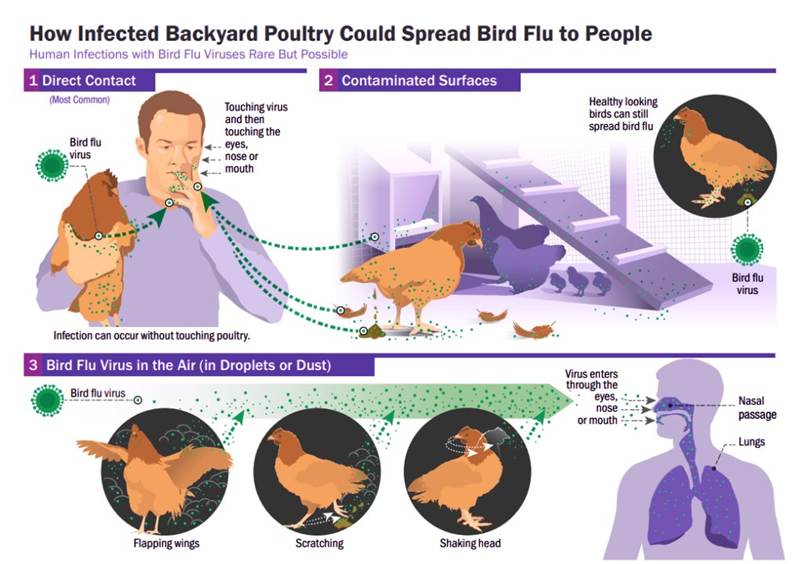
- Virus spreads among birds via saliva, nasal secretions, and faeces, contaminating shared water bodies, feed sources, cages, and farm equipment in intensive poultry environments.
- Human infection mainly occurs through direct handling of infected birds, carcasses, or contaminated environments, especially in farms and live bird markets with poor biosecurity.
- No sustained human-to-human transmission documented, limiting pandemic potential, yet sporadic human infections justify continuous global and national surveillance.
- Virus survives longer in cool, moist conditions, making wetlands and winter seasons ecologically favourable for persistence and transmission among bird populations.
Symptoms & Pathology
Clinical Features
- In birds, infection causes sudden death, respiratory distress, swelling, neurological signs, diarrhoea, and drastic fall in egg production due to multi-organ viral replication.
- In humans, symptoms include high fever, cough, sore throat, muscle aches, and pneumonia, sometimes progressing to acute respiratory distress syndrome requiring intensive care.
- WHO records indicate around 50% case fatality among confirmed human H5N1 cases globally, though total human infections remain very limited in number.
Prevention & Control
Biosecurity Measures
- Culling of infected and exposed poultry remains primary containment method as vaccination effectiveness is limited against rapidly mutating highly pathogenic strains.
- Farm biosecurity requires controlled entry, sanitation, protective clothing, and routine disinfection, reducing farm-to-farm transmission risks.
- Safe disposal of carcasses through deep burial or incineration prevents soil and water contamination and secondary transmission.
- Proper cooking above 70°C destroys virus, ensuring well-cooked poultry and eggs remain safe for human consumption.
Institutional & Legal Framework (India)
Governance Structure
- Governed under Prevention and Control of Infectious and Contagious Diseases in Animals Act, 2009, empowering authorities to enforce quarantine, culling, and movement control.
- National Action Plan on Avian Influenza guides surveillance, outbreak response, zoning, and farmer compensation to ensure transparency and cooperation.
- India follows One Health approach, integrating animal, human, and environmental health surveillance for zoonotic disease management.
- Coordination among Department of Animal Husbandry, State Veterinary Services, and Public Health Departments ensures multi-sectoral outbreak response.
Economic & Social Significance
Sectoral Impact
- Poultry sector is major source of affordable protein, rural employment, and income diversification, making outbreaks economically sensitive.
- Outbreaks often cause consumer panic, price crashes, and trade restrictions, directly impacting farmers’ incomes and agri-exports.
- Compensation mechanisms help ensure early reporting and cooperation from poultry farmers during outbreaks.
Environmental Linkages
Ecology Dimension
- Migratory birds along Central Asian Flyway act as long-distance carriers, linking disease ecology across countries and seasons.
- Wetlands serve as ecological interfaces where wild and domestic birds interact, facilitating viral exchange.
- Climate variability influences migration routes, congregation patterns, and viral persistence in ecosystems.
Challenges
Structural Issues
- Frequent antigenic drift and shift in influenza viruses complicate vaccine development and long-term immunity.
- Informal poultry markets often lack traceability and biosecurity compliance, increasing outbreak risks.
- Veterinary infrastructure and rapid diagnostic capacity remain uneven across regions.
- Misinformation can reduce poultry consumption despite food safety assurances, hurting livelihoods.
Way Forward
Strategic Measures
- Strengthen One Health surveillance systems integrating wildlife, livestock, and human disease databases for early warning.
- Expand district-level veterinary labs and rapid response teams for timely containment.
- Promote farmer awareness on farm-level biosecurity and early reporting practices.
- Enhance international cooperation under WHO–FAO–WOAH frameworks for transboundary disease monitoring.
DEEP TECH START-UPS IN INDIA
Context
Current Trigger
- Government of India issued official definition of “Deep Tech start-up” via DPIIT gazette notification, bringing regulatory clarity to a previously loosely used term amid rising policy focus on technology-driven innovation.
- Definition gains importance due to ₹1 lakh crore Research, Development and Innovation (RDI) Fund and increasing public financing support targeted at high-technology and frontier innovation sectors.
Relevance
GS 3 (Science & Technology)
- Frontier technologies (AI, quantum, biotech, semiconductors), R&D ecosystem, IP generation, innovation-led growth.
GS 3 (Economy)
- Knowledge economy transition, high-tech manufacturing, startup financing, productivity and export competitiveness.
Conceptual & Scientific Basis
Meaning of Deep Tech
- Deep Tech refers to start-ups based on advanced scientific or engineering innovations, producing solutions rooted in new knowledge rather than incremental digital or business-model innovations.
- Typically operates in frontier domains like AI, quantum computing, biotechnology, semiconductors, space tech, and advanced materials, where breakthroughs rely on scientific research and experimentation.
- Distinguished from regular tech start-ups by high R&D intensity, strong IP creation, and technology-led competitive advantage rather than platform or service aggregation models.
- Deep tech innovation often originates from university labs, research institutions, or scientific ecosystems, linking academia, industry, and government research systems.
Official Definition Criteria (DPIIT)
Qualification Norms
- A deep tech start-up must focus on new scientific or engineering knowledge, not merely applying existing technologies in commercial or service contexts.
- Must spend major share of expenditure on R&D, signalling research-driven rather than marketing-driven enterprise structure.
- Required to own or develop significant intellectual property (IP) and actively pursue commercialisation of that IP.
- Characterised by long gestation, high capital needs, infrastructure intensity, and significant technical uncertainty, distinguishing it from fast-scaling digital start-ups.
Start-up Eligibility Norms
Age & Turnover Rules
- Standard start-up defined as entity less than 10 years old or turnover below ₹200 crore, as per DPIIT norms.
- Deep tech start-ups receive extended runway, qualifying as start-up for up to 20 years with turnover ceiling of ₹300 crore, acknowledging longer innovation cycles.
- Recognition requires application and certification by DPIIT, making status rule-based rather than self-declared.
Institutional & Governance Framework
Regulatory Structure
- DPIIT is final authority for recognising start-ups and deep tech start-ups, ensuring standardised national classification.
- Decisions guided by Inter-Ministerial Board of Certification including representatives from DPIIT, Department of Science & Technology (DST) and Department of Biotechnology (DBT).
- Start-ups are restricted from investing in real estate, speculative assets, or securities unless directly linked to knowledge creation, ensuring focus on innovation.
- Reflects governance shift toward mission-oriented innovation policy rather than broad-based start-up promotion alone.
Policy & Economic Significance
Strategic Importance
- Deep tech critical for strategic autonomy, technological sovereignty, and high-value manufacturing, reducing dependence on foreign technology.
- Drives productivity, export competitiveness, and high-skilled employment, moving India up the global value chain.
- Aligns with Atmanirbhar Bharat, Digital India, and Make in India visions focusing on domestic innovation capacity.
- Encourages knowledge economy transition, where growth stems from IP, patents, and research-led enterprises.
Financing Ecosystem
R&D Support
- Anusandhan National Research Foundation (ANRF) oversees ₹1 lakh crore RDI Fund to finance emerging technologies and research over seven years.
- Deep tech start-ups may receive concessional financing at 2–4% interest with tenures up to 15 years, easing capital constraints.
- Public funding reduces early-stage risk where private investors hesitate due to uncertain and long innovation cycles.
- Signals state-led catalytic role in high-risk innovation financing.
Challenges
Structural Constraints
- Long gestation periods delay revenue generation, creating funding stress and investor hesitation.
- Limited deep-tech venture capital ecosystem compared to US and China.
- Weak academia–industry technology transfer pipelines slow commercialisation.
- Talent shortages in frontier science and interdisciplinary research areas.
Way Forward
Strategic Measures
- Strengthen industry–academia collaboration and technology transfer offices in universities.
- Expand deep-tech focused venture funds and blended finance instruments.
- Fast-track approval of national deep tech policy for coherent ecosystem support.
- Promote global partnerships in frontier technologies while safeguarding IP.
RBI FRAMEWORK FOR COMPENSATION TO CYBERFRAUD VICTIMS
Context
- RBI proposed framework to compensate online fraud victims up to ₹25,000, targeting small-value digital payment frauds, reflecting regulatory response to rising cybercrime in digital financial ecosystem and UPI expansion.
- Proposal shifts burden partly to banks and institutions, signalling stronger consumer protection regime amid rapid growth of digital payments, fintech usage, and cashless economy adoption across India.
Relevance
GS 3 (Economy)
- Digital payments ecosystem, fintech regulation, financial stability and consumer confidence.
GS 3 (Internal Security / Cybersecurity)
- Cybercrime trends, digital fraud risks, need for cyber resilience and financial data protection.
Conceptual & Regulatory Basics
Cyber Fraud Meaning
- Cyber financial fraud involves unauthorised digital transactions through phishing, OTP compromise, social engineering, or malware, exploiting gaps in user awareness, digital hygiene, and platform-level security safeguards.
- RBI treats digital payment safety as core to payment system integrity, governed under Payment and Settlement Systems Act, 2007, ensuring trust, stability, and consumer confidence in electronic transactions.
Key Features of Proposed Framework
Compensation Structure
- Victims of small-value online frauds may receive compensation up to ₹25,000, focusing on frequently occurring low-ticket digital frauds affecting large number of retail users.
- Both bank and customer share liability, each bearing 15% of transaction value, while RBI-funded Depositor Education and Awareness (DEA) Fund covers remaining eligible compensation portion.
- Example-based approach ensures proportional relief; if fraud loss is below ₹25,000, compensation aligns with defined percentage-sharing formula rather than full unconditional reimbursement.
- Framework covers cases even where customers inadvertently share credentials, recognising modern fraud complexity and shifting toward victim-sensitive regulatory stance.
Institutional Mechanism
Governance Framework
- Compensation financed through Depositor Education and Awareness Fund, created by RBI using unclaimed deposits, primarily aimed at depositor protection and financial literacy promotion.
- RBI and banks will conduct due diligence checks, ensuring fraud legitimacy and preventing misuse, balancing consumer protection with moral hazard concerns.
- Framework emphasises shared responsibility model, encouraging both institutional safeguards and consumer vigilance in digital transactions.
Economic & Governance Significance
Systemic Importance
- Strengthens trust in digital payments ecosystem, crucial as India leads globally in real-time digital transactions volume, particularly through UPI-driven retail payments revolution.
- Enhances consumer confidence, supporting government push toward less-cash economy, financial inclusion, and fintech-led innovation.
- Reinforces RBI’s role as financial consumer protector, not merely monetary authority, expanding regulatory scope in digital finance governance.
Social & Ethical Dimensions
Citizen Protection
- Protects vulnerable users like elderly and first-time digital adopters, who face higher cyber fraud risks due to limited digital literacy.
- Ethical governance principle of fairness and victim protection reflected in partial compensation even when user negligence exists.
Challenges & Risks
Structural Concerns
- Risk of moral hazard, where guaranteed compensation may reduce consumer caution and digital hygiene practices.
- Verification complexity and dispute resolution delays may burden banks and regulators.
- Fraud detection remains reactive rather than preventive in many cases.
- Cybercriminal innovation evolves rapidly, outpacing regulatory responses.
Way Forward
Strategic Measures
- Strengthen real-time fraud detection systems, AI-driven monitoring, and transaction alerts to prevent frauds before loss occurs.
- Expand nationwide digital financial literacy campaigns on phishing, OTP safety, and secure banking practices.
- Improve coordination between RBI, banks, NPCI, and law enforcement for rapid response and fund recovery.
- Develop clearer liability frameworks for fintech intermediaries and third-party platforms.
RBI MONETARY POLICY COMMITTEE (MPC) & POLICY RATES
Context
- RBI’s Monetary Policy Committee kept repo rate steady at 5.25% while raising FY26 GDP and inflation projections, indicating cautious optimism about growth alongside evolving inflation dynamics.
- Decision reflects RBI’s attempt to balance price stability and growth support, amid changing global monetary conditions and domestic demand patterns.
Relevance
GS 3 (Economy)
- Inflation targeting, interest rates, liquidity management, monetary transmission, macroeconomic stability.
GS 2 (Polity & Governance)
- Institutional autonomy of RBI, rule-based policymaking, accountability mechanisms.
Constitutional–Legal & Institutional Basis
Legal Framework
- Monetary Policy Committee (MPC) established under RBI Act, 1934 (amended 2016) to institutionalise rule-based, transparent, and accountable monetary policy decision-making in India.
- MPC consists of 6 members — 3 from RBI and 3 government nominees, with RBI Governor as Chairperson holding casting vote in case of tie.
- India follows Flexible Inflation Targeting (FIT) framework with mandated CPI target of 4% ±2% (2–6%), notified by Government every five years.
- RBI must publish Monetary Policy Report and explain failure if inflation remains outside target band for three consecutive quarters.
Repo Rate & Policy Rates Basics
Core Concepts
- Repo rate is the rate at which RBI lends short-term funds to commercial banks against government securities, serving as primary monetary policy signalling tool.
- Changes in repo rate influence lending rates, deposit rates, liquidity, credit demand, and overall economic activity, forming core of monetary transmission mechanism.
- Other policy rates include Reverse Repo Rate, Standing Deposit Facility (SDF), and Marginal Standing Facility (MSF) forming liquidity adjustment framework.
- Monetary policy stance can be accommodative, neutral, or tightening, depending on macroeconomic priorities.
Inflation Dynamics
Price Stability Context
- Inflation projections revised upward for FY26, reflecting evolving food price pressures, energy price trends, and demand recovery.
- Benign core inflation provides room for growth support, while food inflation remains structurally volatile due to monsoon dependence and supply-side rigidities.
- Anchored inflation expectations improve real income stability and investor confidence.
- RBI’s primary mandate remains price stability while keeping growth in mind.
Growth Outlook
GDP Projections
- Upward revision in GDP growth projections signals confidence in domestic demand, government capex push, and resilient services sector.
- India remains among fastest-growing major economies, supported by structural reforms and demographic advantage.
- Credit growth and private consumption remain key growth drivers.
- Global slowdown risks and trade uncertainties remain external constraints.
Governance & Economic Significance
Policy Credibility
- Predictable rate decisions enhance policy credibility and financial market stability, reducing volatility in bond and equity markets.
- Supports investment planning and macroeconomic stability.
- Reinforces RBI’s reputation as credible inflation-targeting central bank.
- Strengthens rule-based macroeconomic governance.
Challenges & Risks
Structural Concerns
- Food inflation sensitivity to climate shocks complicates monetary control.
- Global oil price volatility impacts imported inflation.
- Tight policy may moderate private investment.
- Transmission lags reduce immediate policy effectiveness.
Way Forward
Strategic Measures
- Maintain data-driven, flexible policy approach amid uncertainty.
- Improve food supply management to tackle structural inflation.
- Deepen financial markets for smoother transmission.
- Strengthen monetary-fiscal coordination.
AGROFORESTRY IN INDIA
Context
- India targets 50 million hectares under agroforestry by 2050, yet financing remains inadequate, with <5% of ₹20 lakh crore annual agricultural credit flowing to agroforestry despite climate and income benefits.
- Discussions at South Asian Agroforestry & Trees Outside Forests (AF-TOF) Congress 2026 highlighted structural financing gaps, policy awareness deficits, and regulatory hurdles limiting agroforestry expansion across South Asia.
Relevance
GS 3 (Environment & Climate)
- Climate mitigation, carbon sequestration, land restoration, sustainable agriculture.
GS 3 (Agriculture & Economy)
- Farmer income diversification, timber imports, agro-based industries, rural resilience.
Conceptual & Scientific Basics
Meaning of Agroforestry
- Agroforestry integrates trees, crops, and sometimes livestock on the same land management unit, combining ecological and economic functions to improve productivity, sustainability, and climate resilience.
- Recognised by FAO as sustainable land-use system that enhances biodiversity, soil fertility, microclimate regulation, and diversified farmer incomes while reducing land degradation.
- Includes systems like agri-silviculture, silvo-pastoral, and agri-horticulture, depending on tree–crop–livestock combinations suited to agro-climatic zones.
- Bridges agriculture and forestry sectors, falling under Trees Outside Forests (TOF) category in policy discourse.
Policy & Legal Framework
Institutional Basis
- India launched National Agroforestry Policy, 2014, becoming first country with dedicated agroforestry policy, aiming to integrate tree cultivation with farming systems.
- Policy seeks to simplify felling and transit regulations, improve market access, and promote research, extension, and institutional credit support.
- Agroforestry aligns with National Forest Policy, 1988 goal of one-third geographical area under tree/forest cover.
- Linked with schemes like Sub-Mission on Agroforestry (SMAF) under National Mission for Sustainable Agriculture.
Current Status & Data
Key Figures
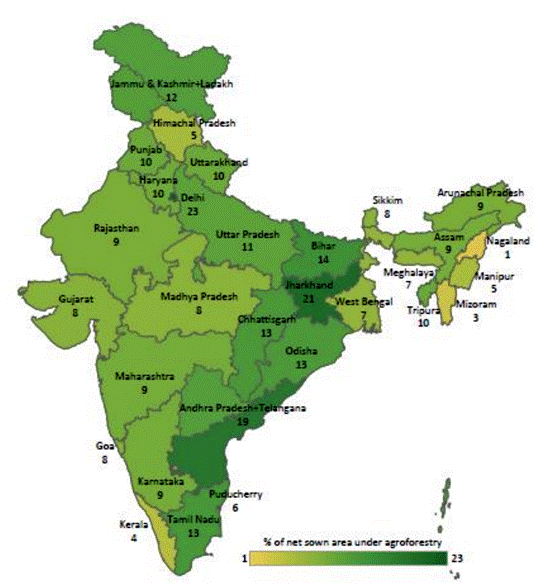
- India has nearly 28 million hectares under agroforestry, contributing significantly to tree cover outside traditional forests.
- Agroforestry systems hold nearly 20% of India’s national carbon stocks, demonstrating climate mitigation potential.
- India imports over $7 billion worth of wood annually, indicating domestic production gap and livelihood opportunity for farmers.
- Around 86% Indian farmers are small and marginal, making diversified income sources like agroforestry economically relevant.
Economic Significance
Livelihood & Trade Impact
- Agroforestry provides diversified income streams through timber, fruits, fodder, fuelwood, and non-timber forest products, reducing farm income volatility.
- Reduces import dependence on timber and wood products, improving trade balance and domestic value chains.
- Long-term tree assets function as natural savings and insurance for rural households.
- Supports agro-processing and rural industries linked to wood and tree-based products.
Environmental & Climate Significance
Ecological Benefits
- Enhances carbon sequestration, supporting India’s NDC commitments under Paris Agreement.
- Reduces soil erosion, improves soil organic carbon, and enhances water retention.
- Acts as buffer against climate variability through microclimate regulation and windbreak effects.
- Studies show agroforestry helps avoid millions of tonnes of GHG emissions annually.
Governance & Financial Challenges
Structural Constraints
- Long gestation periods (5–30 years) discourage formal credit as returns are delayed compared to seasonal crops.
- Land tenure complexities and lack of clear tree ownership rights reduce creditworthiness and farmer confidence.
- Trees often not accepted as collateral by banks, limiting institutional finance access.
- Limited farmer awareness about harvesting and transit rules restricts adoption.
Way Forward
Strategic Measures
- Develop dedicated agroforestry credit lines with longer repayment cycles matching tree growth periods.
- Integrate agroforestry with carbon markets and green finance mechanisms for additional revenue streams.
- Simplify tree felling and transit regulations across states for market confidence.
- Promote digital traceability and private-sector procurement linkages.
BLYTH’S TRAGOPAN (Tragopan blythii)
Context
- Blyth’s tragopan highlighted in conservation discourse as a rare Himalayan pheasant facing habitat loss and hunting pressure, drawing attention to indicator species role in fragile Eastern Himalayan ecosystems.
- Renewed focus arises from biodiversity reporting and conservation discussions stressing indicator species importance for monitoring mountain ecosystem health, forest integrity, and climate-sensitive habitats in Northeast India.
Relevance
GS 3 (Environment & Biodiversity)
- Endangered species conservation, Eastern Himalayan biodiversity hotspot, indicator species concept.
GS 3 (Ecology)
- Habitat fragmentation, climate-sensitive mountain ecosystems, forest ecology.
Taxonomy & Biological Basics
Species Identity
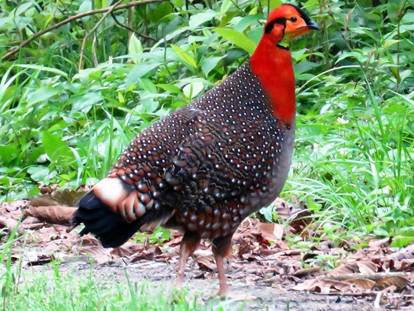
- Blyth’s tragopan is a pheasant species (Family: Phasianidae), named after Edward Blyth, characterised by strong sexual dimorphism, elaborate male display features, and cryptic female camouflage for nesting survival.
- Belongs to genus Tragopan, which includes Satyr, Temminck’s, Western, and Blyth’s tragopans, collectively known for ornate plumage, inflatable throat lappets, and horn-like display structures during breeding.
- Medium-sized galliform bird; male length 65–70 cm, female about 59 cm, showing size dimorphism alongside colour differences typical of pheasant reproductive strategies.
Habitat & Distribution
Geographic Range
- Distributed across Bhutan, Northeast India, northern Myanmar, southeastern Tibet, and Yunnan (China), forming a fragmented Eastern Himalayan and Indo-Burma range.
- In India, found mainly in Arunachal Pradesh, Nagaland, Manipur, and Mizoram, particularly within undisturbed montane broadleaf forests rich in bamboo and rhododendron understory.
- Shows altitudinal migration, occupying 1,400 m in winter and up to 3,300 m in summer, responding to snowfall, food availability, and seasonal vegetation patterns.
- Stronghold populations survive in areas like Dihang-Dibang Biosphere Reserve, indicating importance of large intact forest landscapes for species persistence.
Ecological Significance
Indicator Role
- Recognised as an indicator species, reflecting health of Eastern Himalayan montane forests, which are among Asia’s richest biodiversity hotspots and climate-sensitive ecosystems.
- Presence indicates intact understorey vegetation, minimal disturbance, and high habitat quality, useful for ecological monitoring and conservation prioritisation.
- As a forest-floor feeder, contributes to seed dispersal and ecological balance, supporting forest regeneration processes.
Conservation Status
Legal & Global Status
- Listed as Vulnerable on IUCN Red List, indicating high risk of population decline due to habitat loss and hunting pressures.
- Included in Schedule I of Wildlife (Protection) Act, 1972, granting highest legal protection in India against hunting and trade.
- Also listed under CITES Appendix I, prohibiting international commercial trade and recognising global conservation concern.
- Estimated global population below 10,000 individuals, fragmented across isolated habitats, increasing extinction vulnerability.
Threats
Anthropogenic Pressures
- Habitat fragmentation from hydropower projects, road construction, and settlements disrupts forest continuity critical for species survival.
- Shifting cultivation (jhum) reduces mature broadleaf forests, replacing them with secondary vegetation unsuitable for tragopan nesting and foraging.
- Hunting for meat, feathers, and cultural uses remains localised threat despite legal protections.
- Low reproductive rate and secretive behaviour slow natural population recovery.
Governance & Conservation Measures
Protection Strategies
- Protected Areas, community reserves, and biosphere reserves form primary conservation framework for tragopan habitats in Northeast India.
- Community-based conservation models in Nagaland demonstrate local stewardship and reduced hunting pressure through awareness and eco-cultural pride.
- Surveys and population monitoring needed for evidence-based conservation planning and adaptive management.
- Awareness campaigns critical to reduce illegal bird trade and bushmeat demand.
Way Forward
Strategic Measures
- Expand community-led conservation and eco-tourism, linking livelihoods with species protection to build local incentives.
- Strengthen habitat protection in Eastern Himalayas through landscape-level conservation planning.
- Promote scientific monitoring using camera traps and acoustic surveys for better population estimates.
- Integrate tragopan conservation within biodiversity hotspot and climate adaptation strategies.