

Contents
- Pension Reforms in India
- Swap app mandates for digital literacy
- Draft ISI Bill, 2025
- Brain-Stem Death (BSD)
- National intelligence grid gains traction as Central agencies, police scour for information
- Filaments
Pension Reforms in India
WHY IN NEWS ?
- India’s elderly population (60+) is 153 million today, projected to reach 347 million by 2050.
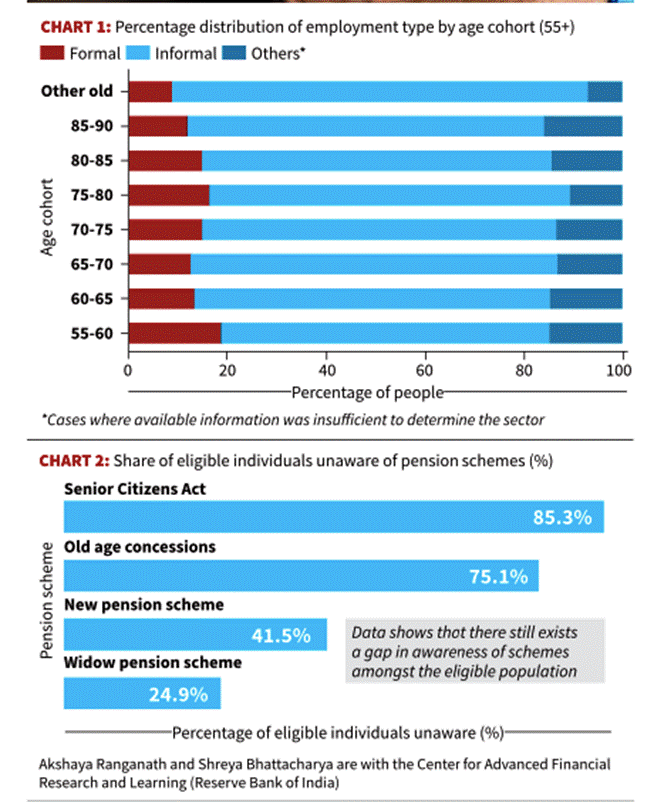
- Over 88% of senior citizens work in the informal sector with no assured pension or social security.
- Renewed focus due to:
- Expansion and redesign of Atal Pension Yojana and National Pension System,
- Launch of e-SHRAM portal,
- Labour Codes reform redefining “wages” for pension calculations.
- LASI Survey (2017–18) and Comprehensive Annual Modular Survey (2022–23) reveal:
- 42% of people above 55 unaware of NPS.
- 63% of elderly lack basic internet usage skills.
Relevance :
GS Paper II – Governance & Social Justice
- Welfare schemes for the vulnerable sections (elderly, informal workers)
- Social security architecture: IGNOAPS, NPS, APY, e-SHRAM
- Role of Labour Codes in redefining wage-linked social protection
- Digital exclusion and governance delivery gaps
- Institutional mechanisms for old-age welfare
GS Paper I – Indian Society
- Demographic transition and population ageing
- Informalisation of labour and its social consequences
- Gendered vulnerability in old-age employment
GS Paper III – Indian Economy
- Household savings and capital market deepening
- Pension funds as long-term infrastructure financing source
- Fiscal sustainability of OPS vs contributory pensions
BASICS: WHAT IS A PENSION SYSTEM?
- Pension = Regular post-retirement income for old-age security.
- Two broad types:
- Social Assistance (Non-contributory) → Government-funded.
- Contributory Pension → Individual + employer/government contribution.
INDIA’S DEMOGRAPHIC & STRUCTURAL CHALLENGE
- Rapid ageing + Informalisation:
- Informal sector share among 55+:
- Women: 75.6%
- Men: 68%
- Informal sector share among 55+:
- Consequence:
- No employer pensions.
- No assured retirement income.
- Continued old-age labour → poverty risk + dignity deficit.
FIRST PHASE: WELFARE-BASED SOCIAL ASSISTANCE
Indira Gandhi National Old Age Pension Scheme (1995)
- Target: BPL elderly (65+)
- Nature: Non-contributory
- Role:
- First national effort to assure minimum old-age income security.
- Expanded coverage and benefit levels over time.
- Limitation:
- Very low pension amount.
- No linkage to savings or investment behaviour.
Old Pension Scheme (Pre-2004)
- For government employees.
- Defined benefit; fully state-funded.
- Problem:
- Heavy fiscal burden.
- Unsustainable with rising life expectancy.
SECOND PHASE: SHIFT TO CONTRIBUTORY PENSIONS
National Pension System (2004)
- Replaced OPS for new recruits.
- Features:
- Defined contribution.
- Market-linked returns.
- Applies to:
- Government employees.
- Corporate sector workers.
- Recent reform: NPS 2.0
- 100% equity option.
- Multiple Scheme Framework (MSF).
- Targets young, high-risk investors.
Atal Pension Yojana (2015–16)
- For informal sector workers (18–40 years).
- Features:
- Monthly/quarterly/half-yearly contribution.
- Government guarantees minimum pension.
- Behavioural impact:
- Encourages formal savings culture.
- Improves retirement planning in low-income groups.
THIRD PHASE: BRIDGING FORMAL–INFORMAL DIVIDE
e-SHRAM portal
- National database of informal workers.
- Functions:
- Registration for welfare schemes.
- Eligibility discovery.
- Attempted integration into formal social security.
Challenges:
- Aadhaar–bank–mobile linkage errors.
- Digital exclusion:
- 63% elderly cannot use the internet.
- Risk of exclusion errors > inclusion gains.
ROLE OF LABOUR CODES IN PENSION SECURITISATION
- Uniform definition of wages:
- Basic pay ≥ 50% of total earnings.
- Direct impact:
- Higher:
- PF contribution,
- Gratuity,
- Pension base.
- Higher:
- Closes employer strategy of inflating allowances to reduce social security burden.
POLICY EVOLUTION: SEQUENTIAL LOGIC
- Stage 1 – Welfare Protection:
- IGNOAPS, OPS.
- Stage 2 – Financial Behaviour Change:
- NPS, NPS 2.0.
- Stage 3 – Informal Inclusion:
- APY, e-SHRAM.
- Current Direction:
- Data-driven targeting + contributory security.
CRITICAL GAPS
- Awareness deficit:
- 42% above 55 unaware of NPS.
- Coverage vs Access mismatch:
- Availability ≠ Effective utilisation.
- Digital divide:
- Elderly excluded from portal-based access.
- Pension adequacy:
- APY pension slabs insufficient for inflation-adjusted living.
IMPACT ON FINANCIAL SYSTEM
- Promotes:
- Long-term household savings.
- Capital market deepening.
- Reduced old-age dependency ratio pressure over time.
- Shifts India:
- From welfare-centric pension state
- To participatory, market-linked social security state.
Swap app mandates for digital literacy
WHY IN NEWS ?
- The Union government withdrew its directive to mandatorily preload the ‘Sanchar Saathi’ app on every new smartphone after:
- Civil society backlash
- Political opposition
- Objections from digital rights groups
- The controversy sits at the intersection of:
- Exploding cyber fraud
- Expanding state surveillance capacity
- Right to privacy jurisprudence
Relevance
GS Paper II – Polity & Governance
- Right to Privacy under Article 21 and Puttaswamy doctrine
- Limits of executive power without statutory backing
- Surveillance vs civil liberties
- Citizen–State trust in digital governance
GS Paper III – Internal Security & Cybersecurity
- Cyber fraud ecosystem and telecom security
- Digital arrest scams, OTP frauds, financial cybercrime
- Platform regulation and behavioural cybersecurity
GS Paper IV – Ethics in Public Administration
- Informed consent and digital coercion
- Surveillance ethics vs public safety
- Technological paternalism vs citizen autonomy
WHAT IS SANCHAR SAATHI?
- A telecom safety platform for:
- Reporting spam and fraud
- Blocking lost/stolen devices
- Checking mobile number misuse
- Operates through:
- Web portals
- SMS
- USSD codes
- Linked with the Central Equipment Identity Register (CEIR) system.
WHAT DID THE WITHDRAWN DIRECTIVE REQUIRE?
- Mandatory pre-installation on all new smartphones
- App:
- Could not be uninstalled
- Was visible on first boot
- Would receive over-the-air updates
- Reportedly sought access to:
- Phone
- SMS
- Location
- Effect:
- Transformed a voluntary safety tool into a system-level state surveillance interface
CONSTITUTIONAL TEST: K.S. PUTTASWAMY (2017)
Under K.S. Puttaswamy vs Union of India, any restriction on privacy must pass:
- Legality – Backed by law
- Necessity – No less intrusive alternative
- Proportionality – Least restrictive method
Why the directive failed:
- Necessity failed:
- Same objectives already achieved via:
- Sanchar Saathi portals
- USSD codes
- SMS reporting
- 1909 spam helpline
- Same objectives already achieved via:
- Proportionality failed:
- Permanent background access ≫ limited, on-demand verification
- Legality weak:
- No detailed parliamentary statute authorising forced installation
CYBER FRAUD CONTEXT: SCALE OF THE PROBLEM
- Interpol estimate (2023):
- $1 trillion global loss due to online financial fraud
- India witnessing growth in:
- “Digital arrest” scams
- Investment frauds
- OTP-based account takeovers
Key constitutional principle:
- “Serious problem” ≠ automatic justification for mass surveillance
EXISTING INDIAN ANTI-FRAUD ECOSYSTEM (ALREADY IN PLACE)
- Sanchar Saathi + CEIR portals
- Telecom Regulatory Authority of India ‘DND’ app
- National 1909 short code for spam/fraud
Privacy Warning from DND Experience:
- Earlier versions required access to:
- Call logs
- SMS data
- Apple blocked it for violating privacy safeguards.
- Only after system-level redesign was limited access allowed.
- Sanchar Saathi mandate repeated this mistake at a much larger scale.
CYBERSECURITY RISK OF “PRIVILEGED APPS”
- A privileged, non-removable app:
- Becomes a high-value target for hackers
- If compromised:
- Enables lateral movement across millions of devices
- Cybersecurity research consensus:
- Widely deployed system components = single-point failure risks
SURVEILLANCE STATE VS BEHAVIOURAL CYBERSECURITY
- Digital scams succeed through:
- Fear
- False authority
- Psychological manipulation
- Pure technological surveillance:
- Does not eliminate human vulnerability
- Risks normalising permanent monitoring
Kenya Study (2023):
- Generic scam warnings:
- Did not improve scam detection ability
- Behaviour change must be:
- Continuous
- Culturally adapted
- Behaviour-specific
INDIA’S EXISTING BEHAVIOURAL CYBER AWARENESS MODELS
- Reserve Bank of India e-BAAT outreach
- ‘RBI Kehta Hai’ mass media safety campaign
- Chhattisgarh cybersecurity awareness vans
- Telangana ‘Fraud Ka Full Stop’ campaign
- Reported 8% decline in cybercrime
- Police-bank mobile kiosks in:
- Tiruchi, Tamil Nadu
- Other urban centres
CORE GOVERNANCE ISSUE
- Shift from:
- “What’s there to hide?”
to
- “What’s there to see — and how is it being used?”
- “What’s there to hide?”
- Citizens treated as:
- Passive surveillance subjects
Instead of:
- Active cybersecurity participants
- Passive surveillance subjects
POLICY WAY FORWARD: THREE-PILLAR MODEL
1. Platform & Network Regulation
- Mandatory obligations on:
- Telecom firms
- Banks
- FinTech platforms
- For:
- Pattern detection
- Real-time fraud blocking
- Large-value transaction traceability
2. Robust Citizen Reporting & Redress
- Seamless:
- 1930 helpline
- App-based reporting
- Time-bound grievance disposal
3. Sustained Digital Public Education
- Not slogan-based
- Must be:
- Continuous
- Local-language
- Behaviour-specific
- Community-led
Draft ISI Bill, 2025
WHY IN NEWS ?
- On September 25, 2025, the Ministry of Statistics and Programme Implementation (MoSPI) released the Draft Indian Statistical Institute Bill, 2025.
- The Bill seeks to:
- Convert ISI from a “registered society” into a “statutory body corporate”.
- The move triggered:
- Protests by students and faculty
- Opposition by political parties (TMC, CPI-M)
- A letter by D. Ravikumar demanding withdrawal.
Relevance
GS Paper II – Polity, Governance & Federalism
- Autonomy of Institutions of National Importance
- Statutory bodies vs registered societies
- Centre–State relations and cooperative federalism
- Accountability vs independence dilemma
WHAT IS THE INDIAN STATISTICAL INSTITUTE (ISI)?
- Founded in December 1931, Kolkata by P.C. Mahalanobis.
- Registered originally under:
- Societies Registration Act, 1860
- Later under West Bengal Societies Registration Act, 1961.
- Declared an Institution of National Importance (INI) under:
- Indian Statistical Institute Act, 1959
- Academic spread:
- ~1,200 students
- 6 centres across India
- Disciplines: Statistics, Mathematics, Economics, Computer Science, Operations Research, Cryptology, Quality Management.
ISI’S STRATEGIC SIGNIFICANCE TO INDIA
- Backbone of India’s statistical governance architecture.
- Birthplace of:
- National Sample Survey Organisation (NSSO) → foundation of India’s official data ecosystem.
- Key contribution:
- Mahalanobis Model → Heavy-industry based planning.
- Global academic legacy:
- C.R. Rao
- S.R.S. Varadhan (Fields Medalist)
- Often linked with the Bengal Renaissance and scientific institution-building.
WHAT DOES THE 2025 BILL PROPOSE?
(A) Change in Legal Status
- From:
- Registered Society
- To:
- Statutory Body Corporate
(B) New Governance Architecture
- Power concentrated in:
- Board of Governors (BoG) under Section 15.
- Earlier structure:
- 33-member Council
- 10 from ISI community (8 elected faculty, 1 worker, 1 scientific worker)
- Under 2025 Bill:
- Zero elected ISI representatives
- Dominated by Union Government nominees
(C) Funding Model Shift
- Section 29: “Power to generate revenue”
- Student fees
- Consultancy
- Sponsored research
- Signals a shift towards corporate-style funding model
WHY ARE ACADEMICIANS PROTESTING?
1. Loss of Institutional Autonomy
- Society model allowed:
- Independent Memorandum & Bye-laws
- Faculty-driven governance
- Statutory corporate model:
- Direct state control via BoG
2. Political Interference in Appointments
- All appointments routed through:
- Union Government-controlled BoG
- Fear of:
- Ideological capture
- Loyalty-based hiring over academic merit
3. Threat to Basic Research
- ISI’s strength:
- Long-gestation, non-commercial basic research
- Corporate funding logic:
- Favours short-term, revenue-generating projects
- Risks marginalising pure mathematics & statistics
4. Federalism Concerns
- Bypasses:
- West Bengal Societies Registration Act
- Seen as violating:
- Spirit of cooperative federalism
5. Democratic Deficit
- Over 1,500 academicians wrote to Rao Inderjit Singh (MoS, MoSPI).
- Students formed:
- Human chain protest in North Kolkata (B.T. Road campus).
GOVERNMENT’S POSITION
- Objective:
- Make ISI a “world-leading institute” by its centenary in 2031.
- Justification:
- Four review committees examined ISI.
- Most recent chaired by R.A. Mashelkar (2020).
- Recommendations:
- Governance reforms
- Academic expansion
- Global competitiveness
CORE POLICY DILEMMA
| Issue | Government View | Academicians’ View |
| Legal Status | Strong statutory backing | Society model protects autonomy |
| Governance | Centralised professional management | Democratic academic self-rule |
| Funding | Diversification via market | Commercialisation of research |
| Appointments | Uniform national control | Political interference risk |
CONSTITUTIONAL & GOVERNANCE DIMENSIONS
- Article 19(1)(g): Academic freedom & professional autonomy
- Federalism: Central law overriding state-registered societies
- Institutional independence: Similar debates seen in:
- Universities
- Regulatory bodies
- Research councils
Deeper risk:
- Shift from knowledge institutions as public goods
- To knowledge institutions as corporate entities
LIKELY POLITICAL TRAJECTORY
- Opposition parties:
- TMC
- CPI(M)
- Have vowed to:
- Oppose Bill if tabled in Parliament.
- Indicates:
- Possible Standing Committee scrutiny
- Legislative confrontation ahead
BROADER IMPLICATIONS FOR INDIA
- Affects:
- Credibility of India’s statistical system
- Independence of official economic data
- Global trust in Indian research institutions
- Comes at a time when:
- Data transparency and methodological credibility are already under scrutiny.
Brain-Stem Death (BSD)
WHY IN NEWS ?
- Renewed debate on legal ambiguities in Brain-Stem Death (BSD) certification under the Transplantation of Human Organs and Tissues Act, 1994.
- India’s deceased organ donation rate remains critically low:
- India (2023): 0.77 donors per million
- Spain (2023): 49.38 donors per million
- ~5 lakh Indians die annually while waiting for organ transplants.
- Demand rising to:
- Expand the donor pool
- Remove legal-bureaucratic bottlenecks
- Clarify death certification & consent protocols
Relevance :
GS Paper III – Health Sector & Human Resource Development
- Public health system capacity: ICU infrastructure & trained transplant coordinators
- Organ donation as a resource optimisation strategy in healthcare
- Demand–supply gap in transplants and mortality burden
- Health system efficiency and end-of-life care management
- Medical technology, ventilator dependence and ICU rationing
WHAT IS ORGAN TRANSPLANTATION LAW IN INDIA?
- Governed by:
- Transplantation of Human Organs and Tissues Act, 1994
- Covers two types of transplants:
(A) Deceased Donor Transplant
- Organs retrieved from a person with certified Brain-Stem Death (BSD).
- Heart may still beat with ventilator support.
- Law legally recognises BSD as death.
(B) Living Donor Transplant
- Organ removed from a healthy living person.
- Needs legal sanction because:
- Doctors are otherwise prohibited from removing healthy organs.
WHAT IS BRAIN-STEM DEATH (BSD)?
- Defined under the 1994 Act as:
- “Permanent and irreversible cessation of all functions of the brain-stem.”
- Brain-stem controls:
- Breathing
- Consciousness
- Vital reflexes
- BSD = irreversible biological death, even if heart is artificially supported.
WHY INDIA’S ORGAN TRANSPLANT PERFORMANCE IS POOR
- Extreme shortage of:
- ICU infrastructure
- BSD-certified hospitals
- Trained transplant coordinators
- Major bottlenecks:
- Legal confusion
- Bureaucratic controls
- Family consent delays
- Low public awareness
- Result:
- Massive organ-demand vs supply gap
KEY LEGAL CONFUSIONS AROUND BSD
Q1. Is BSD legally equivalent to cardiac death?
Yes, under the 1994 Act:
- “Deceased person” includes:
- Death by brain-stem death
- Death by cardio-pulmonary failure
- Core legal phrase:
- “Permanent disappearance of all evidence of life”
- Therefore:
- BSD has full legal recognition as death
Q2. Should life support continue if family refuses organ donation?
- Law:
- Only defines death
- Does not dictate post-death hospital actions
- Ethical-legal position:
- If no consent:
- Life support may be continued on family request
- But death certificate time is final
- If consent exists:
- Life support must continue temporarily to preserve organs
- If no consent:
Q3. Are two death certificates required?
- Current practice:
- BSD certificate issued first
- Fresh death certificate issued after organ harvest
- Legal position:
- Unnecessary duplication
- BSD certificate alone is sufficient for legal death registration
LINK WITH DEATH REGISTRATION LAW
- Registration of Births and Deaths Act, 1969
- Definition of death:
- “Permanent disappearance of all evidence of life.”
- Same core definition as 1994 Act.
- Form 4 (Death Registration Form):
- Separates:
- Cause of death
- Mode of death (heart failure, respiratory failure, etc.)
- Separates:
- BSD is interpreted as:
- Respiratory failure due to brain-stem damage
- Conclusion:
- No new amendment needed to register BSD legally.
MAJOR LEGAL CONTRADICTION NEEDING AMENDMENT
Section 14(1) of 1994 Act:
- BSD certification & organ retrieval allowed only in registered hospitals.
Rule 5(1) & 5(2):
- BSD certification mandatory in every hospital with ICU, including:
- Non-transplant hospitals
| Provision | What it Allows |
| Section 14 | Only registered hospitals |
| Rule 5 | All ICU hospitals |
Resulting Contradiction:
This legally blocks universal BSD identification.
CRITICAL NEED FOR LEGISLATIVE AMENDMENT
Reform Required:
- Allow BSD certification and organ retrieval in all ICU-equipped hospitals.
- Restrict actual transplant surgery to:
- Registered transplant centres only.
Why Essential:
- BSD commonly occurs in:
- Trauma
- Stroke
- Brain haemorrhage cases
- Most such deaths occur in:
- District hospitals
- Medical colleges
- Current law artificially shrinks the donor pool.
BUREAUCRATIC BOTTLENECKS IN BSD CERTIFICATION
Problem 1: Doctor Approval by Appropriate Authority (AA)
- Form 10 requires:
- 2 of the 4 certifying doctors to be AA-approved
- Issues:
- No special qualification criteria
- Cumbersome approval process
- Doctors reluctant to apply
- Effect:
- BSD certification gets delayed or avoided
- Reform Needed:
- Allow any registered specialist medical practitioner to certify BSD.
Problem 2: No “Time of Death” in Form 10
- A death certificate without time = legally incomplete
- Kerala Government (2020) solved this by:
- Defining time of death as:
- “Time when arterial pCO₂ reaches target value in second apnoea test”
- Defining time of death as:
- Other States still lack this clarity.
- Result:
- Legal uncertainty in death registration.
CONSENT PROCESS: LEGAL SEQUENCING
When should consent be sought?
- As per law:
- First → BSD must be diagnosed & certified
- Then only → Family approached for consent
Legal tools:
- Form 8 (Declaration & Consent Form):
- Starts with:
- “Has been declared brain-stem dead/dead…”
- Confirms:
- Authorisation for organ removal after BSD certification
- Starts with:
Consent before BSD certification is legally incorrect.
POLICY IMPORTANCE OF CLEAR BSD LAW
- Addresses three national priorities:
- Public health → Organ availability
- Medical ethics → End-of-life clarity
- Resource efficiency → ICU & ventilator optimisation
- Prevents:
- Indefinite ventilator occupation
- Medico-legal hesitation
- Family-doctor conflict
National intelligence grid gains traction as Central agencies, police scour for information
WHY IN NEWS ?
- National Intelligence Grid (NATGRID) is now handling ~45,000 data access requests per month.
- At the 2024 DGPs’ Conference in Raipur, chaired by Narendra Modi, States were asked to scale up NATGRID usage in all investigations.
- Union Home Ministry directed States to liberally use NATGRID.
- Access expanded:
- From 10 Central agencies
- To Superintendent of Police (SP)-rank officers in States.
- Comes amid:
- 20.41 lakh cybersecurity incidents in 2024 (highest since 2020).
Relevance :
GS Paper III – Internal Security
- Counter-terrorism intelligence architecture
- Cybersecurity incidents and digital infrastructure protection
- Financial crime, narcotics, terror financing investigations
- Technology-driven policing
GS Paper II – Polity & Governance
- Federalism in policing (State subject, Central platform)
- Executive powers, absence of statutory backing
- Oversight and accountability mechanisms
WHAT IS NATGRID?
- A real-time, secured data access platform for:
- Police
- Intelligence agencies
- Investigative bodies
- Purpose:
- To integrate multiple government & private databases
- Enable fast, intelligence-led investigations
- Conceptualised in 2009 after the 26/11 Mumbai attacks.
- Became fully operational in 2023–24.
WHAT KIND OF DATA DOES NATGRID ACCESS?
NATGRID enables real-time access to:
- Aadhaar data
- Driving licence & vehicle registration
- Airline passenger data
- Banking & financial transactions
- Telecom records
- Social media account metadata
This allows multi-dimensional profiling for:
- Terror cases
- Financial crimes
- Narcotics
- Cybercrime
- Organised crime
WHO CAN ACCESS NATGRID?
Earlier Access (Only Central Agencies):
- Intelligence Bureau
- Research and Analysis Wing
- National Investigation Agency
- Enforcement Directorate
- Financial Intelligence Unit
- Narcotics Control Bureau
- Directorate of Revenue Intelligence
Current Expansion:
- SP-rank State Police officers now included
Marks a shift from Central-only intelligence to federal policing integration.
WHY WAS NATGRID CREATED?
- Problem earlier:
- Agencies had to:
- Write letters
- Seek case-specific approvals
- Wait weeks for data
- Agencies had to:
- Post-26/11 reform logic:
- Terror attacks exploited information silos
- NATGRID solves this by:
- Providing single-window, integrated access
- Eliminating:
- Inter-agency delays
- Jurisdictional bottlenecks
OPERATIONAL ADVANTAGES
- No FIR required to access data.
- Enables:
- “Join-the-dots” investigations
- Preventive intelligence
- Financial trail mapping
- Reduces:
- Inter-agency dependency
- Tactical delays
- Critical for:
- Terror financing
- Cryptocurrency fraud
- Cross-border crime
- Cyber extortion
CURRENT OPERATIONAL CHALLENGES
Despite being designed as a real-time system, State police report:
- Slow login processes
- Delayed data retrieval
- Procedural friction
- Officers still dependent on manual follow-ups
Indicates a gap between platform design and field usability.
CYBERSECURITY CONTEXT
- India recorded:
- 20.41 lakh cyber incidents in 2024
- Government concern:
- Repeated attempts to breach:
- Power grids
- Telecom networks
- Financial infrastructure
- Repeated attempts to breach:
- NATGRID is now positioned as:
- A core digital internal security backbone
GOVERNANCE & POLITICAL CONTEXT
- Originally conceptualised under P. Chidambaram (2009).
- Gained full momentum after 2019 under Amit Shah as Home Minister.
- Key governance change:
- Central–State trust deficit was resolved
- Enabled State police onboarding
CONSTITUTIONAL & PRIVACY IMPLICATIONS
NATGRID directly engages:
- Article 21 – Right to Privacy
- Doctrine from:
- Puttaswamy judgment (Legality, Necessity, Proportionality)
Key Risks:
- Mass surveillance potential
- Profiling without judicial warrant
- No FIR requirement dilutes judicial oversight
- Data misuse risk in political or civil cases
- Lack of independent audit mechanism
Security efficiency ↑ but privacy safeguards remain institutionally weak.
FEDERALISM DIMENSION
- Policing is a State subject.
- NATGRID:
- Operates under Union Home Ministry control.
- Expansion to State police:
- Strengthens cooperative federalism
- But:
- Central platform still controls architecture, access logs, and audit
COMPARISON WITH GLOBAL MODELS
| Country | Platform | Oversight |
| USA | Fusion Centers | Strong Congressional + Judicial oversight |
| UK | GCHQ–NPCC systems | Parliamentary Intelligence Committee |
| India | NATGRID | Executive-controlled, weak statutory oversight |
CORE POLICY DILEMMA
| Security Objective | Liberty Risk |
| Faster crime detection | Mass data aggregation |
| Preventive intelligence | Surveillance without suspicion |
| Unified access | Weak data minimisation |
WHAT NEEDS TO BE DONE (REFORM AGENDA) ?
- Enact a dedicated NATGRID statutory law:
- Defines:
- Purpose limitation
- Data retention period
- Audit standards
- Defines:
- Mandatory:
- Independent oversight authority
- Judicial access logs
- Technical reforms:
- Faster access interfaces
- Tiered access control
- Parliamentary reporting on:
- Annual request volumes
- Misuse cases
- Breach audits
Filaments
WHY IN NEWS ?
- On December 3, researchers from the University of Oxford reported:
- Discovery of a ~50 million light-year-long galaxy filament.
- The filament shows aligned galaxy spins, suggesting that the entire filament itself is rotating.
- The team claims it may be:
- “One of the largest spinning structures ever observed in the universe.”
- This provides direct observational support to predictions made by cosmological simulations.
Relevance :
GS Paper III – Science & Technology
- Astrophysics and cosmology
- Dark matter and large-scale structure of the universe
- Observational astronomy and simulation-based science
GS Paper I – Physical Geography (World Geography Interface)
- Large-scale structure of the universe
- Formation of galaxies and cosmic web

WHAT ARE COSMIC / GALAXY FILAMENTS?
- Cosmic filaments are:
- The largest known structures in the universe.
- Thread-like formations forming the Cosmic Web.
- They are composed of:
- Dark matter
- Intergalactic gas
- Galaxies
- Typical scale:
- Tens to hundreds of millions of light-years
- They:
- Connect massive galaxy clusters
- Surround vast empty regions called voids
STRUCTURE OF THE COSMIC WEB
The large-scale universe is arranged into:
- Filaments → long, thread-like galaxy highways
- Walls/Sheets → flat, dense galaxy regions
- Nodes (Clusters) → intersections of filaments
- Voids → enormous empty regions
 Together, these form the Cosmic Web, the universe’s fundamental large-scale architecture.
HOW DO COSMIC FILAMENTS FORM?
- Originates from:
- Tiny density fluctuations just after the Big Bang
- Under the influence of gravity:
- Matter collapses into sheets
- Sheets intersect → filaments
- Filaments intersect → clusters
- Dominant driver:
- Dark Matter, which provides gravitational scaffolding
- Ordinary matter (gas + galaxies) follows dark matter distribution.
WHY ARE FILAMENTS CALLED “COSMIC HIGHWAYS”?
- Gas and small galaxies:
- Flow along filaments toward massive galaxy clusters.
- This inflow:
- Feeds galaxy growth
- Triggers star formation
- Shapes galactic evolution over billions of years
- Hence, filaments decide:
- Where galaxies form
- How fast they grow
- How much fresh gas they receive
HOW DO ASTRONOMERS DETECT FILAMENTS?
- By:
- Mapping positions and distances of thousands of galaxies
- Using redshift surveys
- Then:
- Tracing spatial clustering patterns
- Supported by:
- Large-scale computer simulations based on:
- Lambda-CDM Model of cosmology
- Large-scale computer simulations based on:
- These simulations reproduce:
- Filaments, walls, voids, and clusters almost exactly as observed.
WHAT EXACTLY DID THE OXFORD TEAM DISCOVER?
- A ~50 million light-year galaxy filament
- Traced by:
- At least 14 galaxies
- Unique feature:
- The galaxies’ axes of rotation are aligned with the filament’s direction
- Interpretation:
- The entire filament is slowly rotating as a coherent structure
WHY IS ROTATION OF A FILAMENT IMPORTANT?
- Earlier belief:
- Filaments are static gravitational channels
- New result shows:
- Filaments can have large-scale angular momentum
- This supports:
- The theory that gravitational infall and tidal forces can spin up even gigantic cosmic structures
- It links:
- Galaxy-scale rotation → filament-scale rotation → cosmic-scale dynamics
SCIENTIFIC SIGNIFICANCE
- Confirms that:
- Angular momentum exists at the largest observable scales
- Strengthens:
- Theoretical predictions from cosmological simulations
- Helps explain:
- Why galaxies in the same filament often show spin alignment
- Improves understanding of:
- Structure formation
- Galaxy evolution
- Dark matter dynamics
IMPLICATIONS FOR COSMOLOGY
- Validates:
- The gravitational instability model of structure formation
- Improves:
- Precision in large-scale universe mapping
- Supports:
- The idea that:
- The universe evolved from tiny early ripples into a connected cosmic network
- The idea that: