

Content
- India–U.S. rice tariff issue
- High Court judge impeachment move
- Gannon’s Storm discovery
- SURYAKIRAN-XIX
- Cyber Slavery Racket in Southeast Asia
India–U.S. rice tariff issue
Why in News?
- Days before a U.S. trade delegation led by Rick Switzer arrived in New Delhi (Dec 10–12), Donald Trump hinted at fresh tariffs on Indian rice.
- The claim: India is “dumping” rice in the U.S. market.
- Statement made during a White House meeting while announcing a $12 billion farm support package.
- Question raised to U.S. Treasury Secretary Scott Bessent regarding India’s “exemption” on rice.
- This comes when the U.S. has already imposed 50% tariffs on Indian exports in multiple sectors.
Relevance
GS II – International Relations
- India–U.S. trade relations under stress.
- Impact of protectionism under Donald Trump-style economic nationalism.
- Trade diplomacy amidst strategic partnership narrative (QUAD vs tariffs contradiction).
- Use of tariffs as coercive foreign policy tools.
GS III – Economy & Agriculture
- MSP-based procurement and export competitiveness.
- Agricultural exports vs global protectionism.
- WTO Agreement on Agriculture – public stockholding & dumping dispute.
- Impact on:
- Farmer income stability
- Food inflation abroad
- Export market diversification
Core Economic Facts
1. Trade Asymmetry in Rice
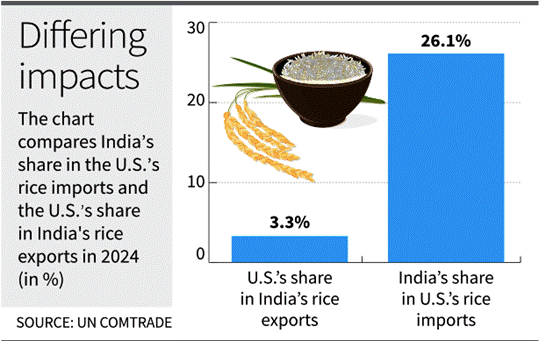
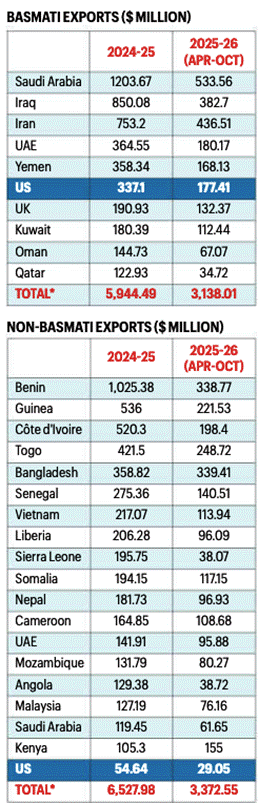
- Only ~3% of India’s total rice exports go to the U.S.
- Over 25% of total U.S. rice imports come from India
- Conclusion:
- India is not dependent on U.S.
- U.S. is highly dependent on India
Inference: Any tariff shock hurts U.S. consumers more than Indian exporters.
Dumping: Is the allegation valid?
Dumping (WTO definition):
- Exporting goods below domestic cost/price to capture foreign markets.
Indian rice exports:
- Backed by:
- Low cost of production
- Economies of scale
- MSP-based procurement
- Not proven as:
- Below production cost
- Below domestic wholesale price
Conclusion:
- U.S. claim is political, not legally established under WTO rules.
Strategic Context
1. Domestic U.S. Politics
- Trump’s statement made alongside:
- $12 billion farm bailout
- Pressure from American farmer lobbies
- Objective:
- Signal protectionism
- Externalise domestic agrarian stress
2. Trade Negotiation Pressure Tactic
- Timed just before:
- India–U.S. tariff negotiations
- Classic U.S. strategy:
- Create pre-negotiation pressure
- Use sector-specific threats (rice) as leverage
Who Loses If Rice Tariff Is Imposed?
Impact on the U.S.
- Sharp rise in:
- Retail rice prices
- Food inflation
- Disproportionately affects:
- Low-income and immigrant consumers
- No quick alternative suppliers at Indian scale + price
Impact on India
- Minimal export loss due to:
- Market diversification:
- West Asia
- Africa
- Southeast Asia
- Market diversification:
- U.S. market is non-critical for Indian rice
WTO & Legal Angle
- Anti-Dumping duties require:
- Cost-price investigation
- Injury to domestic industry
- Unilateral tariff announcement:
- Violates spirit of multilateral trade rules
- Reflects weaponisation of tariffs
Strategic Implications for India
- Reinforces need for:
- Export market diversification
- Reduced dependence on U.S. trade leverage
- Strengthens India’s case for:
- South–South trade
- Agro-export diplomacy
- Shows limits of:
- “Strategic partnership” under transactional protectionism
Link with MSP, Food Security & Global Image
- India’s rice dominance stems from:
- MSP-backed procurement
- High buffer stocks
- Green Revolution legacy
- U.S. attack indirectly targets:
- India’s food security architecture
- Public stockholding system (WTO AoA debate)
Broader Trend: Return of Trump-era Protectionism
- Sectoral targeting:
- Steel, auto, pharma earlier
- Rice now
- Tools used:
- National interest
- Dumping allegations
- Farm lobby pressure
Conclusion
- The proposed U.S. tariff on Indian rice is economically irrational, politically motivated, and strategically self-damaging.
- It exposes:
- Fragility of U.S. commitment to free trade
- Weaponisation of tariffs for electoral optics
- India remains structurally resilient due to:
- Market diversification
- Cost leadership
- Global rice dominance
High Court judge impeachment move
Why in News?
- 107 MPs of the INDIA bloc submitted a notice to Om Birla seeking impeachment of Justice G.R. Swaminathan, judge of the Madras High Court (Madurai Bench).
- Allegations:
- Deciding cases on political-ideological lines
- Bias towards a particular community
- Undue favour to a senior advocate
- Violation of secular character of the Constitution
- Triggering case:
- Direction to light Karthigai Deepam on a deepasthambam near a dargah atop the Thirupparankundram hill.
Relevance
GS 2 – Polity & Constitution
- Removal of constitutional authorities
- Judicial independence vs accountability
- Secularism and Basic Structure
GS 4 – Ethics & Integrity
- Judicial ethics
- Conflict of interest
- Public perception of impartiality
Constitutional Basics: How Are High Court Judges Removed?
Relevant Articles
- Article 217 → Appointment & removal of High Court judges
- Article 124(4) → Removal procedure (borrowed from Supreme Court judges)
- Judges (Inquiry) Act, 1968 → Detailed investigation mechanism
Grounds of Removal (Only Two)
- Proved misbehaviour
- Proved incapacity
“Judicial error” or “unpopular judgment” is NOT a ground for removal.
Step-by-Step Removal Process (Impeachment)
- Motion signed by:
- 100 Lok Sabha MPs OR
- 50 Rajya Sabha MPs
- Speaker/Chairman admits the motion
- 3-member Judicial Inquiry Committee formed:
- One SC judge
- One HC Chief Justice
- One distinguished jurist
- If charges are proved:
- Motion voted in both Houses separately
- Special majority required:
- Majority of total membership
- 2/3rd of members present & voting
- President issues removal order
What Is Being Alleged in This Case?
- Ideological adjudication violating judicial neutrality
- Communal bias in religious dispute (deepasthambam–dargah issue)
- Selective judicial favouritism
- Violation of:
- Article 14 (Equality before law)
- Article 25–28 (Secularism)
- Basic Structure doctrine
Why This Is Constitutionally Sensitive ?
- Judges are protected by:
- Security of tenure
- Difficult removal procedure
- Purpose:
- Prevent political intimidation
- Maintain judicial independence
Overuse of impeachment threats can convert judicial accountability into political control.
Key Judicial Precedents on Judge Removal
- Justice V. Ramaswami (1993) – First impeachment attempt, failed due to political abstentions
- Justice Soumitra Sen (2011) – Rajya Sabha passed removal; judge resigned before Lok Sabha vote
- Justice J.B. Pardiwala (2018) – Attempt dropped at notice stage
No judge has ever been fully removed in India through impeachment so far.
But Also: Why Accountability Cannot Be Ignored
- Judiciary is not above constitutional scrutiny
- If credible evidence of bias exists, impeachment is:
- A democratic constitutional remedy
- Not contempt of court
Conclusion
- The impeachment notice against Justice G.R. Swaminathan reflects a deepening friction between judicial independence and political accountability in communally sensitive cases.
- While the Constitution permits removal for proved misbehaviour, deploying impeachment in politically charged religious disputes risks:
- Undermining judicial autonomy
- Converting constitutional remedies into political weapons
- The only legitimate path forward lies through:
- Objective judicial inquiry
- Due process under the Judges (Inquiry) Act
- And strict adherence to constitutional morality
Gannon’s Storm discovery
Why in News?
- Aditya-L1, India’s first solar observatory, along with six U.S. satellites, has decoded why the May 2024 solar storm behaved abnormally.
- The storm, also called Gannon’s Storm, showed unexpectedly high geomagnetic impact on Earth.
- ISRO confirmed for the first time ever:
- Magnetic reconnection occurred inside a Coronal Mass Ejection (CME).
- The reconnection region spanned ~1.3 million km (~100× Earth’s size).
- Discovery made using joint data from:
- NASA missions: Wind, ACE, THEMIS-C, STEREO-A, MMS
- DSCOVR (NASA–NOAA joint mission)
Relevance
GS Paper III – Science & Technology
- India’s first solar observatory Aditya-L1.
- Breakthrough in heliophysics: internal magnetic reconnection in CME.
- Multi-satellite scientific collaboration (NASA–ISRO data fusion).
GS Paper III – Disaster Management
- Space weather as a non-conventional disaster risk.
- Threat to:
- Power grids
- GPS & NavIC
- Telecom & aviation
Basics First: What Is a Solar Storm?
- A solar storm is a disturbance caused by:
- Solar flares
- Coronal Mass Ejections (CMEs)
- CMEs:
- Giant clouds of superheated plasma + magnetic fields
- Travel at 500–3,000 km/s
- When CMEs hit Earth:
- Disturb magnetosphere
- Cause:
- Satellite damage
- GPS errors
- Radio blackouts
- Power grid failures
- Intense auroras
What Is a Coronal Mass Ejection (CME)?
- Massive magnetic “bubble” ejected from the Sun
- Contains:
- Charged particles
- Twisted magnetic field lines (flux ropes)
- Normally:
- A single CME interacts with Earth’s magnetic field
- Severity depends on magnetic orientation (southward = dangerous)
What Was Unusual in the May 2024 Storm?
1. Collision of Two CMEs in Space
- Instead of one CME:
- Two CMEs collided mid-space
- Result:
- Intense compression of magnetic fields
- Triggered violent internal magnetic reconnection
2. Magnetic Reconnection Inside the CME (First-Ever Direct Evidence)
- Magnetic reconnection:
- Process where:
- Twisted magnetic field lines snap
- Rejoin in new configurations
- Release enormous energy
- Process where:
- Earlier belief:
- Reconnection mainly occurs:
- On the Sun
- Near Earth’s magnetosphere
- Reconnection mainly occurs:
- New discovery:
- It occurred inside the CME itself during transit
3. Scale of the Reconnection
- Size of reconnection zone:
- ~1.3 million km
- ~100 times the diameter of Earth
- Scientific significance:
- Largest reconnection region ever observed inside a CME
Why Did This Make the Storm More Dangerous?
- CME collision caused:
- Sudden reversal of magnetic fields
- Effects:
- Stronger coupling with Earth’s magnetosphere
- Higher:
- Geomagnetic storm intensity
- Ionospheric disturbances
- Satellite drag
- Power grid stress
Role of Aditya-L1 (India’s Strategic Edge)
- Payloads used:
- Magnetometers
- Plasma analysers
- Solar wind detectors
- Contribution:
- Provided precise 3D magnetic field mapping
- Enabled localisation of the reconnection zone
- This marks India’s:
- Entry into hard-core space weather physics
- Leadership in real-time solar monitoring
Strategic Importance for India
- Protects:
- NavIC
- Defence satellites
- Power grids
- Telecom & internet
- Reduces dependence on:
- U.S. and EU space weather alerts
- Supports:
- Human spaceflight (Gaganyaan)
- Lunar and interplanetary missions
Global Scientific Significance
- Improves:
- Prediction models of CME evolution
- Early warning systems for:
- Aviation
- Military communication
- Stock exchanges
- Validates:
- Multi-satellite cooperative heliophysics
Link with Global Space Weather Preparedness
- Major past disruptions:
- Carrington Event (1859) – Telegraph systems failed
- Quebec blackout (1989) – 9-hour grid collapse
- May 2024 storm confirms:
- Modern digital civilisation is highly vulnerable to solar extremes
Conclusion
- The Aditya-L1–led discovery of internal magnetic reconnection during the May 2024 CME collision marks a paradigm shift in heliophysics.
- It establishes that:
- CMEs are not magnetically stable objects
- Their internal dynamics can amplify storm intensity mid-journey
- For India, this transforms Aditya-L1 from:
- A scientific mission → a strategic national security asset
SURYAKIRAN-XIX
Why in News?
- The 19th edition of the India–Nepal Joint Military Exercise “SURYAKIRAN-XIX” concluded at Pithoragarh.
- The validation phase was jointly witnessed by the Directors General of Military Operations (DGMOs) of:
- Indian Army
- Nepal Army
- The exercise focused on:
- Counter-terrorism operations
- Intelligence-based surgical missions
- High-altitude and complex terrain warfare
- Tactical validation aligned with Chapter VII of the United Nations Charter.
- The DGMOs planted a “Tree of Friendship”, symbolising deepening strategic trust.
Relevance
GS II – International Relations
- India–Nepal defence diplomacy.
- Military ties amidst Nepal’s strategic balancing (India–China factor).
- Border security cooperation.
- Military confidence-building measures (CBMs).
GS III – Internal Security
- Counter-terrorism interoperability.
- High-altitude warfare capability (Himalayan security context).
- Tactical alignment with UN Chapter VII mandates.
What Is Exercise SURYAKIRAN?
- SURYAKIRAN is the annual bilateral military exercise between:
- India and Nepal
- It is conducted alternately in both countries.
- It focuses on:
- Counter-terrorism
- Humanitarian assistance & disaster relief (HADR)
- Peacekeeping operations
- It reflects the unique nature of India–Nepal military ties, rooted in:
- Open borders
- Shared recruitment (Gorkha regiments)
- Historical defence cooperation
Blue Corner Notice
Why in News?
- A Blue Corner Notice has been issued against Goa club owners Saurabh and Gaurav Luthra.
- They are promoters of:
- Café Cubi
- Curlies
- The accused reportedly:
- Fled to Thailand
- Background case:
- A massive fire in a Goa club killed 25 people
- Interpol issued the Blue Notice at India’s request.
Relevance
GS Paper II – International Institutions
- Role and limits of Interpol.
- Nature of international police cooperation.
- Difference between Red, Blue & other notices (Prelims favourite).
GS Paper III – Internal Security
- Transnational crime tracking.
- Fire safety negligence → criminal liability → international escape routes.
- Extradition as a security tool.
Basics First: What Is Interpol?
- Full form: International Criminal Police Organization
- Headquarters: Lyon
- Established: 1923
- Members: 195 countries
- Functions:
- Facilitates police cooperation
- Shares:
- Criminal data
- Fingerprints
- DNA records
- Financial crime info
- Interpol is NOT a global police force:
- It cannot arrest directly
- It only assists national police agencies
What Are Interpol Notices?
- International alerts issued to:
- Share criminal information
- Track fugitives
- Prevent cross-border crime
- Issued at the request of:
- A member country
- Or an international tribunal
- Circulated to:
- All 195 member states
Colour-Coded Interpol Notices
| Notice | Purpose |
| Red Notice | To locate and provisionally arrest a wanted person for extradition |
| Blue Notice | To collect information about a person’s identity, location, activities |
| Green Notice | Warning about habitual criminals likely to reoffend |
| Yellow Notice | To locate missing persons, especially children |
| Black Notice | To identify unidentified dead bodies |
| Orange Notice | Warning about imminent threats (terror, biological, chemical) |
| Purple Notice | Modus operandi of criminals, tools, concealment methods |
| Silver Notice | Used for financial crimes and asset tracing |
| UN Special Notice | For persons sanctioned by UN Security Council |
What Is a Blue Corner Notice?
- Purpose:
- To trace a suspect’s location
- To gather:
- Identity details
- Travel history
- Criminal background
- It is used when:
- Person is not yet formally charge-sheeted
- Or arrest is not yet approved
- It DOES NOT authorise arrest
- It is:
- An intelligence-gathering tool
- A pre-extradition step
Difference Between Blue Notice & Red Notice
| Parameter | Blue Notice | Red Notice |
| Objective | Information gathering | Arrest & extradition |
| Legal force | No arrest power | Provisional arrest allowed |
| Stage | Investigation phase | Charges proved |
| Use | Track & verify | Detain & extradite |
Cyber Slavery Racket in Southeast Asia
Why in News (2024–25) ?
- ~300 Indians repatriated from Myanmar after being forced to run cyber scams in “scam compounds”.
- Delhi Police arrested key recruiters of a transnational cyber slavery syndicate.
- Parallel FIRs and arrests in Gujarat and Haryana.
- Renewed focus on cross-border human trafficking + cybercrime convergence.
What is “Cyber Slavery”?
- A form of human trafficking for forced cybercrime.
- Victims:
- Lured via fake overseas job offers (data entry, hospitality, BPO).
- Taken abroad on tourist visas.
- Detained, tortured, and forced to conduct online fraud.
- Work conditions:
- 15–18 hours/day
- Physical assault, emotional abuse
- Confined to dormitory-style scam compounds
When Did Indian Authorities First Take Note?
- September 2022: Publicly flagged by M K Stalin
- Reported youth from Tamil Nadu stranded in Myanmar & Southeast Asia.
- Subsequently, similar cases emerged from:
- Gujarat
- Delhi
- Uttar Pradesh
Geographic Hotspots of Cyber Slavery
- Myanmar
- Border town Myawaddy = most notorious hub
- Cambodia
- Casino cities, especially Sihanoukville
- Laos
- Golden Triangle SEZ
- Structural enablers:
- Weak law enforcement
- High casino density
- Presence of criminal syndicates
- Post-COVID economic distress
Why Did These Countries Become Cyber Slavery Hubs?
- Post-COVID digital crime boom
- Legal casinos & online betting provided cover infrastructure
- Porous borders (especially Myanmar–Thailand)
- Chinese crime syndicates relocating abroad
- Cheap captive labour from South Asia
- High scam profitability using:
- Crypto fraud
- Investment scams
- Romance scams
- Fake trading platforms
Indian Government’s Intervention
- Immigration profiling at airports
- Verification of sponsors and contacts
- Cyber awareness campaigns
- Flagging at-risk destinations
- Embassy-led rescue coordination
Key Data
- Jan 2022 – May 2024:
- 70,000+ Indian job seekers flagged for Cambodia & Laos
- 1,500+ Indians rescued mainly from:
- Myanmar
- Cambodia
Use of Strategic Assets
- Indian Air Force aircraft deployed for repatriation
- Rescues conducted in coordination with:
- Myanmar military (select cases)
- Local police and immigration authorities
Why This is a National Security Concern ?
- Human trafficking + cybercrime + foreign syndicates
- Large-scale financial fraud targeting Indian citizens
- Use of coerced Indians to attack Indian systems
- Links to:
- Money laundering
- Crypto-based terror financing
- Organised transnational crime
Structural Gaps Exposed
- Weak overseas job regulation
- Poor digital literacy among youth
- Lack of real-time international police cooperation
- Slow mutual legal assistance (MLAT) processes
Diplomatic & Legal Dimension
- Long-term resolution depends on:
- Bilateral treaties
- ASEAN-level cybercrime cooperation
- Extradition agreements
- Joint task forces