
Published on Sep 12, 2025
Daily Current Affairs
Current Affairs 12 September 2025

Content
- Can vultures help prevent pandemics?
- First tri-service all-women circumnavigation sailing expedition flagged off
- Working to blend isobutanol with diesel after ethanol blending failed’
- Clearing the fog: need for revised strategies against Aedes mosquitoes
- Climate change-induced dengue resulted in 4.6 million additional cases annually
Can vultures help prevent pandemics?
Why in News?
- As India’s National Action Plan for Vulture Conservation (2016–25) nears completion, discussions are underway on its next phase.
- Emerging scholarship and conservation strategies highlight vultures as critical to pandemic preparedness, linking biodiversity conservation to public health security.
Relevance:
- GS-III (Environment, Biodiversity & Disaster Management): Vulture conservation, ecological services, diclofenac ban.
- GS-II (Health, Governance): One Health, zoonotic spillover, pandemic preparedness.
Basics
- Role of Vultures: Nature’s most efficient waste managers — prevent spread of pathogens like anthrax, rabies, Clostridium botulinum.
- Decline in India: From ~40 million in 1980s → >95% decline since 1990s, largely due to diclofenac (veterinary drug).
- Central Asian Flyway (CAF): Migratory corridor (30+ countries) used by millions of birds including vultures.
- Public Health Link: Carcass disposal prevents zoonotic spillovers; absence of vultures increases disease risk.
- Existing Plan (2016–25): Banned toxic veterinary drugs, established breeding centres, awareness campaigns.
Overview
Ecological & Health Significance
- Carcass management: Vultures consume dead animals rapidly, preventing open dumping and feral dog population growth (linked to rabies).
- Pandemic prevention: Reduce risk of zoonotic disease spillover (e.g., anthrax).
- Surveillance role: First scavengers to detect carcasses → potential sentinels in One Health monitoring.
Decline Drivers
- Diclofenac toxicity: Veterinary anti-inflammatory drug, lethal to vultures.
- Habitat risks: Power line electrocution, poorly managed landfills, reduced prey base.
- Underfunded conservation: Limited financial support, fragmented across states.
Regional & Global Dimension
- CAF = Biodiversity + Public Health corridor → carcass sites can become cross-border disease hotspots.
- Links to Convention on Migratory Species (CMS) commitments and WHO SEARO Roadmap (2023–27) for health security.
India’s Strategic Opportunity
- With large CAF-connected populations (Himalayan griffon, cinereous, Eurasian griffon), India can lead global biodiversity-linked health policy.
- Integrating One Health approach (human–animal–environment) with vulture conservation strengthens resilience against pandemics.
Post-2025 Roadmap – 5 Pillars
- Nationwide telemetry → real-time mapping of habitats, dumps, hotspots.
- Decision Support System (DSS) → integrate wildlife, livestock, human health data.
- One Health coordination → link environment, veterinary, public health agencies.
- Transboundary collaboration → strengthen CAF partnerships, disease monitoring.
- Community stewardship → empower local groups (esp. women/youth) in carcass management & surveillance.
Cost-effectiveness
- Low investment, high returns: Vulture conservation requires modest funds vs outbreak costs.
- Aligns with Ayushman Bharat (preventive health) and India’s Viksit Bharat 2047 vision of resilience.
Conclusion
- Vultures are not just keystone scavengers but guardians of public health.
- Protecting them integrates biodiversity conservation with pandemic prevention and regional health security.
- India has the chance to position itself as a global leader in linking ecological resilience with public health preparedness.
First tri-service all-women circumnavigation sailing expedition flagged off
Why in News?
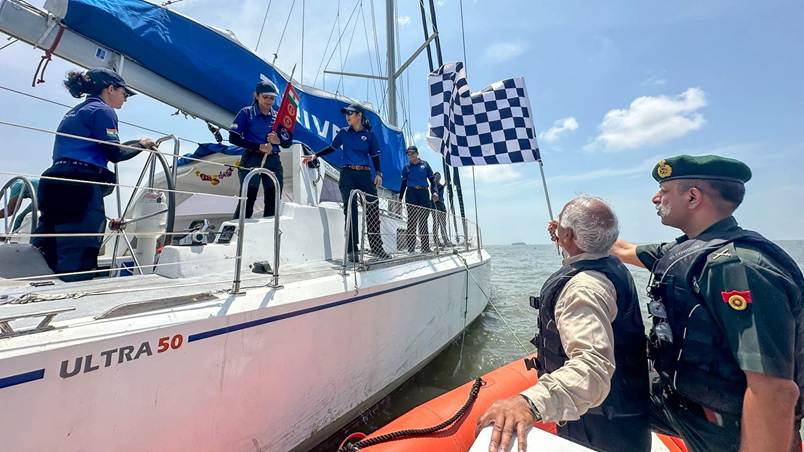
- Defence Minister Rajnath Singh flagged off Samudra Pradakshina, the world’s first tri-service all-women circumnavigation sailing expedition, from the Gateway of India, Mumbai.
- 10 women officers from the Army, Navy, and Air Force are participating.
- Expedition aims to showcase Nari Shakti, armed forces’ jointness, and Aatmanirbhar Bharat vision.
Relevance :
- GS-I (Society): Women empowerment, Nari Shakti.
- GS-II (Polity & Governance): Tri-service jointness, Aatmanirbhar Bharat.
- GS-III (Security, S&T): Maritime capability, blue-water ambitions, defence preparedness.
Basics
- Vessel: Indian Army Sailing Vessel (IASV) Triveni, a 50-foot indigenous yacht.
- Duration: 9 months (Sept 2025 – May 2026).
- Route: ~26,000 nautical miles, following an easterly course.
- Crosses the Equator twice.
- Rounds the Three Great Capes – Cape Leeuwin, Cape Horn, Cape of Good Hope.
- Significance: First-of-its-kind tri-service, all-women global circumnavigation.
Overview
Symbolism & National Vision
- Nari Shakti: Represents women’s empowerment in high-risk, high-skill maritime domains.
- Tri-Service Integration: Highlights jointness of Army, Navy, and Air Force.
- Aatmanirbhar Bharat: Use of indigenously built yacht underscores India’s self-reliance in defence & maritime capabilities.
Strategic Significance
- Blue-water aspirations: Showcases India’s maritime capability and global naval presence.
- Soft Power Diplomacy: Sailing expeditions project India’s commitment to gender equality and sustainable seafaring.
- Geopolitical Signalling: A visible assertion of India’s maritime confidence across critical sea lanes.
Social & Cultural Impact
- Breaking gender stereotypes: Women officers undertaking extreme endurance expedition in male-dominated sphere.
- Inspiration: Encourages more women to join armed forces, particularly after expanded recruitment under Agnipath scheme.
- Public Engagement: National and global awareness campaign linking women’s empowerment with nation-building.
Operational & Training Value
- Skill demonstration: Demands seamanship, navigation, meteorology, and crisis management under extreme oceanic conditions.
- Joint learning: First time Army, Navy, Air Force officers sail together on a prolonged global mission → fosters inter-service camaraderie.
- Resilience-building: Enhances psychological endurance, leadership, and teamwork in prolonged isolated environments.
Challenges
- Extreme Weather: Rounding Cape Horn and Southern Oceans involves high winds, massive waves, sub-zero conditions.
- Sustenance & Logistics: Requires robust planning for food, medical emergencies, and mid-sea technical support.
- Crew Well-being: Mental health and cohesion critical during 9 months of confined, high-risk voyage.
Conclusion
- Samudra Pradakshina is more than a sailing expedition — it is a national statement of women’s leadership, defence preparedness, and maritime ambition.
- By combining gender empowerment, strategic signalling, and Aatmanirbhar Bharat, the expedition positions India as a modern maritime power with inclusive values.
‘Working to blend isobutanol with diesel after ethanol blending failed
Why is it in News?
- Union Minister Nitin Gadkari announced that the Automotive Research Association of India (ARAI) is exploring the feasibility of 10% isobutanol blending with diesel.
- The statement was made during an annual industry meeting on biofuels.
Relevance :
- GS-III (Economy, Environment, Energy): Biofuels, energy security, import reduction.
- GS-III (Agriculture): Farmers’ income, corn & sugarcane demand, food vs fuel debate.
- GS-III (Science & Tech): Alternative fuels, blending technologies, ARAI trials.
Isobutanol & Ethanol Blending
- Isobutanol: A four-carbon alcohol produced via fermentation (from biomass such as corn, sugarcane, or agricultural residues).
- Properties:
- Higher energy density than ethanol.
- Lower hygroscopic nature (absorbs less water) → reduces corrosion in engines.
- Compatible with existing fuel infrastructure.
- Ethanol blending success:
- India achieved 12% ethanol blending with petrol in 2023-24 (target of 20% by 2025-26).
- Farmers benefited: Corn prices rose from ₹1,200/quintal → ₹2,600–₹2,800/quintal.
- Farmers collectively earned ₹42,000 crore from ethanol blending.
Overview
Government Push for Biofuels
- Energy Security: Reduce dependence on crude oil imports (India imports ~85% of crude).
- Farmers’ Income: Diversified demand for crops (corn, sugarcane).
- Environment: Cleaner-burning fuels, lower GHG emissions compared to fossil fuels.
- Export Potential: Government encouraging ethanol producers to enter global markets.
- Industry Demands:
- Sugar sector wants FRP alignment with rising costs.
- Higher minimum support price (MSP) for sugarcane.
- Increase in permissible sugar export quota for 2025–26.
Isobutanol-Specific Prospects
- Can complement ethanol in blending programs.
- More efficient combustion properties in diesel engines.
- Potential to tap into corn and sugarcane surplus.
Challenges & Concerns
- Food vs Fuel Debate: Diversion of sugarcane/corn to fuel may impact food prices & availability.
- Water Stress: Sugarcane is water-intensive; large-scale cultivation strains groundwater.
- Economic Viability: Higher production costs of isobutanol compared to ethanol; requires subsidies/market support.
- Technological Barriers: Engine modifications, regulatory approvals, and large-scale production technology readiness.
- Global Competitiveness: Need to keep biofuel prices competitive to succeed in export markets.
Sugar Production Outlook (ISMA)
- 2025–26 season: 349 lakh tonnes, higher than 2024–25.
- Healthy monsoon → strong harvests in Maharashtra & Karnataka.
- Scope for both domestic supply and exports.
Clearing the fog: need for revised strategies against Aedes mosquitoes
Why in News?
- Recent rise in dengue, Zika, and chikungunya cases across Indian cities.
- Fogging and fumigation still widely used, despite lack of evidence for effectiveness.
- Experts highlight need for integrated strategies combining personal protection, community action, and innovative top-down interventions.
Relevance :
- GS-II (Health, Governance): Vector-borne diseases, public health policy, community mobilisation.
- GS-III (S&T, Environment): Wolbachia, repellents, vaccine trials, urban resilience.
Basics:
- Aedes aegypti & Aedes albopictus → primary vectors of dengue, Zika, chikungunya.
- Breeding sites: small stagnant water collections (plastic bottles, coconut shells, plant pots, air coolers, tyres).
- Feeding habits:
- Bites during daytime and under artificial lights at night.
- Indoor feeders → vaporizers, nets, and outdoor fogging less effective.
- Range: short, 100–200 m → localised community action is crucial.
Overview:
Why Current Measures Fail
- Outdoor fumigation/fogging:
- Temporary effect; mosquitoes quickly return.
- No endorsement by national/international agencies for routine use.
- Household vaporizers:
- Aedes least active at night.
- Mosquitoes evolving tolerance to pyrethroids.
- Bed nets: ineffective, as Aedes bites during the day.
Personal Protection – First Line of Defence
- Protective clothing: loose, full-body coverage (esp. Sep–Nov peak).
- Topical repellents (WHO/CDC approved):
- DEET (20%) → gold standard; ~6 hrs protection, safe for pregnancy/lactation.
- Picaridin, IR3535, 2-undecanone → safe, effective, but not widely available in India.
- PMD (lemon eucalyptus extract) → effective but not for children <3 yrs.
- Ineffective “natural” oils (citronella, etc.) → short-lived, irritant, unsafe in undiluted form.
- Spatial emanators (transfluthrin-coated materials) → 34% risk reduction in trials.
Community Mobilisation – Bottom-Up Action
- Larval source reduction:
- Cleaning air coolers, discarded containers, indoor plants, flower vases.
- Not reusing old cooler grass, covering water storage containers.
- Randomised trials evidence:
- Camino Verde study: 29% reduction in dengue via community-led cleanups.
- Chennai study: container lids cut larval risk by 94%.
- India-specific campaign: “10 Weeks, 10 AM, 10 Minutes” → weekly neighbourhood clean-up drives.
- ASHA workers’ role: disseminating behavioural change communication.
Top-Down Innovations
- Wolbachia mosquitoes:
- Release of mosquitoes infected with Wolbachia bacteria → block viral transmission.
- Successfully deployed in 15 countries.
- Barriers in India: high cost, weak institutional push.
- Dengue vaccine trials: ongoing, but no cross-protection for Zika/chikungunya.
- Policy gaps: absence of systemic push for DEET availability and community education.
Structural Challenges
- Plastic pollution: discarded plastics → key larval habitats; waste management is directly tied to ABVD control.
- Chemical larvicides (temephos): shown to increase dengue risk due to false security + resistance development.
- Public misinformation: preference for “natural” repellents and mistrust of DEET.
- Weak urban health systems: over-reliance on municipal fogging, little investment in local community-led interventions.
Way Forward
- Integrated approach:
- Bottom-up: community-led source reduction + personal protection.
- Top-down: Wolbachia deployment, spatial emanators, vaccine development.
- Urban governance reform: link RWA initiatives with municipal corporations.
- Health communication: counter misinformation on repellents; promote safe, effective alternatives.
- Institutional support: scale up ASHA workers’ role, ensure repellents’ availability, incentivise innovations.
- Policy focus: plastic waste management, water management, and urban resilience planning.
Climate change-induced dengue resulted in 4.6 million additional cases annually
Why in News?
- A study in Proceedings of the National Academy of Sciences (PNAS, Sept 2025) links climate change directly to rising dengue cases.
- Found 4.6 million additional annual cases (1995–2014) across 21 countries in Asia & Americas due to higher temperatures.
- By 2050, cases may more than double in cooler regions, impacting 260+ million people.
Relevance:
- GS II (Governance & Health): Public health preparedness, disease surveillance, role of community health workers.
- GS III (Environment & Science): Climate change impact, vector-borne diseases, One Health approach, use of vaccines and Wolbachia.
Basics
- Dengue virus: Transmitted by Aedes aegypti mosquito.
- Symptoms: Fever, body pain; severe cases → bleeding, organ failure.
- Habitat drivers: Warm temperatures, erratic rainfall, urban waterlogging.
- “Goldilocks Zone” → Dengue peaks at ~27.8°C; rises as cooler regions warm, drops slightly if too hot.
Overview
- Current Trends
- Climate change caused ~18% of cases across study regions (1995–2014).
- 1.4 million observations analysed; first robust causal evidence linking warming to disease burden.
- Net global effect: Sharp rise in dengue incidence despite some declines in hottest areas.
- Future Risks
- Projected 25% spread increase by 2050 (esp. SE Asia, Sub-Saharan Africa, S. America).
- 49–76% spike possible under higher emission scenarios.
- Dengue range expanding: Local cases now in US (California, Texas, Hawaii, Florida) & Europe.
- Urbanisation, migration, and viral evolution add to risks.
- Public Health Concerns
- Data gaps: India & Africa excluded due to underreporting → actual burden underestimated.
- Health system strain: Dengue already among fastest-rising global vector-borne diseases.
- Pandemic angle: Mosquito-borne outbreaks linked to climate instability → part of One Health challenge.
- Mitigation & Adaptation
- Climate action: Aggressive emission cuts reduce long-term risk.
- Vector control: Beyond fogging → community clean-ups, Wolbachia-infected mosquitoes, spatial repellents.
- Vaccines: Under trial; potential game-changer but limited by strain diversity.
- Health system strengthening: Surveillance, rapid diagnostics, ASHA-led awareness campaigns.
Conclusion
- Dengue surge exemplifies climate-health nexus: rising temperatures → shifting disease geography.
- Calls for integrating climate mitigation + One Health approach + resilient urban planning into public health strategies.
- India, with endemic dengue and climate vulnerabilities, must act as a leader in vector-borne disease preparedness.