
Published on Dec 17, 2025
Daily Current Affairs
Current Affairs 17 December 2025

Content
- India’s Position on West Asian Conflicts
- Infiltration Along India’s Borders and Regulation of the Free Movement Regime
- AH-64E Apache Attack Helicopters and India’s Defence Modernisation
- Insurance Laws (Amendment) Bill, 2025: 100% FDI in Insurance
- Inhalable Microplastics: A New Frontier of Urban Air Pollution
- Special Intensive Revision (SIR) of Electoral Rolls and Voter Inclusion Concerns
India’s Position on West Asian Conflicts
Why is this in News?
- December 2025:
- PM Narendra Modi visited Jordan.
- EAM S. Jaishankar visited Israel.
- India publicly reiterated its stance on:
- Israel–Palestine conflict.
- Wider West Asian instability (Gaza war spillovers, regional escalation risks).
- Significance:
- Diplomatic signalling amid polarised global positions.
- India balancing strategic ties with Israel and traditional support to Palestine & Arab world.
Relevance
GS II – International Relations
- India’s West Asia policy: balancing strategic autonomy with issue-based alignment.
- India–Israel relations vs India’s support for Palestine & Two-State Solution.
- India–Jordan relations and role of moderate Arab states.
- India as a balancer power amid polarised global geopolitics.
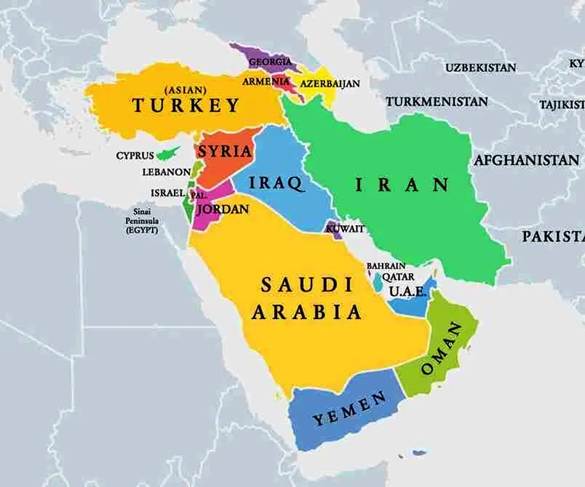
West Asia: Strategic Basics
- Region includes:
- Israel–Palestine
- Jordan, Gulf states, Iran, Iraq, Syria.
- Importance for India:
- ~60% of India’s crude oil & LNG imports.
- 9+ million Indian diaspora.
- Critical trade routes (Red Sea, Suez).
- Counter-terrorism cooperation.
India’s Traditional Policy on West Asia
- Core principles:
- Strategic autonomy.
- Non-alignment (now issue-based alignment).
- Support for international law & UN resolutions.
- Historical pillars:
- Support for Two-State Solution.
- Strong ties with Arab states.
- Since 1992: Full diplomatic relations with Israel.
India–Israel Relations: Snapshot
- Diplomatic ties: Since 1992.
- Key areas:
- Defence & weapons systems.
- Intelligence & counter-terrorism.
- Agriculture, water technology, innovation.
- Israel is among India’s top defence suppliers.
- Post-2017:
- De-hyphenation of Israel–Palestine policy.
India–Jordan Relations: Snapshot
- Jordan’s role:
- Custodian of Islamic holy sites in Jerusalem.
- Moderate Arab state with diplomatic credibility.
- Cooperation areas:
- Defence training.
- Water & renewable energy.
- Infrastructure and skill development.
- Jordan often acts as a bridge between Arab concerns and Western diplomacy.
Continuity and Change in India’s West Asia Policy
Continuity
- Support for Palestinian cause.
- Emphasis on diplomacy and restraint.
- Non-interventionist approach.
Change
- Clearer articulation against terrorism.
- Open strategic embrace of Israel.
- Willingness to engage all sides simultaneously.
Challenges for India
- Diplomatic tightrope:
- Israel vs Arab & Muslim world sentiments.
- Diaspora safety amid conflicts.
- Energy security risks due to regional instability.
- Pressure from:
- Western allies.
- Global South expectations.
Opportunities for India
- Mediation potential due to credibility with all sides.
- Strengthening role in:
- Humanitarian diplomacy.
- Conflict de-escalation narratives.
- Leveraging West Asia for:
- IMEC corridor.
- Energy transition cooperation.
Infiltration Along India’s Borders
Why is this in News?
- Union Ministry of Home Affairs (MHA) informed Lok Sabha about:
- 878 infiltrators apprehended along the India–Myanmar border in the last two years.
- Status of border fencing across Myanmar, Bangladesh, and Pakistan borders.
- Update followed:
- Manipur ethnic violence (since 2023).
- Government decision to regulate (not fully scrap) the Free Movement Regime (FMR).
Relevance
GS III – Internal Security
- Border management challenges: porous borders, insurgency, illegal migration.
- Internal security implications of India–Myanmar border instability.
- Terrorism, arms trafficking (Pakistan border).
- Role of forces: Assam Rifles, BSF.
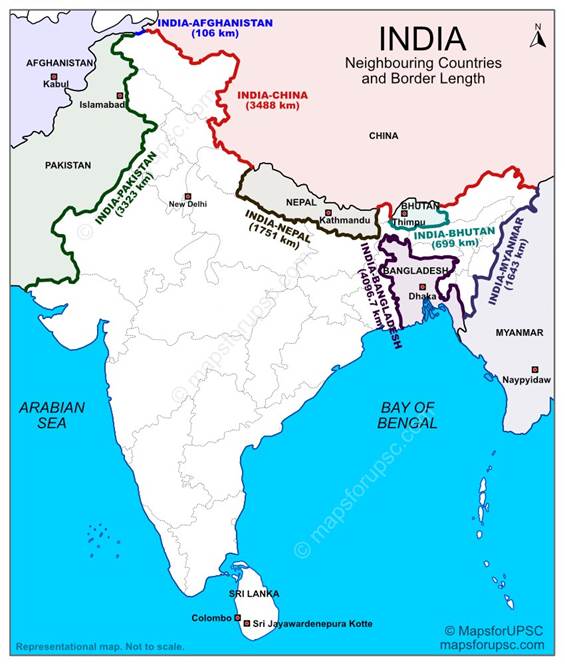
Border Infiltration: Basic Understanding
- Infiltration:
- Unauthorized cross-border movement of persons.
- Motivations include:
- Illegal migration.
- Ethnic conflict spillovers.
- Insurgent movement.
- Economic distress.
- India shares porous land borders with:
- Myanmar (Northeast).
- Bangladesh (East).
- Pakistan (West).
India–Myanmar Border: Key Facts
- Total length: 1,643 km.
- Terrain:
- Dense forests, hills, poor connectivity.
- Fencing status:
- Only 9.2 km fenced so far (<1%).
- Infiltration trend (2014–2025):
- Sharp rise post-2021 Myanmar coup and post-2023 Manipur violence.
- Annual arrests rose from double digits → 400+ in 2024–25.
Free Movement Regime (FMR): Basics
- Introduced: 2018.
- Purpose:
- Facilitate movement of ethnically linked border communities (Naga, Kuki-Chin groups).
- Original provision:
- Visa-free movement up to 16 km across border.
Recent Changes in FMR (Regulation, Not Abolition)
- Announcement (Feb 2024):
- Entire Myanmar border to be fenced.
- FMR to be scrapped (political intent).
- Actual implementation (Dec 2024):
- FMR regulated, not abolished.
- Key changes:
- Movement limit reduced: 16 km → 10 km.
- 43 designated entry–exit gates notified.
- Introduction of:
- Gate passes.
- Biometric registration.
- Rationale:
- Balance security concerns with humanitarian & ethnic sensitivities.
Bangladesh Border: Infiltration Snapshot
- Border length: 4,096.70 km.
- Fencing status:
- 79.08% fenced (3,239.92 km).
- Arrests:
- 2024: 2,525
- 2025: 2,556
- Nature of infiltration:
- Economic migration.
- Illegal stay beyond permits.
- Not primarily insurgency-driven.
Pakistan Border: Snapshot
- Fencing status:
- 93.25% fenced.
- Remaining unfenced:
- Difficult terrain (riverine, marshy).
- Infiltration nature:
- Terrorism-centric.
- Arms & narcotics trafficking.
Security Implications
- Internal Security :
- Nexus between:
- Illegal migration.
- Insurgency.
- Ethnic violence (Manipur).
- Nexus between:
- Demographic stress:
- Local resource competition.
- Ethnic balance concerns.
- Governance challenges:
- Law & order.
- Refugee vs infiltrator distinction.
Government’s Border Management Strategy
- Physical measures:
- Accelerated fencing.
- Smart fencing (sensors, surveillance).
- Administrative measures:
- Regulated FMR.
- Biometric identification.
- Institutional mechanisms:
- Assam Rifles (Myanmar border).
- BSF (Bangladesh & Pakistan).
- Policy shift:
- From open-border pragmatism → security-first approach.
Challenges
- Terrain constraints in Northeast.
- Ethnic ties across borders.
- Humanitarian concerns (refugees vs illegal migrants).
- Diplomatic sensitivity with Myanmar.
Opportunities & Way Forward
- Integrated Border Management System (IBMS).
- Technology-driven surveillance (drones, AI).
- Clear refugee policy framework.
- Border-area development to reduce local collusion.
- Diplomatic engagement with neighbours for coordinated border management.
AH-64E Apache Attack Helicopters
Why is this in News?
- Indian Army received the final batch of three AH-64E Apache helicopters, completing its six-helicopter fleet.
- The helicopters were inducted into the 451 Army Aviation Squadron, based at Jodhpur, Rajasthan.
- Background:
- Deal signed in February 2020 with the United States for $600 million.
- Delivery was delayed by ~15 months due to global supply-chain disruptions.
- Strategic context:
- Comes amid high-level India–US defence engagement and review of bilateral cooperation.
Relevance
GS III – Defence & Security
- Military modernisation and force multipliers.
- Role of attack helicopters in conventional deterrence.
- Jointness and role demarcation between IAF and Army Aviation.
- Western front preparedness.
GS II – International Relations
- India–US strategic and defence cooperation.
- Defence technology transfer and interoperability.
- Implications of foundational agreements (LEMOA, COMCASA, BECA).
What is the AH-64E Apache?
- A heavy attack helicopter designed for:
- Close air support.
- Anti-armour warfare.
- Armed reconnaissance.
- Operated by:
- United States Army and several allied forces.
- AH-64E (“Guardian”) is the latest and most advanced variant.
Key Technical Features
- Role:
- Multi-role attack helicopter.
- Capabilities:
- Precision strike.
- Night and all-weather operations.
- Network-centric warfare.
- Core systems:
- Advanced fire-control radar.
- Longbow sensors.
- Integrated electronic warfare suite.
- Armament:
- 30 mm chain gun.
- Air-to-ground missiles (e.g., Hellfire).
- Rockets and air-to-air missiles.
Insurance Laws (Amendment) Bill, 2025
Why is this in News?
- Lok Sabha passed the Insurance Laws (Amendment) Bill, 2025.
- Key highlight: FDI limit in insurance raised from 74% to 100%.
- Context:
- Government push for financial sector reforms under Viksit Bharat vision.
- Need to improve insurance penetration, capital adequacy, and product innovation.
- Political context:
- Bill passed amid opposition protests over foreign ownership concerns.
Relevance
GS III – Economy
- Financial sector reforms and insurance penetration.
- FDI liberalisation and capital inflows.
- Role of insurance in risk management and economic stability.
- Reinsurance capacity and systemic risk reduction.
GS II – Governance
- Role and powers of regulators (IRDAI).
- Legislative reforms and regulatory oversight.
- Public sector reforms and listing of PSUs.
Basics: Insurance Sector in India
- Insurance in India governed by:
- Insurance Act, 1938
- LIC Act, 1956
- IRDAI Act, 1999
- Two segments:
- Life insurance.
- General (non-life) insurance.
- Regulator:
- Insurance Regulatory and Development Authority of India (IRDAI).
- Key challenge:
- Low insurance penetration:
- ~4% of GDP vs global average ~7%.
- Low insurance penetration:
What is FDI in Insurance?
- FDI allows foreign entities to:
- Invest capital.
- Bring technology and managerial expertise.
- Evolution of FDI limits:
- 26% (pre-2015).
- 49% (2015).
- 74% (2021).
- 100% (2025 Bill).
Key Provisions of the Bill
100% FDI in Insurance Companies
- Foreign insurers can:
- Set up wholly owned subsidiaries.
- Operate without mandatory Indian joint-venture partners.
- Conditions:
- All Indian laws applicable.
- Full regulatory oversight by IRDAI.
Reinsurance Reforms
- Net Owned Fund (NOF) requirement for Foreign Reinsurance Branches (FRBs):
- Reduced from ₹5,000 crore → ₹1,000 crore.
- Objective:
- Attract global reinsurers.
- Expand domestic risk-bearing capacity.
- Reduce premium outflows abroad.
Enhanced Powers of IRDAI
- New powers:
- Disgorgement of wrongful gains from insurers and intermediaries.
- Penalty rationalisation:
- Maximum penalty on intermediaries raised:
- ₹1 crore → ₹10 crore.
- Maximum penalty on intermediaries raised:
- Objective:
- Strong deterrence.
- Improved compliance and governance.
Public Sector Insurance Strengthening
- Capital infusion:
- ₹17,450 crore into three public sector general insurers.
- Structural reforms:
- Listing of:
- LIC.
- GIC Re.
- New India Assurance.
- Listing of:
- Objective:
- Market discipline.
- Transparency.
- Operational efficiency.
Rationale Behind the Reforms
- Capital constraints in insurance sector.
- Need for:
- Better products.
- Deeper risk coverage.
- Digital and actuarial expertise.
- Ease of doing business:
- Joint ventures often complex and restrictive.
- Align India with:
- Global best practices in insurance regulation.
Potential Benefits
- Increased capital inflow.
- Enhanced competition and innovation.
- Improved insurance penetration.
- Better reinsurance availability.
- Stronger regulatory enforcement and policyholder protection.
Concerns and Criticism
- Foreign dominance fears in a sensitive financial sector.
- Profit repatriation risks.
- Public sector insurers’ competitiveness.
- Regulatory capacity of IRDAI under expanded mandate.
Way Forward
- Phased and monitored implementation.
- Stronger consumer grievance redressal.
- Capacity building within IRDAI.
- Parallel reforms in:
- Financial literacy.
- Insurance awareness.
- Safeguards to protect public interest.
Inhalable Microplastics and Urban Air Pollution
Why is this in News?
- November–December 2025:
- A first-of-its-kind Indian study, published in Environment International, has flagged inhalable microplastics as a serious and overlooked air pollutant.
- Conducted across Delhi, Mumbai, Kolkata, and Chennai by IISER Kolkata.
- Context:
- Severe winter smog episodes in NCR.
- Public protests demanding the right to clean air.
- Key finding:
- City residents inhale ~132 micrograms of microplastics daily, with Delhi and Kolkata worst affected.
Relevance
GS III – Environment & Public Health
- Emerging environmental contaminants.
- Limitations of AQI and existing pollution frameworks.
- Urban air pollution and health externalities.
- Plastic waste management failures.
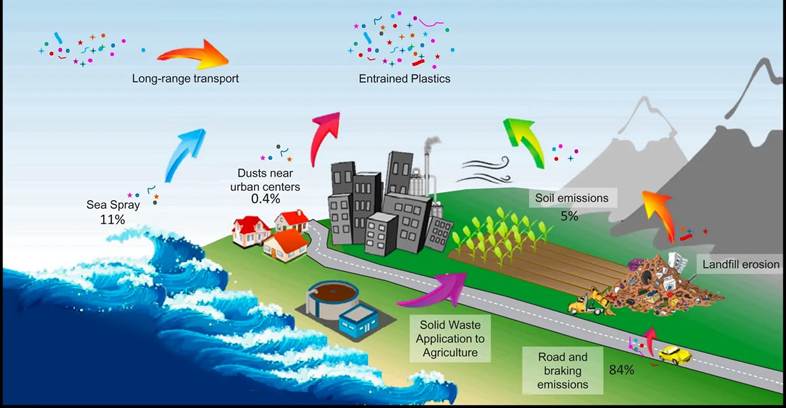
What are Microplastics?
- Microplastics:
- Plastic particles <5 mm in size.
- Inhalable microplastics:
- Particles <10 micrometres (µm).
- Small enough to:
- Bypass nasal filtration.
- Penetrate deep lung tissue.
- Source:
- Primary: Microbeads, synthetic fibres.
- Secondary: Breakdown of larger plastic waste.
Traditional Air Pollution Framework
- Focus on criteria pollutants:
- PM2.5, PM10.
- SO₂, NOx, CO, ozone, lead.
- AQI:
- Does not explicitly account for microplastics.
- Gap:
- Emerging contaminants like microplastics remain outside regulatory radar.
Key Findings of the Study
Concentration Levels
- Average inhalable microplastics (4 cities):
- 8.8 µg/m³.
- Daily exposure:
- ~132 µg per person per day.
- City-wise exposure:
- Delhi: 14.18 µg/m³
- Kolkata: 14.23 µg/m³
- Mumbai: 2.65 µg/m³
- Chennai: 4 µg/m³
Seasonal Variation
- Winter evenings:
- 32.7 particles/m³
- Non-winter evenings:
- 18.8 particles/m³
- 74% increase during winter due to:
- Temperature inversion.
- Low wind speed.
- Poor dispersion.
“Trojan Horse” Effect
- Microplastics act as carriers for:
- Heavy metals:
- Lead (highest in Kolkata).
- Cadmium.
- Endocrine-disrupting chemicals:
- Diethyl phthalates.
- Microbes:
- Fungi like Aspergillus fumigatus.
- Antibiotic-resistance genes.
- Heavy metals:
- Net impact:
- Amplifies toxicity beyond physical particles.
Health Implications
- Deep lung penetration → chronic exposure.
- Linked risks:
- Respiratory diseases.
- Hormone-related disorders.
- Cancer.
- Breast and reproductive health issues.
- High-risk groups:
- Traffic police.
- Construction workers.
- Urban informal labour.
- Tyre-wear microplastics:
- Identified as particularly carcinogenic.
Sources of Inhalable Microplastics
- Urban origins:
- Tyre wear.
- Synthetic textiles.
- Packaging materials.
- Cosmetics.
- Construction activities.
- Household waste.
- Waste management failures:
- Open dumping.
- Burning of plastics.
- Poor segregation.
Why Delhi and Kolkata are Worse Affected
- High population density.
- Severe waste mismanagement.
- Landlocked geography.
- Adverse winter meteorology.
- Contrast:
- Mumbai and Chennai benefit from:
- Coastal winds.
- Better atmospheric dispersion.
- Mumbai and Chennai benefit from:
Governance and Policy Gaps
- AQI framework:
- Not designed to capture microplastics.
- Plastic regulation:
- Weak enforcement of single-use plastic bans.
- Occupational safety:
- No specific standards for microplastic exposure.
- Waste management:
- Persistent urban governance failures.
Special Intensive Revision (SIR) of Electoral Rolls
Why is this in News?
- Draft electoral rolls published after SIR in West Bengal, Rajasthan, Goa, Lakshadweep, and Puducherry.
- 1.02 crore names removed, causing the total electorate to shrink by 7.6%.
- Trigger:
- Election Commission of India (ECI) conducted Special Intensive Revision ahead of upcoming elections.
- Public debate:
- Concerns over large-scale deletions, transparency, and voter disenfranchisement.
What is an Electoral Roll?
- Electoral Roll:
- Official list of eligible voters in a constituency.
- Constitutional basis:
- Article 324 – Superintendence of elections vested in ECI.
- Statutory framework:
- Representation of the People Act, 1950.
- Purpose:
- Ensure free, fair, and inclusive elections.

What is Special Intensive Revision ?
- SIR:
- A comprehensive, door-to-door verification of electoral rolls.
- Conducted:
- Periodically or before major elections.
- Objective:
- Remove:
- Duplicate voters.
- Deceased voters.
- Shifted or non-resident voters.
- Add:
- Eligible but left-out citizens.
- Remove:
- Differs from:
- Routine annual revision (more limited, application-based).
Key Findings from the 2025 SIR
- Total electors:
- Reduced from 13.35 crore → 12.33 crore.
- Net deletion:
- 1.02 crore voters.
- States/UTs affected:
- West Bengal.
- Rajasthan.
- Goa.
- Lakshadweep.
- Puducherry.
- Official reasons for deletion:
- “Shifted”.
- “Deceased”.
- “Untraceable”.
- Duplicate entries.
State-wise Snapshot (Indicative)
- West Bengal:
- Largest absolute deletions.
- Rajasthan:
- Significant rural and urban deletions.
- Goa:
- Notable drop despite smaller electorate.
- Lakshadweep & Puducherry:
- Smaller numbers, but high proportional impact.
Reasons Behind High Deletions
- Migration:
- Seasonal and inter-state mobility.
- Urbanisation:
- Address mismatches.
- Documentation gaps:
- Failure to submit required forms.
- Administrative factors:
- Booth Level Officer (BLO) discretion.
- Short verification windows.
- Digital divide:
- Limited awareness of verification procedures.
Democratic Concerns Raised
- Voter disenfranchisement risk:
- Eligible voters may be wrongly deleted.
- Due process issues:
- Inadequate notice.
- Limited opportunity for appeal.
- Impact on vulnerable groups:
- Migrant workers.
- Urban poor.
- Elderly.
- Women.
- Political neutrality:
- Allegations of selective or uneven deletions.
Election Commission’s Position
- Deletions are:
- Based on field verification.
- Subject to claims and objections process.
- Draft rolls:
- Not final; corrections allowed.
- Legal safeguards:
- Re-inclusion possible before final publication.
Constitutional & Legal Dimensions
- Right to vote:
- Statutory right (not fundamental).
- Still central to democratic participation.
- Supreme Court view:
- ECI must ensure procedural fairness and transparency.
- Balance required:
- Roll purity vs inclusiveness.
Governance and Federal Issues
- Centre–State coordination:
- SIR executed by state machinery under ECI.
- Trust deficit:
- Between voters, political parties, and election authorities.
- Institutional credibility:
- Directly affects legitimacy of electoral outcomes.
Way Forward
- Improve transparency:
- Public disclosure of deletion reasons.
- Strengthen due process:
- Mandatory notice before deletion.
- Technology use:
- Aadhaar-linked but consent-based verification.
- Awareness drives:
- Especially for migrants and urban poor.
- Independent audit:
- Post-SIR review of deletions and additions.