
Published on Jan 21, 2026
Daily Current Affairs
Current Affairs 21 January 2026

Content
- The Importance of Pax Silica for India
- Pax Silica and the Global Tech Economy: Continuities, Shifts, and India’s Choices
- Reusable Rockets and the Commercial Space Revolution
- Hate Speech as a Constitutional Tort: Constitutional Accountability and Democratic Integrity
- Chagos Islands Dispute: Sovereignty, Security, and the Changing Global Order
- Darwin’s Bark Spiders: Why Only Females Weave the Toughest Webs
- Faster Warming, Faster Breeding: Climate Change and Antarctic Penguins
The importance of Pax Silica for India
Global Economic Context: Continuity and Change
Enduring Structural Continuities
- The North–South divide in per capita income, technological capability, and resource consumption continues to define the global economy despite decades of globalisation.
- Advanced economies still dominate high-value manufacturing, frontier technologies, and intellectual property, while developing countries remain resource suppliers or low-end manufacturers.
Structural Shifts in Growth Drivers
- Semiconductors and Artificial Intelligence (AI) have emerged as core drivers of economic power, productivity, and national security in the 21st century.
- Control over critical minerals, especially Rare Earth Elements (REEs), has become central to technological competitiveness and geopolitical influence.
Relevance
- GS 2: India’s foreign policy, minilateral groupings, strategic partnerships, and technology diplomacy.
- GS 3: Critical minerals, semiconductors, AI, supply-chain resilience, industrial policy, and economic security.
Pax Silica Summit 2025: Origins and Objectives
Background and Timing
- On 12 December 2025, the United States convened the inaugural Pax Silica Summit to secure supply chains for semiconductors, AI, and critical minerals.
- The term ‘Pax Silica’ symbolically links peace with silicon-based technologies, signalling that trusted technology supply chains are now integral to global stability.
Declared Objectives
- According to the Pax Silica Declaration, the initiative aims to:
- Reduce coercive dependencies
- Secure global semiconductor and AI supply chains
- Build trusted digital and manufacturing infrastructure
Membership Composition: Strategic Logic
Core Members and Their Comparative Advantages
- United States & Japan: Global leaders in advanced technology, research, and semiconductor design ecosystems.
- Australia: Leading exporter of lithium and holder of significant REE reserves, critical for batteries and electronics.
- Netherlands: Home to ASML, the world’s sole supplier of extreme ultraviolet (EUV) lithography machines.
- South Korea: Global manufacturing leader in memory chips (DRAM, NAND).
- Singapore: Long-standing semiconductor manufacturing hub integrated with U.S. firms.
- Israel: Strength in AI software, defence technologies, and cybersecurity.
- United Kingdom: Hosts the third-largest AI market with a strong research and start-up ecosystem.
- Qatar and UAE: Possess large sovereign wealth funds and are investing heavily in AI and advanced technology ecosystems.
Observers and Potential Expansion
- Canada, EU, OECD, and Taiwan participated as observers, indicating scope for future expansion and institutionalisation.
Countering China: Strategic Rationale
China’s Dominance in REEs
- China controls a dominant share of global REE processing, giving it leverage over high-tech supply chains.
- In response to U.S. tariff measures, China suspended REE exports to the U.S. and others, weaponising resource dominance.
Impact on India
- India faced disruptions in rare-earth magnet imports, affecting automobile and electronics manufacturing.
- Supplies resumed only after Indian firms complied with stringent Chinese licensing conditions, including assurances against defence or dual-use applications.
Lessons from the Pandemic
- COVID-19 exposed vulnerabilities of single-country-dependent supply chains, accelerating diversification and “friend-shoring” strategies.
India and Supply Chain Resilience Efforts
Existing Initiatives
- Supply Chain Resilience Initiative (SCRI) launched in 2021 with Japan and Australia.
- Quad Critical Minerals Initiative launched in 2025 to strengthen supply chains for emerging and critical technologies.
India’s Exclusion and Prospective Entry
- Despite participation in similar initiatives, India was not invited to the inaugural Pax Silica Summit.
- On 12 January 2026, the new U.S. Ambassador to India indicated that India will soon be invited to join Pax Silica.
What India Brings to Pax Silica ?
Strengths
- Strong digital public infrastructure and rapidly expanding AI adoption across enterprises.
- Launch of IndiaAI Mission and Semiconductor Mission with substantial public funding.
- Growing investments by Indian firms (e.g., Tata Group) and foreign players like Micron in semiconductor manufacturing.
- Expanding pipeline of AI start-ups and a large pool of Indian students trained in advanced STEM fields abroad.
Human Capital Advantage
- Large number of Indian graduates and PhDs in computer science and engineering trained in the U.S.
- Restrictive U.S. visa policies may trigger reverse brain gain, strengthening India’s domestic AI and semiconductor ecosystems.
Strategic Opportunities for India
Technology Ecosystem Scaling
- Participation in Pax Silica could help India scale collaborations with Japan, Singapore, Israel, and the U.S.
- Opportunity to integrate into trusted semiconductor and AI value chains beyond low-end manufacturing.
Long-Term Strategic Alignment
- Given historical India–West collaboration in IT services, India may naturally gravitate towards Pax Silica’s supply chain framework.
Challenges and Risks for India
Developmental and Strategic Asymmetry
- Pax Silica members are largely high-income U.S. allies, while India would be the first developing country and non-ally entrant.
- This may create an expectation gap on security alignment and policy convergence.
Strategic Autonomy Concerns
- India’s foreign policy responses may differ in nuance from U.S. allies, requiring careful balancing to avoid dilution of strategic autonomy.
Industrial Policy Tensions
- India will seek to protect its nascent ecosystems through subsidies, government procurement preferences, and calibrated import controls.
- Such policies may conflict with prevailing preferences in Washington and some Pax Silica economies.
The Road Ahead: Competing Supply Chain Blocs
Dual Supply Chain World
- China is likely to maintain and strengthen its REE export control regime to preserve dominance.
- Pax Silica may develop a parallel export regulation and supply chain framework.
- Over time, two major REE and tech supply chains—China-led and Pax Silica-led—may dominate the global economy.
India’s Strategic Choice
- Given strained India–China economic ties and longstanding collaboration with Western firms, India may tilt towards Pax Silica, while seeking policy space.
- India will need sustained dialogue to shape Pax Silica’s evolution in ways compatible with its developmental needs and strategic autonomy.
Strategic Assessment
- Pax Silica reflects the geopoliticisation of technology and supply chains, where economic efficiency is subordinated to security and trust.
- For India, participation offers technology access and resilience, but requires careful negotiation to avoid strategic and industrial policy constraints.
Reusable Rockets and the Commercial Space Revolution
Global Space Economy: Structural Shift
From State-led to Commercial-led Space
- After four decades of government-dominated space exploration, the 21st century marks a transition to private-sector-led space innovation and financing.
- The global space economy is projected to exceed USD 1 trillion by 2030, driven by satellite services, launch systems, human spaceflight, and deep-space missions.
Cost and Cadence Transformation
- Partial reusability of rockets has reduced cost per kg to orbit by 5–20 times compared to expendable launch vehicles.
- Reusability has significantly increased launch cadence, shifting spaceflight from episodic missions to routine operations.
Relevance
- GS 3: Science and technology, space technology, innovation ecosystem, private sector role, and strategic industries.
Economics of Space Missions
Human vs Satellite Missions
- Human space missions cost 3–5 times more than satellite launches due to life-support systems, safety redundancies, abort mechanisms, and stringent reliability requirements.
- Satellite missions are typically one-way, using simpler hardware and software architectures with lower safety margins.
Payload Efficiency Constraints
- Rockets face gravity losses and aerodynamic drag during ascent, requiring enormous energy to reach orbital velocity.
- The Tsiolkovsky rocket equation highlights a structural limitation: fuel mass increases exponentially with velocity requirements.
- Over 90% of a rocket’s launch mass consists of propellant and tankage, leaving less than 4% for payload.
Why Rockets Use Multiple Stages ?
Staging as an Engineering Solution
- Staging divides a rocket into sequential propulsion units that are discarded mid-flight to shed dead weight.
- This improves the propellant-to-mass ratio of the remaining vehicle, partially overcoming the Tsiolkovsky mass penalty.
Traditional Expendable Architecture
- Conventional rockets such as PSLV and LVM-3 use expendable stages that are discarded, usually falling into the ocean after use.
- While reliable, expendable systems incur high per-launch costs and low launch frequency.
Reusability: The Game-Changer
SpaceX’s Technological Breakthrough
- SpaceX introduced disruptive innovations such as vertical integration, modular design, 3D-printed components, and stage reusability.
- The Falcon 9 first stage returns to Earth using retro-propulsion and aerodynamic drag, dissipating kinetic energy during descent.
Demonstrated Success
- SpaceX has successfully recovered Falcon 9 first stages over 520 times, establishing operational reliability.
- Individual Falcon 9 boosters have been reused more than 30 times, demonstrating economic viability of reuse.
Towards Full Reusability
Next-generation Systems
- SpaceX is developing Starship, a fully reusable heavy-lift rocket capable of carrying crew and cargo to Earth orbit, Moon, and Mars.
- Fully reusable architecture aims to reduce launch costs to levels comparable with terrestrial transportation systems.
Global Developments
- Blue Origin (USA) has demonstrated vertical landing recovery for its New Glenn booster.
- China’s commercial space firms, such as LandSpace, are advancing reusable launch vehicles like Zhuque-3.
- More than a dozen private companies globally are working on reusable rockets, with at least three pursuing full reusability.
Limits to Reusability
Engineering Constraints
- Reusability is limited by material fatigue in engines and fuel tanks caused by thermal cycling, pressure loads, and g-forces.
- Cryogenic propellants and combustion heat create microfractures, increasing inspection complexity over time.
Economic Trade-offs
- Beyond a point, refurbishment costs and downtime outweigh savings from reuse.
- Practical reuse limits are determined by acceptable risk, inspection time, and cost-benefit balance, not engineering feasibility alone.
India’s Position in the Reusable Launch Ecosystem
ISRO’s Ongoing Efforts
- ISRO is developing a Reusable Launch Vehicle (RLV) programme featuring a winged spacecraft capable of runway landing.
- Another approach involves first-stage recovery using aerodynamic drag and retro-propulsion to land on barges or land.
- Technology demonstrations in these domains are currently underway.
Competitive Imperative
- In a market where reusability is becoming standard, cost reduction is essential for competitiveness in global launch services.
- Future Indian launch vehicles must treat stage recovery and reuse as non-negotiable design drivers.
Design Principles for Future Launch Vehicles
Fewer Stages, Higher Efficiency
- Advances in engine efficiency and propellant density allow two-stage systems to perform missions that earlier required three stages.
- Optimising energy distribution across stages is crucial for cost-effective design.
Integrated Design Approach
- Key considerations include:
- High-performance, compact engines
- Partial or full stage recovery
- Rapid refurbishment cycles
- Increased launch cadence
- These factors collectively determine economic sustainability of future launch systems.
Strategic Assessment
- Reusability has transformed spaceflight from a disposable launch model to a transportation paradigm.
- Countries failing to adopt reusable architectures risk technological obsolescence and loss of market share.
- For India, timely induction of disruptive launch technologies is essential to remain competitive in the trillion-dollar space economy.
Conclusion
- Reusable rockets are redefining access to space, and India’s competitiveness will depend on how decisively it integrates reusability into future launch vehicle design.
Hate Speech as a Constitutional Tort: Constitutional Accountability and Democratic Integrity
Context of the Case
- In January 2026, prominent activists, journalists, and religious leaders urged the Supreme Court of India to recognise hate speech as a “constitutional tort”, not merely a law-and-order issue.
- Petitioners highlighted the rise in hate speech incidents, particularly at religious congregations, and sought regulatory and accountability mechanisms.
Relevance
- GS 1: Social harmony, communal relations, and challenges to fraternity in a diverse society.
- GS 2: Fundamental Rights, Supreme Court jurisprudence, constitutional torts, governance and rule of law.
- GS 3: Internal security implications of hate speech and its linkage with communal violence.
What is a Constitutional Tort?
Conceptual Meaning
- A constitutional tort is a judicially evolved remedy where the State is held vicariously liable for actions or omissions of its agents that violate fundamental rights.
- It moves beyond criminal prosecution to public law compensation and accountability, rooted in Articles 14, 19, and 21.
Judicial Evolution in India
- Recognised through landmark cases such as:
- Rudul Sah v. State of Bihar (1983)
- Nilabati Behera v. State of Odisha (1993)
- D.K. Basu v. State of West Bengal (1997)
- Courts held that monetary compensation can be awarded for State failure to protect constitutional rights.
Why Hate Speech is Argued as a Constitutional Tort ?
Discriminatory Character of Hate Speech
- Petitioners argued that hate speech is inherently discriminatory, targeting individuals or groups based on religion, caste, ethnicity, or identity.
- Such speech violates:
- Article 14 (Equality before law)
- Article 15 (Non-discrimination)
- Article 21 (Dignity and life)
Beyond Law and Order Paradigm
- Treating hate speech as a routine policing issue reduces it to crowd control or preventive detention, ignoring its systemic and structural harm.
- Petitioners stressed that hate speech erodes constitutional morality, not just public order.
Failure of Existing Legal and Administrative Framework
Supreme Court’s 2022 Directions
- In October 21, 2022, the Supreme Court directed States to:
- Register suo motu FIRs against hate speech that incites communal violence
- Act irrespective of religion or political affiliation of offenders
Ground-Level Non-Compliance
- Petitioners cited persistent inaction by police despite prior knowledge of habitual offenders and recurring hate-speech events.
- Common administrative failures include:
- Refusal to register FIRs
- Invocation of weaker penal provisions
- Delayed investigations
Hate Speech and Hate Crimes: Empirical Link
Causal Relationship
- Petitioners argued a direct correlation between hate speech and hate crimes, where incendiary public speeches often precede:
- Mob violence
- Communal riots
- Targeted attacks
Constitutional Implications
- Failure to prevent hate speech despite foreseeability constitutes State negligence, engaging vicarious liability under constitutional tort doctrine.
Governance and Federal Accountability Issues
Police as a State Subject
- Public order and police fall under the State List, but constitutional rights impose non-negotiable obligations on States.
- Repeated inaction suggests institutional complicity or abdication of constitutional duty.
Need for Judicial Oversight
- Petitioners urged continued Supreme Court monitoring, arguing that mere advisory directions lack enforceability.
Ethical and Democratic Dimensions
Impact on Constitutional Morality
- Hate speech undermines the values of fraternity, secularism, and dignity, enshrined in the Preamble.
- Normalisation of hate corrodes democratic discourse and legitimises exclusion.
Free Speech vs Harm Principle
- While Article 19(1)(a) protects free speech, Article 19(2) permits reasonable restrictions to prevent:
- Public disorder
- Incitement to violence
- Harm to social harmony
- Hate speech falls squarely within constitutionally permissible restrictions.
Arguments Against Overreach (Counterview)
- Expanding constitutional tort doctrine may:
- Increase judicial overreach into executive functions
- Create chilling effects on legitimate speech
- Raise concerns of subjective interpretation
- Hence, safeguards and clear doctrinal thresholds would be necessary.
Way Forward
Legal and Institutional Measures
- Develop clear judicial standards to identify hate speech triggering constitutional tort liability.
- Fix personal accountability of supervisory police officers for non-compliance with court directions.
Preventive and Structural Reforms
- Mandatory videography and prior permission for large religious congregations with history of hate speech.
- Independent monitoring mechanisms under State Human Rights Commissions.
Strengthening Constitutional Culture
- Training law enforcement in constitutional values and hate-crime sensitivity.
- Reaffirmation of fraternity and dignity as enforceable constitutional norms.
Chagos Islands Dispute
Context and Recent Trigger
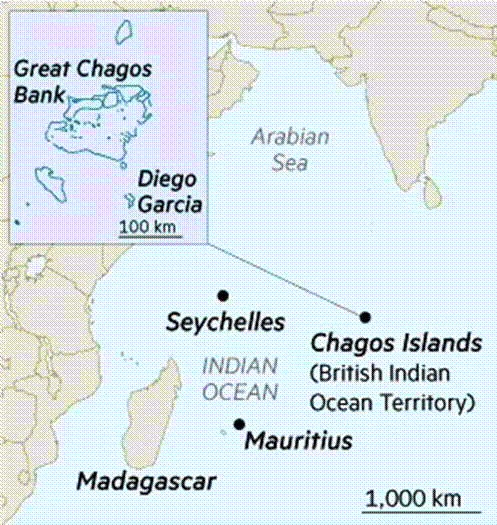
- U.S. President Donald Trump criticised the UK’s decision to hand over sovereignty of the Chagos Islands to Mauritius, citing strategic and security concerns.
- The UK government has defended the move, stating that a deal is being finalised to transfer sovereignty to Mauritius by May 2026, while retaining the Diego Garcia military base on lease for at least 99 years.
Chagos Islands: Strategic and Historical Background
Geographic and Strategic Significance
- The Chagos Archipelago is located in the central Indian Ocean, astride major sea lanes connecting Africa, West Asia, and the Indo-Pacific.
- Diego Garcia, the largest island, hosts a U.S.–UK military base, critical for operations in the Middle East, Indo-Pacific, and Africa.
Colonial Legacy
- The UK separated Chagos from Mauritius in 1965, three years before Mauritius gained independence in 1968, creating the British Indian Ocean Territory (BIOT).
- Between 1967–1973, over 1,500–2,000 Chagossians were forcibly evicted to enable the U.S. military base—raising serious human rights concerns.
Relevance
- GS 2: International law, ICJ opinions, UN system, sovereignty disputes, and India’s foreign policy principles.
Legal and Diplomatic Developments
International Court of Justice (ICJ) Opinion, 2019
- The ICJ (2019) held that:
- The decolonisation of Mauritius was not lawfully completed.
- The UK is under an obligation to end its administration of Chagos as rapidly as possible.
United Nations General Assembly (UNGA) Resolution
- Following the ICJ opinion, the UNGA voted overwhelmingly demanding that the UK withdraw from Chagos within six months.
- Though advisory, the opinion strengthened Mauritius’ diplomatic and legal position.
The UK–Mauritius Deal (Proposed)
Key Features
- Sovereignty over Chagos to be transferred to Mauritius.
- Diego Garcia base to remain under UK–US control via a long-term lease (≈99 years).
- Guarantees for continued military access for the U.S. and UK.
UK’s Rationale
- Aims to:
- Comply with international legal obligations.
- Reduce diplomatic isolation in the UN.
- Secure long-term legitimacy of the Diego Garcia base.
Implications for India and the Indian Ocean Region
Decolonisation and Global South Solidarity
- The issue resonates with India’s long-standing support for decolonisation and territorial integrity, consistent with its stance at the UN.
- Strengthens Global South demands for post-colonial justice.
Indian Ocean Security Architecture
- Diego Garcia remains central to:
- Indo-Pacific security.
- Freedom of navigation.
- Counter-terror and logistics operations.
- Stability in Chagos supports India’s interest in a stable, rules-based Indian Ocean Region.
Broader Global Order Implications
Rules vs Power
- The Chagos case illustrates tension between:
- International law and decolonisation norms, and
- Great-power security imperatives.
Precedent Setting
- Compliance with ICJ opinions reinforces international legal institutions.
- Defiance risks accelerating erosion of the rules-based order.
Way Forward
Balanced Resolution
- Sovereignty transfer with binding security guarantees offers a middle path reconciling law and strategy.
Human-Centric Approach
- Address Chagossian resettlement, compensation, and dignity as integral to any final settlement.
Multilateral Transparency
- Greater engagement with UN mechanisms and regional stakeholders to ensure long-term legitimacy.
Darwin’s Bark Spiders (Caerostris darwini)
Relevance
- GS 3: Biodiversity and adaptation in unique ecosystems.
- GS 3: Science and technology, evolutionary biology, biomaterials, and bio-inspired innovation.

- Species & Habitat: Darwin’s bark spider is endemic to Madagascar and is known for building the largest orb webs recorded, often spanning up to 25 metres across rivers and lakes.
- Record-breaking Silk: Its dragline silk has a tensile strength of ~1.6 GPa, making it the toughest biological material ever tested, around three times stronger than iron and tougher than steel.
- Key Scientific Finding: Only large adult females produce this ultra-tough silk; silk from males and juveniles is significantly weaker and mechanically indistinguishable across sexes and ages.
- Reason for Female-only Tough Silk:
- Adult females are 3–5 times larger than males, facing stronger evolutionary pressure to support massive webs.
- Tough silk evolved primarily to structurally support huge webs, not to catch specific prey.
- Energy–Efficiency Trade-off:
- Producing high-performance silk is metabolically expensive, requiring costly proteins like proline.
- Females therefore produce less silk overall, rebuild webs more slowly, and invest in quality over quantity.
- Web Architecture Strategy:
- Female webs are sparser, with wider gaps and fewer threads, but each thread absorbs very high mechanical strain.
- Males and juveniles spin denser webs using cheaper, weaker silk.
- Genetic vs Adaptive Traits:
- Elasticity of silk is genetically conserved across all individuals.
- Extreme toughness is selectively “switched on” in large females based on body size and ecological demand.
- Evolutionary Significance:
- Demonstrates sex-specific adaptive evolution, where costly biological materials are produced only when they provide clear survival advantages.
Faster Warming, Faster Breeding: Climate Change and Antarctic Penguins
Context and Key Finding
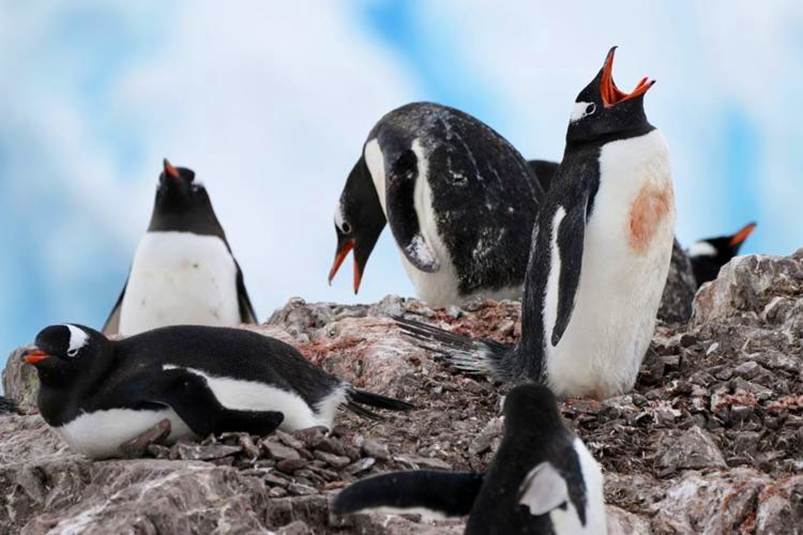
- A recent study reports that three Antarctic penguin species are breeding about two weeks earlier compared to a decade ago.
- This phenological shift coincides with a ~3°C rise in Antarctic temperatures between 2012 and 2022, highlighting rapid climate impacts in polar ecosystems.
- The findings are based on remote-controlled photographic monitoring of penguin colonies from 2010–2021.
Relevance
- GS 1: Climate change impacts on polar regions and global environmental systems.
- GS 3: Climate change, biodiversity loss, ecosystem disruption, and environmental conservation.
Penguin Species Affected
Species Showing Early Breeding
- Adélie penguin (Pygoscelis adeliae)
- Gentoo penguin (Pygoscelis papua)
- Chinstrap penguin (Pygoscelis antarcticus)
- These species showed a ~14-day advancement in breeding timing, one of the fastest documented shifts among vertebrates.
Why Timing Matters in Penguin Life Cycles ?
Dependence on Environmental Synchrony
- Penguins rely on precise alignment between:
- Breeding timing
- Food availability (krill, plankton, fish)
- Ice conditions and sea productivity
- Breeding too early or too late can reduce chick survival, as food availability peaks are narrow and climate-sensitive.
Comparison with Other Vertebrates
- Most vertebrates show similar phenological shifts over ~75 years, whereas Antarctic penguins have exhibited this shift in just 10 years.
Role of Antarctic Warming
Temperature Trends
- The Antarctic Peninsula is among the fastest-warming regions on Earth, with warming rates exceeding the global average.
- Western Antarctica has warmed significantly, altering:
- Sea-ice duration
- Snow melt timing
- Marine productivity cycles
Differential Species Response
- Gentoo penguins are more adaptable and benefit from reduced ice and diversified diets.
- Adélie and Chinstrap penguins are more ice-dependent and specialised, making them more vulnerable to ecosystem shifts.
Food Web Changes and Competition
Krill and Plankton Dynamics
- Warming waters and changing ice conditions affect krill abundance, the primary food source for many penguin species.
- Climate-driven plankton changes have:
- Increased food for some species (e.g., Gentoo)
- Reduced predictability for specialist feeders (Adélie, Chinstrap)
Interspecies Competition
- Gentoo penguins have expanded southward and now:
- Breed earlier
- Compete aggressively for nesting sites
- Displace Adélie penguins from traditional habitats
Observed Ecological Consequences
Population Trends
- Chinstrap penguin populations are declining globally, linked to food stress and habitat change.
- Adélie penguins show mixed trends—some colonies declining, others adapting locally.
- Gentoo penguins are increasing in number and range, benefiting from warmer conditions.
Chick Survival Risks
- Earlier breeding does not automatically imply higher success.
- If food availability shifts faster than breeding adaptation, phenological mismatch may reduce chick growth and survival.
Broader Climate Change Signals
Indicator Species
- Penguins act as sentinel species, reflecting broader changes in Antarctic marine ecosystems.
- Rapid breeding shifts indicate ecosystem-level stress, not isolated behavioural change.
Future Projections
- Climate models suggest continued acceleration of Antarctic warming, increasing risks of:
- Further phenological disruption
- Loss of ice-dependent species
- Ecosystem restructuring