

Content
- Communist Party of India — From Origins to Consolidation
- Aravalli Mining — What the “No New Leases” Claim Really Means
- India’s Renewed Tilt Toward Coal Power Despite Cheaper Renewable Options
- Fake / Adulterated Paneer and FSSAI’s Proposed Regulatory Action
- Indian Army’s Revised Social-Media Policy — Passive Participation with Operational Safeguards
Communist Party of India — 100 Years
Foundation & Early Evolution
- Formal founding: Kanpur, 26 December 1925
- Alternate ideological origin claim: Tashkent, 1920 (M.N. Roy–Comintern initiative)
- Nature of rise: Gradual convergence of diaspora activists + urban labour groups + peasant movements
- Key pioneers:
M.N. Roy, S.A. Dange, Muzaffar Ahmad, Ghulam Hussain, Shaukat Usmani, Singaravelu Chettiar
Relevance
- GS-I | Modern Indian History
- Left movements, labour & peasant mobilisation
- Role of ideological currents in the freedom struggle
- GS-II | Political Ideologies & Party Systems
- Evolution of Left politics in parliamentary democracy
Global-Ideological Background
- Industrial capitalism → inequality → socialist critique
- Karl Marx: class struggle, surplus value, historical materialism
- Russian Revolution (1917): inspiration to anti-imperialist movements
- Comintern (1920s): coordination of revolutionary groups in colonies
Streams Feeding the Indian Communist Movement
- Internationalist–diaspora strand (M.N. Roy)
- Independent Left circles in India: Bombay, Calcutta, Madras
- Worker–Peasant activism: trade unions → AITUC (1920) as mass platform
Early State Response & Repression
- Meerut Conspiracy Case (1929–33): arrests, bans, underground re-organisation
- Established CPI as a serious labour-based ideological force
Role in the National Movement
- Labour & Peasant mobilisation: strikes, plantation & mill workers
- 1930s: cooperation with Congress Socialist Party
- WWII phase: “People’s War line” after Nazi invasion of USSR
- Regional bases: Bengal, Bombay Presidency, Andhra, Punjab agrarian belts
Aravalli Mining — What the “No New Leases” Claim Really Means
Core Facts — What the Supreme Court / Union Government Have Stated ?
- The statement “No new mining leases in Aravalli” is not absolute.
- The restriction currently applies only to general minerals — and only until a Management Plan for Sustainable Mining (MPSM) is finalised.
- Exemption exists for:
- Critical minerals
- Strategic minerals
- Atomic minerals (First Schedule, MMDR Act, 1957)
- Existing mines may continue, and renewals may be allowed under strict regulation.
Bottom line: This is not a permanent ban; it is a temporary pause for general minerals while guidelines are prepared — with exceptions for strategic resources.
Relevance
- GS-III | Environment & Ecology
- Ecologically fragile landscapes, biodiversity corridors
- Desertification barrier, groundwater recharge role
- GS-III | Economy & Mineral Resources
- Critical minerals → energy transition & strategic security
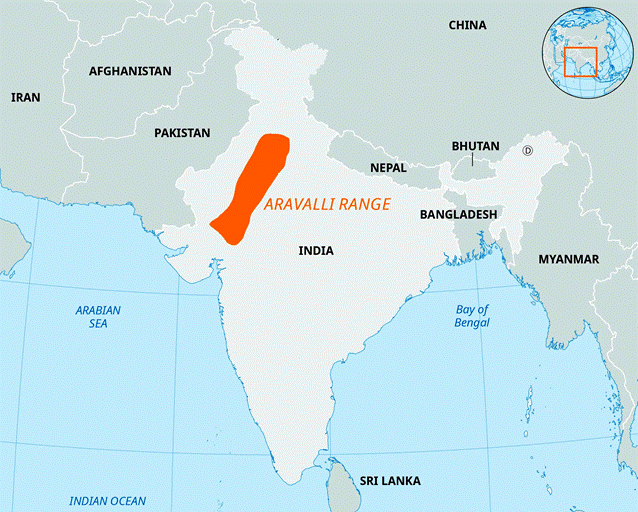
Why Exemptions Exist — Strategic & Economic Rationale ?
- Committee report (Uniform Definition of Aravalli Hills & Ranges) notes:
- Aravallis host deep-seated, site-specific critical minerals.
- India remains import-dependent for many of these resources.
- Minerals flagged as strategically important include:
- Lead, zinc, copper, silver
- Tin, graphite, molybdenum, nickel
- Niobium, lithium, rare earth elements (REEs)
- These are essential for:
- Energy transition technologies
- High-technology manufacturing
- Defence & national security
- Economic growth & supply-chain resilience
Policy logic: Strategic minerals are treated as national-interest resources, hence exempt from blanket restrictions.
Temporary Ban + Future Mining under Guidelines
- The MoEFCC letter (Dec 24, 2025) directs States (Haryana, Rajasthan, Gujarat):
- No new mining leases until MPSM for the entire Aravalli landscape is finalised.
- MPSM preparation agency:
- Indian Council of Forestry Research & Education (ICFRE)
- Final approval by MoEFCC
- MPSM will:
- Map ecologically sensitive, conservation-critical, and restoration-priority zones
- Identify areas where mining could be allowed under strict, science-based conditions
- Approach modeled on Saranda–Chaibasa (Jharkhand) sustainable mining precedent:
- Geo-referenced ecological assessment
- Zones marked as:
- No-mining / conservation priority
- Conditional mining
- Permissible mining
Implication: Mining is expected to resume selectively, not disappear.
Ecological Significance of Aravallis
- Among the oldest mountain ranges on Earth
- Key environmental functions:
- Barrier against Thar desertification
- Groundwater recharge & aquifer protection
- Biodiversity corridors (Aravali-Delhi Ridge landscape)
- Urban climate-buffering for NCR & Rajasthan
- Landscape already impacted by:
- Illegal quarrying
- Habitat fragmentation
- Dust pollution & slope destabilisation
Trade-off: Critical mineral extraction vs ecological integrity & climate resilience.
Governance Reality — Gaps & Risks
- Public messaging vs policy nuance mismatch
Claim of “no new leases” can mask exemptions → risk of misinterpretation. - Future permissions likely after MPSM, especially for strategic minerals.
- Monitoring challenges:
- Enforcement inconsistencies across States
- Potential for misclassification of leases as ‘strategic’
- Community & environmental concerns:
- Risk of incremental ecological creep
- Possible conflicts in restoration-priority zones
Policy Implications — What Needs Safeguarding ?
- Transparent mineral zoning maps (public domain)
- Clear distinction between:
- General vs critical vs atomic mineral leases
- Independent ecological audits & social impact review
- Cumulative-impact assessments, not mine-wise approvals
- Strict no-go protection for:
- Wildlife corridors
- High-biodiversity & recharge zones
- Restoration-linked mining permissions (progressive reclamation norms)
India’s renewed tilt toward coal power despite cheaper renewable options
Why is it in News?
- Multiple States — Assam, Bihar, Madhya Pradesh, West Bengal, Uttar Pradesh — have recently signed high-tariff coal-based PPAs (₹5.4–₹6.64/unit) even though:
- Solar/Wind costs = ₹2.5–₹4/unit
- Hybrid + Storage = ~₹5/unit or lower
- Meanwhile, 43 GW renewable capacity (~₹2.1 lakh crore investment) is stuck without buyers.
- Signals weakening demand for renewables and raises doubts over India’s energy-transition trajectory as the country also plans to add 100 GW new coal capacity by 2032.
Relevance
- GS-III | Energy, Economy & Environment
- Energy security vs energy transition
- Coal dependency, grid reliability, baseload economics
- GS-II | Centre–State Energy Governance
- DISCOM behaviour, PPA structures, policy incentives
India’s Power Mix & Transition Goals
- Installed capacity (approx. profile)
- Coal/Lignite: ~55–57% share in generation
- Renewables (solar, wind, biomass, SHP): ~30% capacity share, lower in actual generation
- Key targets
- 500 GW non-fossil capacity by 2030
- Net-zero by 2070
- Demand trend: Power demand is growing ~8–10% annually, driven by industry, AC load, urbanisation, EVs, and digital infrastructure.
Tension line: Rising demand + reliability concerns → states reverting to coal for baseload security.
Why States Prefer Coal Despite Higher Tariffs?
1. Baseload & Reliability Advantage
- Renewables are intermittent (“no sun → no power, no wind → no power”).
- Coal provides round-the-clock firm power for grids.
- Battery-storage–based RE is still perceived as risky/untested at scale.
2. Battery-Storage Constraints
- Current storage supports 5–7 hours, not 24×7 supply.
- Import dependence + supply-chain uncertainty
- 18% GST on battery services increases effective tariff.
- Discoms wary of technology + price volatility risk.
3. Discom Incentives & Risk Aversion
- Discoms prioritise short-term reliability over long-term cost efficiency.
- Failure of power supply → political & social backlash.
- Coal PPAs shift risk to generators, not discoms.
4. Curtailment of Renewables
- States like Rajasthan & Gujarat have curtailed solar output.
- Developers lose revenue → bankability issues → project slowdown.
Economic Signals Emerging
- Coal PPAs at ₹5.5–₹6.6/unit vs RE at ₹2.5–₹4/unit =
→ States are paying more for what they perceive as reliable power. - 43 GW RE stranded = capital locked, threatens investor confidence.
- Push toward new 100 GW coal capacity → long-term carbon lock-in risk.
Strategic Implications for India’s Energy Transition
Opportunities
- Coal ensures immediate grid stability & peak-demand support.
- Prevents blackouts during seasonal demand spikes.
- Supports industrial growth phase.
Risks
- Transition slowdown → jeopardises 2030 climate commitments.
- Long-term stranded coal assets if RE + storage becomes cheaper.
- Increased emissions & air-pollution burden.
- India may lose competitiveness in global green-manufacturing supply chains.
Governance & Policy Challenges Identified
- Absence of firm RE + storage procurement frameworks
- Weak incentives for Round-the-Clock renewables (RTC)
- Discoms’ financial stress → conservative power-purchase behavior
- Lack of:
- Grid-balancing infrastructure
- Peaking power markets
- Ancillary services pricing
- Policy-tariff misalignment (GST on storage, import dependence).
Way Forward
Short-Term
- Scale RTC renewable + storage tenders with viability-gap support.
- Reduce GST on batteries / storage services.
- Standardise RE-storage risk-sharing PPA models for discoms.
Medium-Term
- Build Green Grids + Transmission corridors.
- Develop peaking & ancillary services markets.
- Invest in domestic battery supply chains (PLI, recycling ecosystem).
Long-Term
- Shift from coal-centric baseload → diversified dispatch mix.
- Promote flexible thermal operation instead of new capacity.
- Align state-level PPA policies with national transition goals.
Fake / Adulterated paneer and FSSAI’s proposed regulatory action
Why is it in News?
- The Food Safety and Standards Authority of India (FSSAI) is proposing stricter labelling and disclosure norms to curb the sale of fake or non-dairy paneer substitutes in markets.
- Many loose / unpackaged paneer products sold locally are made using:
- Vegetable oils
- Skimmed milk powder
- Starches & emulsifiers
- These products imitate the look and texture of real paneer but lack its nutritional profile and may pose health risks.
- FSSAI proposes that such products must be:
- Labelled as “Paneer Analogue”
- Prohibited from using dairy-related terminology
- Sold only in sealed packages
- Carry clear consumer warnings
- The issue is significant because paneer forms an important protein source for a large vegetarian population and the market is ₹65,000-crore+, largely unorganised.
Relevance
- GS-II | Governance & Regulatory Institutions
- Role of FSSAI, consumer protection, labelling norms
- GS-III | Public Health & Food Security
- Adulteration risks, nutrition quality, public health burden
What is Food Adulteration?
Food adulteration refers to:
- Addition, substitution or removal of ingredients
- With the intent to increase profit, reduce quality or mislead consumers
- Leading to health risks, fraud, or nutritional loss
Types
- Intentional — dilution, substitution, artificial colouring, synthetic fat use
- Unintentional — contamination during storage, processing, transport
Relevant Law
- Food Safety and Standards Act, 2006
- Establishes FSSAI as the national regulator
- Provides for:
- Standards & labelling
- Licensing & inspections
- Penalties for adulteration & misbranding
What is the Issue in This Case?
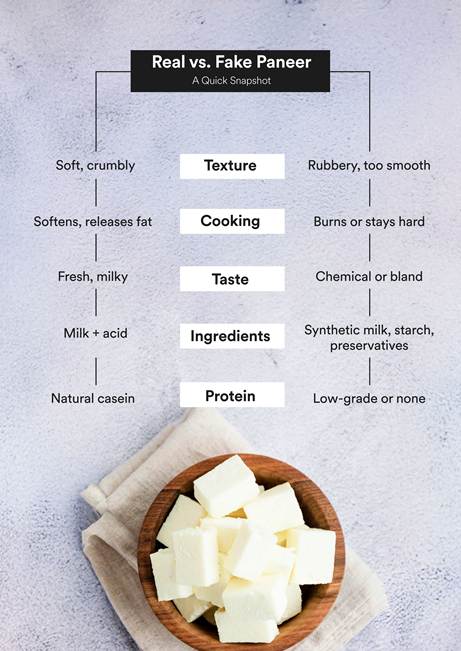
Real Paneer
- Made by curdling milk
- Rich in milk fats, protein, calcium
Fake / Substitute Paneer
- Uses vegetable oils + starch + emulsifiers
- Designed to look identical
- Cheaper, widely sold in loose unpackaged form
- Often not disclosed to consumers
Market Dynamics
- Organised brands = ~10% market
- Majority sold in unorganised informal sector
- Loose paneer ~₹300–340/kg
Branded paneer ~₹450–500/kg
→ Price arbitrage drives adulteration
Public Health & Governance Concerns
- Consumers unknowingly consume:
- Trans fats
- Low-protein substitutes
- Poor-quality oils
- Risk of:
- Obesity & heart disease
- Nutrient deficiency
- Food safety violations
- Violates:
- Right to informed choice
- Food-labelling ethics
- Consumer protection norms
Why Enforcement is Weak ?
- Large, fragmented unorganised dairy markets
- Lack of routine inspections in local mandis
- Low consumer awareness
- Weak supply-chain traceability
- Seasonal festival demand → adulteration spikes
- Incentives for traders are high, penalties limited
FSSAI’s Proposed Measures
- Mandatory Labelling
- Non-dairy substitutes to be marked “Paneer Analogue”
- Ban on Dairy Terminology
- Cannot be sold as paneer / dairy product
- Colour Marking
- Visual differentiation from natural paneer
- Sealed Packaging Only
- Loose sale to be restricted
- Disclosure of Ingredients & Nutrition
- To prevent consumer deception
Regulatory Rationale:
Shift from post-facto enforcement → preventive labelling + traceability.
Way Forward — Policy Recommendations
Regulation & Enforcement
- Strengthen supply-chain audits & random sampling
- Expand food testing infra at district level
- Strict penalties for repeat offenders
- Introduce QR-code traceability for dairy chains
Consumer Protection
- Public campaigns on how to identify real paneer
- Labelling literacy programs
- Encourage certified dairy cooperatives
Market Reform
- Support formalisation of local dairy value chains
- Incentivise quality-assured small producers
- Promote self-regulation & cooperative branding
Indian Army’s revised social-media policy
Why is it in News?
- The Indian Army has revised its social-media policy to allow “passive participation” on select platforms such as Instagram, X, YouTube, Quora, etc.
- Personnel may only view or monitor content on these platforms.
Active engagement remains banned — posting, sharing, commenting, reacting, messaging, uploading content. - Limited use of WhatsApp, Signal, Telegram, Skype is permitted only for general, unclassified communication with known persons.
- Policy reiterates strict operational security (OPSEC) and warns against:
- VPNs, torrents, cracked software, proxy sites, anonymous forums, risky cloud storage.
- This replaces the stricter 2020 policy, when officers and soldiers were ordered to delete Facebook, Instagram and 89 mobile apps amid heightened security risks (including apps with China links).
Signal: The policy reflects a shift from total restriction → controlled, security-aware digital discipline.
Relevance
- GS-III | Internal Security & Cyber Security
- Operational security (OPSEC), espionage & information warfare
- GS-II | Constitutional & Governance Dimension
- Article 19(2) — reasonable restriction on speech in disciplined forces
- Article 355 — duty to ensure national security
Why Do Armed Forces Restrict Social Media?
- Operational Security (OPSEC):
- Location leaks, troop movement exposure, geotags, photos, logistics hints.
- Espionage & Phishing Risks
- State-sponsored hackers, honey-traps, identity spoofing.
- Psychological & Information Warfare
- Disinformation, profiling, cognitive targeting.
- Privacy & Data Harvesting
- Apps collecting sensitive behavioural metadata.
Core principle: Even harmless posts can reveal actionable intelligence.
Conceptual Value-Addition
- State’s Duty under Article 355
- Ensuring security of the nation includes safeguarding operational secrecy and military preparedness — social-media discipline supports this constitutional obligation.
- Reasonable Restrictions under Article 19(2)
- Army personnel, as members of disciplined forces, face constitutionally valid limits on free expression in the interest of:
- Sovereignty & integrity
- Security of the State
- Public order & discipline
- Doctrine of Institutional Discipline
- Armed forces operate on command hierarchy, confidentiality, and collective responsibility — unrestricted online expression can undermine this structure.
- Administrative Law Principle — “Proportionality”
- Shift from blanket bans (2020) to risk-based, limited relaxation reflects a proportional policy approach balancing:
- National security
- Individual autonomy
- Civil–Military Relations Perspective
- The policy reinforces that the armed forces remain politically neutral, preventing:
- political commentary
- ideological mobilisation
- identity-based polarisation via social media.